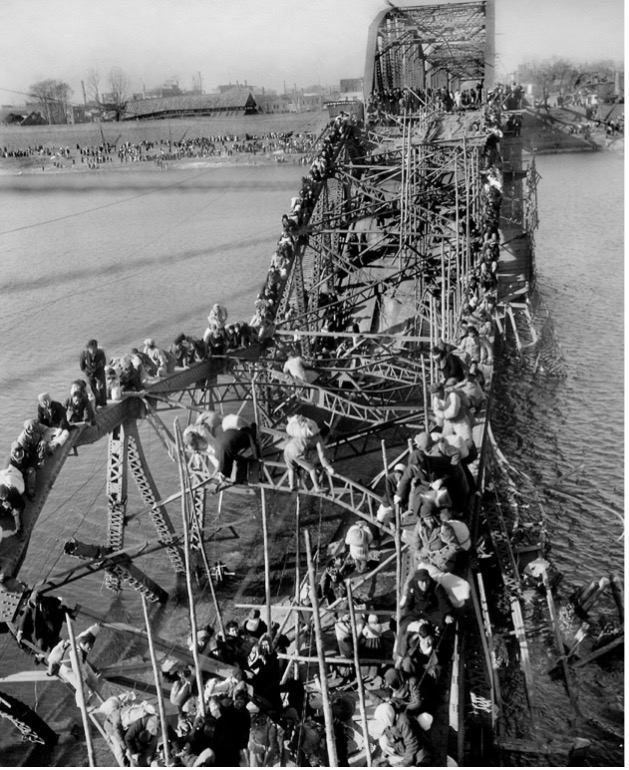
Photo by Associated Press photographer Max Desfor
By Joseph Mazur
Judging war must include civilian witnesses who suffer through it.
Humans’ strategy for coping with the immensity of the universe is to classify, reducing it to, possibly, more comprehensible chunks. Thus, we generalize about topics like “nature”, “space”, and “time”, although we really don’t understand any of these. The label “war,” it may be said, is another such “convenient” generalization.
– John Locke, Essay Concerning Human Understanding
Some stories that happened when I was a child are too hard for me to believe today. My father told and retold a story about me on so many family occasions that it feels like a significant detail of my life. “He was just five years old when he and two of his little friends ran away,” he would say. “I got a call from the police to come and get him seven miles away from home.” For years, he would tell the same story: “He now has a police record.” Yes, we were taken to a police station and given ice cream, but when I came home, he scolded me, “That is very, very bad. Do you understand!? You now have a police record!” and repeatedly asked, “Do you understand?” [1] “Daddy,” I cried, “What do you mean?” It may have been that I didn’t understand what a police record meant, but it’s more likely that I didn’t know what “understand” meant.
Of course, I did not. For a long while, I contemplated the question but could not satisfactorily grasp the elusive verb. I still do not, though the column that I write each month is headed “Understanding War.” To understand, one must delve into the kernel, where evidence of a cause we cannot easily see lies. However, we sometimes use the expression “I see,” as if agreeing with someone who is trying to explain a difficult concept, providing evidence that may hold true after mental cross-examination. Understanding is like cracking open a sea urchin to get to its inside without using a tool. Not an easy task, and sometimes not possible. Look up the word “understand” in almost any modern dictionary to ponder the entry that gives meaningless, unsatisfactory circular definitions.
So, bear with me as we go further into the depths of the verb. I looked to one of the seventeenth century’s most famous philosophers, John Locke, who in 1690 published “Essay Concerning Human Understanding” on some notions of understanding that join opinion to belief, suspicion to assurance, and persuasion to knowledge. The strength of his essay is in the loops of evidence that tie certainties to moderate beliefs. Locke shows that in coming to understand something, we cannot sense the brain’s acknowledgement moments, even from any part of the brain that is firing an “Aha!” sensation. Understanding doesn’t pop up even in consciousness and awareness, as expected, certainly not in any organs or nerves that contribute signals to “the mind’s presence-room,” as Locke calls it, like they would with sensations involving tastes, smells, or touches. That leaves the question surrounding understanding as one of those many persistent philosophical, biological, and psychoanalytical questions.
On the other hand, is there a feeling of being convinced of an argument? The English philosopher David Hume thought so. “In philosophy, we can go no farther than assert, that belief is something felt by the mind, which distinguishes the ideas of the judgement from the fictions of the imagination.” [2] All we can do is to know whatever we need to know. From the connection with understanding war, it means absorbing information on geography, genocide, arms investment and control, and using that information as evidence for adjustments and balancing knowledge with persuasion. There are no organs or nerves that speak to give confidence in beliefs. What goes into your brain (Locke’s “presence-room”) will be evidence for acceptance of truth or falsity, with no tingles of the spine nor shocks of comprehension. It’s judgment that counts all truth. The problem with understanding war is that, eventually, whenever we come across the inevitable attempt to distinguish civilian casualties from refugee diaspora, we do sense sympathy coming from the mind’s presence-room.
I struggled with Locke’s presence-room and was even more confused when I came across Wittgenstein’s take on the subject. For him, if I interpret his words correctly, “understanding” is not some access to cognition but rather to the way we use language as flexible, generous interpretations of what we see, hear, and gather from the rich caches of our intrinsic feelings. The verb is defined by how we unconsciously or consciously use it in everyday practical contexts. In other words, grasping an idea is a social process rather than a mental one. In that sense, reading the last 20 essays of my column, “Understanding War,” is a one-way social communication needing more reviews and responses.
The principal question is this: Why do we understand anything? What gives us the basic communication connections that guarantee a belief? Why is it that we know when we know? The answers link to the power of persuasion that brings reasoning and trust through internal language, relaying a generosity of meanings to each word for our expressions to fall prey to semantics based on conflicting background experiences of life that encourage disagreements involving environmental differences and cultural experiences.
– Michel de Montaigne Essays, quoting Cicero
In Cicero’s perception, understanding involves different approaches because experiences are the driving forces of belief systems, as we become so accustomed to what we believe that we cannot think otherwise.
We cannot understand war without considering its multiple consequences
How can we understand war without fully knowing the indirect consequences of war and what they do to alter the geopolitical balance of power? In particular, the mass exoduses are not just from the war zones but also from the anticipation of political troubles in relatively peaceful areas. Throughout history, at least starting with the Jewish diaspora, we know how war creates more wars by immigrant migrations that burden infrastructure and economies. Few wars in history have escaped forced migration, and for some, migration had been so severe that it is impossible to know if it caused more war or not. Besides migration, which is a forced displacement and devastation of a nation’s home and economy, there are other colossal consequences. Primary military news focuses on deaths and major injuries. Those numbers are shocking, though they miss the overall indirect humanitarian consequences that are deemed ancillary news, relegated to the back pages as an afterthought – infrastructure, health, environment, and economic consequences. Without a sense of how devastating those effects are, we miscomprehend the essence of war. War histories are not just stories of battles, military policies, generals, and deaths; they include the people who escaped under severe duress with courage and hope for safety, and sadness about having to leave their homes. We cannot understand war without considering its fate.
Probing a concept while ignoring its consequences could be a draft installment of understanding, but not a comprehension that builds absoluteness. My five-year-old self didn’t understand what a police record meant, because I had no notion of the consequences. My father understood that a police record is not just a piece of paper that archives a misbehavior that could affect my potential successes. Potential successes? What could that mean to such a young child? My father overreacted, or more likely tried to make me feel punished; surely, he knew that the police sergeant, who left the station for a few minutes to buy a few ice creams, was not charging us and putting me (and two four-year-olds) behind bars. I had no grasp of breaking the word apart to “under” + “stand,” and certainly no sense of the consequences of a police record.
One of the many consequences of war: Psychological traumas of mass migration
All wars come with unpredictable changes to a nation’s landscape, pride, economy, and social cohesion. Some wars create mass exoduses that sprawl, first to neighboring states, then to countries far from home. Some internal wars divide friends, families, acquaintances, colleagues, and neighbors. Others, especially those under fascist or autocratic regimes, are purposely planned to create divisions, so citizens stay frightened, though with naïve optimistic belief in an imminent, unlikely change in government policies. Can we ever understand war if we do not distinguish civilian casualties from refugee diaspora? Citizens fleeing from war zones are just one piece of an understanding that many millions fled for their lives in the last hundred years.
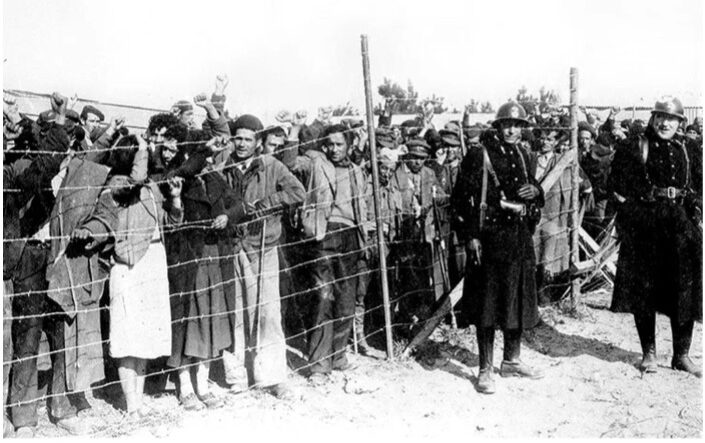
Spanish Civil War: It is difficult to estimate the number of refugees fleeing the battlegrounds of the Spanish Civil War, because more than 30,000 (some experts say between 50,000 and 200,000) were executed as they tried to flee. So many others were sent to labor camps to build railways and canals. [3] At the end of the war, an estimated 500,000 fled to France, where they were confined in squalid internment camps with barely enough food to survive.

I’m afraid that the world forgets the history of that war, supported by the Soviet Union on the side of the Republican Popular Front, comprised of socialists, separatists, and anarchists, who were fighting the Nationalists in alliance with fascist conservatives supported by Nazi Germany. In that war, partly of class and religion, between fascists and communists, refugees who were sent to forced labor in Southern France internment camps were considered political prisoners. When the Free French Forces liberated those camps during the liberation of France in 1944, those freed prisoners were rounded up by the Vichy-controlled government and deported to Nazi Germany, where more than 5,000 Spaniards died in the Mauthausen concentration camp in Austria.
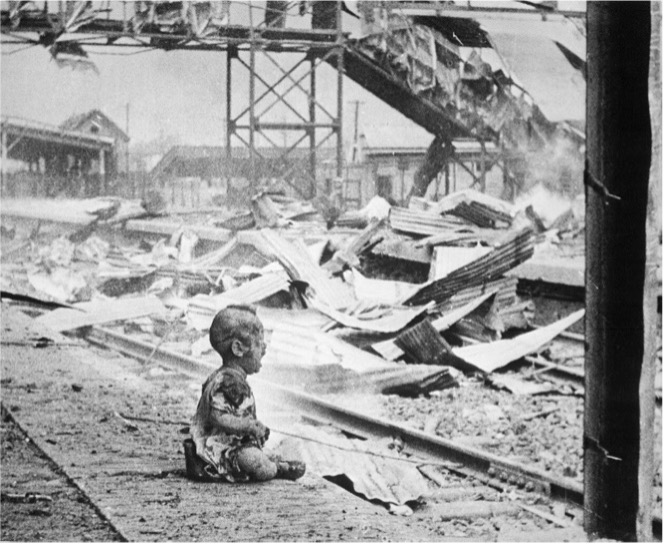
Second Sino-Japanese War: In 1939, Shanghai, close to a million refugees lost all they had after leaving all their belongings behind. Imagine the fear, the despair, and the discomfort of families crossing into the unknown. Those civilians with no connection to war discussions were trying to survive the only way they could, by leaving homes embroiled in battle. Imagine, if you can: “Separation of families; lost children; pitifully helpless sick and aged; child-births by the way; women struggling with little children over blasted railway tracks and bridges; crowded boat-trains bombed in the canals; repeated scattering from buses and trains to the field, as overhead the dreaded zoom of airplanes threatened...” [4] This quotation aptly encapsulates the experience of many ordinary Shanghai residents on the beginning of a journey into the unknown. The photo above, one of the most iconic images of the twentieth century, does not tell us much about the fleeing refugees; however, it is heartbreaking to see an injured, crying Chinese baby whose mother lay dead nearby under the ruins of the Shanghai South Railway Station.
Creative Commons Attribution-Share Alike 3.0 Germany license
Credit: Willhelm Holtfreter
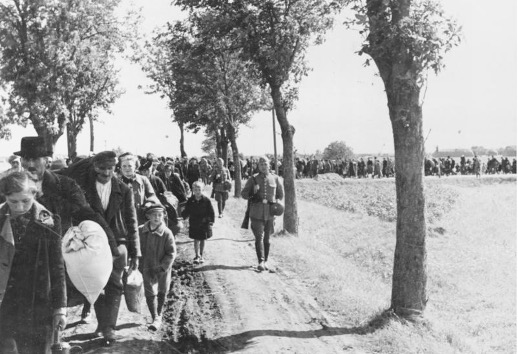
Hitler’s Third Reich: The Nazi regime in Hitler’s Third Reich began passing discriminatory laws and violence against Jews, forcing them to emigrate or be murdered. Hundreds of thousands, for whom there was no way to leave, were murdered. Decisions to leave were difficult because, from 1933 to 1938, policies changed by the month, and most hesitaters believed in a change for the better. It did not. For those who survived the holocaust, though they went through life with heartbreaking traumas, their migrations across the globe contributed to building economic and infrastructural growth in almost every country that took them in by the thousands.
Minorities living in Germany in the mid-1930s had hopes that their government would not cross the line between morality and evil. It was a bad bet. Without the ability to foresee the Holocaust, Jews had to assess how much of a threat the regime posed. Nazi policies kept evolving and changing, making it difficult to gauge this danger. Some Jews immediately left Germany, unwilling to accept the Nazis’ limitations on Jews. Others, however, hoped that the political situation at home would stabilize.
The Second World War cost millions of deaths, including the horror of the Holocaust. Hundreds of thousands of refugees left Europe, particularly Germany, hoping to find a new life far enough away from antisemitism. Many escaped Nazi Germany, but the psychological traumas of their existence stayed with them.
| Jewish emigration from Germany, 1933-1940 | |
| Country | Refugee numbers |
| United States | 90,000 |
| Palestine | 50,000 |
| Shanghai | 15,000 – 18,000 |
| Argentina | 25,000 |
| Brazil | 15,000 |
| Chile | 10,000 |
| Bolivia | 9,000 |
| Central American Countries | 21,000 |
| Cuba | 2,90 |
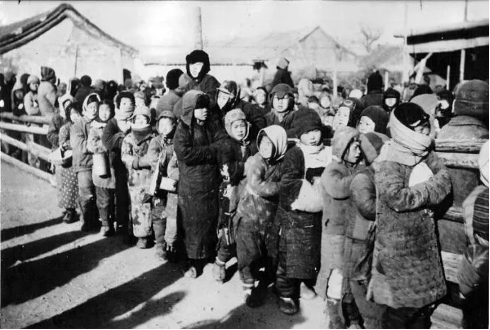
Chinese Civil War: Over the course of four years of the Chinese Civil War, an estimated 100 million Chinese civilians from all classes, religions, and backgrounds were displaced to Taiwan and Hong Kong. The exodus population in 1945 was 22 percent of China’s population of 450 million, the largest known displacement in history. Even now, it is hard to judge whether it was a massive-scale forced government displacement and relocation for Chiang Kai-shek’s exiled government. Like many other immigrants to a new country, those wartime refugees were initially harassed by unfriendly local communities. [5] Hong Kong’s population more than doubled by the end of that war. Refugees became the majority in their new environment, and with that rapid influx of refugees from the Chinese mainland, the British colony vibrantly swerved to a capitalist, international, free society. As for Taiwan, the population increased by a third, from 6 to 8 million.
Credit: US Department of Defense
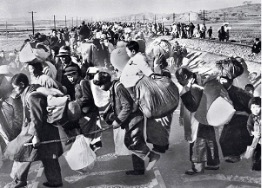
Korean War: Unlike the hesitant migration in the years of the Third Reich, an estimated 4.5 million North Koreans fled south or abroad shortly before the three-year Korean War came into full-scale conflict. Another 646,000 (estimated) fled after the United Nations peacekeeping forces retreated from North Korea. Many were evacuated to Busan, Ulsan, and Geoje-si Island, southeast of South Korea; others were sent to China. Orphans old enough to leave Pyongyang, along with the millions migrating to Seoul, eventually were sent to Communist countries in Eastern Europe. As dangerous, daring, and miserable as it was, ultimately, the trek for those who made it to the south had made consummate lifesaving decisions. This is a rare example of benefiting from resettlement. Those who left the North for the South bettered their lives by living in a freer and more enriched society.
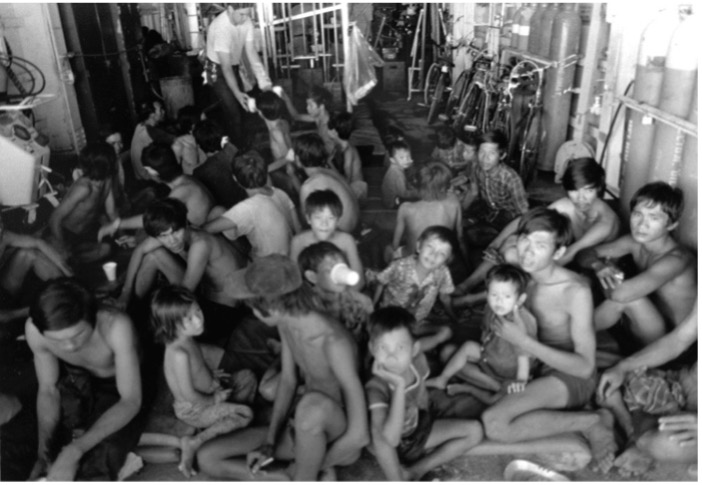
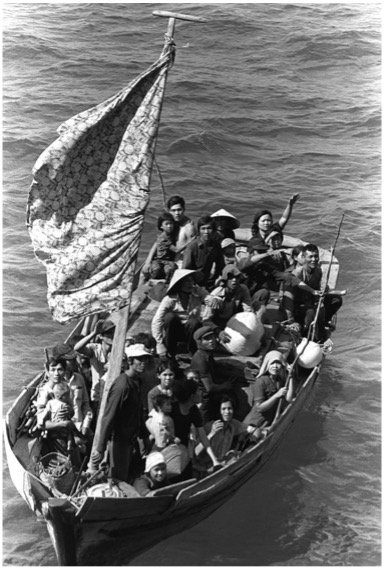
Vietnam War: When Saigon fell, 50 years ago, more than 800,000 Vietnamese refugees fled for safety and left their families behind. They went mostly by sea in overcrowded small boats. Many drowned or became victims of piracy. Some made it to land, but sadly, had to spend years in refugee camps. Fortunately, more than a million Vietnamese, Laotians, and Cambodians immigrated to America during and after the Vietnam War. It turned into a massive resettlement requiring emergency aid and protection for the hundreds of thousands of boat people fleeing the war region. The United Nations Children’s Fund (UNICEF) helped children and families with aid, education, and food, while the United Nations High Commissioner for Refugees (UNHCR) provided food, water, healthcare, and channels for refugees to leave.
Click here to read the full brief.
January 2016. Credit: Mstyslav Chernov/Unframe
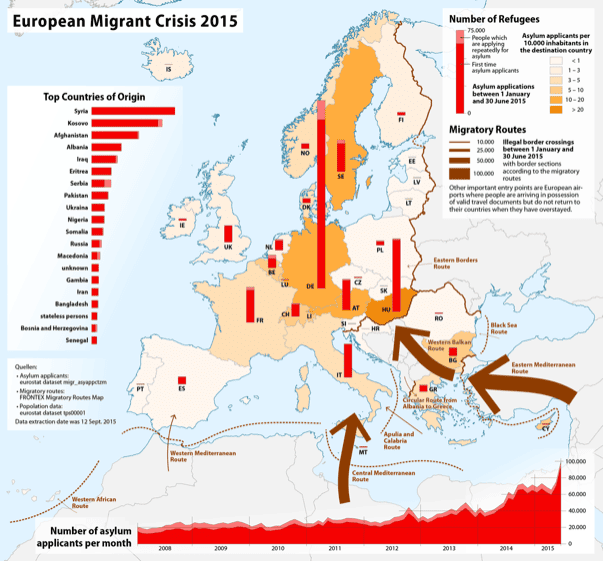
Syria Civil War: The largest number of people displaced by war is estimated to be between 12 and 14 million, caused by the Syrian Civil War. The exodus was caused by the Assad regime’s internal brutality, unemployment, food and water shortages, virtual economic collapse, constant bombings, and housing destruction. Those millions fled from their homes to neighboring countries such as Turkey, Lebanon, and Jordan. Some, in abject poverty, were dispersed throughout the European Union by crossing the Aegean on boats to Greece. Others were displaced to aid settlements within Syrian boundaries. [6] The refugee displacement from that war at first created a sympathetic migration throughout many Western European countries and later became an overwhelming political problem that remains challengingly unsolved. Instability in Syria persists, but fortunately, the UNHCR and UNICEF are supporting international cooperation with Turkey, Jordan, and Lebanon to create pathways for self-sufficiency while simultaneously supporting rebuilding within Syria for those who return. [7]
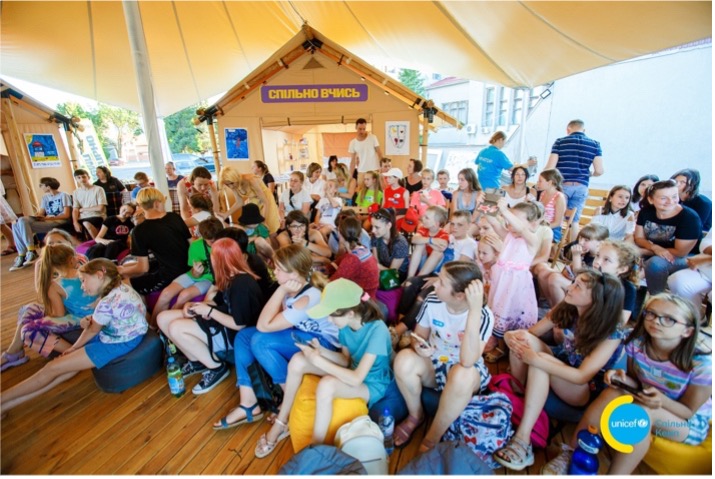
Ukraine War: From the first days of Russia’s invasion of Ukraine in 2022, hundreds of thousands of Ukrainians, including children, were forcibly deported to Russia. Almost immediately, the ICC issued an arrest warrant for Vladimir Putin and Maria Lvova-Belova, Russia’s commissioner for children’s rights.[8] More than 7 million Ukrainians fled to Western Europe and to other countries outside of Europe, hoping to return when it would be safe to do so.
So many Ukrainians are in exile. I spoke with Diana Chipak, who fled from Ukraine to Germany with her younger brother when the war in Ukraine began. In 2022, when she was a student at Bennington College, she shared what it’s like to be living in a war zone, always thinking about her brother and parents. [9] In the Bennington Banner, a local newspaper in Bennington, Vermont, she wrote, “My dad is somewhere in the east, fighting this war. He doesn’t even tell me his location. I don’t know what he’s doing. He’s not allowed to say anything. He’s in my mind every single day. I have to make peace with the possibility of not seeing him again. That’s what I wake up to.
“You could just feel the fear, see it. There was just this silent knowledge. The air was really charged around you… Russia has sent Secret Service agents in civil uniforms into many of the towns, mine included. They were walking around, putting small explosives, throwing them around, a kind of campaign to get people fearful, to create mass fear. And that worked at first.
“I think operating in war—there are a couple of ways you can react to it. You can either freeze and sort of not do anything and be scared. Or you can, despite that fear that you have inside of you, grow. Isn’t that the backbone of improving your well-being and helping others? I’m the oldest of four. I have other people to take care of. So, I wasn’t in a place where I could allow myself to just be in a dark place.
“I wake up in the morning terrified that something major happened while I was sleeping. When I wake up, I first get to my phone to check the news. What I want people in Vermont to understand is that freedom, safety, and democracy are very sacred.”
Now I think about the war in Ukraine, about how civilians are coping, and about how young people are thinking about their own safety and the safety of the people they love. How does one witness the cruelty of indiscriminate bombing, constantly carrying frightening thoughts of being instantly killed or inhumanely injured at any time?
Credit: Jaber Jehad Badwan
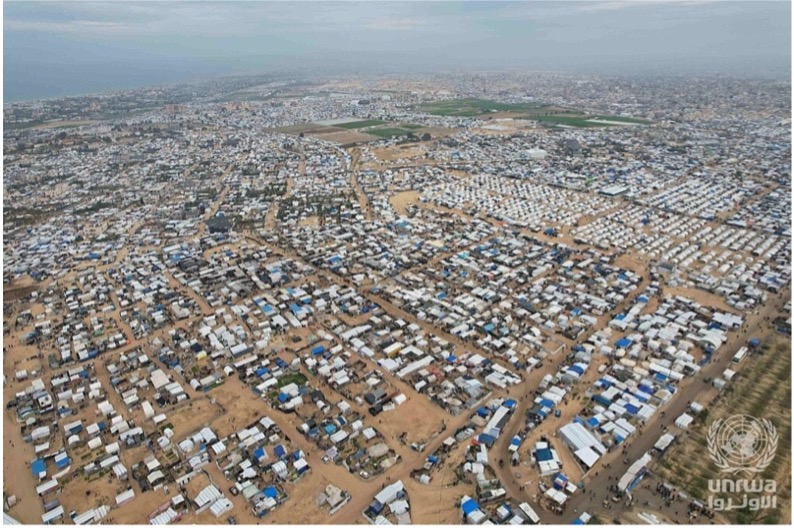
Israel-Hamas War: Directly after Hamas’s October 7th surprise terrorist attack on Israel, murdering more than 1,200 innocent Israeli men, women, and children, Israel’s defense forces (IDF) responded by entering Gaza to destroy Hamas’s military and to bring home the 254 Israeli hostages, dead or alive, taken by Hamas. By November, almost 2 million Palestinians had lost their homes and were seeking refuge in tents and unsafe shelters. Over 90 percent of homes in Gaza were destroyed.
Public Domain
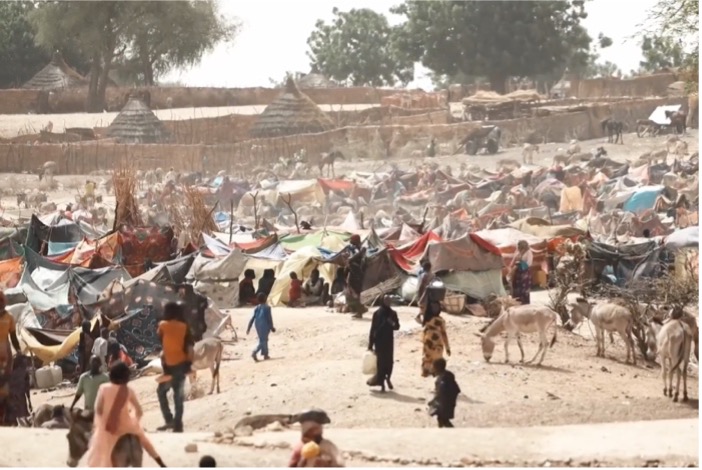
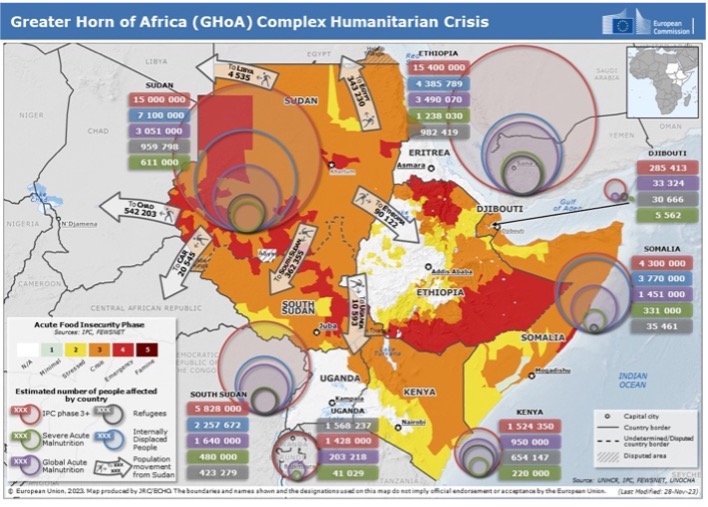
Sudan-Darfur: We don’t have to physically or mentally feel war victims’ pains to be sympathetic to their suffering. Millions live in a moment of horror, and most of us reading this cannot imagine the sensations of their fears. According to the United Nations account, more than 140,000 people have fled the violence in Sudan’s North Darfur. Amy Pope, the Director General of the UN Migratory Agency, said at a press conference in November, “When people are coming out of the area, they are reporting widespread violence, sexual abuse, civilians who are sometimes being shot on sight.” Her descriptions bring chills to humans who feel the horrors of such brutalities of forced migration over long distances, women and children “hiding from drones” stepping over “dead bodies along the way.” [10] Five million people, 44 percent of Sudan’s displaced population, live in overcrowded temporary camps with few basic services scattered in 18 states. Cholera is rising in some camps that lack effective assistance for combating the disease. [11]
Public Domain
North African States: Sudanese have fled to Egypt, Chad, South Sudan, Uganda, Ethiopia, and other Central African Countries to seek shelter. They arrive shocked, malnourished, and with hardly any possessions. The camps are striving to feed them but, with food insecurity and refugee numbers, they are reaching limited supplies. According to the United Nations Food Program, “millions of Sudanese refugees risk plunging deeper into hunger and malnutrition as critical funding shortages force drastic cuts into life saving food assistance.” [12] More than 8 million civilians inside Sudan live in areas of fighting and are risking their lives as they are continuously trapped in conflict with almost no functioning services.
A possible imminent potential U.S.-Venezuelan War: Trump said that the U.S. will “run [Venezuela] until we can do a safe, proper, and judicious transition.” Really? How? With intelligence information. But information is not understanding. Intelligence could supply governments with information about Venezuela, with little knowledge about how to govern a country with a population of 32,926,000 possessing 5,895,000 civilian guns (likely a significant underestimation, 18.8 per 100), which will be a risk for any foreign interference in governing that country. To run it would take an occupation force of over 30 thousand troops to keep the peace, with an understanding that many of those troops will be killed in the long run of many years of occupation or a civil war creating a refugee problem for Guyana, Suriname, Colombia, and Brazil.
Refugees of all wars
Even with our generous empathy for war victims, our feelings triggered by war news cannot compare with those of others who live in war zones or have families that do. For refugees who dared to leave their homelands, their memories, their families, their communities in search of safety, we praise their hopes and expectations. In most cases, they have bravely gone through miserable gauntlets of flames to achieve what would seem impossible. Those of us who are lucky enough to be safe cannot imagine ourselves capable of what most war immigrants have to do to flee from war zones. The depth of wars goes far deeper than simply the battles, killings, and excuses of brutality, and conquering land and raw materials. Forced mass migration is just one consequence of war.
Back to “understanding”
Well, here we are with a reasonable view of just some of the major consequences of war. If my father were alive to ask: Do you understand?!, I would have to say: No, I don’t.
Again, the mathematician within me would ask: What about other humanitarian crises – health malfunctions, environmental disintegration, political and military overstretches, social change, economic breakdown, disease, malnutrition, mental health issues, poverty, pollution, contamination, ecosystem interruptions, climate impact, and so many other consequential issues that are directly and indirectly caused by war. Those components of understanding, all embedded and structured in a mosaic theory gathering of information tesserae, will have to wait for me to decompose them and reassemble them. I’m not up to that yet. What I can say is that all war consequences are attacks on social structures and fundamental systems in support of humanity. Thinking that the war is simply about which side can kill and maim more than the other and not considering all the many opposing effects on society is a misunderstanding of the point of war. Without a point, there is no excuse for war. The only possible humanitarian justification is honest defense, not to win but to compromise to a balanced level that benefits all sides.
So, when I think about my five-year-old brain struggling to understand what my father had in mind when referring to a police record, it always brings me not to the depths of what the word means, but to how the mind fills the blanks in conversation.
Unlike mathematics, spoken language is informal and therefore has generous interpretations. It flexibly wants more information to tightly lock in the best-possible elucidation. Immanuel Kant wrote about that in The Critique of Pure Reason, saying, “No doubt the conception of right, as employed by a sound understanding, contains all that the most subtle investigation could unfold from it, although, in the ordinary practical use of the word, we are not conscious of the manifold representations comprised in the conception.” [13] We must ask what Kant means by that statement filled with words hinting at reception, investigation, consciousness, and representations that cycle through a thesaurus of compounding thoughts of a potential understanding. As a five-year-old, I must have been having a philosopher’s moment trying to grasp the meaning of understanding, just as Locke, Hume, Kant, Leibniz, and Wittgenstein did, possibly when they were at age five. Here I am as an adult, though, still trying to understand war, gathering and decomposing information that completes a puzzle of missing pieces.
About the Author
 Joseph Mazur is an Emeritus Professor of Mathematics at Emerson College’s Marlboro Institute for Liberal Arts & Interdisciplinary Studies. He is a recipient of fellowships from the Guggenheim, Bogliasco, and Rockefeller Foundations, and the author of eight acclaimed popular nonfiction books. His latest book is The Clock Mirage: Our Myth of Measured Time (Yale).
NOTES
[1] Recently, I tried to fact-check this story through calls to the Yonkers Police Department Records Section and the Westchester County Archives, which is a repository for historical public records dating from 1680. I spoke with two people in charge of records. Both agreed that police at that time were not mandated to make reports on child misbehaviors, and whatever records there had been at the Police Records Section would have been destroyed if they referred to any dates before 1980.
[2] https://msuweb.montclair.edu/~furrg/gned/humefictionbelief.pdf
[3] Antony Beevor, The Battle for Spain: The Spanish Civil War 1936–1939. (London: Weidenfeld & Nicolson, 2006) 405.
[4] https://shs.hal.science/halshs-00004065/file/Shanghai_refugee_problem.pdf
[5] Yang DM-H. “Together in the Same Boat: Exiled Nationalist State and Chinese Civil War Exiles in 1950s Taiwan”. Journal of Chinese History. 2021;5(2):285-309. doi:10.1017/jch.2020.46
[6] https://journals.sagepub.com/doi/10.1177/2158244019856729
[7] https://www.unrefugees.org/emergencies/syria/#:~:text=What%20is%20UNHCR%20doing%20to,drive%20progress%20in%20their%20communities.
[8] https://www.npr.org/2023/03/17/1164267436/international-criminal-court-arrest-warrant-putin-ukraine-alleged-war-crimes
[9] https://www.benningtonbanner.com/local-news/vermont-voices-life-divided-until-war-and-after-war/article_a2780688-780d-11ed-b600-2f0a3076992e.html
[10] https://news.un.org/en/story/2025/11/1166347#:~:text=Some%2090%2C000%20people%20have%20been,below%20what%20is%20needed%2C%20Ms.
[11] https://www.acaps.org/fileadmin/Data_Product/Main_media/20250102_ACAPS_Briefing_note_Sudan_Cholera_situation.pdf
[12] https://www.wfp.org/news/refugees-escaping-sudan-face-escalating-hunger-and-malnutrition-food-aid-risks-major
[13] Immanuel Kant, Trans. Norman Kemp Smith, Critique of Pure Reason (New York: St. Martin’s Press, 1965) p. 317.