The article explores the link between geopolitics and economic performance in the context of the Russia-Ukraine war. It argues that, if the conflict is to be ended on terms favourable to Ukraine, and the world economic system restored to its pre-war equilibrium, Europe must lead the ceasefire negotiations.
The gathering storm
Wars have a habit of re-ordering the world economic system, with some nations gaining and others losing. While the Second World War enriched the United States, it nearly bankrupted the United Kingdom, with the country’s national debt rising from £760 million to £3,500 million. Following the cessation of hostilities, Britons suffered almost a decade of rationing and austerity.
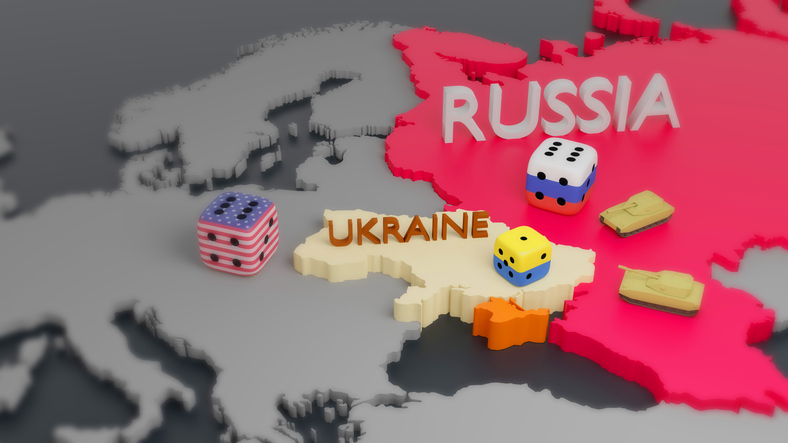
The Second World War confirmed the Twentieth Century as The American Century. Like the Second World War, the Russia-Ukraine war is restructuring the world economic system. Two economic blocs have emerged. One bloc serves the interests of states organised along authoritarian lines, for example, Russia, China, Iran, North Korea and Venezuela, the other serves the interests of states organised along democratic lines, for example, France, Germany, Australia and the United Kingdom. Global ideological polarisation, expressed in proxy wars such as that being fought in Ukraine, has fostered economic polarisation.
It is predicted in some quarters that Europe will find itself at war with Russia in the next five to ten years, possibly over the Baltic states, which Russia covets. Mark Rutte, NATO Secretary General, has issued a stark warning: “We are Russia’s next target …. Russia has brought war back to Europe, and we must be prepared for the scale of war our grandparents … endured”. By rehabilitating Putin – witness Trump’s sycophancy during the August, 2025 Alaska summit – Washington has increased the likelihood of a wider European war. It is interesting to note how America’s recently-published National Security Strategy studiously avoids criticising Russia. Should a wider European war come to pass, the world economic system will receive its biggest jolt since the 1939-45 war. It goes without saying that Europe will again be the biggest loser. Economies will be significantly degraded.
A new world order?
There is little doubt that America’s neutralism (that borders on amorality) is encouraging Putin, perhaps to the point where he feels he can attack western Europe with impunity. The origins of America’s neutralism lie first, in a rejection of so-called forever wars, such as the Afghan and Iraq wars, and secondly in Donald Trump’s world view and mind-set. Understanding Trump is the key to understanding today’s chaotic world.
As I explain in my 2025 book The Russia-Ukraine War – Security Lessons, Trump, who some consider an authoritarian, is drawn to strong leaders who are prepared to go to any lengths to get what they want. Regarding the protagonists in the Russia-Ukraine war, Trump’s sympathies lie not with Zelensky but with Putin. Trump has, since returning to office, effectively aligned the United States with Russia. This has not gone unnoticed, with Zelensky claiming that the United States “Present[s] the Russian side’s perspective … they relay Russia’s signals, demands, steps and indications of readiness, or lack thereof”.
Trump practices a cold Realpolitik that eschews morality for economic and political aggrandisement. As Romania’s president, Nicușor Dan, observes: “We [have] shifted from a – in some sense – moral way of doing things to a very pragmatic and economical way of doing things”. Given the fact that the US and Russia are now aligned, it is reasonable to conclude that any security guarantees offered to Ukraine by the United States will be worthless. America is not to be trusted.
Security guarantees – the truth
Security guarantees have a chequered history. The security guarantee extracted by British Prime Minister Neville Chamberlain from Adolf Hitler proved worthless. Hitler signed the Munich Agreement in 1938 only to invade Poland in 1939. In the final analysis, security flows not from security guarantees but from military hardware and the will to use it. Security flows from boots on the ground.
Given Trump’s perfidy only Europe can guarantee Ukraine’s security. Europe must negotiate a peace treaty that sees European peacekeepers – armoured brigades supported by warplanes based in Ukraine – deployed to the Donbas to defend the current line of contact. Ukraine should not be required to cede any land to Russia. It should defend those areas of the Donbas still under its control and negotiate the return of those areas illegally occupied by Russia. Only if Ukraine’s 1991 borders are restored can Kyiv, Paris, Berlin, London and Europe’s other capitals rest easy.
A chronically unreliable ally
America is an unreliable ally. It was late to the fight in both the Great War and the Second World War. Despite the fact that British scientists were involved in the Manhattan Project (that saw the United States detonate the first atomic bomb) Washington refused to share its nuclear secrets with Britain post-war. During the Vietnam War, Washington proposed a settlement that allowed insurgent North Vietnamese troops to remain in South Vietnam, against the wishes of South Vietnam’s elected government. In the Doha Agreement of 2020, Washington handed Afghanistan to the Taliban, a duplicitous Islamist terror group, behind the back of Afghanistan’s elected government. Today, the Americans are willing to accept Russia’s illegal occupation of circa 20% of sovereign Ukrainian territory, thereby rewarding Russian aggression.
America forfeited its moral authority and traction over Europe when Trump rolled out the red carpet for Putin in Alaska. Europe’s failure to cut Trump adrift at that low ebb has led us to the current impasse. Europe must create its own Realpolitik. It should:
- stop humouring Trump. Obsequiousness invites contempt, as evidenced by Washington’s hostile characterisation of Europe in its National Security Strategy
- insist that it and Ukraine lead the peace negotiations with Russia
- ensure that Europe has the men and matériel to sustain an army capable of eliminating the Russian army in the field. That will get Putin’s attention
- admit Ukraine to both the EU and NATO
- frame the United States as a partially, if not a fully lapsed ally.
A wider European war would plunge the global economy into turmoil. To avoid it Europe must act unilaterally. The Pax Americana is dead. Trump will not honour America’s NATO Article 5 commitment. Europe must equip itself militarily to act independently of the United States. It must frustrate Putin’s militarised colonialism by arming itself to the point where it is indigestible to him. Free Europe must transform itself into a steel porcupine. Quickly.
About the Author
 Dr Simon Ashley Bennett teaches risk management at the University of Leicester, England. He researches the social, economic and political origins of risk, including groupthink, political instability and armed conflict. His recent books include Atomic Blackmail? (Libri Publishing) and The Russia-Ukraine War – Security Lessons (Peter Lang International Academic Publishers).