
Being a successful business owner requires knowing how to prioritize an endless list of demands and opportunities. That means identifying the select tasks that truly move the needle and enable smarter, more strategic decision-making. This is why using the 80/20 rule is so critical for maximizing profitability and growth.
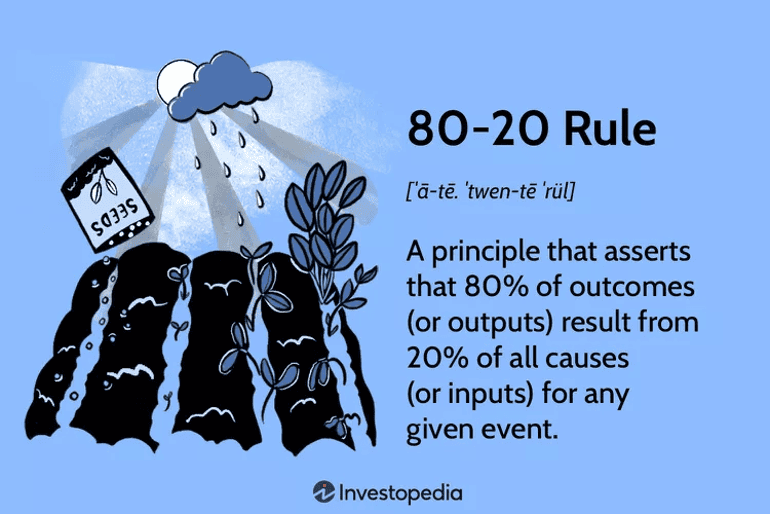
The 80/20 rule — also called the Pareto Principle — helps business leaders identify and focus on the efforts that matter most. The goal is to zero in on the 20% of activities that generate 80% of results. Taking this approach allows you to reduce wasted effort, speed up progress, and secure long-term success. You can even use the rule to guide strategic partnerships. For example, you may find it’s best to partner with a PEO for small businesses to streamline HR and free up more time for growth-focused initiatives.
So, the real question is, how do you identify your 20% and put it to work? Let’s dive in.
Understanding the 80/20 Principle in Business
One of the great things about the 80/20 rule is that it’s universal—you can apply it to any role at any company in any industry. Most businesses use it to pinpoint the 20% of products, clients, or activities that produce the majority of their income, customer satisfaction, or operational success.
For some businesses, the top 20% is their most loyal customer segment, top-performing marketing channels, or most profitable service lines. No two businesses are the same, so the exact makeup will be different from one company to the next.
Your top 20% could be:
- Highest-value repeat customers
- Bestselling product categories
- Most profitable service offerings
- Top-converting ad campaigns
- Most engaged email subscribers
- Most productive sales reps
- Highest-margin client contracts
- Most visited website pages
- Strongest referral partnerships
- Best-performing store locations
- Other consistently high-return activities
Why Focusing on the Right 20% Matters
Recognizing your highest-impact contributors is a key part of strategically allocating time, talent, resources, and capital toward the most productive areas. Instead of trying to improve everything at once, it’s easier to concentrate on the few tasks that deliver the biggest results.
Here are the essential benefits of focusing on your highest-impact 20%:
- Maximizes return on invested resources
- Improves overall business efficiency
- Boosts profitability in less time
- Strengthens competitive market position
- Reduces wasted time and effort
- Enhances customer satisfaction and loyalty
- Supports sustainable long-term business growth
A study found that companies who concentrate resources on their more profitable customers can increase profits by as much as 25% to 95% through improved retention alone.
Identifying the Activities That Drive the Most Growt
Identifying your most high-impact activities requires both data analysis and professional judgment. You need to focus on the most profitable opportunities for two reasons: (1) to build your strengths around proven results and (2) to put your resources toward initiatives that have the greatest return.
Here’s how to do that:
- Create a complete list of all revenue streams.
- Document every customer touchpoint across the business.
- Map out your core operational processes.
- Gather performance data for each area.
- Evaluate profitability for every stream and process.
- Measure client retention rates over time.
- Track lead conversion rates to find top performers.
How Data Helps Pinpoint High-Impact Actions
As we said before, data analysis is a crucial part of validating which activities belong in the top 20%. Tracking KPIs and performance metrics across your sales, operations, and customer service will reveal where your time and money produce the most value.
Using data analysis to identify trends is also helpful because it helps avoid biases that can cloud judgment. For example, just because a certain marketing channel “feels” effective, it may be underperforming when compared to other measurable results. With robust analytics, it becomes much easier to prioritize strategies and act on findings that actually drive growth.
Leveraging Employees for Maximum Results
The 80/20 rule applies just as much to people and processes as it does to financial performance. You want to make sure your highest-impact workers have all the tools, training, and autonomy they need to amplify results across the whole company.
How to identify your top-performing employees:
- Review performance metrics regularly
- Assess consistency over time
- Gather peer and manager feedback
- Evaluate problem-solving skills
- Monitor adaptability and learning
- Track impact on company goals
- Recognize innovation and creativity
Once you know who your best employees are, take these strategic steps to maximize their impact:
- Provide advanced tools and resources
- Offer continuous skill development opportunities
- Delegate high-value tasks strategically
- Streamline processes to reduce inefficiencies
- Encourage collaboration among key players
- Measure and reward impactful contributions
Further research shows that highly engaged employees deliver 21% greater profitability, reinforcing the importance of focusing resources on your top performers.
The Role of Strategic Partnerships in Accelerating Growth
When you focus on high-yield collaborations, you strengthen your company’s competitive position. Using the 80/20 rule to guide your partnership strategy is a smart way to highlight the small percentage of relationships that generate the majority of value.
For a lot of businesses, the best move is to engage a PEO for small businesses. This type of partnership allows companies to streamline HR operations and reduce administrative burdens—both of which free leadership to focus on the 20% of activities that drive the greatest results.
What is a PEO?
- Streamlines HR compliance tasks
- Handles payroll and benefits administration, including workers’ compensation
- Provides access to expert HR guidance
- Offers competitive employee benefits packages
- Reduces administrative burdens
- Minimizes legal and compliance risks
With the 80/20 rule, you finally have a way to focus on high-impact priorities instead of low-value tasks that waste time and resources. You’ll have a much clearer idea of which strategies, activities, and partnerships truly drive growth. You may find it’s best to partner with a PEO provider that offers HR outsourcing services to further streamline your operations. Just remember, no two companies are exactly alike, so the 80/20 rule will work differently for each business to deliver the best results.