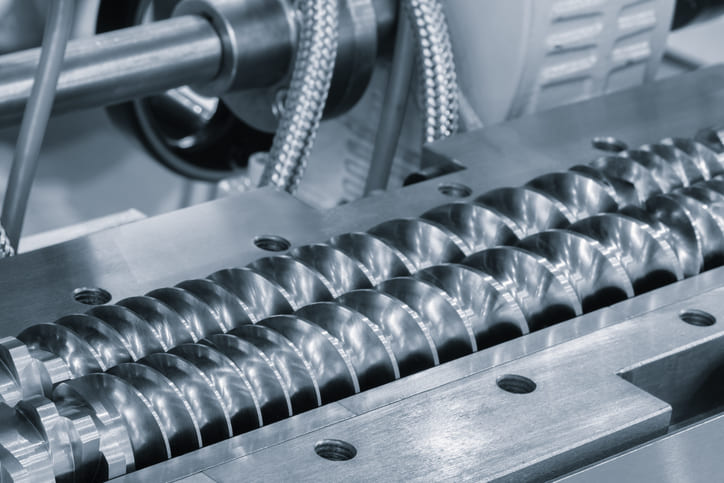
In the industrial sector, there is a constant search for technological solutions that can make production processes more efficient and cost-effective, without compromising the quality of the final product. Twin screw extrusion is a classic example of advanced and versatile technology which is used in several industrial sectors, including polymers, food, and pharmaceuticals.
The main feature of twin screw extrusion is that it turns complex materials into regular, repeatable products. In other words, this technology allows you to work with different ingredients or polymers (complex materials) and convert them into regular products that can be produced over and over again with identical features (repeatable).
How does a twin-screw extruder work?
In the industrial sector, extrusion is carried out using special machines called extruders, which can be single screw, twin screw, or triple-screw. During processing, the raw material is mechanically transformed and shaped through a die.
A key part of the extruder is the cylinder, which contains the two screws. It represents the “heart” of the system, because it is inside the cylinder that the material undergoes the various processing stages that lead to a homogeneous distribution of the various ingredients (polymers, food, chemicals, etc.).
The screws contained in the cylinder can be co-rotating – the most common – or counter-rotating. In the first case, they rotate in the same direction, while in the second case, they rotate in opposite directions. The choice between co-rotating and counter-rotating screws depends on the type of processing required. For example, the counter-rotating are particularly suitable for applications where high compression force is required.
Twin-screw or single-screw extruders?
As mentioned above, the choice between twin screw and single screw extruders essentially depends on the type of processing. It is worth pointing out the differences between the two options, as both have pros and cons.
For example, from a cost perspective, twin screw extruders are definitely more expensive, as this type of machine is capable of delivering the highest quality performance with complex and/or heat-sensitive materials. For less complex processes, a single screw extruder is a perfectly suitable choice, as it offers good performance, lower energy consumption, and very simple maintenance.
Therefore, the choice should be made according to processing requirements: for less complex processes, single screw extrusion is an efficient and economically attractive solution. If, on the other hand, higher performance is required (blending of complex, viscous, and abrasive materials, precise temperature control, etc.), the twin screw extruder remains the preferred choice for most. A good example is compounding, which refers to mixing polymers with additives, colorants, and different types of fibers to create a material with specific features.
Twin-screw extrusion: which are the main areas of application?
One of the sectors that makes the most use of twin screw extrusion is the plastics industry. Here it is used for compounding, for the production of plastics reinforced with carbon or glass fibers, for the processing of thermoplastics (PVC, PP, PE, PET, and similar products), recycled materials, etc.
Extrusion is also used in the food industry for the production of snacks, pasta, cereal-based products, vegetable proteins, etc. This technology is also used in the chemical and pharmaceutical industries. The high level of precision guaranteed by twin screw extruders is essential in the preparation of materials for the production of granules, capsules, and tablets, where the equal distribution of active ingredients and excipients is a prerequisite. In fact, it is necessary to get rid of the risk of differences between batches.
What are the characteristics of twin-screw extrusion?
The twin screw extrusion process has some interesting aspects. Among these, one of the main ones is the intensive and homogeneous mixing of materials, including those that are more difficult to process (and for which single-screw extrusion may not be adequate). This feature ensures homogeneity and repeatability, two fundamental aspects in certain specific industrial sectors. Modern extruders also guarantee maximum precision in terms of temperature control (which in some processes does not always have to be the same) and pressure.
However, it is important to keep in mind that the quality guaranteed by a twin screw extruder involves a significant upfront investment, which should be taken into account when calculating the costs to be recovered over time. Operating and maintenance costs are also generally high because this is a very complex machine. The training of those who will use it is yet another thing to think about, as this type of machine requires qualified operators.