Home Blog Page 529

Secrets To Establishing a Successful E-Commerce Business

If you’ve been debating what’s best for your company, I can tell you right now that you’re in luck because you’re going to discover the best methods for building a successful e-commerce company from the ground up utilizing extremely simple concepts.

Positive developments have been brought about in many facets of life throughout the years thanks to the ongoing growth of technology. Even the corporate sector has seen a significant change. You must have observed it, without a doubt.

Businesses that were formerly constrained by physical locations may now experience incredible levels of success due to the e-commerce boom.

You may live the lifestyle of your choosing by creating an internet company since they operate mostly autonomously.

The possibility of creating a successful online company is constant. You will be on the road to success as soon as you put in the necessary time and effort. To help you on your journey, here are the best tips to establish a successful e-commerce business. 

Create an audience before the launch for a successful e-commerce business

Too many business owners make the error of opening a shop and starting their marketing campaigns later. The issue, however, is that it often takes some time before digital marketing strategies start producing the expected sales results. 

You’ll be spending money on site hosting and other costs while waiting for sales to come in to pay for them.

Instead, you must create a pre-launch audience and begin your marketing campaign early. This often happens with Kickstarter initiatives that raise money and generate hype before the project is complete.

You still need to spread the word even if your product isn’t entirely unique or innovative. You may increase your audience with social media competitions, product giveaways, and email list signups so that your business can generate sales on opening day.

Utilize the effectiveness of remarketing

In order to attract new consumers to their website and encourage them to make a purchase, the majority of e-commerce experts devote a significant portion of their money to marketing.

What about the individuals you have already persuaded, though? You can be losing out on a big profit if you don’t use remarketing campaigns to target them.

Not only are returning clients more likely to make another purchase from you, but they also often make larger purchases. 

According to various studies, returning consumers have a 60 to 70% probability of making another purchase in the future, which is a much higher likelihood than the normal conversion rate for online sales.

To get a greater marketing ROI, make sure your Facebook and AdWords are advertising precisely those targets who have previously visited your website.

Let your consumers speak for themselves

It is crucial to have a strong brand identity because it enables you to establish an emotional connection with your target market. You may use your most enthusiastic customers’ excitement to promote your shop after you’ve established solid ties with them.

The problem is that your consumers won’t always spread the news about your business on their own. You often need to provide some more incentives. 

Don’t be hesitant to send individual messages to your best clients asking for a recommendation or just to gain their opinion on your goods and services. Utilize social media competitions to increase interest and spread the word.

Your consumers are more likely to become genuine “brand ambassadors” who bring in new customers to your shop the more personalization you put into these encounters.

Optimize for mobile 

The fastest-growing retail category is mobile commerce.

Mobile commerce had a growth of 42% in 2015, making it the fastest-growing retail sector. Make sure your e-commerce site is completely optimized for mobile to stay ahead of the competition. 

To do this, create a mobile-friendly version of your site that is simple to use with enhanced functionality so that it can adjust to whatever device is being used. To facilitate clients’ purchasing, you could also provide them with a special app.

Find out who and where your customers are

Abe Breuer, founder of VIP To Go shares: “This is a crucial element for every successful e-commerce business. It’s crucial to understand where and who your consumers are. 

If you don’t take this seriously, you can find yourself spending a lot of time and money on marketing that doesn’t bring in money for your company.

The saying “Build it and the customers will come” is not true at all when it comes to e-commerce as you have to find and attract customers before you build your product. 

Your company will get a consistent stream of motivated and qualified leads if you can figure out where to spend your marketing budget to get the most returns on your spending.” 

Streamline the checkout process

According to Percy Grunwald, founder of Compare Banks: “The friction at checkout is one of the greatest issues that most businesses deal with.

Your online store shouldn’t need customers to create accounts in order to make purchases.

Only a few form fields should be used as well. These are the factors that often deter clients from making online purchases.

Many of them don’t think it’s convenient to have to enter their personal information each time they want to make an online purchase either. 

Many businesses that still do this do so in order to gather sufficient data for subsequent consumer marketing campaigns.” 

Update your social media 

According to Jack Sobel, founder of Rabbi Meir Baal Haness Charities, you should maintain and constantly update your social media. He shares: “Avoiding social media is just not an option if you want to compete online. 

Online retailers must have a social media presence that is completely supported by a social strategy. 

Regularly post updates to your Facebook, Twitter, or Instagram accounts to promote your newest goods and deals, present interesting and amusing material that attracts customers, and inform your followers of any company news.” 

Communicate your brand’s values

Create a section on your website just for your brand’s narrative and values so that consumers will recognize it as an authority and will see that it is trustworthy. This might appear as a FAQs page, an About page, or a Testimonials section. Give your online store a distinct character and emphasize what makes you unique.

How To Better Manage Your Church’s Finances and Donations

Churches have always been a vital part of the community, and with the current economy, they are more important than ever. Not only do churches provide a place for people to gather and worship, but they also offer support and resources for those in need. Unfortunately, many churches find themselves struggling financially, and one of the main reasons is poor money management. Here are some tips to help your church manage its finances effectively.

Work With A Digital Donations Company

Many churches rely on donations to help support their activities and programs. Unfortunately, collecting cash or checks can be a tedious and time-consuming process. By working with a digital donations company, you can quickly and easily collect online donations from anywhere in the world. This will save you both time and money while providing your donors with an easy and secure way to donate. With online giving tools, you can also easily track donations, set up recurring payments, and issue tax receipts. This will make it easier to keep your finances organized and in order.

Set Up An Emergency Fund

Unexpected expenses are one of the biggest challenges for churches. To help prevent last-minute scrambling from covering a bill, it’s important to create an emergency fund that is separate from your operating budget. This fund should contain enough funds to cover at least three months of your church’s anticipated expenses. Setting up an emergency fund can protect your church from unexpected financial burdens and can help you continue with the important work that you do for your congregation and community. For example, if a hurricane damages your church building, you will have the funds to cover repairs or rebuild.

Create A Budget And Stick To It

Having a budget is essential for managing church finances effectively. Make sure to include all necessary expenses and calculate how much money you need each month to meet those obligations. Once you’ve created your budget, stick to it and review it regularly to make sure you’re on track. You’ll also want to plan ahead for any potential donations that are received. Create a budget for anticipated donations, so you can use them to cover expenses as needed. Creating a budget may seem daunting, but it’s really quite simple. First, list all of your expenses, such as rent, utilities, and supplies. Then add up the amounts to get a total. Finally, subtract that from any income you receive (including donations) so you know how much money is left over each month. By creating and sticking to a budget, you’ll be able to manage your church’s finances more efficiently and effectively.

Engage Your Congregation In Fundraising Efforts

The support of your congregation is essential when it comes to fundraising. The good news is that churches have several tried-and-true methods of engaging their congregants in the mission and stimulating donations.

One way to get your congregation involved with fundraising is through campaigns. You can create a special funding initiative for a specific project or program, such as building repairs, new technology for the church, or providing food for the hungry.

Once you have identified your needs, you can create a detailed plan that outlines how much money is needed and what it will be used for. This provides an excellent opportunity to get people in the church engaged in the cause, as they become invested in making sure their donations are put to good use.

Then, it’s time to get creative and find ways to promote the fundraising campaign. You can host public events, such as bake sales and car washes, or organize special dinners with guest speakers. Social media is also a great way to spread the word about your cause and solicit donations online.

By involving your congregation in meaningful fundraising efforts, you can bring together your members and ensure that the financial resources of the church are directed towards important causes.

Hire An Accountant

It is important for churches to hire an accountant who can help them manage their finances and donations. An experienced accountant will be able to provide direction about budgeting, fundraising, investment strategy, and any tax matters that may arise. Furthermore, the accountant’s expertise will help ensure that a church is compliant with all local laws and regulations in regard to handling and accounting for donations or other funds.

It is important to not only hire a qualified accountant but also to ensure that the accountant is familiar with the particular needs of churches. For example, an accountant who has experience working with religious institutions will be able to provide advice on how best to invest donation money in addition to compliance matters. The accountant should also be knowledgeable about any local laws that could affect how a church handles donations and other finances.

Additionally, an accountant’s insight can be invaluable when it comes to fundraising. Many churches rely on donations from the public and having an experienced accountant who can provide guidance on marketing materials, budgeting for campaigns, and other related topics can be beneficial.

Don’t Overdo It

When managing donations, it is important to remember that less can be more. It is easy to get carried away with fancy tools and technology in an effort to optimize the donation process, but this can create an unnecessary burden on both church staff and donors. Overcomplicating the process will make it harder for potential donors to give and could potentially lead to fewer donations.

church window

Ultimately, when it comes to managing finances and donations for a church, the most important thing is to find the right balance between efficiency and simplicity. By taking the time to create a budget, engage your congregation in fundraising efforts, and hire an accountant who understands religious institutions, you will be able to ensure that your church’s finances are managed in the best possible way. Finally, it’s important to remember that managing donations is not a one-size-fits-all process. Different churches have different needs and capacities, so it’s important to take the time to research and understand what will work best in the specific context of your church. With careful planning and attention to detail, you can ensure that donations are properly managed and utilized for the greatest benefit of your church.

Inflation Changes British Consumer Behaviour

The inflation rate in Great Britain is still soaring high despite all the government’s efforts to combat the situation. As the prices of essential items, including energy and food needed for survival, continue to increase, most British people are already developing inflationary psychology to prepare themselves for the worst. 

With this psychology setting in, many British are starting to expect commodity prices to be even higher moving forward, which has changed their approach. Bruce Clark, an associate professor of marketing at D’Amore-McKim School of Business, also noted that several information sources about inflation have added to creating higher inflationary expectations, ultimately influencing spending behaviour. 

British Consumer Behavior In Recent Times

As expected, the consumer demand for many goods has significantly reduced. To survive the inflationary rates, many low-income consumers have reduced the rate at which they used to eat out and are focusing on more at-home feeding. Hence, their purchasing patterns have received quite a drastic switch. 

As winter fast approaches and commodities’ costs continue to rise, British people have begun to flock to promo sites like promocodius.co.uk. Higher-income consumers who have been able to cope well with inflation still have some consistencies in their purchasing patterns but now go for options that give them more value for their money. 

According to a recent Institute of Grocery Distribution survey, many shoppers have planned to cut down their grocery budgets as food prices seem to be staying the same. A study by Promar International for the National Farmer’s Union (NFU) also revealed that farmers are discouraged and unmotivated to continue in the sector as production costs rise daily. 

Impact on Recent Consumer Behavioural Patterns on Health

Food and energy costs have recently been very high in the British market. Groceries have become more unaffordable for low-income consumers, and they only purchase items they believe to be essential on their grocery lists. 

The cost of living crisis in the UK is now becoming more painful. A recent survey conducted by Tesco with Diabetes UK exposed that ongoing crises have led about 60% of British shoppers to prioritise other things they need instead of their health. The primary concern of most shoppers now is not if an item is healthy enough for consumption but if it is filling and cheaper than the healthier options. 

Name Your Price: 4 Counterintuitive Pricing Strategy Tips

By Vital Shpakouski

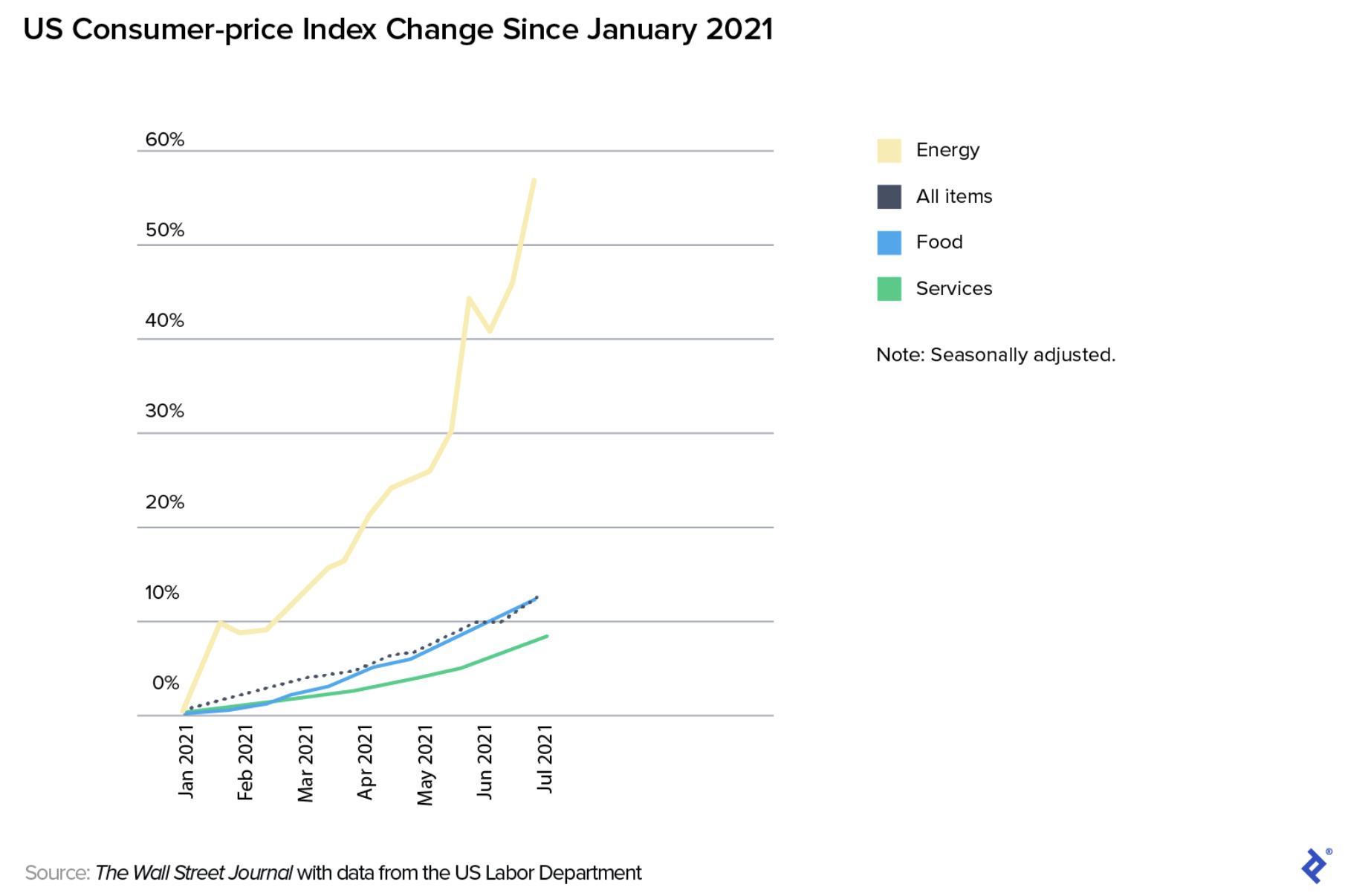
Pricing is always a crucial element in business strategy, but in a turbulent economy, it becomes much more crucial. Globally, inflation is growing quickly as a result of expanding consumer demand, broken supply chains, and cheap monetary policy. The US Consumer Price Index increased by 9.1% between June 2021 and June 2022, according to the most recent statistics from the US Bureau of Labor Statistics, the largest annual gain in the previous 40 years.

price index.

Given the uncertainty surrounding the duration of global inflation, it is particularly challenging to set prices for goods competitively now without reducing profits. The moment is now if there was ever a time to carefully consider your pricing approach.

Management teams need to continuously modify their models to better reflect changing macroeconomic conditions and customer preferences in order to develop and sustain a successful pricing strategy.

To assist your team in achieving this, we’ll provide four pricing strategy recommendations in this post. They may seem counterintuitive, but they are backed by independent study and may be useful for any business trying to create and maintain a practical and adaptable pricing plan.

1. Being the cheapest isn’t always the best option

You might assume that the greatest method to outperform your rivals is to lower their pricing. But pricing isn’t always that straightforward.

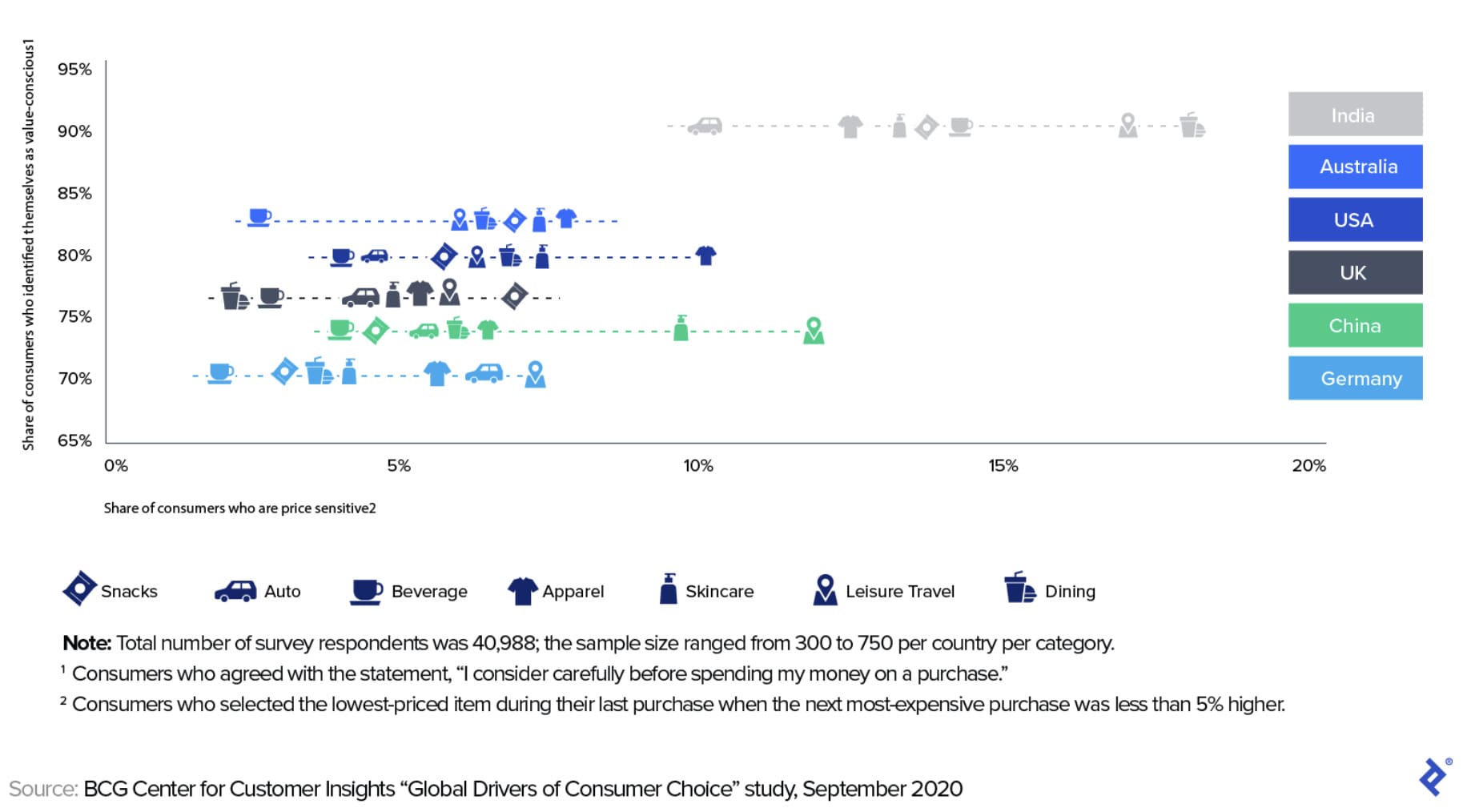
According to research done in 2021 by the Boston Consulting Group’s Center for Consumer Insights, 70% to 90% of the 41,000 people polled consider themselves to be “value sensitive” customers, depending on the purchases they were questioned about (defined as always carefully considering price before spending money). Only a tiny percentage of people polled had really bought the lowest-priced item when asked regarding their latest purchase in a wide variety of consumer products and services categories – in most cases, fewer than 15%.

price index.

The main lesson to be learned from this is that each consumer’s perception of a product’s worth is unique. Customers frequently agree to spend a little bit extra for a product that they believe to be of greater quality. For many consumers, a product’s price can be used to determine its quality or to assign it a specific status. 

When creating a pricing strategy, context and conditions are essential elements to take into account.

2. Don’t believe that promotions = profits

Promotions may be a powerful method to increase sales when done well. However, businesses may quickly become overly dependent on promotions, which eventually erodes value. Read more about other signs your pricing strategy isn’t working.

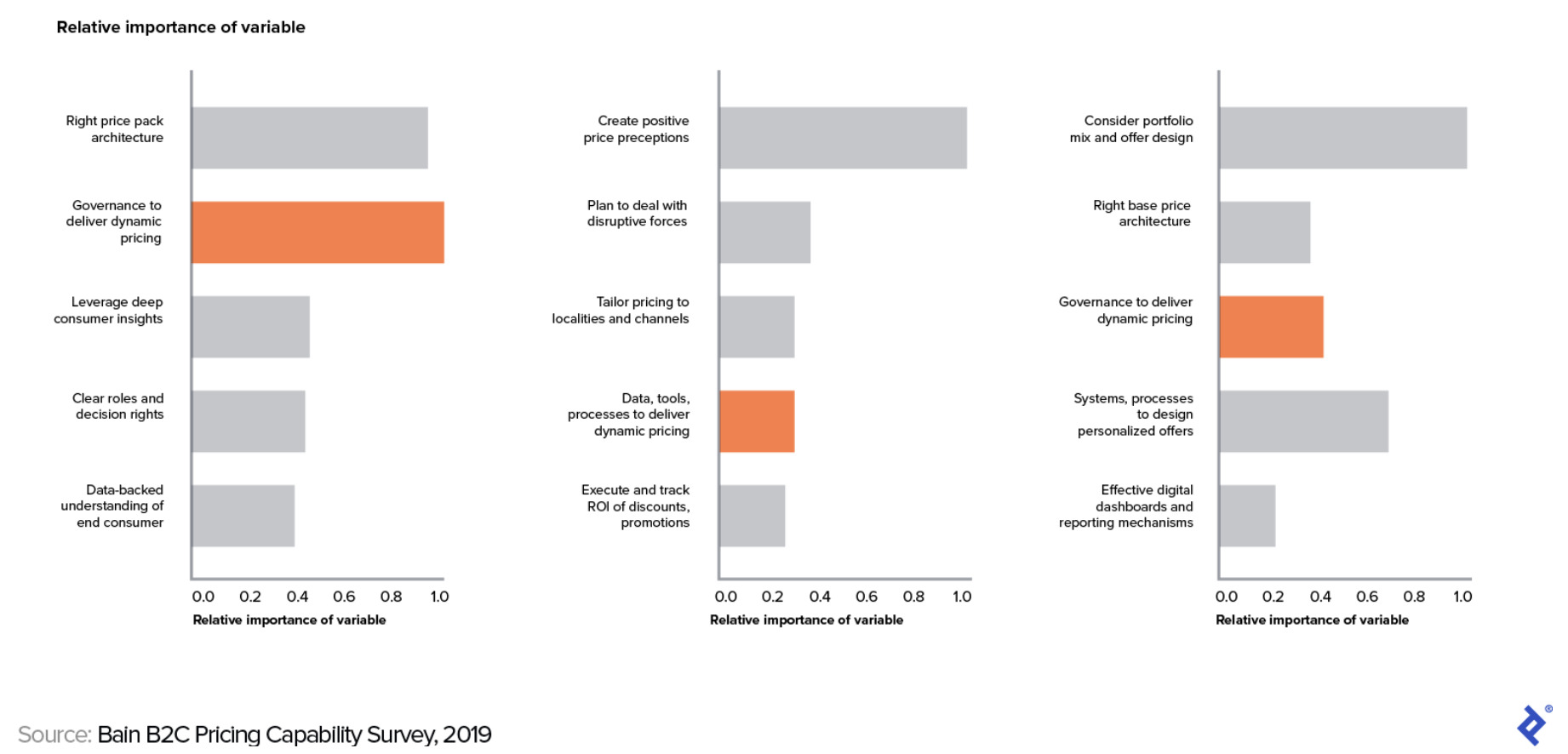
Bain discovered that the majority of the best-performing firms in terms of market share gain shared a few strategies after polling more than 1,000 top consumer brands about their pricing strategies in 2019. One of these was promptly identifying and eliminating “bad promotions,” which are defined as those that impact profitability, harm the brand, or fail to significantly increase sales. Another was using data to continuously fine-tune their campaigns.

These results support the idea that promotions should be conducted scientifically rather than as a fast technique to increase sales.

3. Not only airlines use dynamic pricing

You might believe that dynamic pricing is just used in the travel and e-commerce industries, but it’s spreading (entertainment industry, taxi services, etc.)

dynamic pricing

Consulting firms and enterprise software companies typically use proposal-based pricing, a type of value-based pricing in which the price quotation for delivering a specific good or service is customized to a customer’s requirements and their estimation of its worth.

Retail businesses with physical locations can also benefit from dynamic pricing strategies. For instance, a buyer could object to price adjustments for essential products but not as much for trendy or one-off purchases.

Regardless of the scale and scope of your business, by regularly and systematically reexamining the price issue, you may manage it more effectively and perhaps provide considerable profit gains.

4. Information is the most valuable thing you can gain from a price change

From marketing initiatives to public policy choices, many procedures are now “data-driven” or “evidence-based,” and your pricing plan surely is too, but certainly not to the level that it should be. The more data you can get about your market, rivals, and consumers and utilize it to constantly update and enhance your tactics, the more successful your pricing will be.

Concentrate your efforts on clearing up datasets that can most significantly affect the most lucrative items or segments for your organization. Before you use the data you already have as the foundation for pricing changes, try using an 80/20 approach to cleaning it up.

Watching your customers’ reactions to price adjustments in a deliberate and organized manner will provide you with the data you need to improve your approach and successfully optimize revenue and retention.

Conclusion

In order to sustain profitability during uncertain economic times, all firms must examine their prices more carefully. Setting prices too low or abusing discounts and promotions can change consumer views and behavior unfavorably, while arbitrarily boosting prices might drive away consumers and hurt sales. The most prosperous companies regularly review their pricing tactics and cautiously experiment with price modifications supported by reliable data.

About the Author

Vital Shpakouski

Vital Shpakouski is a Philologist with higher education, professional translator, former volunteer and teacher, entrepreneur, and salesperson with 13 years of experience. Now I’m a copywriter in Internet marketing, writing about everything that helps businesses grow and develop. In my free time, I create music and songs that no one hears and take photos and videos that no one sees.

BlackRock CEO’s Comments About Inflation and Remote Work Show Poor Judgment

By Gleb Tsipursky

BlackRock CEO Larry Fink claimed1 in a recent interview2 with Fox that “we have to get our employees back in the office.” According to him, doing so would result in “rising productivity that will offset some of the inflationary pressures.”

Fink did not provide any data in the form of statistics, surveys, or studies to support his claims. He simply insisted, without evidence, that in-office work would reduce inflation. So what does the data say3?

A widely-cited July 2022 study4 from the highly-respected National Bureau of Economic Research (NBER) found strong evidence that remote work decreased inflation. Namely, because employees have a strong preference5 for mostly or full-time remote work, they are willing to accept lower wages to work remotely. As a result, the researchers found that remote work decreased wage growth by 2 percent over the last two years. Notably, the decrease in growth occurred specifically in the mostly higher-paid, white-collar positions that could be done remotely, leading to wage compression that reduced wage inequality between blue-collar and white-collar work. Given that higher wages result in more consumer spending that leads to inflation, the study concluded that remote work reduces inflation.

Companies are investing more into support for work from home such as IT and cybersecurity. And more forward-looking ones are providing remote work support for home offices.

Plenty of other evidence backs up the finding that remote work reduces wage growth, such as a June 2022 survey6 by the Society for Human Resources. It reports that 48% of survey respondents will “definitely” look for a full-time WFH job in their next search. To get them to stay at a full-time job with a 30-minute commute, they would need a 20% pay raise. For a hybrid job with the same commute, they would need a pay raise of 10%. A different survey7 of 3,000 workers at top companies such as Google, Amazon, and Microsoft found that 64% would prefer permanent work-from-home over a $30,000 pay raise. Indeed, companies that offer remote work opportunities are increasingly hiring in lower cost-of-living areas of the US and even outside8 the US to get the best value for talent. That’s a major reason why one of my clients, a late-stage software-as-a-service startup, decided to offer some all-remote positions.

This data shows that remote work decreases costs of labor and thus reduces inflation. What about Fink’s claims about productivity?

working remotely
Surveys have long found9 that workers report being more productive working remotely, but we might feel some skepticism for self-reported answers. It’s harder to feel skeptical of evidence from employee monitoring software10 company Prodoscore. Its President David Powell said that, “after evaluating over 105 million data points from 30,000 U.S.-based Prodoscore users, we discovered a five percent increase in productivity during the pandemic work from home period.”

And we have become better at working remotely over time. A Stanford University study11 found that remote workers were 5% more productive than in-office workers in the summer of 2020. By the spring of 2022, remote workers became 9% more productive, since companies learned how to do remote work better12 and invested into more remote-friendly technology13.

A July 2022 study14 reported in another NBER paper found that productivity growth in businesses widely relying on remote work like IT and finance grew from 1.1% between 2010 and 2019 to 3.3% since the start of the pandemic. Compare that to industries relying on in-person contact, such as transportation, dining and hospitality. They went from productivity growth of 0.6% between 2010 and 2019, to a decrease of 2.6% from the start of the pandemic.

Case study evidence backs up these broader trends, as reported in another NBER paper15 about a study at a real-world company, Trip.com, one of the largest travel agencies in the world. It randomly assigned some engineers, marketing workers, and finance workers to work some of their time remotely and others in the same roles to full-time in-office work. Guess what? Those who worked on a hybrid schedule had 35% better retention, and the engineers wrote 8% more code. Writing code is a standardized and very hard measure of productivity, and provides strong evidence of higher productivity in remote work.

office workplace
The evidence demonstrates that remote labor both costs less and is more productive, reducing inflation at both ends. What about ancillary costs?
Employees can save a lot of money, up to $12,000 for full-time remote work according to a Flexjobs analysis16. That involves savings on transportation, such as gas, car maintenance, and parking, or public transportation. Workers also don’t have to buy expensive office attire, or eat out at overpriced downtown restaurants. Workers do need to pay somewhat more for cooking at home and higher utilities. Yet these costs are much smaller than the costs of coming to the office.

Surveys have long found9 that workers report being more productive working remotely, but we might feel some skepticism for self-reported answers..

Companies save a lot of money on real estate, utilities, office furniture, cleaning services, and related costs. An average office space per employee can be up to17 $18,000 per year, which means savings can add up fast. No wonder office occupancy is down18 and companies are cutting19 their real estate footprint. For example, Amazon – which allows full-time and part-time remote work – recently paused20 its construction of five towers in Bellevue, Washington, due to remote work.

Companies are investing more into support for work from home such as IT and cybersecurity. And more forward-looking ones are providing remote work support for home offices. For instance, Twitter, Facebook, and Google provided21 a flat stipend of $1,000 for home offices. As another alternative, one of my clients22, the University of Southern California’s Information Sciences Institute, researched the best options for home offices and provides a standardized and wide range of home office technology and furniture to its staff. Doing so improves productivity, and is a wise long-term investment. And such expenses are much less than the costs of employees in the office.

Thus, in addition to lower labor costs and higher productivity, both employees and employers pay much less to have staff work remotely. All the evidence shows that remote work decreases inflation.

remote work meetingSuch information is easily available, and Fink could have assigned a summer intern at BlackRock to find the evidence. He chose not to do so, instead making statements that are patently against the facts. By doing so, he shows poor judgment23, likely due to a combination of cognitive biases24. One is called the belief bias25, where our belief in the desirability of an outcome – such as Fink’s desire for workers to return to the office – causes us to misinterpret the evidence supporting this outcome. Another is the confirmation bias26, where we look for evidence that confirms our beliefs, and ignore evidence that does not.

Fink’s failure to evaluate the abundant evidence accurately casts doubts on the recommendations made by BlackRock more broadly. It’s likely to undermine investor trust in its products. His poor judgment should be a lesson to all business leaders to rely on the facts, and not wishful thinking, in their public communication and decision making27.


About the Author

Gleb TsipurskyDr. Gleb Tsipursky serves as the CEO of the boutique future-of-work consultancy Disaster Avoidance Experts. He is the best-selling author of 7 books, including Never Go With Your Gut: How Pioneering Leaders Make the Best Decisions and Avoid Business Disasters and Leading Hybrid and Remote Teams: A Manual on Benchmarking to Best Practices for Competitive Advantage. His cutting-edge thought leadership was featured in over 650 articles in prominent venues such as Harvard Business Review, Fortune, and USA Today. His expertise comes from over 20 years of consulting for Fortune 500 companies from Aflac to Xerox and over 15 years in academia as a behavioral scientist at UNC-Chapel Hill and Ohio State.

References

  1. BlackRock CEO Larry Fink thinks he has a solution to inflation: Bring people back to the office, Fortune, November 7, 2022 https://fortune.com/2022/09/07/blackrock-ceo-larry-fink-remote-work-inflation-labor-productivity/?itm_source=parsely-api
  2. BlackRock CEO Larry Fink discusses inflation, ESG investing in the energy sector, Fox Business, September 6, 2022 https://www.foxbusiness.com/markets/blackrock-ceo-larry-fink-discusses-inflation-esg-investing-energy-sector
  3. Hybrid and Remote Teams, Disaster Avoidance Experts https://disasteravoidanceexperts.com/hybrid/
  4. The Shift to Remote Work Lessens Wage-Growth Pressures, NBER, July 2022 https://www.nber.org/papers/w30197
  5. Americans are embracing flexible work—and they want more of it, McKinsey, June 23, 2022 https://www.mckinsey.com/industries/real-estate/our-insights/americans-are-embracing-flexible-work-and-they-want-more-of-it
  6. Nearly Half of Workers Are ‘Definitely Looking’ to Work Remotely, SHRM, June 13, 2022 https://www.shrm.org/resourcesandtools/hr-topics/behavioral-competencies/global-and-cultural-effectiveness/pages/nearly-half-of-workers-are-definitely-looking-to-work-remotely.aspx#:~:text=Forty%2Deight%20percent%20of%20about,with%20a%2015%2Dminute%20commute.
  7. A $30K raise or remote work forever? Employees want remote, Human Executive Report, June 14, 2021 https://hrexecutive.com/a-30k-raise-or-remote-work-forever-employees-want-remote/’
  8. Remote work is freeing tech talent from the limits of geography, Fortune, April 8, 2022 https://fortune.com/2022/04/07/remote-work-tech-talent-international-limits-careers-work-labor-shortage-pandemic-cohen-bouaziz/
  9. The Benefits of Working From Home, AirTasker Blog, March 31, 2022 https://www.airtasker.com/blog/the-benefits-of-working-from-home/
  10. 3 New Studies End Debate Over Effectiveness Of Hybrid And Remote Work, Forbes, February 4, 2022 https://www.forbes.com/sites/bryanrobinson/2022/02/04/3-new-studies-end-debate-over-effectiveness-of-hybrid-and-remote-work/?sh=52dfba9e59b2
  11. Tell your boss: Working from home is making you more productive, Vox, May 30, 2022 https://www.vox.com/recode/23129752/work-from-home-productivity
  12. Hybrid and Remote Teams, Disaster Avoidance Experts https://disasteravoidanceexperts.com/hybrid/
  13. How remote work will force technology to improve in 2022, FastCompany, January 5, 2022 https://www.fastcompany.com/90706854/how-remote-work-will-force-technology-to-improve-in-2022
  14. A New Interpretation of Productivity Growth Dynamics in the Pre-Pandemic and Pandemic Era U.S. Economy, 1950-2022, NBER, July 2022 https://www.nber.org/papers/w30267
  15. Hybrid work is looking like a silver bullet for cutting down on employee churn, Fortune, July 26, 2022 https://fortune.com/2022/07/26/hybrid-work-lowers-attrition-rates-improves-satisfaction/
  16. 6 Ways Working From Home Can Save You $6,000 or More Annually, FlexJobs https://www.flexjobs.com/blog/post/does-working-remotely-save-you-money/
  17. The Wisenet Imperative https://www.kcrepsource.com/library/media/pdf/MASTER-WISENET.pdf
  18. Office Owners Reeling From Remote Work Now Fret About Recession, Wall Street Journal, July 5, 2022 https://www.wsj.com/articles/office-owners-reeling-from-remote-work-now-fret-about-recession-11657022402
  19. Companies Plan Additional Cuts to Office Space Amid Looming Downturn, Wall Street Journal, July 7, 2022 https://www.wsj.com/articles/companies-plan-additional-cuts-to-office-space-amid-looming-downturn-11657186201
  20. Amazon will pause Bellevue towers to study impact of hybrid work on its offices, still plans 25k jobs, Geek Wire, July 14, 2022 https://www.geekwire.com/2022/amazon-will-pause-bellevue-towers-to-study-impact-of-hybrid-work-on-its-offices-still-plans-25k-jobs/
  21. Can a company save money with remote work?, Lano, August 27, 2021 https://www.lano.io/blog/can-a-company-actually-save-money-with-remote-work
  22. Testimonial from Dr. Craig Knoblock, ED of USC ISI, for Dr. Gleb Tsipursky’s hybrid work consulting, YouTube https://www.youtube.com/watch?v=PrSbwctaVDg
  23. Never Go With Your Gut, Disaster Avoidance Experts https://disasteravoidanceexperts.com/nevergut/
  24. The Blindspots Between Us, Disaster Avoidance Experts https://disasteravoidanceexperts.com/blindspots/
  25. The belief-bias effect in the production and evaluation of logical conclusions, Springer Link, November 17, 1989 https://link.springer.com/article/10.3758/BF03199552
  26. How Confirmation Bias Reduces Business Profits, Disaster Avoidance Experts, February 8, 2022 https://disasteravoidanceexperts.com/how-confirmation-bias-reduces-business-profits/
  27. Never Go With Your Gut, Disaster Avoidance Experts https://disasteravoidanceexperts.com/nevergut/

What Slots Are The Highest Paying At Online Casinos?

Slot machine is one of the most played types of online casino games. This article will interest you if you’re looking for ways to play slots while earning money. Find out what slot machines are the highest paying in different casinos and if any bonus offers are available for your favorite game.

Types of Slots

The best online casinos offer various types of slots to choose from so that everyone can find the perfect game for them. Whether you’re a fan of classic slot machines or want to try your hand at some new video slots, there’s sure.

Classic Slots: These are perhaps the most well-known form of slot game, and they typically feature traditional symbols like bars, clubs, hearts, and diamonds on a grid with space for up to five characters. The object is to match at least three characters of the same type on the screen to win money. 

Video Slots: These games are similar to classic slots but use video images instead of static icons. It makes them more exciting to play because you can see the action on the screen as you play. 

Mobile Slots: Many casinos now offer mobile slots as an alternative way for players to enjoy their favorite games. These games work like desktop slots but can be played on your phone or tablet. It makes them convenient for when you’re on the go, and it’s also more accessible than ever to deposit and withdraw money from your account.

Why are slots so popular?

Some of the most played casino games worldwide are slot machines. They’re simple to play, offer many reward opportunities, and can be fun for anyone who enjoys gambling. Here are five reasons why slots are so popular:

  1. Slots Offer Variety: Plenty of different slot machine types to choose from, so players will always have something new to explore. Slots are an excellent choice for those that want to keep their gaming performance fresh because of their variety.
  2. Slots Are Fun And Rewarding: In addition to being varied, slots also offer a lot of rewards and payouts. Players can win big money by playing the suitable slot machine, making them one of the most rewarding casino games.
  3. Slots Are Easy To Learn And Play: Many slot machines don’t require special knowledge or skills to play them – all you need is a bit of luck and an interest in gambling. It makes slots an excellent choice for anyone new to casino gaming or those who want an easygoing experience.
  4. Slots Are Portable: Because they’re so easy to carry around and play anytime, they make great on-the-go gaming choices. It means slot players can enjoy their favorite game no matter where they are in the world!
  5. Slots Aren’t Limited To Specific Countries Or Regions: Slot machines aren’t tied to any specific country or region – meaning that players

Which Slots Are The Highest Paying?

Online casinos offer a wide range of slots of games with different payout percentages. Some slot games have high payouts, while others have lower payouts. Here are the top five slots games with the highest payout percentages:

Dragon’s Lair II: The Return to Treasure Island: This slot game has a 98% payout rate.

Kings and Queens: This slot game has a 97% payout rate.

Labyrinth: This slot game has a 95% payout rate.

The Dark Knight Rises: This slot game has a 94% payout rate.

How to Maximize Your Winnings?

When playing slots, there are a few items you can do to increase your winnings.

  1. Know the Pay Lines and Symbols. When playing slots, knowing the pay lines and symbols on the screen is essential to maximize your wins. The more pay lines you are on the higher your chances of winning something. And remember, if you’re getting close to winning a big prize, always hit the “free spin” button to try your luck again! 
  2. Play Multiple Games at Once. Slots are all about trying your luck, so why not play multiple games at once? This way, even if one game doesn’t give you the win you were hoping for, another round might be more rewarding. 
  3. Bet Bigger on Special Features. Sometimes special features – like wilds or Bonus Rounds – can add an extra layer of excitement to a slot game and make it more likely that you’ll win something big. Bet bigger when these features are available to increase your chances of hitting it big!

Conclusion

Slot selection is one of the factors you should take into account when selecting the best online casinos. While many different types of slots are available, some of the most popular and lucrative places belong to the best online casinos. One of the most popular slot machines is the classic video slot machine. 

These machines allow players to experience variations on traditional fruit and video poker games offer multiple ways to win money. From Hi-Lo games, where you can get up to five winning hands in a row, to Bonus Poker variants, where you can win up to one hundred times what you initially bet, there is an option for everyone at these top online casinos. In addition to classic video slots and poker games, some online casinos also offer bonus rounds that feature specific types of places. 

For instance, one casino may feature bonus rounds with traditional slot machines called progressive jackpot slots. Players can win big prizes by playing through these rounds even if they don’t hit any significant wins during regular play. It means that not only are these rounds entertaining, but they can also be profitable for those who take advantage of them!

Commercial Architecture Changes With Permits

Whether you own a commercial building or a home, there are a few things you should know about how to get permits for changing your architecture. Some of the things you need to know include how to get a new certificate of occupancy, how to get a permit to use your property for a new purpose, and how to get a permit to operate your property.

Change of use permits

Whether you’re converting a building from residential use to commercial use, or just adding an extra room, you will need a change of use permit. The permit gives you a Certificate of Occupancy (C of O), which will allow you to legally occupy the building. It will also show that you are in compliance with current codes and ordinances.

The process of getting a change of use permit can be complicated. It involves several different departments, including the city’s building departments, the coastal commission and the Landmarks Preservation Commission.

Before you apply for a change of use permit, you should contact your local building department. They will tell you what approvals you need and which permits you need to apply for.

The building department will also need a copy of your Planning Approval. This is a document that you’ll need to have prepared by a licensed architect. The permit application needs to be notarized and you must include three sets of detailed construction plans. You will also need a recent complete survey of the site.

Using and operating permits

Using and operating permits as a commercial architect aren’t as simple as they might seem. A number of requirements must be met before any work is deemed safe and compliant with state or local regulations. A building permit is required before any work can begin, and a trade permit is required before any trade work can be performed.

A building permit is required for new construction and for all renovations, additions, and alterations. A trade permit is required for the construction or replacement of mechanical, electrical, and plumbing systems. A fire detection and suppression permit is also required.

A building permit is also required to build or replace a fence. A fence is defined as any fence whose height is more than 6 feet. A permit is required for a masonry wall, but not for a wood or aluminum fence.

A building permit may also be required for new construction of a prefabricated module, or for work done on a public right-of-way. A building permit is also required for a deck on an existing building, or a new parking lot.

Review by a structural engineer

Whether you are building a new home or remodeling your current one, you’ll want to get a structural engineer’s take on the matter. Having an expert check out your plans before you begin your remodeling or construction projects will save you from costly mistakes. The engineer might also be able to identify a problem area that you’ve overlooked, thereby saving you time and money.

There are many roads to choose from when determining what the best path for your remodel is. You can have a designer or architect draw up custom plans for you, but it’s always a good idea to get a second opinion. A structural engineer can help you find and fix any problems you may have overlooked. The engineer may also be able to provide you with a scope of repairs and bidding opportunities for materials and labor.

A structural engineer might also be able to point you in the right direction when it comes to identifying leaky roofs, determining the cause of a damp or moldy basement, and identifying the cause of a leaky bathroom vanity.

Obtaining a new certificate of occupancy

Obtaining a new Certificate of Occupancy is a must when changing the use or occupancy of a building. This certificate, issued by the local government, ensures that your building meets all building codes. If you have any questions about getting a Certificate of Occupancy for your business, you can contact the Department of Buildings in your area.

If you’re planning to renovate or build a new commercial building, you will need to get a Certificate of Occupancy. The building will need to be inspected and approved by a certified building inspector before the CO can be issued.

If you’re making significant changes to your building, such as adding more rooms or relocating an entrance, you will need to obtain a Certificate of Occupancy. If you’re planning to renovate or rebuild a building that is currently in use, you may not need to obtain a CO.

Obtaining a new Certificate of Occupancy for your business requires four sign-offs. This includes an application from the owner of the business, a copy of the lease agreement, a copy of the building permit, and a signed certificate from the business manager.

The Valuation of Nature after the Pandemic Seeing More Than Instrumental and Intrinsic Values

By Johanna Zoe Hartmann & Michael Palocz-Andresen

The valuation of nature has relied broadly on instrumental and intrinsic values that form a dichotomy, an approach that has been inadequate to address the variety of human-nature connections that people may hold. However, human-nature relationships may be more appropriately described through the concept of relational values. To elicit such multiple values and guide action more effectively, the notion of plural valuation has emerged, which is seen to improve the way nature is valued and accounted for in decision-making.

Nature is an integral part of our lives; its resources are the basis for livelihoods and economic success, while the natural realm gifts us with sociocultural benefits that can be perceived through, for example, connectedness, identity, and spirituality.
Nevertheless, discussing nature’s values is still often restricted to the instrumental perspective, namely its economic and use value, and with the majority of the human population living in cities, our lives get more and more technical and disconnected from the environment, while nature gets increasingly commodified.

In recent years, the global COVID-19 pandemic has forced people to retreat from a multitude of social locations and structures. With social gathering restricted and societal institutions mostly closed, people were forced to spend more time in their own homes. Meanwhile, people retreated to nature, which led to an increasing individual appreciation of nature, as well as connectedness with it. Spending time in nature has helped people to maintain their well-being during a time characterised by extensive restrictions. Therefore, the pandemic seemed to have a positive effect on individuals’ connectedness to nature and values1.

This paper explores how different values of nature are conceptualised and expressed in forms of human-nature relationships. Starting with the common idea of a value dichotomy, it is argued that a third value domain is necessary to adequately address value perceptions by exploring tangible examples (figure 1). The prevailing question is how the variety of values can be assessed and integrated for decision-making, aiming at more ecologically and socially sustainable outcomes.
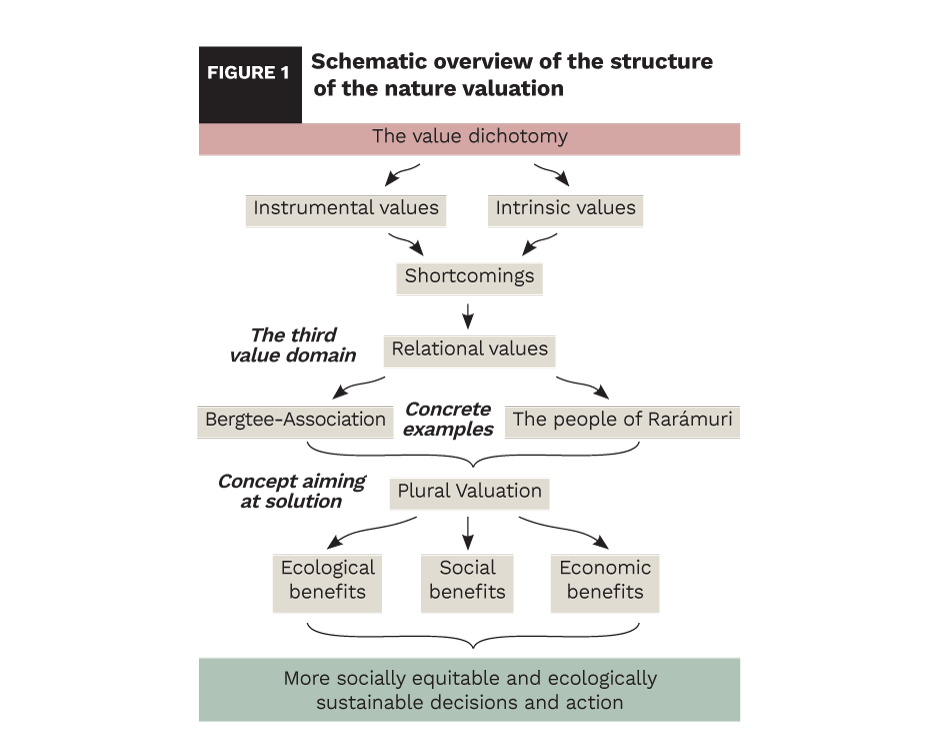
figure 1

The Value Dichotomy

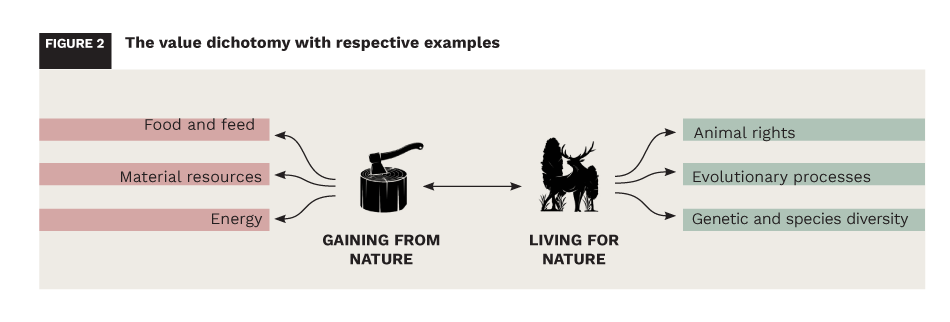
figure 2

The values of nature can have various forms. Generally, values can be defined as the multitude of ways in which different people, places, or entities are of importance, how we relate to them, and how we consider them for action and behaviour2.
The scientific and political discourse was dominated for a long time by a dichotomy of values, consisting of instrumental and intrinsic value considerations (figure 2). These two value domains derive from opposing stances. Instrumental values seem to originate from an economic perspective, putting the utilitarian view in focus. Meanwhile, intrinsic values are biocentric and emphasise the ethical perspective towards nature as its own entity3. Nevertheless, these two value domains are insufficient to describe the complexity and context-specificity of human-nature relationships and the values arising from these. In this part of the paper, both value domains are first briefly described, and the issues arising from this dichotomy examined.

log

Instrumental Valuation

Instrumental valuation often focuses on monetary, economic aspects and how humans can gain from nature. This concept dates as far back as Aristotle, who distinguished between nature’s exchange and use values, concepts which are currently still in use. Since then, economic thoughts have dominated the valuation discourse4. With the Millennium Ecosystem Assessment in 20055, which sorted nature’s services to humans into ecosystem services (ES) categories, the economisation of nature continued6, so that valuation research predominately focuses on monetary and economic valuation methods7. Such methods are primarily market-based, such as assigning value estimates in monetary units to certain aspects of nature, assessing the use value, willingness to pay for the provision of ES, or the willingness to accept compensation for its loss, as well as the cost of replacement through human-made substitutes8. These methods are mostly applied to material, provisioning ES, for example timber, provided by forests, extracted, and then commodified on markets.

Intrinsic Valuation

Intrinsic valuation is regarded as the opposite value perspective. Whereas instrumental values see nature as a means to achieving the greatest human gain, intrinsic valuation considers nature and other species as an end in themselves which exist for their own sake and independently from humans. From this perspective, people have a moral responsibility towards other species with which we share the environment. This view is biocentric and non-anthropogenic in character and includes values such as animal rights and welfare, evolutionary processes, and genetic and species diversity9.

Issues Arising from This Dichotomy

The two value domains within this dichotomy stand opposite to each other and derive from inherently different considerations. Therefore, instrumental and intrinsic values are often conflicting and hard to combine9.

The following metaphor best describes what relational values are: people are living with nature, encompassing those values that arise from human relations with nature, meaning the various ways in which the cultural sphere is connected with the biophysical sphere.


Whereas intrinsic, non-anthropogenic values fail to account for the human relationship with nature, instrumental valuation focuses too much on the utilitarian perspective and cannot capture the non-material contributions of nature to human life. For instance, nature can have spiritual and religious meaning for humans and be an integral part of identities and ancestral belonging to a place. These values are context-specific and subjective and thus cannot be readily commodified and expressed in economic terms8. Other criticised aspects of economic valuation are that it simplifies ecologically complex processes and enhances social inequalities by converting previously open-access resources to semi-public access available only to those with sufficient financial power6.

Therefore, relying on only these two value domains to assess the value of nature is insufficient for assessing and describing the complexities of human-nature relationships and the context-specific meanings of nature according to world view, culture, social status, and gender. A third value domain is necessary.

A Third Value Domain
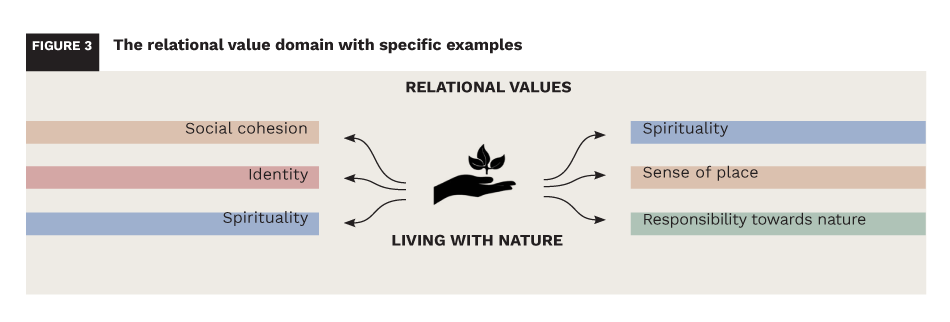
figure 3

Out of this necessity, a third value domain has been introduced in recent years that captures more accurately how people live with nature. These values are called relational values (figure 3).

The following metaphor best describes what relational values are: people are living with nature, encompassing those values that arise from human relations with nature, meaning the various ways in which the cultural sphere is connected with the biophysical sphere10. These are called relational values9. Relational values refer to those processes that enable people to define their identity and social structures, as well as those that are conditional to keeping up functional and resilient ecological systems that also provide for human well-being10. Furthermore, they describe the importance of human-nature connectedness across multiple generations9.

The two previously described value domains can be translated into the metaphors of gaining from nature (instrumental values) and living for nature (intrinsic values)10.
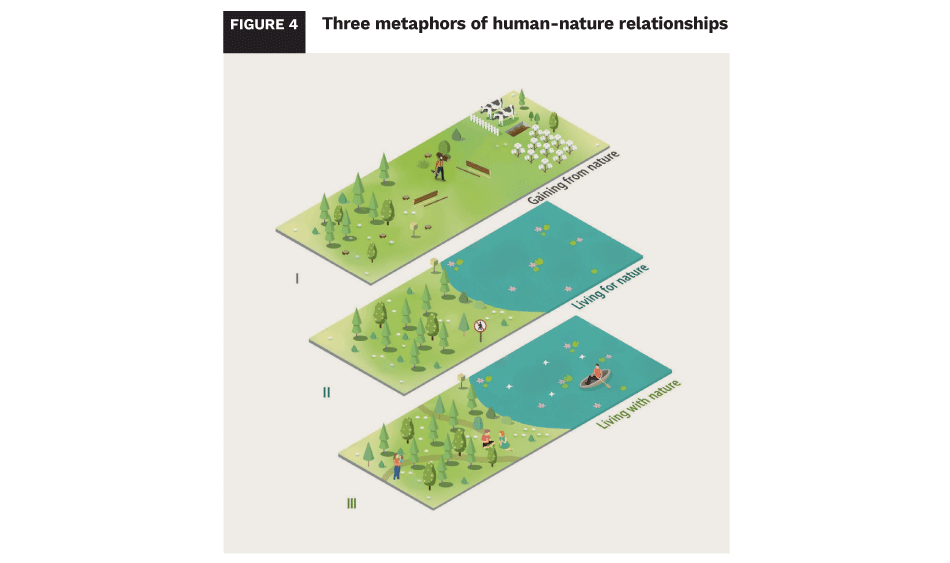
figure 4Together, these three metaphors capture most, albeit not all, of the possible relationships between humans and nature, depicted in figure 4. Having discussed the value dichotomy of instrumental and intrinsic values, in the following section we will explore some examples of how relational values translate into concrete human-nature relationships.

The Austrian “Bergtee” Heritage

A study by Grasser et al.11 assessed which plant species are gathered and valued by local people in the Grosses Walsertal biosphere reserve in Austria. It thereby highlighted the intricate links between nature and culture in this part of Europe.

Plant-gathering activities in this area stem from tradition but became economically unnecessary. However, these practices remained an integral part of the people’s heritage. While gathered plants are used for nutrition, medicine, veterinary, or other purposes, herbal tea is the most frequently mentioned use.

Stemming from the local heritage and knowledge of gathering plants, the Bergtee (mountain tea) community project was founded with the aim of sharing the traditional knowledge held by local women. Plants are gathered by these women and mixed, producing the mountain tea mixture. Even though this mountain tea is locally sold, the interest does not lie in increasing economic gain, but passing on the appreciation and value of nature and what it offers. When picking plants, great attention is paid to keeping the integrity of the ecosystem. For example, the first flowers appearing every season are left for bees. Furthermore, gathering activities are informed by local knowledge and also, in some cases,beliefs in astrology. The tea mixture produced is believed to have medicinal benefits.

These activities reflect regional identity and the value of nature as more than economic gain and intrinsic value. Local women’s identity and heritage is interconnected with plant-gathering activities, showing the relationship these people have with the surrounding nature11.

local women

Indigenous Relationships with Nature: The People of Rarámuri

Indigenous people are often said to live in a very close relationship with nature that enters a cultural, spiritual, physical, and social sphere. Their connectedness with nature can be characterised by reciprocity and interdependency with all other living entities. Thus, if nature is harmed, this comes back to humans12.

Plural valuation stems from the recognition that there are diverse and multiple arrays of knowledge and values which need to be integrated into decision-making to address social inequalities and achieve goals such as those just mentioned.

Salmón12 describes the specific relationship of the indigenous community of Rarámuri, also called Tarahumara. This community is local to the Sierra Madre region of Chihuahua in Mexico, a very biologically diverse area. The people of Rarámuri live by the concept of iwígara, which is the belief that self and culture are interconnected in the web of life. This encompasses all lands, animals, and parts of the natural world, as well as people themselves. All life within this continual system shares the same breath and is relative. For the Rarámuri, their life stems from and emerges from the natural world. In this sense, they believe that their community emerged from ears of corn after the previous world was destroyed. This relationship to corn goes beyond the reliance for food and enters a cultural sphere. As such, this belief system translates into rituals, ceremonies, and language12.

This example of the Rarámuri people shows clearly how nature is more than a means of gaining a livelihood, but enters the cultural sphere and becomes part of the identity of these people. This entails a great connectedness to nature that is essential for their well-being. The Rarámuri live in kinship with nature12, which influences their identity beyond material gain.

Plural Valuation and Its Benefits

The previous examples illustrated how nature can go beyond intrinsic or monetary values and enter the cultural, relational sphere. Nevertheless, valuation methods in the past still predominately applied value monism and focused on economic aspects7. So how can more layered and multifaceted values be assessed, recognised, and integrated into decision-making and why is it of high importance?

What Is Plural Valuation?

In 2015, the United Nations decided on 17 Sustainable Development Goals (SDGs)13 which are recognised as guiding principles for action. Human activities and resource use should be guided by these considerations. With nature and its contributions to people at the core of all resource extraction and benefit for human purposes of whatever kind, how we assess the value of nature is crucial for the achievement of many of these SDGs. How can we achieve “zero hunger” when we (directly) destroy the source of livelihood of many rural communities because it is economically more valuable to a more privileged part of the human population? How can we fulfil goal 14, “Life below water”, and 15, “Life on land”, if we do not acknowledge the right of existence beyond human instrumental value of those ecosystems and species living in them? And how can we fulfil “Reduced inequalities” if we largely ignore the values, connectedness, and needs of nature that marginalised, less powerful populations hold, people who will face adverse consequences for their culture and subsistence if nature is continuously destroyed. Evidently, value considerations guide all aspects of action and are therefore essential in order to reach these goals and sustainably protect nature.

This is where plural valuation has emerged as a concept. Plural valuation stems from the recognition that there are diverse and multiple arrays of knowledge and values which need to be integrated into decision-making to address social inequalities and achieve goals such as those just mentioned. It can be defined as a process of assessing the variety of values ascribed to nature by various stakeholders, and how they are interrelated and can be brought into decision-making and policy14,15.

How Is Plural Valuation Carried Out?
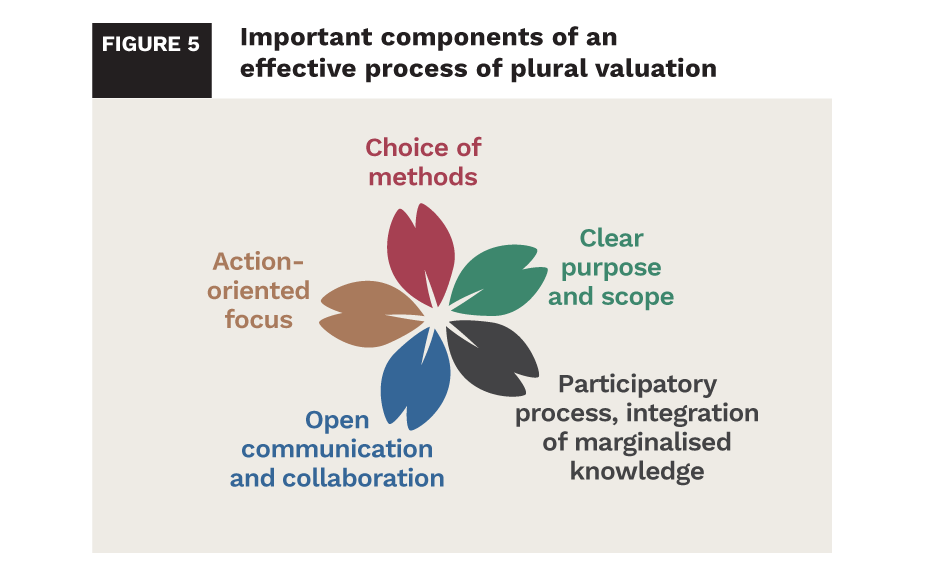
figure 5

Plural valuation is explicitly inclusive of different world views, knowledge systems, beliefs, genders, and power relationships. Since the concept itself developed from various scientific disciplines15, there is no set method for how plural values can be elicited. Arias-Arévalo et al.10 have compiled a comprehensive set of methods for different purposes and value domains. However, the choice of method is not the only factor enabling or constraining adequate valuation beyond a single metric (figure 5).

To successfully elicit plural values, a shared understanding of the purpose and scope of valuation must be deliberately agreed on by scientists, practitioners, policymakers, and all other stakeholders. It should be clear that all relevant methods, concepts, and disciplines need to be included to broaden the value horizon towards the multiple value domains discussed before. Finally, the obvious aim of this process is to integrate the results into decision-making and translate them into action14.

Even so, not all processes of plural valuation lead to sustainable and equitable outcomes as wished. Zafra-Calvo et al.15 showed that there are five primary factors that effectively contribute to desirable outcomes in terms of ecological sustainability and reduced social inequity. Plural valuation processes should (1) be participatory, (2) be action-oriented, (3) give space for marginalised groups to express their values, (4) bring together different concepts of human-nature relationships, and (5) facilitate a space for open communication and collaboration between stakeholders15.

What Are the Benefits of Plural Valuation?

figure 6

When conducted thoroughly and under such criteria, the plural valuation of nature can have various social, ecological, and economic benefits, as summarised in figure 6.

Even though the first thought might be that plural valuation may be less economically feasible, due to increased complexity, it may, in fact, be more cost-effective than approaches relying solely on value monism. It does not necessarily require more funds to conduct, as methods and processes can be combined and can increase the effectiveness and reliability of action, while simultaneously reducing the possible risk factors14.

Conducting plural valuation can also effectively contribute to the achievement of policy objectives for social and ecological concerns, such as the aforementioned SDGs. In addition, intergovernmental environmental assessments that guide policies globally can profit from plural valuation processes and the knowledge gathered14. As integrating marginalised and diverse knowledge systems and world views carries multiple beneficial factors for more effective understanding and management of nature16, plural valuation may contribute to this, too, with its role in eliciting such knowledge and beliefs when conducted correctly.

In terms of social benefits, plural valuation can contribute to an improved flow of nature’s contributions to people and distributional justice in terms of access to these15. Furthermore, the integration of diverse stakeholders can lead to more equitable and accepted decisions, which can reduce injustices and conflicts14;15. Lastly, successful plural valuation may improve factors of stakeholders’ quality of life such as health or cultural identity15.

Outlook

Outlook

Human development, welfare, and quality of life will continue to depend largely on natural resources. Meanwhile, action should be guided by global policy targets, such as the SDGs. To achieve such goals and make decisions that not only contribute to the (economic) welfare of a small, privileged part of society, the plural values of different domains must be recognised, elicited, and translated into action.

Instrumental valuation often focuses on monetary, economic aspects and how humans can gain from nature. This concept dates as far back as Aristotle, who distinguished between nature’s exchange and use values, concepts which are currently still in use.

Academic research has increasingly discussed plural valuation efforts and how it can be done successfully and effectively to create the most beneficial outcomes for future decisions14. Not only instrumental and intrinsic, but also relational values have been recognised as important value domains for describing socio-ecological systems in the latest IPBES report, published in 20199. Recognition has also been given to indigenous and local communities and their knowledge systems and beliefs, which need to be integrated for successful valuation processes14;15 and nature management16. This gives a promising outlook into the future of nature valuation and decisions affecting the natural world.

Even if it may seem that economic decisions still prevail in action, the COVID-19 pandemic has shown us that nature is not only a commodity, but is important for maintaining our well-being and mental health1. So, not only decision makers and policymakers need to consider plural nature values beyond instrumental and intrinsic ones, but also every person on an individual level can guide their action increasingly by considering nature’s contribution to our life, and our responsibility to nature itself.

Summary
In summary, this paper provides an insight into common concepts of nature valuation and explores relational values beyond the intrinsic and instrumental. Effective plural valuation processes aimed at eliciting multiple values can inform decision-making to achieve more socially equitable and ecologically sustainable outcomes. Therefore, action aimed at achieving global policy goals should be guided by the recognition of multiple values in order to achieve future sustainability after the pandemic.

Acknowledgement
The authors would like to thank Dr Jasmine Pearson for her ongoing support during the process of writing the bachelor’s thesis and introducing them to the topic of nature valuation.

About the Authors

HartmannJohanna Zoe Hartmann is studying Sustainability, Society and the Environment at Christian-Albrechts-University, Kiel. She recently fulfilled her bachelor’s degree in Global Environmental and Sustainability Studies at Leuphana University Lüneburg. Her interests lay mainly in socio-ecological systems and she seeks to continue her career in this research field.

AndresenMichael Palocz-Andresen is working as a guest professor at the Benemérita Universidad Autónoma de Puebla México. Since 2018 till 2022 he was a Herder-professor supported by the DAAD at the TEC de Monterrey. He became a full professor at the University West-Hungary Sopron, a guest professor at the TU Budapest, the Leuphana University Lüneburg, and the Shanghai Jiao Tong University. He is a Humboldt scientist and an instructor of the SAE International in the USA.

References

  1. O’Brien, L. and J. Forster. “Engagement with nature and Covid-19 restrictions. Quantitative analysis 2020”. Forest research 2020.
  2. O’Neill, J. Holland, A. and Light, A. Environmental Values. New York: Routledge, 2008.
  3. Pascual, U., Balvanera, P. Díaz, S. et al. “Valuing nature’s contributions to people: the IPBES approach”. Current Opinion in Environmental Sustainability 2017, 26-7:7–16.
  4. Silva, S. S. d., Reis, R. P., and Ferreira, P. A. “Nature value: the evolution of this concept”. Ciência e Agrotecnologia 2012, 36(1):9–15.
  5. [MA] Millennium Ecosystem Assessment (Program). Ecosystems and Human Well-Being. Washington, DC: Island Press, 2005.
  6. Gómez-Baggethun, E. and Ruiz-Pérez, M. “Economic valuation and the commodification of ecosystem services”. Progress in Physical Geography: Earth and Environment 2011, 35(5):613-28.
  7. Abson, D.J., von Wehrden, H., Baumgärtner, S. et al. “Ecosystem services as a boundary object for sustainability”. Ecological Economics 2014, 103:29-37.
  8. Brauman, K. A., Garibaldi, L. A., Polasky, S., et al. Chapter 2.3. “Status and Trends – Nature’s Contributions to People (NCP)”. In: Global assessment report of the Intergovernmental Science-Policy Platform on Biodiversity and Ecosystem Services. Brondízio, E. S., Settele, J., Díaz, S., Ngo, H. T. (eds). 2019. IPBES secretariat, Bonn, Germany.
  9. Brondízio, E. S., Díaz, S., Settele, J. et al. Chapter 1: “Assessing a planet in transformation: Rationale and approach of the IPBES Global Assessment on Biodiversity and Ecosystem Service”. In: Global assessment report of the Intergovernmental Science-Policy Platform on Biodiversity and Ecosystem Services. Brondízio, E. S., Settele, J., Díaz, S., Ngo, H. T. (eds). 2019. IPBES secretariat, Bonn, Germany.
  10. Aras-Arévalo, P., Gómez-Baggethun, E., Martín-López, B. et al. “Widening the Evaluative Space for Ecosystem Services: A Taxonomy of Plural Values and Valuation Methods”. Environmental Values 2018, 27(1):29-53.
  11. Grasser, S., Schunko, C. and Vogl, C. R. “Gathering ‘tea’ – from necessity to connectedness with nature. Local knowledge about wild plant gathering in the Biosphere Reserve Grosses Walsertal (Austria)”. Journal of Ethnobiology and Ethnomedicine 2012, 8:31.
  12. Salmón, E. “Kincentric Ecology: Indigenous Perceptions of the Human-Nature Relationship”. Ecological Applications 2000, 10(5):1327-32.
  13. [UN] United Nations Department of Economic and Social Affairs. “The 17 Goals”. 2022. https://sdgs.un.org/goals [last accessed 19 May 2022].
  14. Jacobs, S., Zafra-Calvo, N., Gonzalez-Jimenez, D. et al. “Use your power for good: plural valuation of nature – the Oaxaca statement”. Global Sustainability 2020, 3(e8):1-7.
  15. Zafra-Calvo, N., Balvanera, P., Pascual, U. et al. “Plural valuation of nature for equity and sustainability: Insights from the Global South”. Global Environmental Change 2020, 63:102115.
  16. Tengö, M., Brondízio, E.S., Elmqvist, T. et al. “Connecting Diverse Knowledge Systems for Enhanced Ecosystem Governance: The Multiple Evidence Base Approach”. AMBIO 2014, 43(5):579-91.

Why Did Adidas Wait So Long to Drop Kanye West?

By Dr. Gleb Tsipursky

Adidas does not tolerate antisemitism and any other sort of hate speech… the company has taken the decision to terminate the partnership with Ye immediately,” according to its October 25 news release1. That statement conveys a principled and admirable stance against the antisemitism shown by the rapper formerly known as Kanye West after his antisemitic tweet2 on October 10 that he would go “death con 3 on JEWISH PEOPLE.”

Yet Adidas waited much, much longer than other companies3 that cut ties4 with Ye. Even Ye’s own talent agency dropped5 him before Adidas. In fact, Adidas delayed so long that Ye taunted them on his October 16 appearance6 on the Drink Champs podcast, saying “I can say antisemitic things, and Adidas can’t drop me. Now what? Now what?”

Adidas faced particular pressure to drop Ye due to its dark past. A German company founded7 by a former member8 of the Nazi party, Adidas had an especially strong reason to drop Ye earlier than other companies. Adidas faced mounting pressure9 from the Anti-Defamation League and other10 organizations to drop Ye given its Nazi past. A Change.org petition11 set up by the Campaign Against Antisemitism urging Adidas to sever ties with Ye had gathered 169,100 signatures by October 25.

Short-term financial damage is highly visible and painful, while the long-term brand damage is much less visible and less painful. Yet realistically, such brand damage is much more important to the long-term success of Adidas.

Yet Adidas refused to drop Ye until all the other companies dropped him. Instead of getting ahead of the problem and dropping Ye immediately after his October 10 anti-semitic tweet, or even his October 16 taunting of Adidas, the company had to be shamed and pressured into cutting its ties with Ye. As a result, Adidas seriously damaged its brand, harming its reputation among anyone opposed to antisemitism. After all, it appeared Adidas dropped Ye due to the pressure, rather than Ye’s antisemitism and other bad behaviors.

What explains the poor decision-making by the Adidas leadership? It’s a classic case of the ostrich effect12: a dangerous judgment error where our minds refuse to acknowledge negative information about reality. It’s named after the mythical notion13 that ostriches bury their heads in the sand at a sign of danger. The ostrich effect is a type of cognitive bias14, one of many mental blindspots15 impact decision making in all life areas16, ranging from the future of work17 to mental fitness18.

The Adidas leadership buried its head in the sand. It refused to acknowledge the growing damage to its brand from Ye’s antisemitism, as well as his prior bad behavior, such as having models wear19 “White Lives Matter” T-shirts in early October.

Such denialism in professional settings happens more often than you might think. A four-year study20 of 286 organizations that had forced out their CEOs found that 23 percent were fired for denying reality, meaning refusing to recognize negative facts about their organization. Other research shows that professionals at all levels suffer from21 the tendency to deny uncomfortable facts.

adidasAdidas’ denialism likely stems from the cognitive bias known as the sunk costs22 fallacy. According to Adidas’ statement23, the termination of the contract is expected to “have a short-term negative impact of up to €250 million on the company’s net income in 2022 given the high seasonality of the fourth quarter.” Presumably, the impact will be much higher in 2023, over half a billion at least.

The partnership with Ye had a long history24 since 2013, when the company signed his brand away from rival Nike. In 2016, Adidas further expanded its relationship with the rapper, calling it “the most significant partnership ever created between a non-athlete and an athletic brand.”

In other words, Adidas invested a great deal of money and reputation into its relationship with Ye. That kind of investment causes our minds to feel strongly attached to whatever we put those resources into, and throw good money after bad.

Adidas seriously damaged its brand, harming its reputation among anyone opposed to antisemitism. After all, it appeared Adidas dropped Ye due to the pressure, rather than Ye’s antisemitism and other bad behaviors.

You’ll see this happen often in major projects that are working out poorly, such as Meta’s Metaverse project. Several high-profile industry figures recently criticized25 Mark Zuckerberg’s efforts. That includes Palmer Luckey, the founder of VR headset startup Oculus, which Meta acquired in 2014 for $2 billion. Luckey said “I don’t think it’s a good product” about Horizon Worlds, Meta’s core metaverse product. He called it a “project car,” a fancy automobile that the owner spends a lot of money on as a hobby. So far, Facebook’s shift to building the metaverse has been costly, with the company last year losing $10 billion on it, and Wall Street analysts expect it to lose more than $10 billion again this year.

Similarly, you’ll see sunken costs in major relationships. That can range from marriages that lasted much longer than they should have to brand partnerships like the one between Adidas and Ye.

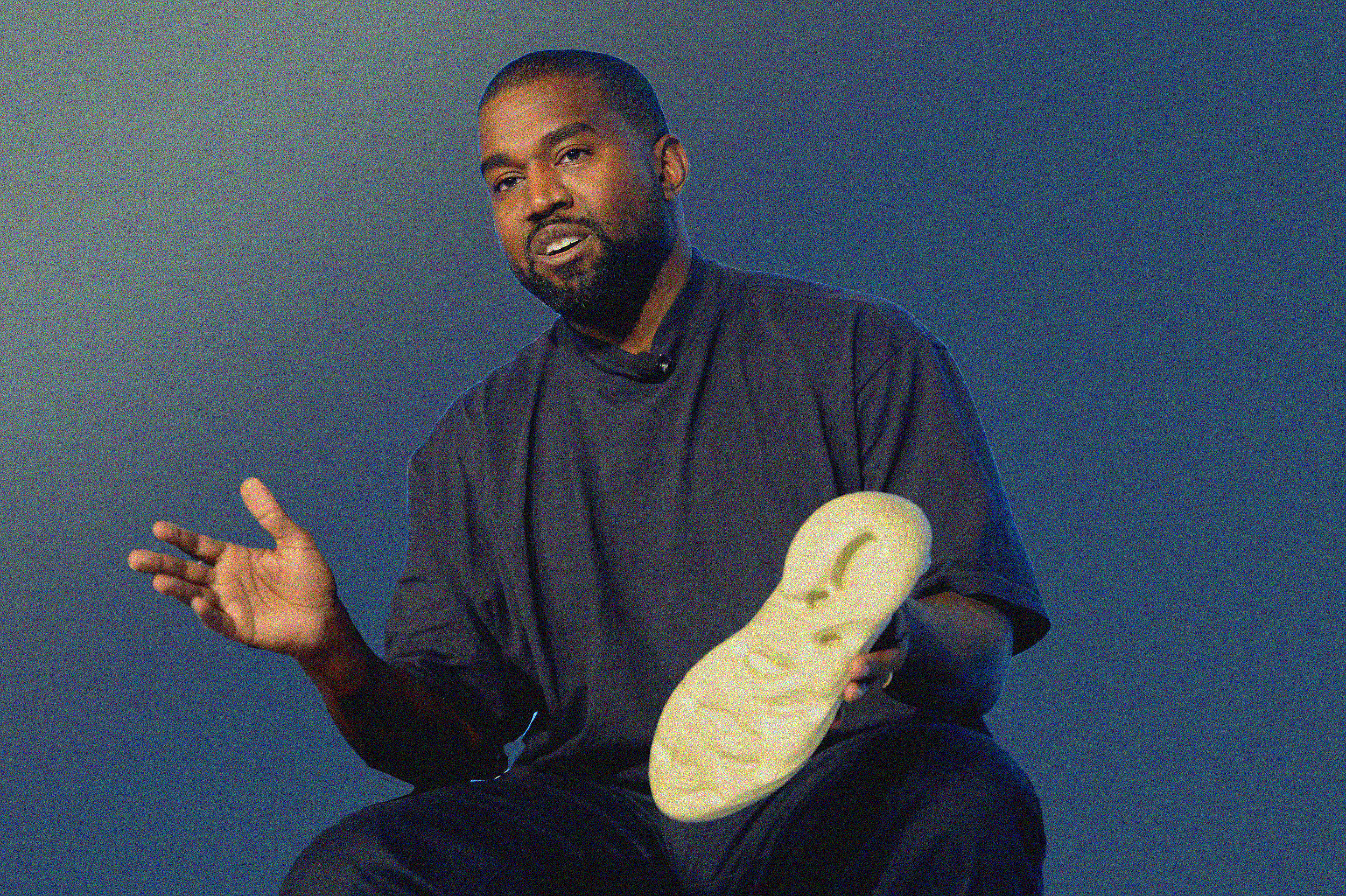
kanye adidasThe final cognitive bias relevant here is called hyperbolic discounting26. This term describes our brain’s focus on short-term, highly visible outcomes over much more important and less visible long-term ones. Adidas didn’t want to take the short-term financial hit to its bottom line from cutting ties with Ye. However, Adidas failed to give sufficient weight to the long-term damage to its brand from failing to do so.
Short-term financial damage is highly visible and painful, while the long-term brand damage is much less visible and less painful. Yet realistically, such brand damage is much more important to the long-term success of Adidas.

In my consulting27, I’ve seen many executives struggling with the same three mental blindspots when they face top performers engaging in bad behaviors, ranging from incivility to sexual harassment and discrimination. Leaders deny it happened because they have so much invested in the top performer, whether a star salesperson or top data scientist, and they don’t consider the long-term consequences to the organization’s culture and employee morale.

In fact, it’s easy for anyone to fall for these three cognitive biases when someone whom you value behaves badly. Fortunately, forewarned is forearmed: knowing about these three mental blindspots means you can watch out for these problems in your own professional and personal life.

About the Author

Gleb TsipurskyDr. Gleb Tsipursky serves as the CEO of the boutique future-of-work consultancy Disaster Avoidance Experts. He is the best-selling author of 7 books, including Never Go With Your Gut: How Pioneering Leaders Make the Best Decisions and Avoid Business Disasters and Leading Hybrid and Remote Teams: A Manual on Benchmarking to Best Practices for Competitive Advantage. His cutting-edge thought leadership was featured in over 650 articles in prominent venues such as Harvard Business Review, Fortune, and USA Today. His expertise comes from over 20 years of consulting for Fortune 500 companies from Aflac to Xerox and over 15 years in academia as a behavioral scientist at UNC-Chapel Hill and Ohio State.

References

  1. Adidas Terminates Partnerships with Ye Immediately, Adidas, October 25, 2022 https://www.adidas-group.com/en/media/news-archive/press-releases/2022/adidas-terminates-partnership-ye-immediately/
  2. Twitter, Instagram block Kanye West over antisemitic posts. AP News, November 11, 2022 https://apnews.com/article/twitter-inc-entertainment-music-ba5c710ec59d195fe4d83cb2c9343589
  3. These brands have dropped Kanye West amid antisemitism controversy, Washington Post, October 25, 2022 https://www.washingtonpost.com/business/2022/10/25/kanye-west-companies-cut-ties/
  4. ‘Had to Cut Ties’: Kanye West Breaks Silence on Adidas, Ye-Related Brands Fallout as Rapper Loses Billionaire Status, Entrepreneur, October 27, 2022 https://www.entrepreneur.com/business-news/adidas-drops-ye-what-companies-have-cut-ties-with-kanye/437844
  5. Hollywood talent agency CAA cuts ties with Kanye West after antisemitic tirade, LA Times, October 24, 2022 https://www.latimes.com/entertainment-arts/business/story/2022-10-24/hollywood-talent-agency-caa-cuts-ties-with-ye-after-anti-semitic-tirade
  6. “the thing about it being Adidas I can say antisemitic things and Adidas can’t drop me … now what … now what …”, Adidas Twitter, October 21, 2022 https://twitter.com/StopAntisemites/status/1583151910932336641?s=20&t=HzybdycOZRdPVv8TBi3fEw
  7. The Nazi history of Adidas, the sportswear giant that took weeks to drop Kanye West over antisemitism, Jewish Telegraphic Agency, October 24, 2022 https://www.jta.org/2022/10/24/culture/the-nazi-history-of-adidas-the-sportswear-giant-that-hasnt-dropped-kanye-west-over-antisemitism
  8. Kanye West antisemitism: Was Adidas really founded by a Nazi?, Yahoo News, October 26, 2022 https://news.yahoo.com/kanye-west-antisemitism-adidas-really-183747882.html?guccounter=1
  9. #RunAwayFromHate, Twitter, October 25, 2022 https://twitter.com/JGreenblattADL/status/1584638026717622275
  10. “the thing about it being Adidas I can say antisemitic things and Adidas can’t drop me … now what … now what …”, Adidas Twitter, October 21, 2022 https://twitter.com/StopAntisemites/status/1583151910932336641?s=20&t=HzybdycOZRdPVv8TBi3fEw
  11. Adidas must end its partnership with the antisemite Ye (AKA Kanye West), Change.org, https://www.change.org/p/adidas-must-end-its-partnership-with-the-antisemite-ye-aka-kanye-west
  12. The ostrich effect: Selective attention to information, Springer Link, February 11, 2009 https://link.springer.com/article/10.1007/s11166-009-9060-6
  13. Truth or Tail: Do ostriches really bury their head in the sand when scared or frightened?, Cleveland Zoo Society, March 11, 2010 https://www.clevelandzoosociety.org/z/2020/03/11/truth-or-tail-do-ostriches-really-bury-their-head-in-the-sand-when-scared-or-frightened#:~:text=Contrary%20to%20the%20popular%20myth,blend%20in%20with%20the%20terrain.
  14. How to Evaluate Unconscious Bias Caused by Cognitive Biases at Work, Disaster Avoidance Experts, June 27, 2019 https://disasteravoidanceexperts.com/how-to-evaluate-unconscious-bias-caused-by-cognitive-biases-at-work/
  15. The Blindspots Between Us, Disaster Avoidance Experts, https://disasteravoidanceexperts.com/blindspots/
  16. Never Go With Your Gut, Disaster Avoidance Experts, https://disasteravoidanceexperts.com/nevergut/
  17. Leading Hybrid and Remote Teams, Disaster Avoidance Experts, https://disasteravoidanceexperts.com/hybrid/
  18. Top 10 Science-Based Tips for Effective Online Therapy, Top10.com, November 2, 2022 https://www.top10.com/online-therapy/top-10-science-based-tips-for-effective-online-therapy
  19. Kanye West stirs controversy in ‘White Lives Matter’ T-shirt at Paris fashion week, The Guardian, October 4, 2022 https://www.theguardian.com/music/2022/oct/04/kanye-west-white-lives-matter-t-shirt-paris-fashion-week
  20. Leadership IQ Study: Mismanagement, Inaction Among the Real Reasons Why CEOs Get Fired, Cision, June 21, 2005 https://www.prweb.com/releases/2005/06/prweb253465.htm
  21. Denial: Why Business Leaders Fail to Look Facts in the Face–and What to Do About It, Amazon, https://www.amazon.com/gp/product/159184391X/ref=as_li_qf_asin_il_tl?ie=UTF8&tag=intentinsigh-20&creative=9325&linkCode=as2&creativeASIN=159184391X&linkId=cea93f837e44949c7402ed264941c0d8
  22. Sunk-cost fallacy and cognitive ability in individual decision-making, Science Direct, https://www.sciencedirect.com/science/article/abs/pii/S0167487016307346
  23. Adidas Terminates Partnerships with Ye Immediately, Adidas, October 25, 2022 https://www.adidas-group.com/en/media/news-archive/press-releases/2022/adidas-terminates-partnership-ye-immediately/
  24. Adidas terminates partnership with Kanye West, CNN, October 26, 2022 https://edition.cnn.com/2022/10/25/business/adidas-ye-ends-partnership/index.html
  25. Oculus founder Palmer Luckey compares Facebook’s metaverse to a ‘project car,’ with Mark Zuckerberg pursuing an expensive passion project that no one thinks is valuable, Insider, October 25, 2022 https://www.businessinsider.com/palmer-luckey-blasts-facebook-terrible-metaverse-product-oculus-2022-10?r=US&IR=T
  26. Hyperbolic discounting, https://psycnet.apa.org/record/1993-97149-003
  27. Consulting, Disaster Avoidance Experts, https://disasteravoidanceexperts.com/consulting/

Top Driving Distractions: Are You Guilty of Tailgating?

While most experienced drivers are completely tuned in to the road ahead of them, distractions can have a huge impact. In fact, distractions within vehicles was the second leading reason for over 2000 accidents in 2020, only behind impairment due to alcohol.

There are plenty of things that can draw your attention away from driving. With some insights from van leasing company, Van Ninja we’ll take you through some of the most common distractions that can occur. This way you’ll know what to be cautious of and avoid while you’re on the road.

Tailgating: the biggest distraction for motorists

Not every distraction comes from within your vehicle, as driving safely also takes into account the environment and other traffic. In a survey conducted by IAM RoadSmart of 1,000 British motorists, tailgating was one of the most popular responses, with 30% stating it’s the biggest distraction.

Tailgating is the act of driving within a short distance of a vehicle ahead of you, and it’s not just frustrating to feel like you’re being followed closely or hurried, but it’s also dangerous.

The appropriate stopping distance between vehicles varies depending on the speed limit and driving conditions, so if you’re having to make a quick emergency brake you’re more likely to be involved in an accident.

There’s no real way to avoid other people tailgating you, but when you’re behind the wheel of your own car, it’s important to stay calm and drive within the limits and laws of the Highway Code.

Eating & drinking: you could be fined for careless driving

Despite the myths you might have heard like wearing flip-flops or smoking, it’s not illegal in the UK to eat or drink while driving.

It’s always good to carry a bottle of water with you to avoid dehydration, especially as research has found that it can have an impact on concentration. It was discovered that even a reduction of 2 or 3% hydration can result in a drop of 20% drop in concentration.

However, if a police officer perceives you to be distracted from your driving while eating or drinking, you could be fined for careless driving. This comes with a fine of £100 and between three to nine penalty points on your license for four years.

To avoid being distracted by eating and drinking, have a bottle close by that you can take a drink from quickly, so your hands aren’t occupied for too long. For food, it might be better to avoid anything that you can’t grab with a single hand so you can keep the other on the wheel.

But for the safest results, wait until your vehicle has come to a halt before reaching for snacks and drinks.

Mobile phones: keep them out of sight and out of mind

No matter whether you’re a car owner or leasing a van, mobile phones have advanced to the point where most of the global population own a smartphone. Research from Uswitch found that at the start of 2022, there were 71.8 million mobile connections in the UK.

This means that more than ever there’s the opportunity to get distracted while on the road, and in 2020 the UK government recorded that 17 people were killed and 499 were injured in collisions that were caused by the use of a mobile phone behind the wheel. Using a mobile phone, satnav, or tablet while driving is illegal, and the maximum possible fine is £1,000 as well as 6 penalty points on your license. In extreme cases, it could result in a driving ban.

If you need your phone for entertainment or directions from a navigation app, connect your phone to your car entertainment system either through Bluetooth, an aux cord or USB cable. Letting contacts know that you’ll be behind the wheel also helps to avoid any phone calls coming through, further distracting you. While it’s tempting to have a quick check of your screen when you hear a text ping through, wait until you’re safely parked and stationary before you open it.

Many drivers actually put their phone away in the glovebox while driving – out of sight, out of mind.

The most crucial thing is not to let the frustration or stress of a reckless driver around you affect your driving. And you can keep your mind at ease knowing you’re operating your vehicle within the law and not at fault.

References:

https://www.statista.com/statistics/323093/road-accidents-caused-by-impairment-or-distraction-factors-severity-in-great-britain-uk/

https://www.uswitch.com/mobiles/studies/mobile-statistics/#:~:text=UK%20mobile%20phone%20user%20statistics,2021%20(around%202.6%20million).

https://www.gov.uk/government/statistics/seatbelt-and-mobile-phone-use-surveys-2021/mobile-phone-use-by-drivers-great-britain-2021#:~:text=Mobile%20phone%20use%20as%20a%20contributory%20factor%20in%20collisions&text=This%20compares%20with%2055%20deaths,recorded%20as%20a%20contributory%20factor.

https://www.gov.uk/using-mobile-phones-when-driving-the-law#:~:text=It’s%20illegal%20to%20hold%20and,videos%2C%20or%20browse%20the%20web.

https://catdrivertraining.co.uk/car-blog/how-dehydration-affects-driving-ability/

https://www.gov.uk/penalty-points-endorsements/endorsement-codes-and-penalty-points

https://www.fleetnews.co.uk/news/car-industry-news/2022/06/20/tailgaters-are-the-biggest-cause-of-driver-distraction

https://www.theaa.com/breakdown-cover/advice/stopping-distances#:~:text=Stopping%20distances%20at%20different%20speeds&text=The%20stopping%20distance%20at%2020mph,more%20like%2024%20car%20lengths.

EDITOR'S PICK OF THE WEEK

CFO's new mandate. CFO explaining the presentation

The Performance and Transformation Orchestrator: The CFO’s New Mandate in the Age of AI

By Terence Tse CFOs are evolving into AI-driven transformation orchestrators, balancing finance, technology, and strategy while upskilling teams, managing risks, and driving measurable business value. A key insight from this year’s AI for CFOs event, organized...

WISE DECISION MAKER GUIDE

POWER INFLUENCERS

Emerging Trends

The Future of Global Trade