Home Blog Page 345

Empowering Banking On-the-Go: How JavaScript Developers Revolutionize Mobile Banking Applications

Empowering Banking On-the-Go How JavaScript Developers Revolutionize Mobile Banking Applications

In today’s fast-paced world, where people are constantly on the move, mobile banking has emerged as a game-changer in the financial industry. With the convenience of managing finances at their fingertips, customers expect seamless and feature-rich mobile banking applications. Behind these cutting-edge apps lie the expertise of JavaScript developers, who play a pivotal role in transforming the way we bank on-the-go.

The Rise of Mobile Banking

Over the past decade, the adoption of mobile banking has skyrocketed, reshaping the banking landscape. Customers now prefer the flexibility of performing transactions, checking balances, and accessing financial services through their smartphones and tablets. According to a report by Statista, the number of mobile banking users is projected to reach 1.75 billion by the end of this year. This surge in demand has compelled banks to invest heavily in mobile app development, thereby propelling the need for skilled JavaScript developers.

Driving Innovation with JavaScript

JavaScript, as a versatile programming language, has revolutionized mobile banking applications by empowering developers to create dynamic, user-friendly, and secure platforms. Let’s explore the key areas where JavaScript developers make a significant impact:

1. Crafting Seamless User Experiences

At the heart of every successful mobile banking app lies an exceptional user experience (UX). JavaScript developers excel at building responsive and interactive interfaces, ensuring that customers can navigate through the app with ease. From smooth scrolling and animated transitions to intuitive navigation, JavaScript breathes life into the user interface, making the banking experience engaging and enjoyable.

2. Real-time Updates and Notifications

Staying informed about financial activities is crucial for customers. JavaScript enables developers to integrate real-time updates and push notifications into mobile banking apps. Whether it’s an account balance alert, transaction status update, or security notification, JavaScript facilitates instant communication, ensuring users are always up-to-date about their finances.

3. Security Reinforcements

Security is a top priority in mobile banking. JavaScript developers work tirelessly to implement robust security measures, safeguarding sensitive data and protecting against potential threats. With advancements in JavaScript libraries and frameworks, developers can build secure authentication systems, encrypted data transmissions, and fraud detection algorithms, bolstering the overall security of mobile banking applications.

4. Optimizing App Performance

Mobile banking apps must deliver a seamless experience, even under varying network conditions. JavaScript developers employ performance optimization techniques, such as code splitting, caching, and lazy loading, to enhance app speed and responsiveness. This optimization ensures that users can access their accounts and perform transactions quickly, irrespective of their device or network strength.

5. Personalization and Customization

Understanding individual customer preferences is vital for banks to offer personalized services. JavaScript developers leverage data analytics and user behavior insights to implement personalized features within the app. These may include tailored product recommendations, customized financial insights, and personalized banking offers, fostering stronger customer relationships.

Unique Insights: Balancing Security and Convenience

While JavaScript developers drive innovation in mobile banking, striking a balance between security and convenience remains a constant challenge. On one hand, customers demand seamless transactions and easy access to banking services. On the other hand, banks must ensure the utmost security to protect customer data from potential breaches.

JavaScript developers face this challenge head-on by implementing multifactor authentication, biometric logins, and encryption protocols to fortify app security. Simultaneously, they maintain a user-centric approach, streamlining the onboarding process, and providing intuitive navigation to ensure a hassle-free banking experience.

Hiring JavaScript Developers: The Key to Success

As the demand for feature-rich and secure mobile banking applications continues to rise, banks recognize the significance of hiring skilled JavaScript developers. Collaborating with experienced developers not only ensures the successful development of cutting-edge apps but also fosters innovation in the financial technology space.

To maintain competitiveness in the digital banking era, it is imperative for financial institutions to hire JavaScript developers with expertise in mobile app development. By assembling a proficient team, banks can continuously enhance their mobile banking offerings and stay ahead of the curve.

In conclusion, the symbiotic relationship between mobile banking and JavaScript developers has revolutionized the financial industry. As customers seek seamless on-the-go banking experiences, the expertise of JavaScript developers becomes indispensable in crafting feature-rich, secure, and user-centric mobile banking applications. By harnessing the full potential of JavaScript, banks empower customers to manage their finances with ease, convenience, and confidence in this ever-evolving digital landscape.

5 Best Cryptocurrencies for Cheap and Fast Money Transfers

5 Best Cryptocurrencies for Cheap and Fast Money Transfers (1)

Cryptocurrencies have revolutionized the way we transfer money, offering a fast and efficient alternative to traditional banking systems. However, some popular cryptocurrencies like Bitcoin and Ethereum are known for their high transaction fees, which can be a significant deterrent for everyday users. Fortunately, there are several other cryptocurrencies that provide cheap and fast money transfer options. In this article, we will explore five popular coins that offer a fast and cheap way to transfer funds online.

Introduction to Cryptocurrencies and Money Transfers

Traditional banking systems can often pose challenges when it comes to sending money, especially across international borders. Delays, high fees, and cumbersome paperwork are common issues, making international transfers time-consuming and expensive.

In contrast, cryptocurrencies have emerged as an increasingly popular alternative for transferring funds. They offer the advantage of fast and borderless transactions without the need for intermediaries like banks. Transactions can be completed at any time, from anywhere in the world, often at a fraction of the cost and time required by traditional banking.

This decentralized and efficient approach has made cryptocurrencies an appealing solution for many looking to send money both domestically and internationally.

The Drawbacks of High Transaction Fees

While cryptocurrencies offer many benefits for money transfers, the high transaction fees associated with some popular coins can be a significant drawback. Bitcoin and Ethereum, in particular, have been criticized for their expensive transaction fees, which can reach upwards of $20 during periods of high network congestion. These high fees make it impractical to use these cryptocurrencies for everyday transactions and micropayments.

Additionally, during times of high demand and network congestion, transactions can become significantly slower. This slow processing time contradicts one of the main selling points of cryptocurrencies – their ability to facilitate quick and borderless transfers. Users may find themselves waiting for extended periods, sometimes even hours, for their transactions to be confirmed. This delay can be frustrating and inconvenient, particularly for those using cryptocurrencies for time-sensitive transactions.

5 Best Cryptocurrencies for Money Transfer

High transaction fees and slow processing time of popular blockchains have led to the emergence of altcoins designed for cheap and fast money transfers. Below, we will explore five popular coins that offer a fast and cheap way to transfer funds online, catering to users who are looking for efficient ways to send value without incurring high costs.

Please note that the transaction fees mentioned here are based on data from July 2023, however, these coins have historically been leaders in terms of low transaction costs.

1. Solana (SOL)

Solana is a highly scalable platform for smart contracts that has gained significant attention in the cryptocurrency space. It uses a unique architecture, including a Proof-of-History algorithm and a Proof-of-Stake consensus mechanism, to process thousands of transactions per second while keeping costs extremely low.

Transactions on the Solana network cost approximately $0.00025, making it one of the cheapest cryptocurrencies for money transfers. Whether you’re sending SOL, custom SPL tokens, or NFTs, you can do so at virtually no cost.

Overall, it is a highly scalable platform that offers one of the lowest transaction fees among popular cryptocurrencies. With its impressive ecosystem and promise for the long term, Solana is definitely a blockchain worth considering for cheap and fast money transfers.

2. Ripple (XRP)

XRP is one of the most established cryptocurrencies on the market, offering efficient and low-cost money transfer capabilities. Unlike Bitcoin, XRP does not rely on Proof-of-Work mining. Instead, it utilizes the unique XRP Ledger Consensus Protocol, which allows for quick transaction processing and extremely low fees.

XRP transaction fees are typically less than $0.001. Given the wide choice of platforms offering to buy XRP instantly, it is an attractive medium to use for simple money transfers. It is also commonly used for moving funds between different cryptocurrency exchanges due to its efficiency.

However, it’s important to note that XRP has faced some criticism for its alleged lack of decentralization, as a significant portion of the supply is held by Ripple, a United States-based fintech company.

3. Stellar (XLM)

Stellar is a cryptocurrency that originated as a fork of XRP, with similar consensus algorithms that enable low-cost and fast transactions. Stellar’s native asset, lumens (XLM), implements a consensus algorithm that allows for transaction fees as low as 0.00001 XLM. This means that 1 XLM can theoretically pay for 100,000 transactions.

Unlike most other coins on this list, Stellar was originally intended as a borderless alternative to traditional bank transfers. And it is easy to see why – you can buy XLM with a credit card, send it anywhere in the world and convert it back to a Fiat currency significantly faster and cheaper than using a bank.

4. Dogecoin (DOGE)

Dogecoin, initially introduced as a meme coin, has gained widespread popularity for its low transaction fees and fast transaction speeds. It is technically a fork of Litecoin, utilizing a decentralized peer-to-peer digital currency system secured through Proof-of-Work mining.

Sending DOGE typically costs around $0.08 in fees, making it one of the cheapest cryptocurrencies for money transfers. However, the efficiency of the Dogecoin network can vary depending on the level of network activity. During periods of low network congestion, Dogecoin offers some of the lowest transaction fees in the market.

5. TRON (TRX)

TRON is a smart contracts platform similar to Ethereum, featuring a Delegated Proof-of-Stake (DPoS) consensus mechanism. This allows TRON to process transactions with very low costs, making it a popular choice for stablecoin transactions, particularly with USDT.

Transaction fees on the TRON network are almost negligible compared to Ethereum, providing an affordable option for users looking to engage in decentralized finance (DeFi) and other on-chain activities without incurring high transaction fees.

Conclusion

Bitcoin and Ethereum, while known far beyond the crypto space, may not always be the best choices for everyday money transfers due to high transaction fees and potential delays. However, the world of cryptocurrencies offers a rich variety of alternatives.

Solana, XRP, Stellar, Dogecoin, and TRON are just a few examples that have been tailored for efficient and affordable money transfers. These options, along with others waiting to be explored, allow users to enjoy the benefits of fast and cost-effective transactions.

Roadmap to Savings: How to Secure the Best Deal When Buying a Car

Roadmap to Savings

Purchasing a car is often seen as an exhilarating process. But, with so many variables to consider, it can be daunting for even the most seasoned shoppers. That’s why this comprehensive guide was crafted to lead you through the labyrinth of auto purchasing, ensuring you secure the best possible deal, whether you’re eyeing the Volkswagen ID 7 or considering a Kia.

Establish Your Budget

The first step in any car-buying process should always be establishing a firm budget. This includes determining the maximum amount you’re comfortable spending on a vehicle, considering not only the purchase price but also insurance, maintenance, and fuel costs. It’s always prudent to make sure your total monthly car expenses don’t exceed 20% of your take-home pay.

Understand Your Needs and Wants

Once you have a clear budget, understand what you need from a vehicle. Are you looking for an eco-friendly option like the electric Volkswagen ID 7, or do you require something more rugged, such as an SUV, for outdoor adventures? Are advanced safety features a must, or are in-car entertainment systems more your style? Prioritizing your needs and wants will make the shopping process much simpler and more effective.

Do Your Homework

Doing extensive research before stepping into a dealership can save you time, money, and a lot of stress. Look at customer reviews and expert opinions about the cars you’re considering. Learn about the pros and cons of each model. It’s also beneficial to explore price ranges, resale values, and average maintenance costs for different models. Websites like Kelley Blue Book and Edmunds can provide you with valuable information.

Shop Around

Never limit yourself to just one dealership. Take time to shop around and compare prices. You may find that one dealer offers a better deal for the Volkswagen ID 7 you’ve been eyeing, or another dealer has a special promotion for a Kia model you’re considering. It may seem tedious, but this step can potentially save you thousands of dollars.

Negotiate With Confidence

Negotiation is the pivotal point in securing a great deal. While many buyers find this step intimidating, being prepared can make the process smoother and more effective. Keep in mind that dealerships need your business, and they will often be willing to negotiate to close a sale. Approach this step with a positive attitude and a firm stand on your budget and requirements.

Evaluate Financing Options

Understanding your financing options is crucial. Most car purchases are financed, so it’s important to secure the best possible terms. Check your credit score beforehand and seek pre-approval for a loan from your bank or credit union. Dealership financing may also be an option but shop around to ensure you’re getting the best interest rate.

Test Drive

It’s a must to take your prospective car for a test drive. Regardless of whether you are considering a luxury model or an economy car like Kia, this will give you a sense of how the car handles, the comfort level, and if the vehicle meets your needs and wants. It’s the best opportunity to assess whether the car is the right fit for you.

Pre-purchase Inspection

If you’re purchasing a used vehicle, a pre-purchase inspection by a trusted mechanic is recommended. This inspection can reveal hidden issues that may not be obvious during a test drive, providing you with a more informed understanding of the vehicle’s condition.

Explore Trade-in Options

If you’re currently a car owner, trading in your old vehicle can be an excellent way to reduce the purchase price of your new car. Dealerships usually offer a trade-in service, making it easy for you to sell your old car and buy a new one in the same place. Before you do this, however, make sure you understand the actual value of your old car. You can use online tools like Kelley Blue Book to get an estimate. If the dealer’s offer seems low, don’t hesitate to negotiate or explore selling the car privately instead.

Consider the Long-term Value

Last but not least, remember that the best deal isn’t just about the lowest upfront price. You should also consider the long-term value of the vehicle. Some cars, like the Volkswagen ID 7 or certain Kia models, might have a slightly higher initial cost but offer excellent fuel efficiency or lower maintenance costs, which can save you money in the long run. Likewise, a car with a strong resale value can be a smarter investment than a car that’s cheaper to buy but depreciates quickly. So, don’t just focus on the sticker price—consider the total cost of ownership, and you’ll be more likely to make a decision that’s financially sound in the long term.

Review the Contract Carefully

Once you’ve decided on a car, ensure you carefully review the sales contract. Make sure all agreed terms, including the price, warranty details, and any special agreements, are correctly noted. Also, be cautious of add-ons like extended warranties or paint protection. These can significantly inflate the cost and may not provide the value they seem to promise.

In conclusion, buying a car, be it a Volkswagen ID 7 or a Kia, doesn’t have to be a daunting process. By taking these steps, you’ll be better prepared to navigate the car purchasing journey and secure the best possible deal. Remember, the key is always to be prepared, be patient, and be ready to walk away if the deal isn’t right. With this roadmap to savings, you’re now ready to embark on your car-buying adventure! Happy shopping.

Foreign Investment Control in France – A Practical Guide for Investors

foreign investor

By Olivia Lê Horovitz

1. What is the control of foreign investments in France?

Foreign investment control is a system of prior authorization of certain investments strictly defined by law, implemented by the Ministry of the Economy. This mechanism has been in force in France since 1966. To carry out this control, the Ministry of the Economy, to which the Secretary of the General Directorate of the Treasury (“DGT“) reports, is responsible for examining certain investment transactions involving French entities to determine whether such transactions could be detrimental to public security, public order or the national defense interests of France.

2. Which foreign investments are subject to the control of the Ministry of Economy?

In France, the principle is that foreign investments are free. Only in exceptional cases are certain operations subject to prior authorization by the Ministry of the Economy. In 2021, 328 applications were examined by the DGT. Thus, the Ministry in charge of the economy will only proceed with an audit if three cumulative criteria are met:

  • The presence of a foreign investor;
  • An investment operation as defined in article R 151-2 of the
    Monetary and Financial Code;
  • Intervening in a sensitive sector.

The definition of a foreign investor is broad. It includes individuals of foreign nationality or tax residence, as well as entities incorporated under foreign law, but also entities incorporated under French law that are controlled by one or more of the above-mentioned persons or entities.

The concept of an investment transaction varies according to the origin of the investor. Regardless of the nationality of the foreign investor, acquisitions of control or of all or part of a branch of activity of an entity governed by French law are subject to authorization. In addition, for investors from outside the European Union, prior authorization is also required to cross the threshold of 25% of the voting rights in a French-law entity. A temporary measure lowering the threshold for holding voting rights (10%) in listed French companies triggering foreign investment control1 has been extended until December 31, 20232.

Finally, and this is the most delicate criterion to handle, the operation must take place in a sensitive sector. These are activities set out by regulation, which fall within the sectors of defense and security, the press, energy or critical technologies.

3. Are intra-group transactions subject to foreign investment control?

When the investment is made between companies all belonging to the same group (i.e., held more than 50% of the capital or voting rights, directly or indirectly by the same shareholder), the authorization is deemed to have been granted.3

Similarly, there is no ne ed to file an application for authorization when the foreign Investor crosses the 25% threshold of an entity over which it has previously acquired control following the issuance of an authorization, or when the foreign investor acquires control of a company and has already received authorization in connection with the previous crossing of the 25% threshold of the capital or voting rights

There are two exceptions to these exemptions: where the investment results in the violation of a condition that had been accepted by the investor in a previous authorization procedure, or where the purpose of the investment is to transfer abroad all or part of a branch of a sensitive activity.4

4. What are the “sensitive” sectors of activity, requiring investment control?

Sensitive sectors are sectors affecting national defense interests or likely to affect public order, public safety and activities essential to guaranteeing the country’s interests.

A decree of the Council of State (“Conseil d’Etat”) sets the restrictive list of sectors and activities presenting such challenges. The list of these sectors was supplemented in 2014 to cover, in particular, critical infrastructure operation activities (“Montebourg” extension), by the decree of November 28, 2018, which came into force on January 1, 2019, to cover future technologies, aerospace, hosting of certain data, and by the decree of December 31, 2019, which came into force on April 1, 2020, which includes new sectors, in particular to take into account developments in the European regulation of March 19, 2019 establishing a framework for the screening of foreign direct investment in the Union, such as print media and online press services for political and general information, food safety, energy storage and critical technologies.

An order dated September 10, 2021 (the Order) has made a number of changes to the current regulations relating to the control of foreign investments, applicable since January 1, 2022. The Order extends the definition of critical technologies mentioned in 1° of III of Article R. 151-3 of the Monetary and Financial Code to include cybersecurity, artificial intelligence, robotics, additive manufacturing, semiconductors, quantum technologies, energy storage, biotechnologies and technologies involved in the production of renewable energy (solar, wind, hydraulic, biomass or geothermal energy), taking into account current developments and challenges in this sector. Henceforth, foreign investments in research and development activities involving such technologies will be subject to the prior control procedure.

Article R. 151-3 of the Monetary and Financial Code identifies the sectors of activity in which foreign investments are subject to prior authorization. There are three types: activities that are sensitive in nature (R 151-3, I), activities involving infrastructure, goods or services that are essential to guarantee public security and public order (R 151-3, II), and research and development activities involving critical technologies and dual-use goods and technologies intended for implementation in one of the other activities mentioned above (R 151-3, III).

Activities that are sensitive by nature are those that are likely to affect the interests of national defense, participate in the exercise of public authority, or are likely to affect public order and public safety. Without claiming to provide an exhaustive list, we can mention:

  • activities related to weapons, ammunition, powders and explosive substances for military purposes;
  • activities related to dual-use goods and technologies;
  • cryptology or communication interception activities;
  • or activities related to the illicit use of pathogens or toxic agents.

With regard to the second category of sensitive sectors: activities involving infrastructure, goods or services that are essential to guarantee public security and public order, the focus is on identifying these infrastructures, goods and services. These include infrastructure, goods or services that are essential to the continuity of water and energy supplies, to the operation of communication and transport networks and services (as well as space operations), to the protection of public health or food safety, or to the dissemination of information.

Finally, the last category, added in 2019, concerns research and development activities on dual-use goods (listed in Annex I of the Council Regulation (EC) of May 5, 2009), as well as critical technologies (cybersecurity, artificial intelligence, robotics, additive manufacturing, semiconductors, quantum technologies, energy storage and biotechnologies and technologies involved in the production of renewable energy).5

5. What to do when in doubt about the “sensitivity” of the activity?

The definition of sensitive sectors in the Monetary and Financial Code is broad and relatively unclear. As a result, foreign investors often have doubts about the eligibility of their operations for the foreign investment control process.

In order to remedy this and to allow the parties to secure the planned transaction, article R. 151-4 of the Monetary and Financial Code provides for a prior application procedure. This allows the investor or the target to obtain a ruling from the administration as to whether the activity of the French entity falls within the scope of foreign investment control.

In order to initiate this procedure of prior request for examination, it is sufficient to submit a simplified file to the DGT. However, the deadline for a response from the French administration is two calendar months, which is still significant in terms of the timetable for the transaction, and this opinion does not dispense with the need for an application for authorization, if necessary. This is why, in practice, most investors file complete applications for authorization in order to avoid delays

6. How does the examination of a request for authorization proceed?

The application for authorization, containing all the information required under Articles L.151-3 and R.151- 1 et seq. of the Monetary and Financial Code, as well as the European notification form for the transaction, must be sent to the DGT, which is responsible for examining it on behalf of the Minister of the Economy. To do this, it relies on the Interministerial Committee on Foreign Investment in France (CIIEF). This Committee brings together administrative officials and institutions with expertise in the sectors subject to control. When specific expertise is required, other French government departments may be mobilized.6

The Minister has 30 working days from the date of receipt of a complete application to give his opinion. The period is suspended due to any request for additional information. At the end of this period, he must then indicate to the investor either that:

  1. the investment is not subject to foreign investment control,
  2. it is authorized without condition,
  3. it falls within the scope of the law, but that further examination is necessary to determine whether the preservation of national interests can be guaranteed by attaching conditions to the authorization. 7

If there is no response within this timeframe, the request is deemed to be rejected, contrary to the former regulation. It is therefore important to obtain a response before the end of this period.

If, at the end of this first phase of appraisal, the Minister has concluded that further examination is necessary, he must notify the investor of the opening of a second phase of appraisal lasting a maximum of 45 working days. At the end of this second phase, the Minister may authorize the transaction with or without conditions or refuse the transaction. In the absence of a response within this 45-day period, the application is deemed to be rejected.

The purpose of these instruction phases is to allow the DGT to analyze the impact of the investment operation on public security, public order, and national defense interests. To this end, and during these two instruction phases, the Minister may communicate with the investor and the target to obtain any document or information necessary for the execution of his mission, without being able to oppose legally protected secrets.8

As a result of the above, the maximum statutory period for obtaining a decision from the Minister is 75 working days.9

The control procedure is protected by strict confidentiality rules. The transmission of documents within the framework of the investigation can only be communicated to the agents of the administration in charge of investigating the files. The decision is not made public.

7. What are the consequences of the Minister’s decision?

Whatever the Minister’s decision, it can be appealed before the Administrative Court of Paris within 2 months.

If the Minister has authorized the transaction, with or without conditions, the investor must make a declaration within two months of the completion of its investment, in accordance with Article 3 of the Decree of December 31, 2019 on foreign investments in France. Such a declaration is not required when the Minister has concluded that the investment does not fall within the scope of foreign investment control.

However, all FDI transactions must be reported to the Banque de France within 20 working days from the date of actual completion, provided that the transaction is worth more than EUR 15 million. If the transaction has been authorized with conditions, compliance with these conditions will be monitored by the competent ministerial departments throughout the period of their application.

8. What are the sanctions when an operation falling within the scope of the control is carried out without authorization?

The penalty for failure to obtain authorization is severe: any commitment, agreement or contractual clause that directly or indirectly makes an investment subject to the control of the Minister of the Economy without the required authorization having first been obtained is null and void.10 In addition, the Minister of Economy may also order the investor to:

  • to file an application for a regularization permit;
  • to restore the previous situation at its own expense, and/or;
  • to modify the investment.11

These injunctions may be accompanied by a penalty payment and/or protective measures (suspension of voting rights attached to the investor’s shares, prohibition on the distribution of dividends, suspension of the free disposal of assets, appointment of a trustee to ensure the protection of national interests, etc.), in order to prevent risks of harm to public order, public security or national defense. 12

These decisions or injunctions can only be made after the investor has been given formal notice, except in urgent or exceptional circumstances.13

The Minister of the Economy may also impose a fine in proportion to the seriousness of the breach, which may not exceed the highest of the following amounts:

  • double the amount of the irregular investment;
  • 10% of the amount of the annual turnover (excluding tax) of the target company of the irregular
    investment;
  • 1 million euros for individuals;
  • 5 million for legal entities.14

These financial penalties are also applicable in the event of fraudulent obtaining of authorization, or failure to comply with injunctions issued by the Minister of the Economy.15

Finally, the making of a foreign investment without prior authorization is subject to criminal sanctions. Thus, the investor is liable to five years’ imprisonment, confiscation of the property and assets resulting from the offence, a fine equal to at least the amount and at most twice the amount of the offence, as well as a ban on carrying out a commercial activity or a public function.16

9. What happens when the conditions of the authorization are not respected?

If the investor has not complied with one or more conditions attached to the authorization of the Minister in charge of the Economy, the Minister shall take one or more of the following measures

  • He may withdraw the authorization issued;
  • require the investor to comply with initial conditions within a specified period; and/or
  • impose compliance with newly established conditions.

10. What are the European regulations on screening foreign investments?

Given the proximity and degree of interconnectedness between different European Union (“EU”) member states, making a foreign investment within one member state has the potential to pose a risk to the security or public order of one or more other member states. To limit this risk, Regulation 2019/453 establishing a framework for screening foreign direct investment (“FDI”) in the EU was adopted in March 2019, and entered into force on October 11, 2020. This regulation does not create a mechanism for screening FDI at the EU level, but it establishes a framework for the screening by member states of FDI occurring on their territory, as well as a mechanism for cooperation between those member states and the European Commission regarding FDI that may undermine security or public order.

Within the framework of this cooperation mechanism, Member States must notify the European Commission and other Member States of any investment subject to screening on their territory and transmit to them certain information (identity of the parties, sectors of operation, amount of the operation, location of the operation, etc.) by secure means. In practice, this translates into the communication of a form entitled “Request for information from the investor” which must be annexed to the request for authorization of the operation addressed to the Minister of the Economy. The Member States and the Commission study this information and may request additional information and issue comments or opinions on the proposed transaction. The DGT is not bound by these opinions but must “duly take them into account” by considering the measures available in its national law. In the case of investments considered to affect projects or programs of interest to the EU (listed in an annex to the Regulation), the member state hosting the planned investment must take “the utmost account” of the Commission’s opinions and justify any non-compliant decision.

The cooperation mechanism may also be implemented at the initiative of another Member State or the European Commission, even when an FDI project planned or carried out in France is not subject to the control of the Minister of the Economy, if the project is likely to affect the security or public order of more than one Member State, or projects or programs of interest to the Union, and this within 15 months of the completion of the investment. The regulation provides an indicative list of factors to be taken into account in identifying investments likely to affect security or public order. It includes consideration of the effects of the investment on critical infrastructure, critical technologies, energy and raw material supplies, access to or control of sensitive information, or the freedom and pluralism of the media. Member States and the Commission may also consider whether the investor is controlled by the government of a third country, has a history of involvement in activities that undermine security or public order, or whether there are serious risks that the investor may engage in criminal or illegal activities.

Investors can rest assured that the exchanges that take place under this cooperation mechanism are strictly confidential. This mechanism is the only one through which France exchanges information on foreign investments on its territory.

However, the differences in regulations between Member States are significant and the lack of uniformity of law between Member States can make the process cumbersome as a multi-jurisdictional operation may result in different regulations being applied.

In addition, in some areas and depending on the circumstances, it may be difficult for parties to determine whether or not to file a permit application. In many cases, as a matter of prudence and in view of the potential sanctions, it may seem more reasonable to file a clearance application. It is therefore important to anticipate in the timing of an investment transaction the time frame for obtaining a response, which may vary considerably from one jurisdiction to another, and the potential consequences of a refusal or a conditional approval.

As such, understanding these regulations, while recognizing the discretionary power of the State, has become essential in the upstream preparation of an M&A or investment transaction in order to understand the timeframes, the risks and to consider possible remedies.

Attorney Disclaimer

This summary is provided for informational purposes only and is not intended to constitute legal advice nor does it create an attorney-client relationship with Rimon, P.C. or its affiliates. Prior results referred to in these materials do not guarantee or suggest a similar result in other matters.

About the Author

OliviaOlivia Lê Horovitz is a founding Partner of Rimôn’s Paris Office. She represents clients during FDI clearance of transactions in France. Her practice is primarily focused on cross-border mergers and acquisitions as well as private equity transactions. She represents clients in a variety of complex multijurisdictional acquisition transactions, including acquisition or sale of businesses, distressed companies, restructurings, divestitures, spin offs, recapitalizations, joint ventures and complex commercial contracts. Ms. Lê Horovitz regularly advises foreign companies wishing to invest in Europe in the context of private or public acquisitions as well as French companies looking to expand internationally.

References

  1. Decree 2021-1758 of 22-12-2021
  2. 12/22/2022 – Extension to 2023 of the temporary lowering of the threshold triggering IEF control in French
    companies listed on a regulated market – Press – Ministère des Finances (economie.gouv.fr)
  3. R. 151-7,I CMF
  4. R. 151-7,II CMF
  5. Order of December 31, 2019, relating to foreign investment in France, Article 6.
  6. 47b9b032-3d2b-4779-8327-15d3400045ab (economie.gouv.fr)
  7. Article R151-6 CMF
  8. Article L151-5 CMF
  9. Article R. 151-6 CMF
  10. Article L 151-4 CMF
  11. Article L151-3-1, I
  12. Article L151-3-1, I
  13. Article L151-3-1, III
  14. Article L151-3-2
  15. Id.
  16. Article L. 165-1 CMF; Article 459, I Code des Douanes,

The Future of Onboarding is Here: Explore Latest Software Innovations

Software Innovations

Are you tired of tedious onboarding processes? Do you struggle to keep track of employee information during the recruitment process? Well, say goodbye to your worries because the future of onboarding is here! The latest recruitment and onboarding software innovations revolutionize how companies approach employee integration.

From hiring the right candidate to ensuring their success within your organization, onboarding is crucial to determining a company’s long-term success. And, with digitalization taking over every aspect of our lives, companies must adapt accordingly. Recruitment and onboarding software have been in trend for quite some time now; however, with advancements in technology and growing demand for more streamlined processes, companies are starting to pay closer attention.

Incorporating recruitment and onboarding software has become a requirement rather than an option – its benefits outweigh any initial reluctance company executives might encounter. Here we will discuss how this technology makes hiring easier than before:

Automation – Streamlining Processes

Manual work can be challenging and tiring without automation tools such as onboarding software. New recruits usually need several forms filled out before they start working at the company. However, getting these done often becomes difficult as vital documents tend to get misplaced or it takes time to gather all necessary signatures.

With various innovative tools such as automated notes & actions features offered by recruitment and onboarding software, today, employees’ information gets automatically recorded from HR workflows. Automating repetitive tasks reduces labor costs enabling recruiters more time for higher-value activities.

Wider Outreach 

The digital age has allowed people across borders to unite through professional means such as job posting announcements or job search sites. Online boards like LinkedIn provide immense reach, enabling recruiters looking for talented professionals and freshers looking for new opportunities from anywhere worldwide.

Using various Job board integrations offered by Recruitment and OnBoarding Systems globally, employers can post multiple jobs roles on multiple sites giving them a much broader outreach.

Better Employee Experience

How often has an unorganized and frustrating hiring process caused qualified candidates to either back out or not show enough interest? It is critical that organizations look into their recruitment and onboarding experiences. According to research by the Society For Human Resource Management, organizations with an efficiently structured onboarding process see higher levels of employee engagement.

A better onboarding experience can help new hires feel more comfortable – making company transitions easier while feeling welcomed from day one. Companies that cannot offer such advantages risk losing employees even before they start working for you. Onboarding software creates customizable checklists that cater to specific deliverables, reducing confusion in case something goes wrong.

Real-Time Monitoring & Insights

With the impressive number of integrations available on recruiting and OnBoarding Systems, companies can keep track of their potential hires’ applications being transferred seamlessly from these systems right until day one and beyond.

When tracking becomes an option, discrepancies may be corrected in real-time rather than waiting till paperwork errors get noticed years later. Additionally, recruiters who gain access to data analytics insights through various reporting dashboards result in ensuring teams stay composed and united toward company goals.

Final Thoughts

Recruitment and Onboarding Software provides solutions for challenges companies face with outdated HR processes ranging from manual form filling to delayed work productivity (or worse, low employee retention rates). 

In the current digital age, business owners and executives must invest in advanced technology tools, such as Recruitment & Onboarding Systems, as technology advances every second. Incorporating such leading-edge solutions gives businesses means they otherwise cannot achieve without high investment costs surrounding labor expenses upgrading HR divisions. It sounds like a no-brainer why companies should incorporate these tools today!

The Silent Power: Unveiling Silver’s Role in Diversified Portfolios

metal

You’ve likely heard about the importance of diversifying your investment portfolio, but have you considered the role silver can play in this strategy? It’s easy to overlook this precious metal, often overshadowed by popular assets like gold and stocks. However, silver carries its own unique potential for stability and growth, making it a valuable addition to any investment strategy.

Whether you’re looking to hedge against inflation or uncover new investment opportunities, silver may be the silent power waiting to boost your portfolio’s performance. In this article, we’ll uncover how you can incorporate silver into your diversified portfolio and why you shouldn’t underestimate its worth.

Let’s delve deep into understanding the dynamics of investing in silver, laying out its benefits as well as risks involved. So sit tight and prepare yourself for an insightful journey highlighting the often-overlooked yet powerful role of silver in diversified portfolios.

Understanding Precious Metals as Investments

If you’re scratching your head over investing in precious metals, don’t sweat it, we’re about to dive into silver’s intriguing role in diversifying your portfolio.

You see, precious metals like gold and silver aren’t just shiny trinkets; they’re considered safe-haven assets that can help protect your wealth during economic downturns. While gold often gets the limelight, silver shouldn’t be overlooked.

Silver is more affordable than gold which makes it accessible for most investors. Plus, its versatility goes beyond ornamentation or coinage; it’s used extensively in industries from electronics to healthcare. This demand can potentially boost its value over time.

In a diversified portfolio, silver investments play a pivotal role by adding balance and mitigating risk. So next time you contemplate investment options, remember: every cloud has a ‘silver’ lining!

Stability Offered by Silver

In the ever-fluctuating world of investments, it’s often overlooked how much stability precious metals like silver can provide. Unlike stocks or bonds, silver’s value doesn’t typically plummet in response to economic downturns. Even when market trends are unpredictable, silver tends to hold its ground.

You might wonder why. Well, silver is in high demand across various industries due to its excellent conductivity and versatility. Its usage ranges from electronics to medicine and renewable energy, assuring its constant demand.

Not only does this keep your investment safe during volatile times, but it also offers potential for growth as these industries expand. So while other investors are biting their nails watching stock prices tumble, you’ll be sitting pretty with your stable silver assets tucked away safely in your diversified portfolio.

Silver as an Inflation Hedge

You’ve got to love how silver stands tall as a reliable hedge against inflation, shrugging off the economic chaos like it’s no big deal!

As prices rise and your purchasing power decreases, silver retains its value, acting as a sturdy fortress amidst market volatility. It’s like having an insurance policy for your wealth.

Precious metals tend to increase in price during inflationary periods. So when you add silver to your portfolio, you’re not just diversifying; you’re preparing yourself for those unexpected fiscal bumps in the road.

When everything else seems uncertain, there’s something comforting about that shiny piece of metal. Remember, it’s not just about protecting what you have—it’s about ensuring growth regardless of economic conditions.

Silver is more than an asset; it’s your financial shield!

Silver’s Potential Investment Opportunity

Beyond its role as an inflation hedge, it’s also worth noting that silver presents a potentially lucrative investment opportunity.

With the global demand for silver constantly rising, particularly in industries like electronics and solar energy, prices are likely to increase. This consistent demand offers you the chance to make profits over time.

Moreover, silver’s volatility compared to gold provides opportunities for high returns if you’re willing to ride out the market fluctuations.

Yet, investing in silver isn’t just about potential profit; it’s about portfolio diversification too. Adding silver can reduce risk by spreading your investments across different asset classes.

So don’t overlook this precious metal; it could be a valuable addition to your portfolio, offering both security and growth prospects.

Incorporating Silver in Your Investment Strategy

So, you’re considering adding a touch of shine to your investment strategy? That’s a smart move.

Incorporating silver into your portfolio isn’t just about enjoying the glitter; it’s about leveraging its potential as an inflation hedge and value store.

To start, consider investing in physical silver or silver-backed exchange-traded funds (ETFs). These are simple ways to gain exposure to the metal’s price movements.

Diversifying with mining stocks can also offer lucrative prospects, but remember they’re subject to market risks.

Finally, futures contracts provide a way to speculate on future prices.

But don’t go all-in straight away. Start small and increase your holdings gradually as you understand the market better.

With careful planning, silver can indeed add luster to your diversified portfolio.

Conclusion

So, you’ve seen silver’s potential in a diversified portfolio. It offers stability and can be an effective hedge against inflation.

Remember, it’s not just about gold when considering precious metals for investment. Don’t underestimate the silent power of silver. Incorporating it into your strategy could provide that extra edge you’re looking for.

Holle Bio vs. Holle Organic: What’s the Difference?

infant formula product

Do you know the difference between Holle Bio and Holle Organic? Then let us clear things up for you with a bit of humor. Holle Bio and Holle Organic are the two most common infant formula products that are frequently contrasted. While the brand names may sound identical, some essential variations exist between them.

The Background Of Holle Bio And Holle Organic

As previously said, Holle Bio is a Swiss company making high-quality organic infant formula for over 80 years. On the other hand, Holle Organic is a German company that has been producing organic baby formula since 1933. Both businesses are devoted to utilizing only the best organic products and have stringent agricultural and manufacturing requirements.

The primary distinction between Holle Bio and Holle Organic is their components. Holle Bio utilizes organic milk produced by cows given a grass and hay diet, whereas Holle Organic utilizes milk from cows offered a mix of grass, hay, and silage. This implies that Holle Bio’s milk is purer and devoid of artificial ingredients, allowing it to be simpler to absorb for newborns.

Therefore you can be confident that your kid is consuming milk from cows given the best hay and grass.

Main Component Difference

Holle Bio also employs lactose as the principal sugar in their infant formula, while Holle Organic uses maltodextrin. Lactose is a natural sweetener in milk that newborns may digest better than maltodextrin. As a result, Holle Bio is a better option for newborns with delicate stomachs. Until, of course, your child enjoys maltodextrin. In such a scenario, Holle Organic is probably the way to go.

Holle Bio and Holle Organic employ delicate processing techniques that maintain the materials’ natural quality while not incorporating chemical preservatives or chemicals in their manufacturing processes. Holle Bio also uses a proprietary manufacturing technique that isolates the whey and casein proteins in the milk, making it more straightforward for newborns to consume.

Pricing

Regarding product offerings, both companies provide a variety of infant formulae geared to the various phases of a baby’s growth. Holle Bio includes baby formula, follow-up formula, and growing-up formula. In contrast, Holle Organic provides comparable goods in addition to a goat milk formula for newborns who are lactose intolerant.

Holle Organic is more costly than Holle Bio, although the variation is not considerable. Due to the utilization of high-quality organic foods and manufacturing processes, both goods sell at a premium level. If you’ve got a limited budget, try creating a goat farm in your yard and making your milk. Just kidding, don’t do that.

So, which one ought you go with? It all relies on your child’s specific demands and likes. Holle Bio could be the best option if your kid has a tummy ache or you want to choose a baby formula free of artificial ingredients. But, if you want a broader selection of items, especially goat milk formula, Holle Organic may be a better option.

Conclusion

To summarize, Holle Bio and Holle Organic are outstanding infant formula companies providing high-quality organic goods. The primary distinctions between the two brands are their components and cost.

With a bit of humor, we hope this article has assisted you in grasping the distinctions between Holle Bio and Holle Organic. The most vital point is to select a baby formula appropriate for your kid’s needs and tastes.

Climate Scenario Analysis for Mexican Container Ports

climate analysis

By Nils Meier, Roberto Carlos Ambrosio Lazaro, Michael Palocz-Andresen

Climate change poses a significant threat to ports globally, and especially in Mexico. This report highlights the hazards that could impact on the throughput, reliability, and profitability of ports, and considers the measures that might be taken to mitigate the negative effects of extreme weather events.

The following analysis is based on two future scenarios developed by the intergovernmental Panel on Climate Change, and follows a business-as-usual scenario. In scenario RCP 8.5, global emissions will remain at the same level. Added is a scenario called SSP3 7.0, which is a socioeconomic scenario that expects larger parts of the developing world to prosper with high greenhouse gas emissions. These two scenarios are homogenous reflections of the current situation in the fight against climate change.

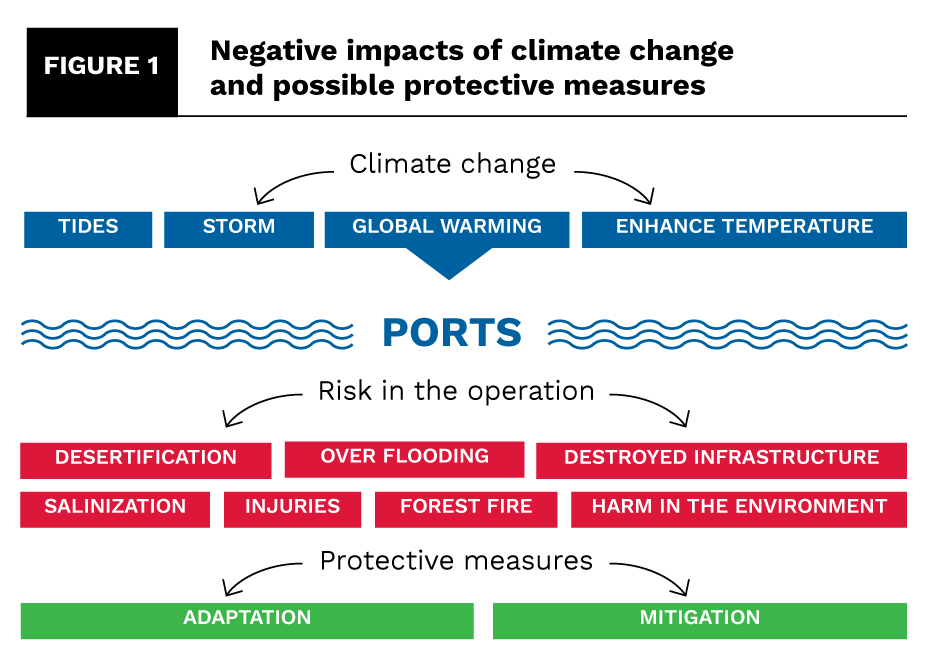
figure 1

figure 2

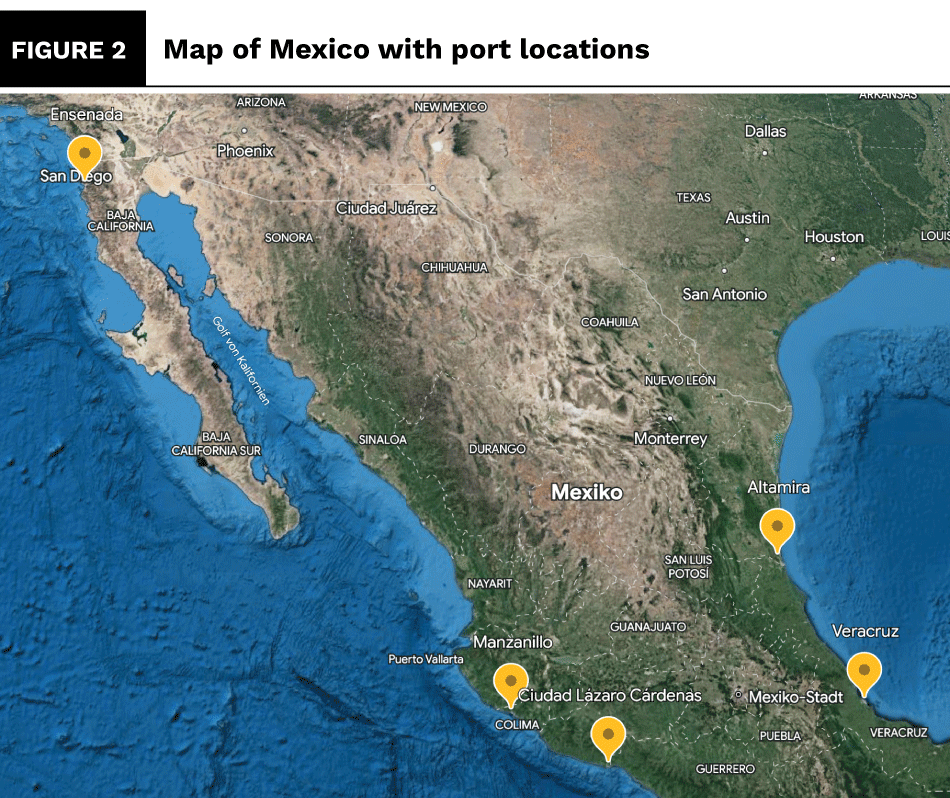
Mexican trade goods are diverse, and range from commodities carried in bulk to natural resources such as oil and, soon, liquefied gas, to containerised goods. The last of these represents the most significant stake. The five major container ports cover more than 90 per cent of the total volume of container handling. Therefore, I will use the following ports as representative locations for a Mexican vulnerability assessment (see figure 2): Manzanillo (3,069.07k twenty-foot equivalents), Lazaro Cárdenas (1,318.73k TEU), Veracruz (1,144.16k TEU), Altamira (877.4k TEU), and Ensenada (337.74k TEU) 1.

Historical Results

regional climate

As data for multiple ports appears to be incomplete for the period prior to 2000, the comparison is limited to the time frame from 2000 to the present. All locations suffer heavy disaster penetration with a frequency of reoccurrence of 1.045 natural disasters each year. Veracruz leads the annual disaster accumulation with a rate of 1.77. The state suffers from a high number of floods as well as storms, which are prone to triggering severe floods.

Next, there was medium risk of drought events and wildfires. Lazaro Cárdenas on the Mexican west coast mainly suffered from the non-climate-related hazard of earthquakes, followed by a high hazard of storms and floods. Freezing temperatures are last. The port and its state of Michoacan experience 0.68 disaster events annually on average.

Manzanillo and Altamira share the same penetration rate of disaster recurrence. Manzanillo is significantly prone to tropical storms and was hit by 13 such events. Second are earthquakes (resulting from the same conditions as Lazaro Cárdenas) on three occasions, and lastly are a flood, one volcanic eruption (due to ashes) and the same extreme freezing temperatures as Lazaro Cárdenas experienced.

We can observe a (partial) change of climate types in four of the five port locations. The tendencies all point towards a deepening of heat and drought, with fewer precipitation scenarios.

Natural disasters hit Manzanillo’s state, Colima, 0.86 times a year. On the other hand, Altamira experiences severe flooding events, as well as storms. Although to a lesser degree, Altamira is comparable to its southern neighbour Veracruz. The dominance of Veracruz might be owed to the greater territorial stretch along the coast of the state of Veracruz compared to the state of Tamaulipas. Beyond the high risk of storms and floods, Tamaulipas suffered from a drought and a wildfire disaster, indicating a medium risk for these events.

table 1

table 2

Ensenada experienced less than one disaster a year, with a tally of 0.682, and 16 events from 2000 to 2022. Storms represent the highest accumulation of disasters, with eight events. Medium risk also comes from floods (2), extremely low temperatures (2), earthquakes (1), one drought and one wildfire (see table 1).
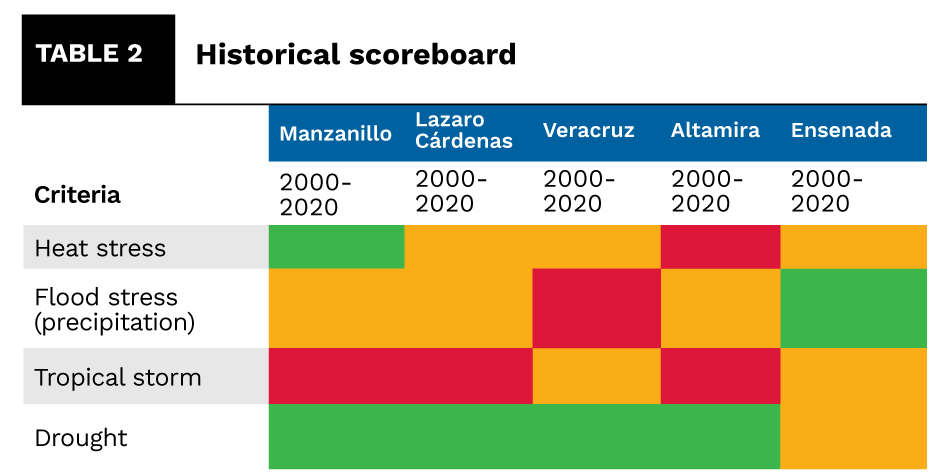
For operability with the linked climate-change-related hazards, historic exposure to hazards is summarised in a visualised table (see table 2).

The following part focuses on the change in climate conditions. Therefore, climate patterns that triggered the above disasters are considered, and their future development forecast is assessed.

Change in Regional Climate

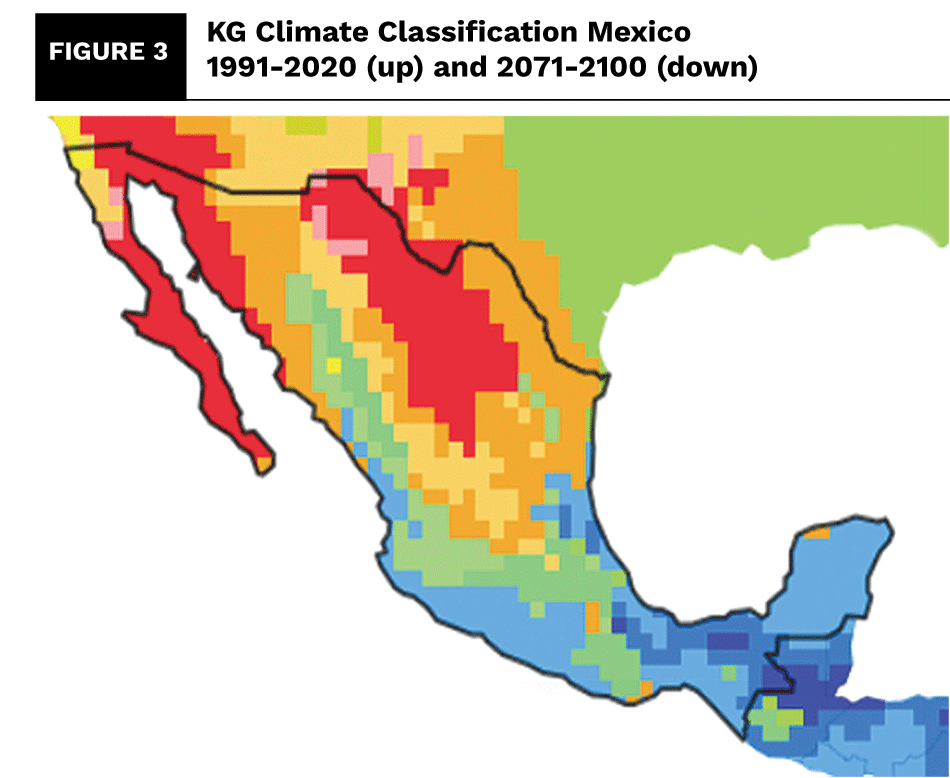
The general change in the different climate regions is assessed for the second pillar of risk analysis. The Köppen-Geiger Climate Classification System is applied. This was first developed by Wladimir Köppen in 1884 and revised in 1940 by climatologist Rudolf Geiger (see figure 3).figure 3

figure 3

First, the current climate zones for the relevant local regions are evaluated. This corresponds to the interval from 1991 to 2020, which is accessible at the climate change knowledge portal of the World Bank 2. The process is repeated in the same manner with an interval from 2071 to 2100, where data is extracted from a projection from Beck et al. (2018) 3. The underlying climate scenario is RCP8.5 (see table 3).

table 3

The city of Veracruz currently connects two climate zones: on the one hand, there is an equatorial monsoon climate with relatively warm temperatures with high precipitation and a short dry season and, on the other, there is a warm temperate climate of full humidity with a cool summer.

We can observe a (partial) change of climate types in four of the five port locations. The tendencies all point towards a deepening of heat and drought, with fewer precipitation scenarios. The most significant jump of change is shown by the area surrounding the port of Altamira in the state of Tamaulipas. Currently, the area is classified as equatorial savannah with dry winters. In the projections, the circumstances match the arid hot steppe, reflected by a climate too hot for forests and larger accumulations of trees to develop. From 2080 to 2100, the average temperature in the region will rise 3.3°C, with the highest maximum temperatures (mean) of approximately 38.17°C during June-August.

Altamira is already exposed to extreme heat, with a probability of extreme heat events occurring once in five years. Extreme heat is considered to be when the temperature exceeds body temperature. As the described maximum temperature during the summer will be above this 37°C, enduring annual extreme heat events are highly probable.

At present, the probability of drought events in Altamira is low, with a 1 per cent chance of a drought event in the next 10 years. Drought risk for the time frame of 2080-2100 under SSP7.0 is high. This will accelerate tree mortality, which enhances the adaptation process to the new climate type.

Manzanillo suggests a similar pattern at a slower pace. The area is also shifting from equatorial savannah with dry winters to an arid hot steppe. Temperature increases 2.75°C in 2080-2100, with an average temperature of 29.054°C, the highest value obtained in the mean data set. The maximum mean temperature is 35.55°C. Manzanillo has a medium EHE probability with a 25 per cent chance of occurrence during the next five years.

Still, climate change creates the potential for wildfires, which are already high in risk (> 50 per cent/year). This setting increases the general vulnerability against exogenous extreme weather events such as storms and earthquakes. A medium probability of river or coastal floods and a high probability of landslides are realities.

With the enduring heat and less precipitation, those will become imminent in the period under consideration.

The city of Veracruz currently connects two climate zones: on the one hand, there is an equatorial monsoon climate with relatively warm temperatures with high precipitation and a short dry season and, on the other, there is a warm temperate climate of full humidity with a cool summer.

The temperature rise is forecast to be +3.38°C, implying the most significant temperature rise in the sample. The attained mean temperature is predicted to stay comparably mild at 25.026°C. The same goes for maximum mean temperature, although this rises 3.75°C.

Nevertheless, EHEs are classified as medium, with an event at least once within the next five years. The risk will become high in 2100. The wet climatic constellation diminishes the exposure to droughts. River floods are highly improbable (with a probability of 1:1,000), whereas coastal floods are of medium risk, with a 20 per cent chance in the next 10 years. Research from Zúñiga and Magaña (2020) reports high extreme precipitation hazards of more than 200 mm daily 4.

Furthermore, they found a growing trend of extreme precipitation events since the 1990s. The increased precipitation and rising temperatures could put pressure on landslide probability as slopes are altered and bedrock stability erodes.

Ensenada experiences a relatively cold, dry climate (mean p.a. temperature is below 18°C). This changes by 2080-2100, mostly in temperature, as it develops relatively warm and dry weather with an average temperature above 18°C. Forests cannot grow, but it is wet enough to maintain grasslands. Although facing the coolest centigrade temperature of all its peers, with an annual mean of 20.86°C, EHE and bushland-fire hazards are high. The mean temperature rise will be 2.85°C over today’s average. Only flood hazard is relevant, as coastal floods and landslides are missing due to the altitude.

Lazaro Cárdenas is the only port whose region does not experience a change of climate, although the temperature for the full state rises sharply. Extreme heat events are still at medium risk and will continue to be so. Precipitation decreases, leading to a lower hazard of droughts and floods.

Lazaro Cárdenas does not experience much change in climate zones as the Pacific has a heavy influence on the climate of the region. The region is characterised by an Aw climate, which indicates an overall warm setting with a short dry season in winter. With a temperature increase of 2.97°C up to 28.052° and the highest average maximum temperature of 34.14°C (+3.24°C), the shift is quite notable. This data is also derived for inland Michoacan, which suggests a false lead. Putting focus only on Lazaro Cárdenas, EHE events are at a medium hazard level, with a possible occurrence of 25 per cent within the next five years. Wildfires, on the other hand, face high levels. Coastal and river floods appear with a medium probability, whereas landslides show a high likelihood.

Sea Level Rise

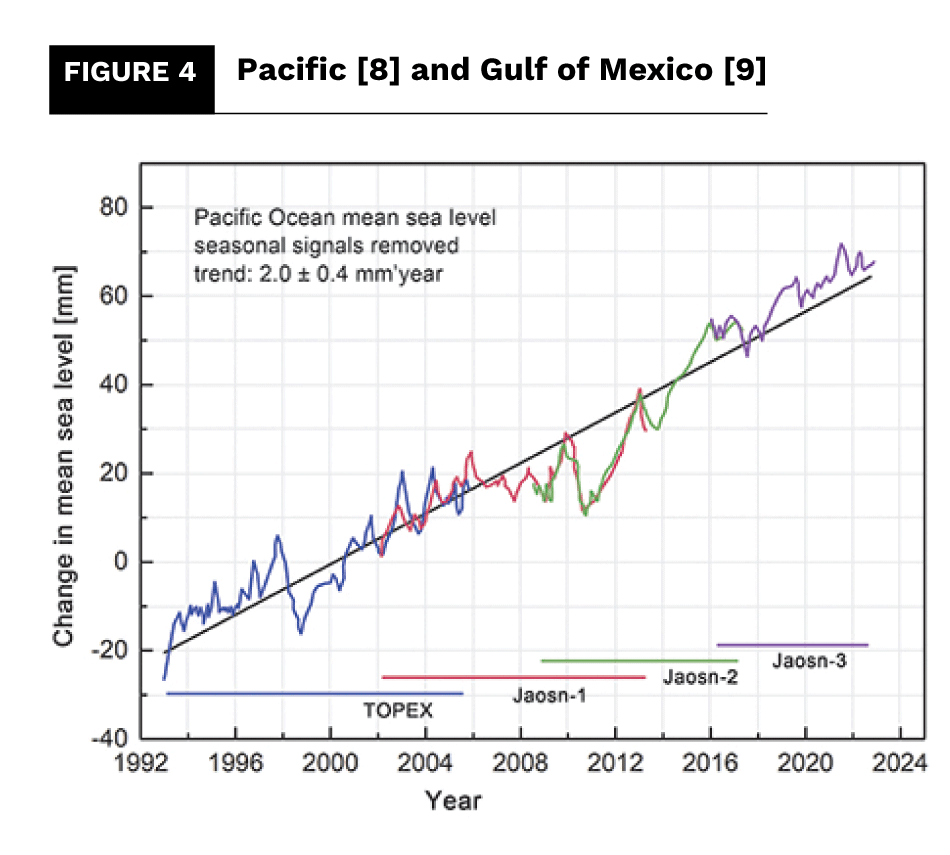
Sea level rise is globally set to rise 15 mm annually from 2100 onwards under RCP8.5 5. Direct numbers for the effect on Mexico are somewhat hard to calculate, although the Mexican government projects sea-level rise to affect all coastal states. However, some are hit harder than others 6 (see figure 4).figure 4figure 4-2The observed sea-level rise trend is 2.8 mm a year. Despite a significant dip in 2012, attributed to “cooler temperatures associated with a negative phase of the Pacific Decadal Oscillation”, the trend has increased over the last 30 years 7. The World Bank’s estimate for the underlying scenario in 2100 is an increase of 0.67 to 0.75 metres compared to 2000 levels (data).

figure 5

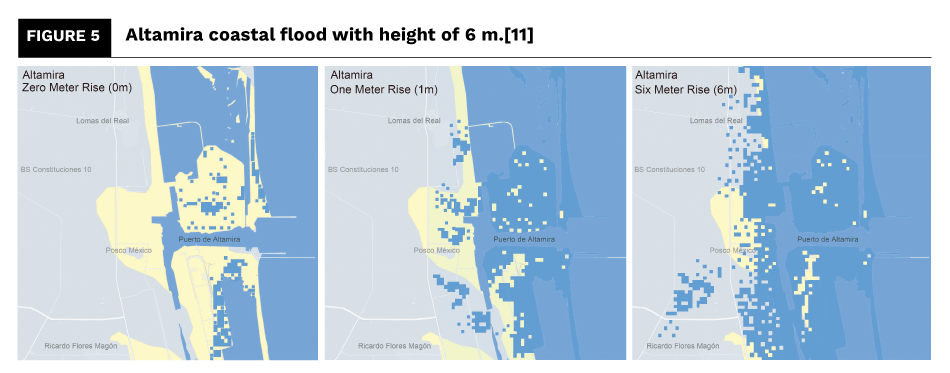
Sea-level rise is especially alarming for the port of Altamira, as its geographical environment is exceptionally prone to coastal flooding, as figure 5 shows.

Even though the port might be sufficiently elevated, on-and-off carriage from port sites might be impossible given a flooded transport system. World Bank estimates of the mean sea level in the Gulf of Mexico are 0.7 to 0.86 metres above 2000 levels (data).

Tropical Storms

Mexico is set geographically between mid and tropical latitudes and has to contend with long coastlines. The combination favours inter-tropical convergence during the tropical season. In both the Pacific and Atlantic Oceans, tropical storms follow a frequent annual pattern. The Pacific region experiences the yearly storm season from May to November. For the Gulf of Mexico, the storm season lasts from June to November.

figure 6In total, the NOAA has counted 798 tropical storms since 1842 that affected Mexican territory. Of these, 676 were solely tropical storms, 364 were hurricanes from categories one to three, and 48 were categories 4 to 5 (see figure 6).

As the two coasts experience different meteorological behaviours, they are treated separately. After the West Pacific, the north-east Pacific, which includes the Mexican west coast, leads in the annual frequency of tropical cyclones globally 8. In the period 1966 to 2015, 125 tropical storms were recorded in the north-west Pacific, 53 per cent being categorised as hurricanes 9.

Under the influence of climate change, tropical storms and associated natural hazards are expected to rise in severity. The annual accumulation of tropical cyclones is, on average, 8.8 and, for tropical storms, 7.4 10.

Even though tropical cyclones are unpredictable, science found patterns that indicate that large numbers of storms are migrating polewards. On average, this occurs at a pace of 50 km each decade for all tropical storms. In the past, they tended to terminate before the 30° line of latitude, as a result of the cold California current. This trend vanishes as water temperature and global tropical atmospheric circulation rise 10.

In terms of differing meteorological systems, the following part is separated into West and East Coast.

West Coast

west coast

Ensenada

As tropical storms move further north, the state of Baja California and port of Ensenada are projected to experience an increase in storm hits. These pose a hazard to the port facilities. In the last 180 years, only five storms have hit the port of Ensenada within a 60-nautical-mile radius. Only two tropical storms hit Ensenada directly.

Manzanillo

Disruptions in port activities are common due to tropical storms 11. Specifically, solely direct hits, where the storms approached the port directly, led to damage in the past. Of the 15 tropical storms recorded by NOAA in history, 11 are counted as direct hits [9]. The most threatened infrastructure is the PEMEX dock, while the container port is on the inside of the port and thus more protected. Manzanillo might experience more intense penetration from tropical storms in the future as these tend to move further north.

Lazaro Cárdenas

As Lazaro Cárdenas and Manzanillo are closely located, a difference is observable for exposure to tropical storms. Storms have hit the port 58 times since 1842 within a 60-nautical-mile radius, 15 of which were direct hits. Lazaro Cárdenas appears to be close to the epicentre of a multitude of East Pacific storms. The port consists of outer facilities directly exposed to the Pacific (PEMEX and Accelor Mittal Steel Terminals) and inner facilities that are more protected. The port might experience less penetration by tropical storms than in prior decades, although these tropical storms might become more extreme.

East Coast

veracruz

Veracruz and Altamira, located in the Gulf of Mexico, are exposed to hurricanes and tropical cyclones during the spring and summer months. Occurrences in the Gulf of Mexico often originate in the North Atlantic basin and are known for their catastrophic consequences. On average, a hurricane in the US causes US$10 billion worth of damage 12. Various studies found a clear trend of increasing intensities of tropical cyclones in the Atlantic basin that are linked to circumstances triggered by climate change 12. 13.

Veracruz

The port of Veracruz has a storm record of 31 storms since 1842. Three of those were direct hits. Port infrastructure is well protected against waves. Multiple piers were constructed to hinder waves from entering directly.

Altamira

Altamira is situated in a region prone to hits by tropical storms. There have been 64 tropical storms with 18 hurricanes within a 60-nautical-mile radius since 1984. Five of them were hurricanes of category three or higher. Twelve tropical storms were categorised as direct hits.

Change Results

manzanillo

With the help of climate zone analysis, according to Köppen-Geiger, it can be assumed that climate change has had such a substantial impact on the port regions under discussion that the climate categorisation has changed for four of the five regions. Through all changes, a pattern of decreases in precipitation and increases in temperature takes place. Altamira is characterised in the future by extreme heat in summer months, a sharp decline in precipitation, and a high probability of drought.

The port of Manzanillo follows a similar pattern at a lower speed. Manzanillo will experience a medium extreme heat threat in 2100, with an average temperature above 29°C. This leads to a medium drought and a high threat of wildfire. Flood hazards will decrease as a result of shrinking precipitation. This excludes coastal floods as sea-level rise appears on the Pacific side with 0.67 to 0.75 metres.

The biggest threat for Manzanillo is tropical storms, which are expected to continue to occur, but with increased severity. The levels of direct hits might decrease, as tropical storms tended to move polewards in the immediate past.

Lazaro Cárdenas is the only port whose region does not experience a change of climate, although the temperature for the full state rises sharply. Extreme heat events are still at medium risk and will continue to be so. Precipitation decreases, leading to a lower hazard of droughts and floods. Lazaro Cárdenas might experience increased impacts from tropical storms (high hazard) for the same reason.

Manzanillo might experience less impact, although rising sea levels will have a similar impact on the port. There is a high hazard of wildfires already, which will rise in the future (high).

Veracruz’s temperatures are rising the strongest in the data set, with an average of +3.38°C. The possibility of extreme heat events and wildfire hazard will be high in the future. Due to high precipitation levels, flooding is a major hazard and will be in the future (high). The hazard of tropical storms will rise, as tropical storms from the Atlantic basin are expected to rise in severity. Sea-level rise is stronger on the Gulf of Mexico side than on the Pacific side, with a maximum of +0.87 metres in 2100.

In the future, Altamira will be characterised by extreme heat in the summer months, a sharp decrease in precipitation, and a high probability of drought. Altamira has a comparable high hazard level of sea-level rise. Altamira’s region is heavily exposed to floods, which will pose a threat not only to the port but also to logistics. On- and off-cargo could be hindered for more extended periods. Although Altamira is prone to being hit by tropical storms, it will experience increases of direct hit impacts of hurricanes of category three and higher (high). Wildfire hazard is high.

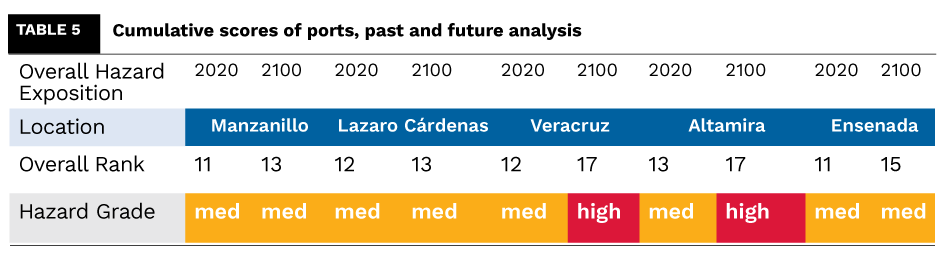
In 2100, the port of Ensenada in Baja California will face a high hazard level of extreme heat events. As the eco-zone is already dry, flood risk is low (excluding coastal floods). The sea-level rise hazard (medium) is the same as Manzanillo and Lazaro Cárdenas, with a 0.67 to 0.75 metre rise compared to the 2000 level. The tropical storm hazard is medium nowadays but will rise to high as the tendency to the poles emerges.table 4

table 5

table 6 reference

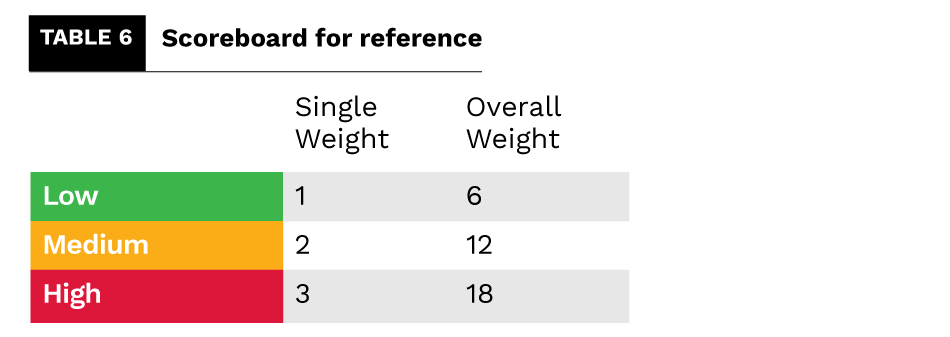
Due to arid temperatures and low precipitation, drought events will rise to high hazard levels. Wildfires are very likely and will continue throughout 2100. The indications align with the IPCC expectations of climate change impacts and imply a broader climatic change in Mexico and the Central American and southern North American area (see tables 4, 5 and 6).

Adaptation Outlook

adaptation outlook

The preceding crisis and hazard analysis identified ports’ vulnerabilities to extreme weather events (EWE). The risks should be understood, and the critical elements in the ports should be identified to protect and / or improve them. Successive to the vulnerability analysis, mitigation measures must be taken.

A framework could look like the list below:

  1. Based on the vulnerability assessment results, ports can develop a plan to address the identified risks. This plan should consider short- and long-term solutions, as well as the potential costs and benefits of each option.
  2. Implement structural (hard) and non-structural (soft) measures. Structural measures include things like building sea walls or reinforcing existing structures to protect against flooding and erosion. Non-structural measures include updating policies and procedures to better prepare for and respond to climate-related events.
  3. Engage with the community. Ports can work with local stakeholders, including businesses and residents, to identify and implement adaptation measures that will benefit the community as a whole.
  4. Consider the economic impacts. Adaptation measures can be expensive; thus, ports should carefully consider the costs and benefits of each option. In some cases, it may be more cost-effective to relocate certain assets or operations rather than try to protect them.
  5. Monitor and evaluate progress. Regularly monitoring and assessing the effectiveness of adaptation measures can help ports identify areas where additional action may be needed and areas where improvement is being made.

The authors would like to thank Mr Daniel Jahn, Trade Visitor Coordinator, International Affairs Department at the Hamburg Port Authority for the support of the seminar series for Climate Protection at the Leuphana University Lüneburg for many years

About the Authors

Nils

Nils Meier is an International Business Graduate from Leuphana University Lüneburg. In his studies, he put focus on the environmental facet of doing business. His particular interest in Latin American markets paired with experience in the shipping industry led him to specialise in climate scenarios for ports.

ambrosioRoberto Carlos Ambrosio-Lazaro is currently Research Professor with the Electronics Faculty at Meritorious Autonomous University of Puebla (BUAP). His research interests include the developing energy harvesting technology, conversion and storage for renewable sources such as vibrations, solar, and thermal; integration of semiconductor materials for the development of solar cells and sensors; in addition, signal conditioning circuits for sensors and automotive electronic systems.

AndresenMichael Palocz-Andresen is a full professor at BUAP Benemérita Universidad Autónoma de Puebla. From 2018 to 2021 he worked as a Herder professor supported by the DAAD at the TEC de Monterrey in Mexico. He became a full professor at the University West Hungary 2005-2017. Currently, he is a guest professor at the TU Budapest, the Leuphana University Lüneburg, and at the Shanghai Jiao Tong University. He is a Humboldt scientist and instructor of the SAE International in the USA.

References

  1. Statista (2020). Leading container ports in Mexico in 2019, by cargo throughput. Retrieved from https://www.statista.com/statistics/729985/mexico-container-ports-cargo-volume/
  2. The World Bank Group. (2022). Köppen-Geiger Climate Classification, 1991-2020. Retrieved 9 September 2022, from Climate change knowledge portal: Mexico: https://climateknowledgeportal.worldbank.org/country/mexico
  3. Beck, H., Zimmermann, N., McVicar, R., Vergopolan, N., Berg, A., & Wood, E. (2018). Present and future Köppen-Geiger climate classification maps at 1-km resolution. Scientific Data(5). doi:10.1038/sdata.2018.214
  4. Zúñiga, E., & Magaña, V. P. (2020). Effect of Urban Development in Risk of Floods in Veracruz, Mexico. Geosciences., 10(10), 402. doi:10.3390/geosciences10100402
  5. IPCC. (2019). Sea Level Rise and Implications for Low-Lying Islands, Coasts and Communities. In: IPCC Special Report on the Ocean and Cryosphere in a Changing Climate. Cambridge University Press. doi:10.1017/9781009157964.006
  6. Semarnat. (12 July 2019). PROGRAMA ESPECIAL DERIVADO DEL PLAN NACIONAL DE DESARROLLO 2019-2024. Retrieved from Secretaría de Medio Ambiente y Recursos Naturales: https://www.dof.gob.mx/nota_detalle.php?codigo=5565599&fecha=12/07/2019
  7. Lindsey, R. (22 April 2022). Climate Change: Global Sea Level. Retrieved from NOAA Climate.gov: https://www.climate.gov/news-features/understanding-climate/climate-change-global-sea-level
  8. Romero-Vadillo, E., Zaytsev, O., & Morales-Pérez, R. (2007). Tropical cyclone statistics in the northeastern Pacific. Atmósfera, 20(2), 197-213. Retrieved from https://www.researchgate.net/publication/26455651_Tropical_cyclone_statistics_in_the_Northeastern_Pacific
  9. NOAA. (19 December 2022). Historical Hurricane Tracks. Retrieved from NOAA Historical Hurricane Tracks: https://coast.noaa.gov/hurricanes/#map=6.37/18.898/-102.878&search=eyJzZWFyY2hTdHJpbmciOiJNYW56YW5pbGxvLCBDb2xpbWEsIE1leGlrbyIsInNlYXJjaFR5cGUiOiJnZW9jb2RlZCIsIm9zbUlEIjoiNTYwNjAwMiIsImNhdGVnb3JpZXMiOlsiSDUiLCJINCIsIkgzIiwiSDIiLCJIMSIsIlRTIiwiVEQiLCJFVCJd
  10. Studholme, J., Fedorov, A., & Gulev, S. (2022). Poleward expansion of tropical cyclone latitudes in warming climates. Nat. Geoscience 15, 14-28. doi:10.1038/s41561-021-00859-1
  11. Connell, R., Canevari, L., Coleby, C., Wright, S., Robertson, J. N., Morgan, W., & Stenek, V. (2015). Port of Manzanillo: Climate Risk Management. Retrieved from https://publications.iadb.org/en/port-manzanillo-climate-risk-management-final-report
  12. Appendini, C. M., Pedrozo-Acuña, A., Meza-Padilla, R., Torres-Freyermuth, A., Cerezo-Mota, R., López-González, J., & Ruiz-Salcines, P. (2017). On the role of climate change on wind waves generated by tropical cyclones in the Gulf of Mexico. Coastal Engineering Journal. doi:10.1142/S0578563417400010
  13. Holland, G., & Bruyère, C. (2014). Recent intense hurricane response to global climate change. Climate Dynamics, pages. 617-27. doi:10.1007/s00382-013-1713-0

The Efforts of the West to Tackle the Sustainability Issue are Like Polishing the Floors on the Titanic

Interview with Sasja Beslik, Chief Investment Officer at SDG Impact Japan

Evaluation of a company’s performance in the sphere of ESG is particularly complicated when it comes to those operating in the finance industry. As Sasja Beslik of SDG Impact Japan explains, what’s needed is a framework on which to base assessments, so that investors have a clear view of exactly what they are investing in.

Sasja Beslik is a prominent figure and a pioneer known for promoting financial sustainability across the world. He left his role (after only six months) as head of sustainability at Danish pension fund PFA to join Japanese sustainable finance platform SDG Impact Japan (SIJ).

Sasja, who left his role as head of sustainable business development at Bank J. Safra Sarasin in September to join PFA, previously held a number of senior sustainability roles, including head of sustainable finance at Nordea Wealth Management, and head of stewardship and engagement at ABN Amro. 

Sasja Beslik is the co-author of Where the Money Tree Grows (2021), and the author of the weekly newsletter “ESG on a Sunday”.

It’s a pleasure to speak with you again, Mr Beslik! Can we start this off by asking what ESG means to you personally, and then also within the context of SDG Impact Japan?

Environmental, social, and governance issues (ESG) is an additive to fundamental financial theory on how to evaluate companies. For me personally, it is an evolution of the existing financial system, in the way that you assess companies not only on the basis of financial returns and financial figures, but you actually assess companies on the basis of additional financial figures, which are related to how these companies manage ESG issues which are relevant for their business. For me, ESG is an evolutionary approach to financial investments.


Making the transition from Danish pensions to Japanese SMEs is an interesting career choice. What made you pursue an active role in this industry?

I  was advising Danish pensions for a short period of time on how to best develop sustainable lifecycle products in accordance with the European SFDR regulations. The reason I took this decision is that I have been working in this industry for a very long time. I think Japan represents a great opportunity especially for sustainable ESG investments, because many Japanese listed companies are undervalued from both financial and ESG perspectives. I think there is a great opportunity to unlock the value in such a large market as Japan.

I have visited Japan and have been investing in emerging markets, including Asia, and I think there are many ways you can provide a new benchmark for a new ESG investment approach, which I think is what we are trying to do right now. There are a lot of opportunities in Japan and, for me, it was almost like a natural step from doing this after 23+ years in Europe, so I wanted to try to do it outside the European context.

You’ve mentioned before how Japan was an opportunity you “simply did not want to miss”. What particular aspects of the Japanese market – especially in relation to ESG – appealed to you?

Many of the companies that we are investing in today are really solid companies, with good potential to grow from both a financial perspective and also from ESG perspectives.

The particular aspects are the quality of the market, that Japanese companies are really outstanding from a quality perspective. Many of the companies that we are investing in today are really solid companies, with good potential to grow from both a financial perspective and also from ESG perspectives. So, when looking at the Japanese market, it was clear to me that there’s quality in a mid-cap segment where generally is overlooked by investors. That’s where the growth will happen and that is exactly what I am looking for. 

Do you see this as a fiduciary duty or a moral duty?

It is actually both. It doesn’t have to be “either … or”; it is fiduciary for investors to take it into account, but also it is a moral obligation to invest in the long term, not just for us, but also for other generations as well. It is a combination of things, and I think people sometimes try to see it as one or the other, and it is not; it is actually both.

What strategies did you adopt in propelling the Asian region to a sustainable transition?

First, Asia is a region where more can be done, especially on improving the disclosure of how these companies are managing key environmental, social, and governance issues. Improving their disclosure would enable companies to get better scores and reach investors globally.

The second thing is that, of course, the Asian region is big. If you compare Japan with any other country, it is a vast economy with an extremely well-established global presence. If you ask me in this context how to separate Japan from the rest of the Asian region, I see Japan more as leading from the ESG perspective.

How does SDG Impact Japan help support your ESG goals now? How can they be a partner to the leaders who are trying to make ESG initiatives a focus for the organisation?

SDG Impact Japan is the first Japanese sustainable finance platform, and we believe that we are currently building a next-generation ESG approach. Additionally, there are a number of venture funds that SIJ has partnership with that are specifically investing in companies as part of the solution going forward. So, from this perspective, I think SIJ plays a particular role in not only framing the debate, but also helping Japanese companies to tap into the global capital pool, and I think that is interesting.

What type of ESG risks and gaps are you debating internally that aren’t always in the mainstream news and how are you integrating cognitive diversity across the organisation and into the investment process?

One of the things we are very cautious about and have some debate about is the fact that there is a lot of greenwashing in our industry. We want to provide solutions to our clients that are really thorough from an ESG perspective, so we spent a lot of time analysing companies and trying to understand where the opportunities are.

The ESG industry is under attack from greenwashing, especially in Europe, because it has been taken over by the marketing departments. Now the regulators in Europe are trying to sort this by introducing new legislation and regulation. This is one of the areas where we really want to be certain that we are delivering what we say. 

Mr Beslik, you have previously held a number of senior sustainability roles. What is the greatest misconception about sustainability you wish more people were aware of?

Sustainability is a complex word; it takes a lot of work. It is not a check box exercise. You need to spend a lot of time and resources, and it needs a very close engagement with the companies in order to make any difference.

The biggest misconception is that simply adding some elements of climate and social issues into an investment strategy doesn’t make it sustainable, and people need to understand that.

You believe that the finance industry is the key to transformation to a sustainable future. The financial industry can move the capital from where it is regarded as not sustainable toward where it is sustainable. The problem is that the finance industry is not truly working in this direction yet. Do you see some evolution or real progression towards this goal in recent years? You have often said that there is a great deal of talking but that we need to “look at the results!”.

I am a very results-focused person when I am writing and when I am talking. So far, I believe that the financial industry hasn’t been able to show results, and this is the biggest problem for the industry. If you buy an electric car, you know what you are buying, but when you buy sustainable funds, you don’t usually understand what it is, because these are processes.

I believe that the financial industry hasn’t been able to show results, and this is the biggest problem for the industry.

So the thing is that the industry needs to be much better at showing what we are actually achieving. Just to give a practical example, let’s say you have a family in Europe that is buying an electric vehicle, recycling, and doing all of the other things. However, at the same time, their pension money is invested in a completely different direction on a global scheme, so that the effect of what they are trying to do is net zero.

The financial industry needs to disclose where the investors’ capital is being deployed. Disclosure has started to improve, but I think financial regulation will increase, because the regulators, both in Japan and in Europe, and even in the US, are understanding that huge capital that is invested in this way has to actually show results. Otherwise, it is just a marketing thing; it is not real.

Indeed, you have also compared the efforts the West is making to tackle the sustainability issue to polishing the floors on the Titanic.

Yes, I did. We need to evolve our current economic model, market economy. ESG is part of that process.

There is a gap between those who work with ESG and those who handle the money. That’s the bridge we need to build, and relocating capital is key. Can you develop this idea or provide an example of a strategy to accomplish this goal?

The people who work on ESG are people that should also handle the money. However, this goes back to the education system, the universities that are educating the future financial analysts and economists are still not equipped to actually introduce a proper ESG curriculum.

One of the biggest problems that we have is that there is separate teams: the team that manages ESG, and the people who invest money. The key to finding this bridge is actually to integrate the knowledge on both sides in establishing a way to actually assess companies. In fact, this is happening in some places but, in general, you will always have the big players around the world that have separate teams. As for our approach, analysts, portfolio managers, and researchers work as one team, so that we can achieve a better understanding of what we actually are investing in and this is very important.

The Bosnian War broke out in 1992, when you were 18 years old. During the year that followed, you spent months sleeping in city parks and you were almost executed during your escape from war-torn central Bosnia. These experiences have surely had a real impact on your personal growth. Did they inspire your journey and career?

Yes, it has shaped me a lot as a person, because when you experience this, you understand the importance of life. I feel I have been given a second chance, because I was supposed to be executed, but I wasn’t. Now, I want to use my time, the rest of my life on this planet, to do something I truly believe in. So, ESG is not a job for me, it is what I do because I think it is the right thing to do. It has shaped my personality a lot, from the perspective that I like to see results.

I spent years visiting companies around the world on the ground. I was one of the few analysts and investors on the ESG side, visiting countries in Africa, Asia and South America. I visited factories, facilities, car producers, gold mines, copper mines, nickel mines, and oil rigs to see what was really happening around the globe, rather than simply being told a nice story. This has shaped me a lot.

This article was originally published on 5 August 2022

Executive Profile

Sasja Beslik

Sasja Beslik is an international financial expert known for promoting financial sustainability across the world. Prior to joining SDG Impact Japan, he was responsible for sustainable investment strategy for J. Safra Sarasin, and Danish pension fund. He was head of responsible investments and corporate governance in Nordea bank from 2009. He was honored as a Young Global Leader at the World Economic Forum (2011) and served on various boards and global committees.

Investing in Innovation: A UAE Resident’s Guide to Buying Apple Stock

UAE

Welcome to the world of investing in innovation! You’re in the right place if you’re a UAE resident eyeing the tech giant Apple Inc. Apple, a global leader in technology, has been a game-changer with its wide range of products and services. 

This article will guide you through the ins and outs of investing in Apple stock, from understanding the company’s business structure to choosing the right broker in the UAE.

So, buckle up and prepare to embark on your investment journey with Apple.

Understanding Apple’s Business Structure

Understanding Apple’s business structure is essential when making an investment decision. The company operates across multiple segments: iPhone, Mac, iPad, Wearables, Home and Accessories, and Services. Each segment contributes differently to Apple’s overall revenue, with the iPhone being the main driver.

The structure of Apple’s business directly affects its stock performance. For example, releasing a new iPhone model often leads to a company stock price surge. However, it’s important to note that Apple’s performance is not solely reliant on product sales. The Services segment, which includes iCloud, Apple Music, and the App Store, has been steadily growing and has become an increasingly significant source of revenue.

Apple’s Global Exposure

Apple is a global behemoth, raking in large sums of money from markets worldwide. Europe, China, Japan, and the Asia Pacific contribute significantly to Apple’s revenue. This vast international presence makes the company susceptible to fluctuations in foreign exchange rates. Therefore, investors based in UAE have a crucial role to play in monitoring currency trends.

To illustrate, if the US dollar gains strength against other currencies, Apple’s international revenue may decline once converted back into dollars. Such a development would undoubtedly impact Apple’s financial performance and stock price.

The Role of Outsourcing in Apple’s Profit Margins

Apple maximizes its profits by outsourcing production to countries with lower labor costs. This strategic decision helps keep their expenses low and profit margins high.

However, outsourcing comes with inherent risks. Supply chain disruptions, whether due to natural disasters or political tensions, can impact Apple’s ability to meet product delivery deadlines. These challenges should be taken into account by UAE investors considering Apple stock investments. A supply chain disruption could temporarily affect the company’s stock price, creating both risks and potential buying opportunities.

Apple’s Capital Structure

In terms of financial management, Apple follows a conservative approach. The company maintains a low debt-to-equity ratio, prioritizing shareholder funds over borrowed money for operational financing. By adopting this conservative capital structure, Apple attracts investors who seek reduced financial risk associated with high debt levels.

Apple’s robust financial health is further evident in its net cash position. With significant cash reserves and marketable securities on its balance sheet, the company enjoys financial flexibility for investments in new projects, acquisitions, and returning capital to its shareholders through dividends and share buybacks.

Investing in Apple Stock

Before diving into Apple stock, selecting a broker is crucial. The UAE has a range of trading platforms with different features, fees, and customer service levels.

Here are some factors worth considering during the selection process:

  • Fees: Be aware of diverse fees such as commission, account maintenance, and withdrawal fees. Understanding these charges in advance will prevent any unforeseen surprises later on.
  • Customer Service: Efficient and helpful customer service greatly enhances your investing experience. Seek out brokers that provide responsive and supportive assistance.
  • Platform Usability: The broker’s trading platform should be user-friendly and equipped with all the necessary tools and features for stock trading and research.

Once you have made your broker choice, you are ready to invest in Apple stocks. Let us now guide you step by step through the process:

First, set up a brokerage account by providing personal information and completing verification steps.

Once your account is set up, you’ll need to fund it. This can be done through bank transfers, credit cards, or debit cards.

Next, access your broker’s trading platform and search for Apple stock using their ticker symbol, AAPL.

After identifying the desired stock, place your trade. Decide on the number of shares you wish to purchase and either buy at the current market price or set a limit order for a specific price.

Conclusion

Investing in Apple stock can be exciting. The company’s innovative spirit, global presence, and strong financial health make it an attractive investment option. Like any investment, buying Apple stocks comes with its own set of risks.

But don’t let these risks deter you. Instead, use them as a reminder to stay informed and vigilant. Keep an eye on Apple’s latest product launches, quarterly earnings reports, and any news that could impact the company’s stock price. Investing is about more than just making quick profits. It’s about participation in growth.

So, are you ready to take a bite out of Apple? If you’ve done your homework and feel confident about your decision, make your move. But remember, the investing world is constantly evolving, so always continue learning and staying updated on market trends.

Happy investing!

EDITOR'S PICK OF THE WEEK

CFO's new mandate. CFO explaining the presentation

The Performance and Transformation Orchestrator: The CFO’s New Mandate in the Age of AI

By Terence Tse CFOs are evolving into AI-driven transformation orchestrators, balancing finance, technology, and strategy while upskilling teams, managing risks, and driving measurable business value. A key insight from this year’s AI for CFOs event, organized...

WISE DECISION MAKER GUIDE

POWER INFLUENCERS

Emerging Trends

The Future of Global Trade