In the dazzling universe of kingbilly nz, where skill and strategy often share the spotlight, a realm exists where luck reigns supreme. These games captivate us with their compelling uncertainty, where the next moment could bring euphoric triumph or humbling defeat. In this article, we delve into luck-based casino games – those delightful concoctions of chance that keep gamblers on the edge of their seats, hearts racing with every spin, shuffle, and draw.
Roulette: The Wheel of Destiny
Roulette stands as the embodiment of casino elegance and excitement. The iconic red and black wheel spins like a hypnotic dance, inviting players to place their bets on numbers, colors, or combinations. The clatter of the ball as it circles the wheel is a symphony of hope, with each revolution bringing the thrill of anticipation. From the classic European roulette to the double-zero American version, the choices are as varied as the outcomes. Whether a straight bet’s boldness or an even-money wager’s prudence, roulette offers a thrilling brush with fate that no casino enthusiast can resist.
Slot Machines: Dance of Symbols
The hypnotic allure of slot machines lies in their sheer variety and simplicity. With themes ranging from ancient myths to blockbuster movies, these games beckon players with their flashing lights and mesmerizing sounds. The thrill begins with the pull of a lever or the press of a button as the reels spin and symbols align. With every spin, the promise of a life-changing jackpot looms, and players are caught in a suspenseful dance of symbols that can turn anyone into an instant millionaire.
Craps: Dice and Destiny
Available at top Bitcoin casinos, Craps is the epitome of camaraderie and excitement in the casino world. Gathered around the craps table, players unite in anticipation of the dice roll. Bets are placed on myriad outcomes, making every roll a spectacle of suspense. The cheers and groans of the crowd mirror the erratic nature of luck, and the excitement reaches a crescendo with every dice throw. With its vibrant atmosphere and many betting options, craps is a game where fortune favors the bold.
Baccarat: Elegance and Chance
Baccarat, a game of sophistication and style, brings luck to the forefront of the casino floor. With its simple rules and aura of refinement, baccarat appeals to seasoned players and newcomers. Players place bets on the player’s hand, the banker’s hand, or a tie, and the cards are dealt with an air of suspense that holds everyone in its thrall. The game’s elegance is matched only by the thrill of seeing destiny unfold with every turn of the card.
Keno: The Lottery Experience
Keno offers a unique blend of lottery-style excitement and casino ambiance. Players select a set of numbers, and the anticipation builds as the balls are drawn. Matching numbers light up the board, and the exhilaration of a winning combination is second to none. With its relaxed pace and potential for substantial wins, keno offers a different thrill for those seeking a pure luck-based experience.
Tips for Riding the Waves of Luck
Set a Budget:Luck-based games are exhilarating, but it’s essential to set a budget and stick to it. Only play with what you can afford to lose.
Embrace Variety: Explore different luck-based games to find the one that resonates with you. Each game has its unique charm and excitement. Besides traditional luck-based games reviewed above, there are many exciting options to explore from Aviator Spiel to plinko.
Manage Emotions: Winning and losing is part of the casino experience. Stay level-headed and avoid chasing losses.
Know the Odds: Understand the odds of each game to make informed decisions about your bets. That can help improve winning chances at a casino game.
Enjoy the Ride: While luck is the driving force, remember that casino games are meant to be entertaining. Enjoy the thrill and excitement of each game, regardless of the outcome.
Conclusion
Luck-based casino games offer an enchanting blend of suspense, anticipation, and the irresistible allure of chance. As the wheel spins, the dice roll, and symbols align, players surrender to the whims of fate, seeking that electrifying rush of a monumental win. In a world where uncertainty is the only constant, these games remind us of the exhilarating dance we share with destiny whenever we step into the captivating realm of the casino floor. So, roll the dice, place your bets, and may fortune favor the bold as you embark on a thrilling journey through luck-based casino games.
In the vast landscape of online casinos, finding a trusted and reputable establishment is akin to striking gold. The allure of entertainment, excitement, and potential winnings draws countless players, making it essential to sift through the sea of options and choose a casino that promises a thrilling experience and ensures your safety and security. In this guide, we’ll walk you through the main factors to consider when selecting a gambling house you can trust, enabling you to embark on your gambling journey with peace of mind.
Licensing and Regulation: The Foundation of Trust
A reputable casino like Razor Returns operates under a valid and recognized license issued by a reputable regulatory authority. Before depositing your funds, ensure the casino proudly displays its licensing information on its website. Organizations like the UK Gambling Commission, Malta Gaming Authority, and Curacao are well-known and respected within the industry, indicating that the casino operates within a framework of fairness and accountability.
Secure Transactions and Data Protection
Your financial and personal information should be treated with the utmost care and confidentiality. Trusted Bitcoin casinos employ advanced encryption technology, such as SSL encryption, to safeguard your data during transactions. Look for the padlock symbol in the website’s address bar, which indicates a secure connection. Additionally, casinos with a transparent privacy policy demonstrate their commitment to protecting your information.
Game Selection and Software Providers
A diverse and high-quality game selection is a hallmark of a trusted casino. Reputable casinos partner with renowned software providers such as Microgaming, NetEnt, and Playtech to offer various games, including table games, slots, and jogar Aviator. A vast game library enhances your entertainment and signals the casino’s dedication to providing a top-notch gaming experience.
Fairness and Randomness
Fair play is a non-negotiable aspect of trustworthy casinos. To ensure the randomness and fairness of games, trusted casinos utilize Random Number Generators (RNGs), guaranteeing unbiased outcomes. Look for casinos that display the eCOGRA seal, an independent testing agency that certifies the fairness and integrity of casino games.
Customer Support and Transparency
Responsive and reliable customer support is a clear indicator of a reputable casino. Trusted establishments offer multiple communication channels, such as email, phone support, and live chat, to promptly address your queries and concerns. Additionally, transparent terms and conditions, including clear information about bonuses, withdrawal policies, and wagering requirements, showcase the casino’s commitment to open communication.
Positive Reputation and Reviews
Before committing to a casino, conduct thorough research by reading player reviews and testimonials. Forums and review websites offer insights into real players’ experiences, shedding light on the casino’s strengths and potential drawbacks. A gambling hub with a solid reputation among players will likely provide a safe and enjoyable environment.
Responsible Gambling Practices
A trusted casino takes responsible gambling seriously. Look for casinos that offer tools for self-exclusion, deposit limits, and reality checks to ensure you can gamble within your means. Moreover, partnerships with organizations like GamCare and Gamblers Anonymous indicate the casino’s dedication to promoting responsible gaming.
Mobile Compatibility and User Experience
In today’s digital age, a trusted casino should offer a seamless and user-friendly mobile experience. Whether through a dedicated app or a responsive website design, the casino’s platform should be accessible and easy to navigate on various devices. A well-designed and intuitive interface enhances your overall enjoyment.
Bonuses and Promotions with Integrity
While enticing bonuses and promotions are common in the casino industry, trusted establishments offer them transparency and integrity. Be cautious of overly generous offers that seem too good to be true, as they might come with unrealistic wagering requirements or hidden terms. A trusted casino provides reasonable and clearly explained bonus terms.
Conclusion
Selecting a trusted casino ensures a safe and enjoyable gambling experience. You can confidently embark on your gambling journey by considering security, licensing, game selection, fairness, customer support, reputation, responsible gaming practices, mobile compatibility, and transparent bonuses. Remember, a trusted casino offers entertainment and excitement and prioritizes your well-being and satisfaction. So, armed with this guide, roll the dice and revel in a world of secure and rewarding gaming.
In the high-stakes Wunderino Online Casino world, knowledge is power, and learning from those who have honed their skills over years of experience can make all the difference. In this article, we’re delving into the minds of gambling pros to unveil exclusive tips and insights that can elevate your game and potentially lead to a more rewarding and successful gambling journey. From strategic gameplay to mental fortitude, these expert strategies are your key to confidently rolling the dice.
1. Master the Art of Bankroll Management
The first rule of successful gambling, as emphasized by the pros, is effective bankroll management. Treat your gambling funds as an investment in entertainment, and allocate a specific amount you’re comfortable with losing. Seasoned gamblers recommend dividing your bankroll into smaller sessions to avoid overspending in the heat of the moment. By sticking to your budget, you’ll ensure that your gaming remains enjoyable without impacting your financial well-being.
2. Embrace Strategic Gameplay
Casino pros stress the importance of strategy in maximizing your chances of success. Understanding the odds and employing well-researched strategies can significantly improve your outcomes, whether at the poker table or spinning the roulette wheel. Take the time to learn the ins and outs of your chosen game, find a trusted site like aviator casino, and practice your skills before putting your money on the line.
3. Cultivate a Winning Mindset
Gambling veterans believe a winning mindset is just as essential as skillful gameplay. The ability to always stay calm under pressure, make rational decisions, and manage emotions sets the pros apart. It’s crucial to accept that losses are a part of the gambling journey. Instead of dwelling on setbacks, focus on the long-term and the bigger picture. This mindset shift can help you stay grounded and make informed decisions even during challenging moments.
4. Know When to Walk Away
Experienced gamblers understand the importance of knowing when to call it a day. Setting win-and-loss limits can prevent you from getting caught up in the excitement and making impulsive decisions. If you’ve hit your predetermined win or loss limit, have the discipline to walk away. This strategy protects your bankroll and ensures that you leave the casino with a sense of control.
5. Study Your Opponents
Observing and analyzing your adversaries is a hallmark of pro-level gameplay for games involving opponents, such as poker. Seasoned poker players pay close attention to betting patterns, body language, and other cues that reveal information about their opponents’ hands. By studying your rivals, you can make more informed decisions and potentially outwit them through strategic plays.
6. Utilize Bonuses and Promotions Wisely
Gambling pros are skilled at taking advantage of Bitcoin casino bonuses and promotions to maximize their value. These incentives can provide extra playing funds or other perks, from sign-up bonuses to loyalty programs. However, it’s crucial to read the terms and conditions carefully and avoid chasing bonuses if they lead you to play beyond your means.
7. Continuous Learning and Adaptation
The gambling landscape is ever-evolving, and the most successful players embrace change and continue to learn. Pros recommend staying updated on new game variations, emerging trends, and innovative strategies. The ability to adapt your gameplay based on new information can give you a competitive edge and keep your gambling experience fresh and exciting.
Conclusion
Exclusive tips from gambling pros offer a unique insight into successful gambling. By mastering bankroll management, implementing strategic gameplay, and committing to continuous learning, you can elevate your gambling experience and increase your chances of success. Remember, gambling should always be approached with responsibility, and while these tips can enhance your gameplay, the thrill lies in enjoying the experience while staying within your limits. So, armed with these expert strategies, roll the dice and let the journey to gambling success begin!
However paradoxical it may sound, Online Casino games, often associated with entertainment and chance, offer more than meets the eye. Beyond the thrill of the spin and the shuffle, engaging in them can sharpen various skills that extend far beyond the gaming table. This article delves into the unexpected skills you can develop through casino entertainment and how it can contribute to your overall cognitive and emotional growth.
Strategic Thinking: The Art of Calculated Risks
Casino games require more than luck. They demand strategic thinking and calculated risk-taking. Whether you’re playing blackjack, poker, or microgaming jackpot slots, your decisions are informed by odds and potential outcomes. Analyzing the game’s mechanics, assessing probabilities, and devising tactics to increase your chances of winning all contribute to honing your strategic thinking abilities.
Quick Decision-Making: Thriving in Fast-Paced Environments
The fast-paced nature of top Bitcoin casinos forces players to make quick decisions under pressure. Whether deciding to hit or stand in blackjack or placing a bet in a matter of seconds, your ability to think on your feet improves with each game. This skill extends beyond the gaming floor, enhancing your capacity to make efficient choices in various real-life situations.
Emotional Regulation: Keeping a Cool Head
Casino games can be emotionally charged, with wins and losses evoking powerful feelings. Learning to regulate your emotions during gameplay is a skill that has broader implications. Keeping a level head when faced with victories or defeats can help you navigate stressful situations outside the casino, fostering emotional resilience and improving your overall well-being.
Mathematics Mastery: Calculations at Your Fingertips
Gambling often involves calculations, whether you’re tallying card values in blackjack or estimating the odds of landing on a specific number in roulette. Regular engagement with these calculations can sharpen your mathematical skills, making you more comfortable with numbers and arithmetic daily.
Observation Skills: Reading Players and Patterns
Reading opponents’ body language and expressions is key to success in games like poker. Sharpening your observation skills in a casino setting enhances your ability to interpret nonverbal cues in other contexts, such as business negotiations or social interactions.
Money Management: Smart Financial Choices
Effective bankroll management is crucial in gambling to ensure you don’t deplete your funds prematurely. This skill translates directly to real-world financial decisions, helping you budget, save, and invest wisely.
Risk Assessment: Weighing Pros and Cons
Casino games inherently involve a risk assessment. Analyzing potential gains against potential losses becomes second nature, equipping you with a valuable skill for evaluating risks in various aspects of life, from career choices to personal relationships.
Focus and Concentration: Immersing Yourself in the Moment
The intense focus required during gambling can improve your concentration skills. Learning to block out distractions and stay engaged translates to better productivity in your daily tasks.
Pattern Recognition: Unveiling Hidden Trends
Many casino games involve identifying patterns and trends, such as tracking winning numbers in roulette. This skill has applications in data analysis, problem-solving, and strategic planning.
Social Interaction: Building Connections
Casino games often occur in a social setting, providing opportunities to interact with other individuals. Developing your social skills can enhance your ability to network, collaborate, and build meaningful relationships.
Conclusion
Casino games offer more than mere entertainment; they serve as a playground for skill development. Engaging in strategic thinking, honing quick decision-making, and improving social interactions are all valuable skills you can acquire through gameplay. Embrace the unexpected benefits of casino games, and you’ll find that your experiences at the gaming table contribute to your growth and proficiency in various aspects of life.
Gambling, when approached with discipline and awareness, can offer entertainment and even occasional monetary gain.
However, the allure of potential winnings often overshadows the inherent risks associated with this activity. To enjoy the thrill of the game without compromising financial security, it’s essential to establish a firm monthly gambling budget.
Understanding the Risks
Gambling, at its core, is a game of chance. While strategies can sometimes influence the outcome, unpredictability remains a defining characteristic. Recognizing the inherent risks enables players to make informed decisions, ensuring that fun doesn’t transition into financial hardship.
Financial Implications
Even seasoned gamblers face losing streaks, and without a well-defined budget, it’s easy to get caught in the downward spiral of trying to recover lost funds. Without safeguards, today’s leisure activity could become tomorrow’s financial catastrophe.
Uncontrolled Spending: The thrill of the game can often blind players to the cumulative amount they’re spending, leading to significant monetary losses.
Decreased Savings: Instead of growing a nest egg for future needs, unrestricted gambling can erode one’s financial future.
Potential Addiction: Beyond the financial consequences, unchecked gambling can growinto a compulsive behavior, deeply affecting an individual’s personal and social life.
Emotional and Psychological Impacts
The emotional toll of gambling is frequently underestimated. The highs of wins and the lows of losses can generate a rollercoaster of emotions, influencing mental well-being.
Stress and Anxiety: The pressure to win back lost money can create an overwhelming sense of anxiety and pressure.
Relationship Strains: Financial instability and secretive behavior related to gambling can drive wedges between family members and friends.
Decreased Self-worth: Continual losses can lead individuals to question their decisions, creating a negative feedback loop that affects their self-perception.
Benefits of a Monthly Budget
Budgeting is not just about limiting expenses; it’s about taking control. A structured approach to gambling expenditures ensures that the excitement of the game doesn’t jeopardize financial well-being.
Financial Control
Knowing where every dollar goes offers a sense of control and empowerment. When it comes to gambling, this control translates to a more enjoyable experience, free from the lurking fear of potential financial ruin.
Limiting Losses: By predetermining the amount to be spent, players can enjoy the game without the cloud of unforeseen expenses hanging over them.
Encouraging Discipline: An established budget becomes a rulebook, setting clear guidelines and preventing impulsive decisions driven by the heat of the moment.
Enhanced Savings: Preserving one’s financial future is as important as enjoying the present. Budgeting ensures that entertainment doesn’t come at the expense of financial growth.
Mental Well-being
Beyond the financial implications, having a budget can significantly enhance the psychological aspects of gambling. It sets a foundation of responsibility and awareness, allowing players to engage in the activity with clarity and peace of mind.
Reduced Anxiety: Predefined limits ensure that losses, if they occur, are within manageable boundaries, mitigating the potential for post-game stress.
Increased Enjoyment: When players know they’re operating within their means, they can focus on the thrill of the game rather than potential repercussions.
Clearer Decision Making: Emotional betting, driven by the urge to recover losses, can be minimized with a firm budget in place.
How to Establish a Monthly Gambling Budget
Setting up a gambling budget isn’t just about picking a number. It’s a meticulous process that demands a thorough understanding of one’s financial landscape, ensuring that the chosen budget aligns with individual financial goals and circumstances.
Assess Your Financial Situation
An accurate assessment forms the foundation of any budget. It provides a clear picture of the funds available for discretionary spending after catering to all essential expenses.
Income vs. Expenditure: By laying out all income sources and mandatory expenditures, individuals can gauge the funds genuinely available for leisure activities like gambling.
Savings and Investments: Financial prudence demands setting aside a portion of one’s income for future security. Only after earmarking these funds should one consider allocating money for gambling.
Set Your Boundaries
Every individual’s financial situation and gambling habits are unique. Therefore, the budgeting process should be tailored to reflect personal preferences and financial realities, ensuring sustainability and adherence.
Decide on a Fixed Amount: Depending on personal comfort and financial flexibility, decide on a monthly amount that doesn’t strain finances.
Frequency of Play: Understanding personal gambling habits, whether one plays daily, weekly, or sporadically, can influence the allocation of the monthly budget.
Adjust and Review: Financial situations evolve. Whether it’s a change in income, unexpected expenses, or a shift in gambling habits, it’s essential to review and adjust the budget periodically.
Conclusion
In the world of gambling, where unpredictability is the only constant, a monthly gambling budget serves as an anchor, grounding players in financial reality.
It ensures that the pursuit of excitement doesn’t derail financial stability, enabling individuals to savor the joys of the game without any accompanying regrets.
By embedding discipline and responsibility into the very fabric of the gambling experience, players ensure not just their financial well-being but also their mental and emotional equilibrium.
As you embed discipline and responsibility into your gambling experience, it’s equally important to choose the right platform for your play. If online casinos pique your interest, don’t miss this article on the best online casinos for real money. Remember, a well-informed player is always a step ahead.
In the BRICS Summit, a key item in the agenda was the further development of new and complementary reserve currencies and settlement mechanisms. The global economy is slowly moving toward a post-US dollar era.
At the end of March, deputy chairman of Russia’s State Duma Alexander Babakov mentioned that the BRICS countries were working on creating a new trade currency. Babakov expected the BRICS to present ideas on its development at the group’s August summit in South Africa.
Interestingly, a marginal comment was quickly inflated into magnificent disproportions in the West. In reality, the group seeks to foster greater prosperity through diversified development.
From top-down to bottom-up network effects
Ever since then, some international observers from the Wall Street Journal to the Financial Times have derided the idea of BRICS currencies, which is reframed as “de-dollarization.” A BRICS currency, they warn, could shake the predominance of the US dollar, which they see as a nightmare of sorts.
In May – oddly, amid the US banking crisis – economist Paul Krugman attributed the “de-dollarization” brouhaha to crypto-cultists and Putin’s sympathizers, as if the trend was nothing but a misguided anti-patriotic melee. And just days ago, even the ex-Goldman Sachs economist Jim O’Neill, who coined the BRIC acronym two decades ago, dismissed as “ridiculous” the notion that emerging nations might develop their own currency.
In reality, the migration from the US dollar has already started. But it seeks to avoid disruption and does not rely on the kind of top-down network effects, which the US dollar and its precursor the UK pound once used, typically through geopolitics and military might.
Instead, the BRICS promote bottom-up network effects. As the group’s summits suggest, the first step is the transition to settlements in local currencies, to avoid redundant currency intermediaries and foreign-exchange traps. The next step is the establishment of digital currency.
The launch of a potential common currency is still another possible mechanism, but more likely in the long-run.
Bottom-up diversification, sovereign choices
Last spring, Brazil’s president Luiz Inàcio Lula da Silva said he asks himself “every night, why all countries have to base their trade on the dollar.” It is a valid point. Global currency arrangements shouldn’t reflect just the interests of Americans who account for only 4.1 percent of the world population.
Thanks to its organizational flexibility, the BRICS makes possible unilateral, bilateral and multilateral measures. These range from gradual reforms to more unilateral individual measures, which are driven mainly by the original BRICS founder economies (Brazil, Russia, India, China, and South Africa). These measures are also promoted by the new aspiring members and coalition partners who share the BRICS vision and are considering its membership.
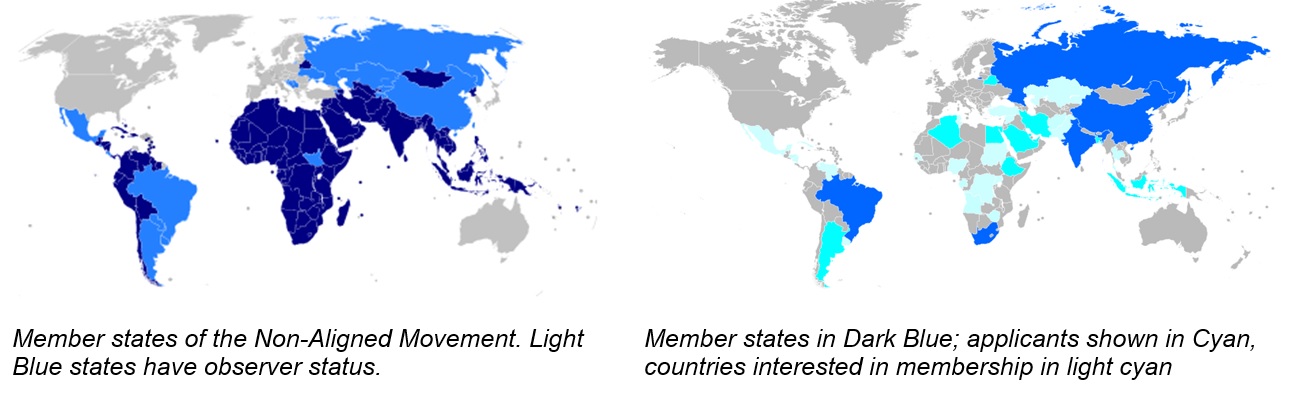
Reportedly, some 22 countries have formally applied to join the group, while an equal number of states have been informally asking about becoming BRICS members. Countries looking to join the bloc include Saudi Arabia, Iran, the United Arab Emirates, Argentina, Indonesia, Egypt and Ethiopia. After the 1955 Bandung Conference, the non-aligned countries were organized into a political movement. Today, the BRICS group is building an economic bloc.
Figure 1 Non-Aligned Movement and the BRICS Group
Source: Wikimedia Commons
It is the rising number of large and populous emerging economies that make possible the kind of bottom-up network effects, which will be critical to launch the new infrastructure for the proposed complementary settlement mechanisms. These bottom-up effects are based on choices by sovereign states. By contrast, the dollar-predominance is imposed on the rest of the world, which excludes sovereign choices.
Like asset managers who seek to maintain appropriate diversification in their portfolios, the BRICS’ strategic objective is to recalibrate reserve currencies.
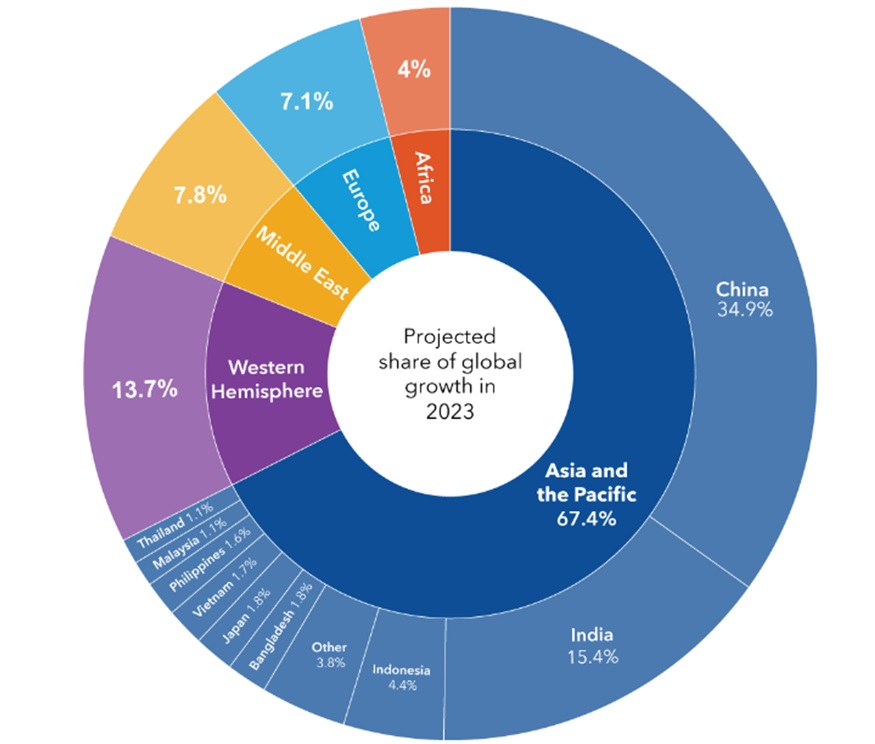
In the multipolar world economy, global growth prospects are driven by the emerging economies; not by the West any longer.
Figure 2 Emerging economies drive global growth, not the West
Source: IMF, May 2023
Exorbitant risks of dollar monopoly
Paradoxically, misguided US policies have accelerated the erosion of the dollar-based regime following the West’s financial crisis in 2008, excessive debt-taking, trade protectionism and technology friction, pandemic-induced depression, and the new Cold Wars.
When the dollar is weaponized by US foreign policy in the name of international community but without the broad support of international consensus, it puts trade invoicing and settlement, foreign corporates, financials and central bank reserves at risk. Hence, too, the recent warning by Fitch Ratings that it may be forced to downgrade dozens of US banks, even the likes of JP Morgan Chase.
After the spring failures of Silicon Valley Bank, Signature Bank, First Republic and the takeover of Credit Suisse by UBS, 200 more banks may be vulnerable to the type of risk that caused SVB to collapse. Across the US, 2,315 banks – almost half of the total – sit on assets worth less than their liabilities.
Today, US public debt hovers around $32.6 trillion; that’s two trillion more than a year ago. Since 2008, US debt as percentage of GDP has doubled and soared to over 120 percent. According to the non-partisan Congressional Budget Office, persistently large federal deficits will push federal debt over 181 percent of GDP by 2053.
Figure 3 US Federal debt held by the public
Source: CBO, June 2023
Avoiding lethal geopolitics
To defer the reckoning, the Biden administration needs to print money, ceaselessly. Such trajectories are damaging to major foreign holders of federal debt, many of which are large emerging economies, particularly China.
If, in a likely crisis, these economies must drastically reduce their purchases of US securities, sell a significant share of their dollar holdings, or do both, Washington needs to offset the gap. Otherwise, it will face significantly higher interest rates. Neither Western Europe nor Japan can alleviate the pain because they are struggling with secular stagnation, as is the US.
To avoid such lethal global scenarios, the BRICS seeks a diversified world economy and reserve currencies. That trajectory is more peaceful, stable and secure.
A version of the commentary was published by China Daily on August 23, 2023
Dr. Dan Steinbockis an internationally recognized strategist of the multipolar world and the founder of Difference Group. He has served at India, China and America Institute (US), Shanghai Institutes for International Studies (China) and the EU Center (Singapore). For more, see https://www.differencegroup.net/
Each time you hit the road, whether on your way to work or off to your favorite getaway spot, there’s always the possibility of being involved in a motor vehicle accident. While we all believe we are the safest and most careful drivers, the same cannot be said for every driver on the road. Accidents do occur, and they can quickly turn your world upside down. Sometimes injuries and medical bills can pile up in an instant.
Connecticut residents harmed in an accident that wasn’t their fault should contact a Bridgeport car accident lawyer. Let the litigation experts do what they do best while you recover from your injuries. You and your family will be much better off working with a car accident expert who will fight for what’s best for you.
Compensation, Insurance, and Connecticut Car Crash Cases
If you’ve been injured in a car accident, you can seek compensation for your damages. Connecticut is no longer an at-fault state. Until 1994, Nutmeg State residents were required to carry PIP (Personal Injury Protection) insurance policies on their vehicles. If injuries resulted from an accident, each driver would file a compensation claim with their insurance companies. However, nowadays, Connecticut uses an at-fault model.
Who’s at fault must be established before a compensation claim can be made. Sometimes the police accident reports show which driver is at fault, but it’s not always this simple. If there’s any doubt, compensation cannot be awarded until the fault has been determined. There could be circumstances when it’s both drivers’ fault.
Connecticut is a modified comparative negligence state. If the injured party is 50% or less responsible for the crash, they can still seek compensation for their damages. However, compensation will be lowered according to the percentage of their fault. If it’s been determined that the victim was 20% at fault for the accident and receiving a settlement of $100k, they’ll be awarded $80k.
How Is Fault Determined?
Ultimately, it is up to the insurance company’s claims adjusters to determine which driver was at fault. If both drivers played a role in causing the crash, the claims adjusters would assign a percentage of the fault to each driver. To receive the best possible compensation, you must work with a reputable personal injury attorney who can challenge a claims adjuster report. A claims adjuster will determine fault by reviewing the available evidence.
Police Accident Report
No matter how minor the accident was, if you’ve been injured, calling the police and requesting an accident report is of utmost importance. Police accident reports will contain information regarding the details of the accident if a citation was issued to either driver and the contact information of anyone who witnessed the accident.
Accident Scene Photos
Photos of the accident are a good source of information to determine who’s at fault in a car accident. Skid marks, road conditions, and even the locations of any traffic signs can be helpful to paint a picture of what occurred. Also of great benefit are traffic light camera photos or video footage from surveillance cameras that could have recorded the accident.
Eyewitnesses
Unbiased witnesses who saw the accident can help to fill in the missing blanks that photos and police reports can sometimes have. The at-fault driver may skew the accident’s details, but eyewitnesses with no skin in the game will state what they witnessed.
The Plaintiff’s Responsibilities and Compensation
Victims of car accidents in Connecticut will have the burden of proving that the other driver was at least 51% responsible for the crash, that the crash caused them injuries, and as a result, have suffered damages. This is done by working with an experienced personal injury attorney who will help you gather evidence and negotiate with the other driver’s legal team.
Along with the evidence mentioned above to prove guilt, your attorney will also help you prove your injuries and damages. Here are some common types of evidence to prove injuries and damages:
First-responders notes
Photos of your injuries
Emergency room intake and discharge papers
The medical paperwork regarding your injuries
Photos of your injuries
Medical bills
Statements from friends, family, and coworkers
Pay stubs and proof of time off due to the accident
The stronger your evidence, the stronger your case will be. This highlights the importance of working with an attorney with knowledge of car crash cases and the savvy to negotiate for the best possible settlement.
Connecticut Car Accidents: Final Thoughts
If you’ve been injured in a Connecticut traffic collision, you have to prove the other party was negligent. An insurance claims adjuster will first determine the fault. However, their decision may not work in your favor. Hiring a seasoned personal injury attorney ensures that the at-fault driver is held accountable for all of your damages.
Working with claims adjusters and insurance companies’ legal teams should only be done through your lawyer. They’re not working for you; they’re trying to limit liability and costs. Some unscrupulous insurance companies may tell you you don’t need a lawyer. This is entirely untrue. Never attempt to seek compensation without legal representation.
The Netherlands, known for its vibrant culture, progressive policies, and strong economy, has attracted a diverse array of foreigners seeking a new life within its borders. While integration into a new society is a multifaceted process, one key aspect that significantly influences this journey is the realm of financial decisions, particularly loans and borrowing. In this article, we will explore how loans and financial choices can contribute to the overall integration of foreigners into Dutch society and its economy.
Access to Opportunities
Financial decisions, including loans, play a pivotal role in shaping an individual’s access to various opportunities in the Netherlands. Foreigners often face initial challenges in securing housing, education, and even starting a business. Loans, such as mortgages, student loans, and small business loans, provide the necessary financial support to kick-start these endeavors. By facilitating access to these opportunities, loans empower foreigners to actively participate in Dutch society and contribute to its economic growth. Besides that, professional mortgage advice for expats is facilitated by Viisi Expats
Building Credit History and Trust
Engaging with the Dutch financial system through responsible borrowing helps foreigners establish a credit history within the country. A positive credit history not only improves their chances of obtaining future loans but also fosters trust with financial institutions. As foreigners make timely repayments and manage their finances effectively, they contribute to building a robust credit profile, thereby enhancing their financial integration into Dutch society.
Cultural Exchange Through Financial Engagement
The act of applying for loans and navigating the Dutch financial landscape exposes foreigners to local financial norms, practices, and regulations. This engagement serves as a platform for cultural exchange, enabling newcomers to learn about Dutch financial etiquette and expectations. As they interact with Dutch lenders, borrowers gain insights into budgeting, financial planning, and investment strategies, fostering deeper integration into the local way of life.
Enhancing Language and Communication Skills
Managing financial matters involves communication and comprehension of complex financial terms. Immersion in the financial system encourages foreigners to improve their language skills, particularly in Dutch, as many financial interactions occur in the local language. By enhancing their language proficiency, foreigners strengthen their ability to communicate effectively in various aspects of life, contributing to successful integration.
Contributing to Economic Growth
Responsible borrowing by foreigners fuels economic growth in the Netherlands. When newcomers invest in housing, education, and businesses, they generate economic activity, create job opportunities, and stimulate local markets. This economic participation not only benefits the individuals directly but also contributes to the overall prosperity of Dutch society.
Long-Term Commitment and Residency
Obtaining loans for significant life milestones, such as buying a home or starting a family, reflects a long-term commitment to life in the Netherlands. This commitment can lead to more permanent residency and a stronger sense of belonging. As foreigners establish deeper roots, they become more invested in local communities, engaging in social activities and contributing to the cultural fabric of Dutch society.
The path to integration is multifaceted, and financial decisions play an integral role in shaping the experiences of foreigners in the Netherlands. Loans and financial choices enable access to opportunities, aid in building trust and credit history, foster cultural exchange, enhance language skills, and contribute to economic growth. As foreigners navigate the Dutch financial landscape, they not only improve their own lives but also enrich the diverse tapestry of the Dutch society and economy, reinforcing the idea that integration is a reciprocal journey of mutual benefit.
The outbreak of the global pandemic in 2020 prompted an unprecedented shift in the way businesses operate, triggering a widespread adoption of remote work practices across industries. In the US, remote work emerged as a transformative solution that ensured business continuity and profoundly impacted the country’s economy. The ripple effects of this shift have reshaped the workplace landscape, redefined productivity paradigms, and prompted a reevaluation of traditional economic structures.
Technological Adoption and Innovation
Prior to the pandemic, remote work was often regarded as a niche arrangement, limited to specific job roles or industries. The pandemic’s disruptive influence accelerated the adoption of remote work across the spectrum, from white-collar professionals to service-based industries. Millions of Americans found themselves setting up home offices, embracing digital collaboration tools, and relying on virtual communication platforms to bridge the gap created by physical distance.
Businesses invested in advanced communication tools, cloud technologies, and cybersecurity measures to facilitate remote collaboration and protect sensitive data. VPNs, such as ExpressVPN, continue to play a pivotal role in ensuring the security of remote employees’ connections. VPNs shield sensitive information from potential cyber threats by encrypting data transmission and establishing secure tunnels. As employees access company networks and systems from various locations, VPNs become paramount in protecting against data breaches and unauthorized access.
This tech-driven transformation not only enhanced connectivity and collaboration but also spurred innovation. Businesses that invested in innovative solutions drove technological advancements that positioned the US as a hub for digital innovation.
Redefined Geographic Boundaries
With remote work eliminating the need for a centralized office, geographic boundaries became less of a constraint for both employers and employees. Workers were no longer limited by proximity to a physical workplace, leading to a talent pool that transcended regional boundaries. As a result, businesses gained access to a broader spectrum of skills and expertise, fostering innovation and diversifying workforce dynamics.
Employees found new flexibility in managing their work-life balance, and commute times, for example, were replaced with family time. Moreover, the ability to work from various locations allowed individuals to strike a harmonious balance between professional and personal commitments, says Forbes. This reimagined work-life equilibrium contributed to enhanced employee satisfaction and well-being.
The widespread adoption of remote work triggered a reevaluation of commercial real estate needs. As offices remained underutilized, businesses reconsidered their real estate footprints, leading to implications for the commercial property market and urban development plans. Some companies embraced hybrid work models, opting for smaller office spaces to accommodate employees who preferred in-person collaboration.
As the US economy enters a post-pandemic era, the remote work revolution has paved the way for a hybrid work future, as mentioned in a new survey by Yoh. Many businesses are adopting flexible models that combine in-person and remote work to maximize productivity, accommodate individual preferences, and support diverse work styles.
This evolution promises to reshape the US economy further, driving innovation, talent acquisition, and sustainable growth. As the nation navigates this new normal, the lessons learned from the remote work revolution will continue to shape the trajectory of the US economy for years to come.
The US dollar has long been the dominant currency in international trade and financial markets. But Kalim Siddiqui argues that a process of change is under way that will see that the dominance of dollar will end soon.
Since the outbreak of the war in Ukraine, trade and financial relations are being reorganised. The United States has disconnected Russian banks from SWIFT, and many US and EU firms have withdrawn from Russia. Russia has been excluded from the Western global financial system. However, Russia is self-sufficient in most essential goods, such as food, energy, machines, and weapons.
Moreover, the sanctions against Russia by the US and EU did not produce the expected results, although it was thought that it would bring Russia to its knees in a short period. Sanctions by their very nature represent a violation of multilateralism, a singling out of one country that is taken out of the multilateral arrangement.
The US decision to freeze Russia’s Central Bank’s foreign reserves over Ukraine has seemingly become the last straw for the developing countries, and they have increasingly started looking for an alternative to the US dollar. It would be wholly premature to say that the hegemony of the dollar will end very soon. For the world’s individual depositors and countries, the US dollar would remain the most attractive currency in the near future.
Recently, interest rates in the US increased to combat inflation and, as a result, capital has been leaving developing countries and they were forced to raise interest rates to stop capital outflows (Siddiqui, 2023; also, 2022d). This has led to the depreciation of their currencies against the US dollar. Meanwhile, gradually the developing countries have begun to move towards bilateral arrangements that replace dollar reserves with other currencies, hence undermining the position of the US dollar.
The US dollar has long held a dominant position in the global financial system. There is a shift taking place towards de-dollarisation, which represents a critical transformation with significant implications for the future of international trade, investment, and monetary policy. Here, I would like to define what is meant by de-dollarisation. De-dollarisation refers to countries reducing reliance on the US dollar as a reserve currency, medium of exchange or unit of account (Desai and Hudson, 2023).
At present, the US dollar is the most prominent currency in the world. This is because the US has the largest economy in the world, and the US dollar is used globally as a medium of trade and global business.
The US dollar had been de facto the primary world reserve asset for a hundred years, because, at the beginning of the twentieth century, the US emerged as pre-eminent in the holding of gold and its creditor position. Moreover, at the Bretton Woods conference in 1944, the US dollar was officially accepted as the world’s reserve currency and was backed by the world’s largest gold reserves. Instead of gold reserves, other countries accumulated reserves of US dollars. This meant that the US could print dollars and buy and invest in assets abroad, while for other countries to get dollars they need to export or borrow from the US. As a result, most countries worldwide rely on the US dollar to support their economies. At present, the US dollar is the most prominent currency in the world. This is because the US has the largest economy in the world, and the US dollar is used globally as a medium of trade and global business.
Currently, the US does not owe a foreign currency debt and its debts are in US dollars, which the US can always print. There is no need for the US to sell dollars in the exchange market to buy euros, roubles, or yen. We must remember that, until the First World War, the British pound sterling was the international global reserve currency and, although it no longer is, Britain still is a significant economy.
Monetarist views are being promoted by the New York Times and the Wall Street Journal and other major Western media, that if the governments print too much money to pay workers or welfare measures, it could create inflation (Armstrong & Siddiqui, 2019). That can lead to currency depreciation. On the other hand, the US needs money to spend on the war in Ukraine. The Pentagon needs money to fight Russia and China (Siddiqui, 2022a; 2022b).
Another important development has taken place in the last four decades. The Chinese economy has grown at higher rates compared to the rest of the world since 1980. The outcome has been that China’s trade has increased enormously and the country has accumulated huge amounts of both US dollars and gold. And now the Chinese economy is capable of not only absorbing technologies from the West but also developing its own, and able to gradually meet internationally competitive requirements of consumers. Moreover, China remains somewhat insulated from predations of global finance due to capital control and its ability to maintain a large foreign currency reserve. China is at present the largest economy in terms of purchasing power. The country is also the world’s largest exporter nation. China holds more than $2 trillion in US government bonds and, thus, cannot easily divest most of these bonds to devalue its own holdings. China is gradually taking measures of arranging multilateral payment mechanisms that bypass the conventional medium of the US dollar.
In contrast to Chinese economic development, where the state played an active role along with the market to promote businesses, in the US since the 1980s, the US as a global economic power has been imposing neoliberal policy and assigning a key role to market forces for resource mobilisation and promoting a particular form of finance capitalism on the rest of the world (Siddiqui, 2022c). The dominance of finance capital destroys productive industries in pursuit of rent-seeking, and what is known as the rentier class (Siddiqui, 2019a). Industrial capitalism played an important role in the nineteenth century in improving productivity and transforming the economy in the western European countries, as observed at the time by Adam Smith, John Stuart Mill, David Ricardo, and Karl Marx, the supporter of the classical labour theory of value.
Usage of the Chinese yuan has now surpassed the US dollar, thus making it the most traded currency in Russia. Another crucial development recently was when China managed to reach an agreement with Saudi Arabia to trade oil using yuan, which is known as the “petro-yuan” deal.
There seems to be a gradual decline in the US dollar hegemony. A recent report from the IMF acknowledged that the use of the dollar in foreign bank reserves is gradually declining and the dollar hegemony is eroding. It seems that the US and EU sanctions on Russia are going to further erode the hegemony of the US dollar. To counter US sanctions, Russia now is doing business with China in the Chinese yuan. Russia is also doing business with India with the Indian rupee. As Galbraith (2022: 328) notes: “The world’s moving away from exclusive reliance on the dollar will clip the wings of US finance. A multipolar world requires multilateral security arrangements, incompatible with the present extent of the US military power projection; adding more money to a dysfunctional force structure will not make the country safe or secure, and it will make inflation worse. On the other hand, a lower dollar would help to revive the domestic economy towards self-reliance in critical goods, an industrial strategy can begin the necessary process of reconstruction, while investment in infrastructure and new technologies can work to offset the social impact of higher energy costs. Those investments are necessary to combat climate change …”
However, in the twenty-first century, the strategy of finance capitalism is to make money by financial engineering, not by industrial development. Finance capitalism has essentially de-industrialised the US and the UK (Siddiqui, 2019b).
The US froze US$300 billion worth of Russian foreign exchange reserves after the Ukraine war. And now most developing countries realise that if the US does not agree with their policy or during war or domestic crisis, the US can freeze their dollar reserves. Therefore, countries like Saudi Arabia and other Gulf countries are thinking that we would be better off getting out of dollars, since, if the US and Israel attack Syria and Iraq, they can freeze our money. Let’s move our money into a safe country. Many countries began to move their money out of the dollar into other currencies and, moreover, began to develop currency swaps and started a BRICS bank to finance trade and investments.
End of Dollar Hegemony?
A capitalist economy does not remain confined to its own domestic market. It moves around all over the world ruthlessly plundering resources, including labour, to expand markets and raise profits. The last three centuries of the rise of capitalism in Europe have shown us this.
The fact that Britain had a large empire meant that surpluses from Britain’s colonies, especially non-white colonies such as India, flowed to Britain. The surpluses extracted by the colonial administration were essentially claimed as charges for the privilege of being ruled by Britain. These colonies ran trade surpluses from other countries and these surpluses were claimed by Britain to balance its own trade deficits with the rest of the world. Britain recycled the surpluses from colonies into famous capital exports which essentially financed the industrialisation of Europe, the US, Canada, Australia, and New Zealand (Siddiqui, 2020a).
In 1910, even though Britain controlled and ruled a large part of the world, the fact is that this was also a period during which Germany’s economy was growing fast and soon started to challenge Britain’s power. Germany linked its currency to gold, not to subordinate itself to some sort of gold standard, but rather to make its own currency attractive to the rest of the world. So, it may increase the market for German goods and increase its global power.
A recent report from the IMF acknowledged that the use of the dollar in foreign bank reserves is gradually declining and the dollar hegemony is eroding.
With the defeat of Germany in the First World War and in the 1920s, hyperinflation in Germany began with an attempt to pay its debt in a foreign currency, as Germany was forced to pay reparations debts it owed in US dollars, British pounds sterling and French francs. However, soon after the First World War, the US, the UK, and France began erecting tariff barriers so that Germany could not export and earn foreign currencies to pay its debts. To find a solution, Germany printed marks and threw them onto the foreign exchange markets to buy the dollars to pay the allies. As a result, domestic prices in Germany rose sharply and the exchange rate of the German mark collapsed, import prices were increased, which finally resulted in the general rise in price levels in Germany (Siddiqui, 2020b).
Under the British, the gold-sterling standard operated until the First World War. The US only established the Federal Reserve system in 1913 and this was another way of essentially asserting its own position and priorities. Only after the Second World War did the US-dollar-centred global financial system emerge. However, this has been an inherently unstable arrangement. The world monetary system was based on the national currency of the dominant capitalist countries, which are governed by the US Federal Reserve and represent the interests of its financial sector and it could generate more private debts than public money. The results have been international rentier elites centred in US dollars. Its power extends through networks of institutions offering private credit to other governments and businesses (Hudson, 2003).
As the BRICS countries implement their currency internationalisation policies, trading activities of BRICS currencies will slowly increase. This increase may not necessarily come at the expense of the US dollar; rather, it may erode the market share of other major currencies, as recent years’ data shows.
In 1944, the US sought to use the Bretton Woods negotiations to revive its plan for world domination by securing the dollar’s position as world money. It also aimed to limit the power of rivals, primarily the British pound sterling. The world dominated by US dollars aimed to protect global US strategic and military power. The US also ensured that the newly formed financial institutions, mainly the World Bank and the IMF, were designed to impose free flows of trade and capital to benefit the US corporations. Then, Keynes proposed a multilateral International Clearing Union to settle international payments in a new multilaterally created currency, the “bancor”, whose value would be determined by a price index of 30 widely traded commodities. This proposal was aimed to eliminate persistent trade and financial imbalances by pressurising the creditor country (the US) to adjust. However, Keynes’s proposal that time was rejected by the US.
In the 1950s and 60s, the rates of economic growth were faster in the West European economies than in the US, while at the same time US defence expenditure rose sharply due to the Korean and Vietnam wars and the US experienced a rising balance of payment deficit.
Since the 1980s, gradually the US reduced financial regulation and, in the name of efficiency and competition, any state interference was removed from financial institutions and banks. As a result, financial monopoly capital had moved away from any commitment towards industrial development. However, after the Second World War, under the Keynesian policy, state intervention separated commercial and investment banks and the securities markets were also hugely supervised. As a result, speculative activity was restricted. But in the 1980s, the Keynesian policy was replaced by neoliberalism, which meant the finances were deregulated and, through various laws, the advanced economies relaxed their supervision over financial institutions and financial markets and efficiency and competition became big mantras to boost economic growth. Over the last four decades, finance capital has grown enormously, while at the same time, industries have witnessed a decline in the developed capitalist countries.
For developing countries, financial dollarisation is a long-standing issue. Financial dollarisation reflects the substitution of national currency assets and liabilities by foreign currency assets and liabilities. Since globalisation and deregulation, the US dollar influence has grown, and a highly dollarised global economy becomes more susceptible to changes in global financial conditions rather than to domestic monetary policy. In January 2023, Russian Foreign Minister Sergey Lavrov and Brazilian President Lula raised the issue of a potential common BRICS currency.
The currency trading activity comparison reveals that the US dollar still maintains its absolute dominance in the currency market. However, the collective market share of BRICS currencies, especially the renminbi, has slowly increased, but it is still far smaller than the US dollar’s market share. However, the small increase in the market share of BRICS currencies did not cause the US dollar’s market share to decrease, as the US dollar’s share has remained stable. As the BRICS countries implement their currency internationalisation policies, trading activities of BRICS currencies will slowly increase. This increase may not necessarily come at the expense of the US dollar; rather, it may erode the market share of other major currencies, as recent years’ data shows.
Russia has been actively promoting the idea of de-dollarisation through BRICS, and its primary motivation for doing so is its geopolitical rivalry with the United States. President Putin said recently that the BRICS members are ready to work together with our partners to promote international financial regulation reforms and to overcome the excessive domination of the limited number of reserve currencies. In October 2018, the Putin administration backed a tentative de-dollarisation plan designed to limit Russia’s exposure to future US sanctions by reducing the use of the US dollar in international settlements and conducting international business using alternative currencies. Brazil initially shared Russia’s enthusiasm for making BRICS a de-dollarisation coalition. Former Brazilian President Lula da Silva argued that BRICS could create our own currency to become independent from the US dollar in our trade relations.
The US dollar dominated Brazil’s exports invoicing, as high as 94 per cent, although exports to the United States were only 17 per cent of Brazil’s total exports. Brazil’s severe economic crisis since 2014 following the end of the commodity boom has fragmented the country’s politics and led to the rise of the right-wing Bolsonaro administration. Under President Bolsonaro, the Brazilian government has sent mixed signals regarding its BRICS policy and has moved closer to the Western powers. Second, Brazil has become more reliant on commodities exports, making the country more exposed to volatility in global markets and currency risks. Brazil’s commodity exports represented 56.5 per cent of total exports in 2008–9. This number has increased to 66.6 per cent over the past 10 years. China has been Brazil’s most important trading partner, and the economic and financial ties between the two countries have increasingly become closer. The use of local currencies in bilateral settlements is beneficial for both sides. Brazil’s close economic and financial ties with China and the real risks to the Brazilian economy due to its dependence on the US dollar suggest that Brazil is unlikely to openly champion BRICS de-dollarisation initiatives.
Initially, India was reluctant to join a BRICS de-dollarisation coalition from the very beginning, despite its support for other key issues on the BRICS agenda, such as reforming the IMF and World Bank. Russia and China proposed to create a new global super-sovereign reserve currency to replace the US dollar in 2009. The Indian government considered this Sino-Russian proposal more ideological than substantive and did not want to challenge the US dollar and upset the US, especially at a time when the US was pressuring Pakistan on counterterrorism and India wanted to build closer economic ties with the US. While the US treats Russia and China as strategic competitors, it considers India as an important ally in the Indo-Pacific region and an important strategic partner. India’s rivalry with China and the recent military stand-off between the two countries have further prevented India from supporting China’s attempt to replace the US dollar.
Saudi Arabia and China are dealing in their own currencies now with currency swaps and the BRICS countries such as Russia, China, Iran, India, and others are putting in place currency swaps for trade in their own currencies (Financial Times, 2023; Siddiqui, 2021b).
Britain recycled the surpluses from colonies into famous capital exports which essentially financed the industrialisation of Europe, the US, Canada, Australia, and New Zealand.
In fact, in 1973, US President Richard Nixon and King Faisal of Saudi Arabia agreed that Saudi Arabia would sell oil to the US, its largest buyer, and in turn, the US would provide Saudi Arabia with money, military aid, and political support. This is known as the “petrodollar” deal. The US agreed to offer armed protection, and weapons and the sale of oil would be in US dollars. Moreover, Saudi Arabia would invest billions of their “petrodollars” back into the US via treasury bond purchases, effectively lending the US money. Since then, oil has traded in US dollars almost exclusively worldwide, even between non-US buyers and producers. In international markets, all the oil bought in US dollars created a huge demand for dollars, an important factor in creating the US dollar’s hegemony. This arrangement has also enabled the US to borrow at very low interest rates to finance the US deficit for the last four decades.
However, the US dollar remains dominant in global forex reserves, even though its share in central banks’ foreign exchange reserves has dropped from more than 70 per cent in 1999 (see figure 1). The US dollar accounted for 58.3 per cent of global foreign exchange reserves by 2022, according to the IMF (see figures 2 and 3). Comparatively, the euro is a distant second, accounting for about 20.5 per cent of global forex reserves, while the Chinese yuan accounted for just 2.7 per cent in the same period. Recently, there are several reasons why de-dollarisation has been under discussion. Perhaps the most immediate is the relatively sharp decline in 2022 in the US dollar’s share of total global reserves. The year 2022 was not the beginning of this trend but rather an acceleration of a 20-year decline. As of 2022, the dollar’s share of global reserves was 58.3 per cent, down from 73 per cent in 2001.
The US dollar’s hegemony is not only about reserves but about trade. However, since last year, BRICS countries have been calling for trade to be carried out in currencies besides the US dollar. Brazilian President Lula da Silva has been one of the most vocal proponents of alternative trade settlement currencies, calling on the BRICS countries to move away from the US dollar. During an April 2023 state visit to China, Lula asked, “Why can’t we do trade based on our own currencies?… Who was it that decided that the dollar was the currency after the disappearance of the gold standard?” (Financial Times, 2023).
Note: The chart shows identified countries that hold US$1 billion or more of RMB in reserve assets. Source: IMF COFER, IMF Reserve Data, and central bank annual reports.
In recent months, we have witnessed some attempt to move away from the US dollar and use their own currencies for bilateral trade. The yuan has now surpassed the euro to become the second most-dominant currency in Brazil’s foreign reserves after the dollar as of the end of 2022 (see figure 4). Similarly, Argentina announced in April 2023 that it would begin paying for Chinese imports in yuan instead of US dollars.
The US foreign debt continues to rise, thus feeding concerns about it, as a recent US Congress hearing noted. These issues cause some to question the stability of the US’s financial infrastructure and the future of the US dollar’s status as the global reserve.
The BRICS countries have witnessed a sharp increase their GDP in recent years. For instance, in 2021 China’s GDP growth rate averaged 6 per cent per year, India’s was 5.6 per cent, and Russia, Brazil, and South Africa ranged from 1.8 per cent to 2.7 per cent (Siddiqui, 2021a; also, 2020c). Moreover, they constitute 42 per cent of the world’s population, the BRICS countries contribute 33.6 per cent to the world’s GDP and are expected to contribute more than 50 per cent by 2030, as figure 5 indicates. With their influence likely to grow, they would be expected to support the process of de-dollarisation in future.
This is a further indication of booming trade through BRICS countries’ national currencies which have progressively gained more market share. One way to gain more market share in the dollar-based global currency system is by using national currencies for cross-border trade transactions. For example, China used the Chinese yuan to trade with Russia after its invasion of Ukraine. Usage of the Chinese yuan has now surpassed the US dollar, thus making it the most traded currency in Russia. Another crucial development recently was when China managed to reach an agreement with Saudi Arabia to trade oil using yuan, which is known as the “petro-yuan” deal. These examples can be seen as a form of currency diversification.
The renminbi was one of the biggest beneficiaries of Russian reserves’ de-dollarisation. In early 2019, Russia’s central bank invested US$44 billion into the renminbi, increasing its share in Russia’s foreign exchange reserves from 5 per cent to 15 per cent. Russia’s renminbi holdings are about 10 times the global average for central banks, accounting for about a quarter of global renminbi reserves. In 2021, Russia’s sovereign wealth fund invested in renminbi and Chinese state bonds. Russia’s aggressive de-dollarisation policies are conducive to strengthening a potential Russia–China partnership for de-dollarisation. Furthermore, the Bank of Russia has also been implementing a gold strategy to move away from US assets. It has been the largest buyer of gold in the past few years, quadrupling Russia’s gold reserves over the past decade. Between 2018 and 2021, the value of Russia’s gold reserves increased by 42 per cent, to US$109.5 billion. As a result, gold has taken up the largest share of Russia’s total reserves since 2000. By 2020, gold constituted 23 per cent of the reserves of Russia’s central bank (as indicated in figure 6), while the share of US dollar assets declined to 22 per cent (see figure 8).
Moreover, there has been an increase in central bank buying of gold around the world (see figure 7), and central banks now constitute about one-third of all annual demand for gold – the highest level since the 1950s – and we’ve seen the price of gold rise about 20 per cent in the last six months.
Concluding Remarks
Since 1944 with the Bretton Woods agreements, the US has ensured the role of the dollar as the international currency under a multilateral framework based on fixed exchange rates with control over financial capital movements. The key point was to bring foreign exchange stability as the value of the dollar was guaranteed by its convertibility into gold, which continued over two decades, a characteristic that created increasing difficulties over the course of two decades. As the West European and Japanese economies recovered from the destruction of the war, the quantity of gold available and extractable on a global scale proved insufficient to meet the demand for international liquidity. Then the US faced a dilemma, whether to support the convertibility between the dollar and gold or to pursue an internal objective of economic growth.
India’s rivalry with China and the recent military stand-off between the two countries have further prevented India from supporting China’s attempt to replace the US dollar.
In fact, the imposition of the dollar as the international unit of account and store of value has helped the US banks to expand and consolidate its financial system. The strategic and military supremacy of the US ensured that not only oil and other internationally traded commodities were denominated in US dollars but also that the liquid funds created by the US banks and accumulated petrodollars flowed back to US banks. And since the 1980s, through neoliberal globalisation and free flows of capital and goods, the US has consolidated its grip over the developing countries, while the IMF and the World Bank have been transformed from multilateral institutions into tools of the US Treasury.
Since the 1980s, the steady rise in the US external deficit drains financial resources from the private sectors and, to prevent a deterioration of the balance of payments, a current account deficit requires an active economic policy to attract new capital inflows from abroad, such as raising domestic interest rates or reducing taxes. And in the absence of such policies, according to the Mundell-Fleming theory, a depreciation of the exchange rate will be inevitable.
Under capitalism, historically we have seen that the contradictions are being externalised onto others by controlling others’ resources, such as cheap labour, raw materials, and markets to sell its products. When rival countries are able to challenge this domination, it could result in wars such as two world wars in the first half of the twentieth century. At present, we saw again rising tensions between countries, such as the US and China, and the US and Russia.
The study concludes that to support de-dollarisation, tighter monetary policy should be in place when the expected yield differential on domestic and foreign currency deposits is close to zero.
The US dollar has “suffered a stunning collapse” as a reserve currency, which has increased after the US decided to wield its control over the dollar-based international financial system against Russia. The developing economies seem unwilling to continue to hold dollar assets but are still unable to divest from the US dollar as an international currency, particularly for financial transactions, because the US dollar still enjoys substantial network advantages as an international currency, mainly because of its huge, liquid, and reasonably well-functioning financial markets.
The study concludes that to support de-dollarisation, tighter monetary policy should be in place when the expected yield differential on domestic and foreign currency deposits is close to zero. It is noteworthy that the expected yield differential incorporates the hysteresis effect, the collective memory about the past episodes of significant currency depreciation. Capitalism has a deep urge to privatise, control, and commodify. However, this, despite its success, becomes the basis for the financial crisis. Karl Polanyi called money a fictitious commodity. We must realise that the world is changing, and that US global financial and economic hegemony is eroding, and the world is moving towards multipolar, which should be celebrated.
Dr. Kalim Siddiqui is an economist specialising in International Political Economy, Development Economics, International Trade, and International Economics. His work, which combines elements of international political economy and development economics, economic policy, economic history and international trade, often challenges prevailing orthodoxy about which policies promote overall development in less-developed countries. Kalim teaches international economics at the Department of Accounting, Finance and Economics, University of Huddersfield, UK. He has taught economics since 1989 at various universities in Norway and the UK.
References
Armstrong, P. and Siddiqui, K. (2019) “The case for the ontology of money as cred-it: money as bearer or basis of value” Real-World Economics Review, 90:98-119.
Desai, R. and Hudson, M. (2023) “Beyond dollar creditocracy: A geopolitical econ-omy” Real-World Economics Review, 97:20-39.
Galbraith, James K. (2022) “The Dollar System in a Multi-polar World” International Journal of Political Economy, 51(4): 321-30.
Hudson, M. (2003) The Origin and Fundamentals of US Dominance, London: Pluto Press.
Siddiqui, K. (2023) “The Political Economy of Shanghai Cooperation Organisation (SCO) and the Growing Regional Multilateral Ties” The World Financial Review, Feb-March, p. 2-14.
Siddiqui, K. (2022a) “Ukraine-Russia War and the Impact on the Global Economy” The World Financial Review, Nov-Dec, p. 22-35.
Siddiqui, K. (2022b) “Capitalism, Imperialism, and Crisis”, The European Financial Review, June-July, p. 16-32.
Siddiqui, K. (2022c) “Is a Global Economic Recession Looming, The World Financial Review,Sept-Oct, p. 17-26.
Siddiqui, K. (2022d) “Problems of Inflation, War in Ukraine, and the Risk of Stagfla-tion”, The European Financial Review, April-May, p. 5-13.
Siddiqui, K. (2021a) “Can 21st Century be an Asian Century?” Asian Profile, 49(1):1-19.
Siddiqui, K. (2021b) “The Bilateral Swap Agreements and the Demise of US Dollar”, The World Financial Review, Sept-Oct, p. 56-64.
Siddiqui, K. (2020a) “Prospects of a Multipolar World and the Role of Emerging Economies” The World Financial Review, Nov/Dec, p. 65-77.
Siddiqui, K. (2020b) “The US Dollar and the World Economy: A critical review” Athens Journal of Economics and Business. 6(1): 21-44. January.
Siddiqui, K. (2020c) “The Rise of the Chinese Economy and Growing Concerns in the United States” The World Financial Review, Sept-Oct, p. 40-9.
Siddiqui, K. (2019a) “Financialisation, Neoliberalism and Economic Crises in the Advanced Economies” The World Financial Review,May-June, p. 22-30.
Siddiqui, K. (2019b) “The Political Economy of Essence of Money and Recent De-velopment”, International Critical Thought, 9(1): 85-108.
Siddiqui, K. (2019c) “The US Economy, Global Imbalances under Capitalism: A Critical Review”, Istanbul Journal of Economics 69(2):175-205.
Siddiqui, K. (2015) “Political Economy of Japan’s Decades Long Economic Stagnation” Equilibrium Quarterly Journal of Economics & Economic Policy 10(4):9-39. The Financial Times. (2023) “The US Dollar”, 19 April, London.
By Terence Tse
CFOs are evolving into AI-driven transformation orchestrators, balancing finance, technology, and strategy while upskilling teams, managing risks, and driving measurable business value.
A key insight from this year’s AI for CFOs event, organized...
The World Financial Review uses cookies to improve site functionality, provide you with a better browsing experience, and to enable our partners to advertise to you. Detailed information on the use of cookies on this Site, and how you can decline them, is provided in our Privacy Policy and Terms and Conditions. By clicking on the accept button and using this Site, you consent to our Privacy Policy and Terms and Conditions. ACCEPT
Privacy & Cookies Policy
Privacy Overview
This website uses cookies to improve your experience while you navigate through the website. Out of these cookies, the cookies that are categorized as necessary are stored on your browser as they are essential for the working of basic functionalities of the website. We also use third-party cookies that help us analyze and understand how you use this website. These cookies will be stored in your browser only with your consent. You also have the option to opt-out of these cookies. But opting out of some of these cookies may have an effect on your browsing experience.
Necessary cookies are absolutely essential for the website to function properly. This category only includes cookies that ensures basic functionalities and security features of the website. These cookies do not store any personal information.
Any cookies that may not be particularly necessary for the website to function and is used specifically to collect user personal data via analytics, ads, other embedded contents are termed as non-necessary cookies. It is mandatory to procure user consent prior to running these cookies on your website.