Home Blog Page 294

Key Factors to Consider When Choosing a Gold IRA Company

If you’re considering diversifying your investment portfolio by adding precious metals, a Gold IRA (Individual Retirement Account) is an excellent choice. However, selecting the right Gold IRA company is crucial to ensure the safety and growth of your retirement funds. In this guide, we’ll walk you through the key factors to consider when choosing a Gold IRA company.

Experience and Reputation: Trust Matters

When safeguarding your retirement savings, experience and reputation are paramount. Look for a Gold IRA company with a proven track record in the industry. A company serving clients for several years is more likely to have the expertise and stability needed to protect your investments.

Reputation is equally important. Research customer reviews, ratings, and independent company performance assessments. You want to partner with a Gold IRA company that has a strong reputation for transparency, reliability, and excellent customer service. After all, you’re entrusting them with your financial future, so trustworthiness is key.

Fees and Costs: Understand the Charges

While it’s essential to consider the quality of service, you should also pay attention to the fees and costs associated with a Gold IRA company. Different companies have varying fee structures, which can impact your returns over time.

Ask about the setup fees, annual maintenance fees, and storage fees. Some companies may offer lower upfront fees but charge higher annual or storage fees. It’s crucial to clearly understand all costs associated with your Gold IRA.

Remember that low fees don’t always mean the best value. A company with slightly higher fees may provide better services, such as secure storage options and easy access to your precious metals. Consider the overall value, taking into account both fees and the quality of service.

Storage Options: Safe and Secure

The physical storage of your precious metals is a critical aspect of a Gold IRA. You need to ensure that your gold and other metals are stored in a safe and secure environment. The Gold IRA company should offer storage options that meet the highest industry standards.

Typically, there are two types of storage: segregated and non-segregated. Segregated storage means your metals are kept separately from other customers’ assets, providing maximum security and accountability. Non-segregated storage combines your metals with those of other customers, which may be less secure.

Consider looking into companies that offer storage in highly secure and insured vaults, preferably outside the banking system. This adds an extra layer of protection to your investments. Remember that the safety of your assets is paramount, so don’t compromise on secure storage options.

Customer Service and Accessibility: A Supportive Partner

When considering a Gold IRA company, it’s essential to evaluate the level of customer service and accessibility they offer. You want a company that’s readily available to assist you, especially when dealing with your retirement funds. Exceptional customer service means you can get answers to your questions, resolve concerns, and receive guidance whenever you need it.

First, check the company’s communication channels. Do they offer multiple ways to reach them, such as phone, email, or live chat? Is their customer support team knowledgeable and responsive? You want a Gold IRA company that values your inquiries and provides timely and helpful responses.

Additionally, accessibility extends to the ease of managing your account. Look for a company with a user-friendly online portal that allows you to view your account, track your investments, and make changes as needed. An accessible platform ensures that you have control and visibility over your Gold IRA, empowering you to make informed decisions about your retirement investments.

Investment Options and Flexibility: Tailoring Your Portfolio

Every investor has unique goals and risk tolerance, so it’s crucial to choose a Gold IRA company that offers a variety of investment options and flexibility. While gold is a primary focus, you may also want the option to diversify your portfolio with other precious metals, such as silver, platinum, or palladium.

Consider looking into Gold IRA companies that provide a range of IRA-approved coins and bars. Diversifying your holdings can help spread risk and potentially enhance your returns. A reputable Gold IRA company should have access to a broad selection of precious metals, allowing you to tailor your portfolio to your specific needs.

Furthermore, flexibility extends to making contributions or rollovers to your Gold IRA. Companies may offer convenient options for funding your account, whether through annual contributions, transfers, or rollovers from other retirement accounts. This flexibility allows you to manage your investments according to your financial situation and retirement goals.

Educational Resources: Empowering Your Investment Knowledge

Investing in a Gold IRA is a significant financial decision, and you should feel empowered with knowledge about the process and your investment options. A top-tier Gold IRA company should provide educational resources to help you make informed decisions.

Look for companies offering informative articles, guides, webinars, or even expert consultations. These resources can help you understand the benefits and risks of investing in precious metals and the ins and outs of managing your Gold IRA.

Educational materials should cover topics like the role of gold and other precious metals in your portfolio, the tax implications of a Gold IRA, and strategies for optimizing your retirement savings. With access to valuable educational resources, you can confidently navigate the world of Gold IRAs and make choices that align with your financial objectives.

In conclusion, customer service, accessibility, investment options, flexibility, and educational resources are all crucial factors to consider when choosing a Gold IRA company. By evaluating these aspects, you can make a well-informed decision that not only safeguards your retirement savings but also empowers you to achieve your long-term financial goals.

Conclusion: Making the Right Choice

Choosing a Gold IRA company is a significant decision that can impact your financial future. By considering factors such as experience, reputation, fees, and storage options, you can make an informed choice that aligns with your retirement goals.

Remember that your Gold IRA company should be a trusted partner in your financial journey, providing you with peace of mind and the potential for long-term growth. So, take your time to research and select a company that best suits your needs and safeguards your retirement savings effectively.
Islamic Ijarah vs Conventional Mortgage: Which is the Right Choice for You?

For Muslims seeking Shariah-compliant home financing, ijarah contracts provide an alternative to traditional mortgages. But how exactly does ijarah differ from conventional loans? This article compares the key features of each model to help you determine the right choice based on your needs and beliefs.

Interest Prohibitions

The clearest distinction is ijarah avoids riba (interest) which is prohibited in Islam. Conventional mortgages charge added interest on the loan principal. With ijarah, monthly payments reflect fair property rental rates rather than financing charges. You better get help from Hejaz Financial Services: Your Source for Islamic Ijarah Finance.

Asset Ownership

In a mortgage, the lender provides a loan while the purchaser gains title and ownership. With ijarah, the financier purchases the home directly from the seller, which it then leases to the customer. The client gains use of the asset but not legal ownership initially.

Payment Flexibility

Mortgages usually have fixed regular installments over the full loan term. Ijarah lease payments can be more flexible and tied to property values. However, in practice many ijarah contracts today also specify a fixed periodic rental amount for simplicity.

Late Payments

Missing mortgage payments leads to accumulating interest, penalties and credit damage. Under ijarah, late rental payments would primarily just extend the lease term before eventual property transfer.

Collateral Risks

In a mortgage, the property itself secures the loan, exposing the buyer to potential foreclosure. Under ijarah, the financier retains ownership, so risks repossession if payments cease rather than the buyer.

Responsibility for Maintenance

With a mortgage, the owner must handle all property expenses like taxes, insurance and repairs. But under ijarah, these costs are generally borne by the occupying lessee.

Purchase Rights

Mortgages obligate the borrower to purchase the home. But ijarah lease contracts give the customer an option, not obligation, to buy the property at lease-end. The financier cannot compel purchase.

Which Is Better for You?

If adhering to Islamic banking principles is important, ijarah has clear advantages over conventional mortgage models. But mortgages also offer greater ownership control initially, and may have lower monthly costs in some cases.

Consider how much you prioritize Shariah compliance versus other factors like purchase rights, maintenance obligations, and payment flexibility. Also weigh the availability of ijarah offerings in your geographic area when deciding between the two models.

For buyers open to either format, comparing total lifetime costs can determine which delivers greater overall value. Shop lenders to identify the best ijarah or mortgage terms tailored to your needs.

If following Islamic law in your financial dealings is paramount, then ijarah will suit you better than interest-based mortgages. But conduct due diligence to ensure the contract complies with Shariah requirements. Consult financial and religious advisors to make the best decision for your situation.

The Takeaway

While functional differences exist between ijarah and mortgages, both can facilitate property ownership over the long term. For Islamic banking customers, ijarah contracts allow financing homes in a manner aligned with religious convictions. For others, traditional mortgages may be more practical or affordable.

By understanding the core distinctions in ownership structure, payments, risks, and purchase rights, you can determine which model fits your beliefs, needs, and financial circumstances when buying a home. Seek guidance and evaluate all options to pick the optimal route.

With sound planning and advice, you can move forward with property purchase using financing that aligns with your faith and supports your financial well-being.

The Flames of Hamas, Israel, Apartheid, and Palestine       

  By Dan Steinbock           

The Israeli-Hamas War is a logical result of 50 years of failed military policies. Assertive pledges of “national security” will not achieve peace in the Middle East. That requires inclusive economic development.

On Saturday, Palestinian militant groups, reportedly led by Hamas, Palestinian Islamic Jihad and other groups, launched a coordinated offensive against nearby Israeli cities, Gaza border crossings, adjacent military installations, and civilian settlements.

Hostilities were initiated by a rocket barrage – literally thousands of rockets – against Israel and vehicle-transported incursions into Israeli territory. The offensive has already caused hundreds of Israeli casualties, up to 2,000 injured and dozens of captured, leading Israel to declare a state of emergency and war.

This is the first major direct conflict within widely recognized Israeli territory since the country’s founding. It is a game-changer in the Israeli-Palestine conflict.

The war is also manna for heaven for Netanyahu’s far-right government, which has escalated the suppression of Palestinians as international attention has focused on the proxy war in Ukraine. And it certainly did not come out of the blue.

The 50-year time bomb

In the early hours of the offensive, Hamas spokesperson Khaled Qadomi said that the group’s military operation is in response to all the atrocities the Palestinians have faced over the decades, and in response to the recent “desecration of the Al-Aqsa Mosque” by the Israeli far-right. The offensive took place during the Jewish holiday and a day after the 50th anniversary of the Yom Kippur War and its aftermath when the first Jewish settlements were established in Occupied Territories.

Half a decade ago, I wrote a commentary for Robert Parry’s investigative Consortium News on “Israel’s 50-Year Time Bomb” (Oct. 16, 2018), arguing that the status quo was untenable and another war just a matter of time. At the time, the International Monetary Fund (IMF) had warned that “deepening rifts between key stakeholders and surging violence in Gaza further imperil prospects for peace.”

As the Trump “peace initiatives” pushed the region closer to an abyss, I warned that the situation was even worse. Under Netanyahu, Israel was morphing into an apartheid state. Those South African blacks, who lived under apartheid, had more to hope for than Palestinians.

That should no longer come as a surprise. Last year, Israel’s former attorney general, Michael Ben-Yair, said that “my country has sunk to such political and moral depths that it is now an apartheid regime.” Recently, the former speaker of the Israeli parliament, Avraham Burg, and the renowned Israeli historian, Benny Morris, were among more than 2,000 Israeli and American public figures who signed a public statement declaring that “Palestinians live under a regime of apartheid”.

And more recently, Tamir Pardo, the former chief of Mossad (2011-16), stated that Israel’s mechanisms for controlling the Palestinians, from restrictions on movement to placing them under military law while Jewish settlers in the occupied territories are governed by civilian courts, matched the old South Africa. “There is an apartheid state here,” Tamir said. “In a territory where two people are judged under two legal systems, that is an apartheid state.”

Yet, the Democratic Biden administration has continued Trump’s Middle East policies, which effectively ignore the Palestinian nightmare. Washington’s bipartisan consensus is driven by the priorities of the Pentagon and the Big Defense. In the past 5 years that has pushed Israel’s democracy at the edge of autocracy fostering an apartheid state, as I warned in 2018.

Dangerous polarization revisited

In 1994, amid the peace talks in Oslo, Palestinian per capita income, adjusted to purchasing power parity, was barely 15% relative to the Israeli level. At the time, the hope was that peace would bring stability, which would raise living standards in the West Bank and Gaza. The hopes died with the Jewish far-right assassination of Prime Minister Yitzhak Rabin, which triggered a new cycle of devastation.

In 2017, Palestinian per capita income had slowly climbed to 16.2% relative to the Israeli level. After more than two decades, barely 1 percentage point. So, what about progress in the past 5 years?

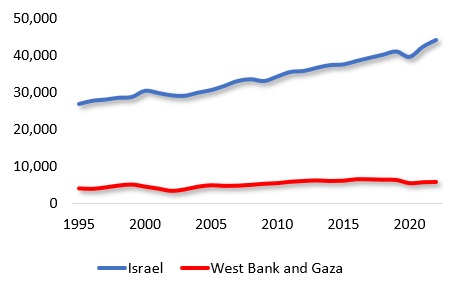
Despite all the hoopla by the Trump and Biden administrations that the Middle East is at the “cusp of peace and prosperity,” Palestinian per capita income has actually fallen behind. It’s now 12.9% compared to the Israeli level. That’s over 2 percentage points lower relative to where it was over two decades ago. Things have not got any better in the Palestine; they’ve got a lot worse (Figure).

Figure 1. Per capita income in Israel and West Bank/Gaza, 1995-2023FIG

GDP Per Capita PPP: Israel Vs West Bank and Gaza (1995-2023). Data from World Bank

This conclusion is supported by the new IMF report warning that “amid a deteriorating security, political and social situation, [Palestinian] per capita income is projected to decline over the medium term.”

So, how does the Palestinian stagnation compare with that of black South Africans in the days of institutionalized racism?

During the period of apartheid (1948-94), the per capita income of South Africa’s blacks relative to the whites climbed from 8.6% to 13.5%. Compared with South African blacks, the Palestinians’ starting point was almost twice as high in relative terms. But now it is lower than that of South Africa’s blacks at the end of the apartheid. The reversal has occurred during the Trump and Biden administrations.

In absolute terms, Israeli per capita income is today at par with the UK and higher than in Italy. By contrast, Palestinian per capita income is estimated at $5,700, which is lower than that of Nigeria and Cambodia; barely ahead of Myanmar.

And worse looms ahead.

Israel’s drift toward autocracy

The Israeli judicial reform is a series of changes to the judicial system and the balance of powers in Israel that was proposed in January. The arguments concern the so-called Reasonableness Amendment, which was passed by Israel’s parliament, the Knesset, in late July. This amendment seeks to curb the judiciary’s influence over lawmaking and public policy. It reflects Israel’s descent toward autocracy.

Under the Netanyahu government, Israel has experienced a deepening divide, as the coalition teeters on a precarious electoral majority. It comprises the conservative Likud party, along with Orthodox and the nationalist religious and the controversial Jewish supremacist factions, which advocate ethnic cleansing in Occupied Territories and a Greater Israel.

After a year of unprecedented events, Israel’s political and constitutional turmoil came to a head on Sept. 12, when the Supreme Court heard oral arguments in the critical case that will determine the future of the Netanyahu government’s judicial overhaul. However, it will also have chilling implications for Palestinian rights.

After all, Israel’s judiciary, mainly its Supreme Court, has regularly upheld policies, practices and laws that help enforce “Israel’s system of apartheid against Palestinians,” including upholding administrative detentions, green-lighting the destruction of villages, upholding a law imposing restrictions on family reunification.

In the past, the Supreme Court has intervened in protecting Palestinian human rights on few occasions. But if the institution loses power to the government, even this “slim and inconsistent” protection would likely disappear. Autocracy would codify apartheid.

That’s another motive for the ongoing offensive.

No peace without development

Today, there are some 5.4 million Palestinian refugees in the West Bank and Gaza, and millions more in the proximate countries, such as Jordan, Lebanon, Syria and internationally. But it is the Palestinians in the Israeli Occupied Territories that find themselves at the edge of an abyss.

Israel has a right to defend itself, and so do the Palestinians.  

With the ongoing war, the Israel/Palestine status quo has entered an entirely new, potentially far more desperate, lethal and coordinated stage. From an economic perspective, the apartheid conditions are pushing Palestinians to a nightmare that’s purely and simply untenable. Worse, the militarization of the crisis is likely to make things far worse before they get any better.    

Half a century of policy mistakes in the Middle East by the key stakeholders should be an adequate warning. Assertive pledges of “national security” will never achieve an enduring peace in the region or elsewhere. That requires inclusive economic development.

About the Author

Dr. Dan Steinbock is the founder of Difference Group and has served at the India, China and America Institute (US), Shanghai Institute for International Studies (China) and the EU Center (Singapore). For more, see http://www.differencegroup.net/    

From Office to Table – How Group Dining Elevates Team Dynamics

In today’s fast-paced business environment, building a cohesive and harmonious team is more crucial than ever. While boardroom discussions and workshops have their place, the magic often lies in the more intimate moments shared away from the workplace. Among these, shared meals stand out as a timeless way of forging bonds, reinforcing team dynamics, and nourishing the collective spirit of an organization.

A Brief History of Communal Eating

From the banquet halls of ancient Rome to the bustling community feasts of Asia, communal eating has always held a special place in human society. These gatherings were not merely about sustenance but symbolized unity, celebration, and mutual respect. Whether it was the Maori of New Zealand sharing a ‘hangi’ or the Vikings hosting grand feasts, communal meals have always transcended geographical and cultural boundaries, acting as a bridge that brought communities together.

The Science Behind Shared Meals

Modern psychology endorses what ancient societies instinctively knew. Sharing a meal promotes interpersonal connections. A study from Oxford University found that those who eat socially are more likely to feel happier and more content than those who eat alone. Furthermore, communal eating fosters trust and understanding among participants, laying the groundwork for stronger interpersonal relationships.

Group Dining in the Corporate Realm

The corporate world, with its ever-evolving demands, has begun to recognize the potential of group dining as an impactful team-building strategy. Beyond the delightful dishes and beverages, such gatherings offer a respite from daily work stress, encourage informal conversations, and lead to the formation of bonds that go beyond professional ties. When teams dine together, they learn together, laugh together, and ultimately work better together.

A Tale from Opa Orlando: Nourishing Teams & Boosting Morale

Jane Smith, a dedicated manager at a leading tech firm, noted the subtle undercurrents of stress and disconnect among her team members. Determined to break the ice, she booked a table at Opa Orlando, known for its inviting space and group dining arrangements. The evening was filled with laughter, light-hearted conversations, and culinary delights. Reflecting on the experience, Jane remarked, “After our team dinner at Opa Orlando, not only did we get to know each other outside of work, but we also saw a noticeable uptick in team collaboration and productivity. It was an investment worth every penny.”

Ambiance & Setting – The Unsung Contributors

While food is undoubtedly the star, the ambiance and setting of a dining venue significantly enhance the overall experience. An open, well-lit space with comfortable seating, like that of Opa Orlando, can foster open conversations. The backdrop, music, and even table arrangements play subtle roles in setting the mood for positive interactions and connections.

Challenges in Group Dining & Overcoming Them

Group dining, though beneficial, comes with its set of challenges. Dietary restrictions, preferences, and scheduling conflicts can act as deterrents. However, with meticulous planning, open communication about preferences, and choosing a versatile dining venue catering to diverse tastes, these hurdles can be effortlessly overcome.

From Casual Banters to Constructive Brainstorms: Evolving Conversations

It starts with a casual chat about a TV show and, before you know it, morphs into a brainstorming session about the next big project. Such is the power of informal settings. Dining tables often become melting pots of ideas, where the boundaries of hierarchy blur, and innovative ideas are born out of candid conversations.

The Future of Group Dining in Team Building

The essence of team building lies in shared experiences. As businesses evolve and team dynamics shift, the age-old tradition of group dining remains a constant, reminding us of the simple joys of shared meals. In the hustle and bustle of corporate life, perhaps it’s time for more businesses to pause, dine, and reconnect.

Understanding APY: The Bedrock of Smart Financial Decisions

In the labyrinth of financial terminologies, few concepts hold as much weight as APY, or the Annual Percentage Yield. For both novice investors and seasoned finance professionals, understanding APY is paramount for making informed decisions. While the definition might seem intimidating at first, grasping its essence can lead to more efficient wealth management and growth. Let’s unravel the intricacies of APY and understand why, more than ever, an APY calculator can be a game-changer in one’s financial journey.

What Exactly is APY?

APY stands for Annual Percentage Yield. It represents the real rate of return on an investment, factoring in the effect of compounding. In simpler terms, it not only considers the interest earned on the principal amount but also the interest accumulated on previously earned interest. Therefore, APY offers a holistic view of the potential gains from an investment.

Why APY Matters?

There’s a myriad of financial metrics available, so why does APY stand out?

  • True Reflection of Returns: Unlike the simple interest rate which only considers interest on the principal, APY encapsulates the power of compounding. It provides investors with a clearer picture of what they stand to earn over time.
  • Standardization Across Financial Products: Whether you’re comparing savings accounts, CDs, or other interest-bearing products, APY provides a uniform metric for evaluation, eliminating the apples-to-oranges problem.
  • Facilitates Informed Decision-making: With a grasp on APY, one can determine which investments offer the best returns for their financial objectives, leading to optimized wealth growth.

How to Calculate APY?

Calculating APY can seem daunting given its formulaic intricacies.

Understand the Variables

  • Nominal Interest Rate: This is the basic interest rate of the investment or loan without considering compounding.
  • Compounding Periods: Determine how often interest is added to the principal in a year (e.g., annually, semi-annually, quarterly, monthly, daily).
  • Time: This is the length of the investment or loan.
  1. Start with 1: Begin your calculation by taking the number “1”.
  2. Add the Nominal Interest Rate divided by the Number of Compounding Periods: If you have a 4% interest rate that’s compounded quarterly, you’d divide 4% (or 0.04 in decimal form) by 4 (because there are 4 quarters in a year).
  3. Raise the Result to the Power of the Number of Compounding Periods: Using the same example, you would take the result from the previous step and multiply it by itself three more times (since it’s compounded quarterly).
  4. Raise the Result to the Power of the Time (in years): If your investment or loan is for multiple years, multiply the result by itself for the number of years you have.
  5. Subtract 1: After you’ve obtained your ultimate value, subtract 1 from it..
  6. Convert to Percentage: To calculate the APY, take the final result and multiply it by 100 to express it as a percentage.

While this formula provides a precise calculation, the process can be tedious, especially when comparing multiple options. This is where tools like the APY calculator come to the rescue, offering instant calculations and clarity.

Using APY to Your Advantage

APY, or Annual Percentage Yield, serves as a compass in the vast financial landscape, directing individuals toward sounder investments and savings decisions. By incorporating compounding effects, APY provides a realistic picture of potential returns, surpassing the mere nominal interest rate. When evaluating financial products, always prioritize those with higher APYs, as they offer superior returns. 

Additionally, comprehend the compounding frequency: the more frequent the compounding, the higher the APY and, consequently, the potential returns. Always ensure to juxtapose APYs when shopping for savings accounts, certificates of deposit, or other interest-bearing instruments. This ensures that you’re not lured by superficially high interest rates that might result in lesser yields over time. In essence, by mastering APY and its nuances, you place yourself in a strategic position to maximize wealth growth and achieve your financial objectives with greater precision.

Conclusion

In the dynamic world of finance, APY emerges as a beacon of clarity. It cuts through the noise, providing a straightforward metric for evaluating the real returns on investments. And in today’s digital age, with tools like the APY calculator at our fingertips, leveraging this knowledge has never been easier. Dive into the nuances of APY, and equip yourself for smarter, more informed financial decisions.

Critical Analysis of Banking Innovations: The Role of Power Influencers

Banking innovations continue to unfold with each advancing technological front, molding the financial landscape. Within this dynamic, power influencers play an indispensable role, acting as catalysts and navigators of change. This article offers a critical analysis of their impact, shedding light on the nuanced interplay between innovation and influence.

Banking Innovations Landscape

The realm of banking innovations is vast and perpetually evolving, with a constant introduction and refinement of technologies and methodologies designed to streamline, secure, and expand financial services. 

Defined by the infusion of progressive technologies and the relentless evolution of digital banking platforms, the landscape mirrors the sector’s commitment to efficiency and alignment with the changing needs and expectations of the global consumer base.

Technological Infusion

  • AI and machine learning empower banks to offer personalized services, enhancing customer experience and loyalty. Smart banking systems learn and evolve with user behavior, providing tailored financial advice and risk assessment.
  • Blockchain technology ensures secure, transparent, and fast transactions, fostering trust among users and diminishing financial fraud risks.
  • Advanced data analytics allows for a more profound understanding of customer behaviors and preferences, facilitating targeted marketing and improved service delivery.
  • Cybersecurity innovations provide robust protections against fraud and breaches, safeguarding both institutions and their customers’ assets and data.

Digital Banking Evolution

  • Mobile banking apps revolutionize accessibility, allowing users to manage accounts, conduct transactions, and seek customer service from virtually any location.
  • Open banking initiatives, supported by APIs, facilitate seamless integration between different financial services, fostering a collaborative financial ecosystem.
  • Financial management tools integrated into digital platforms empower users with real-time insights and recommendations to manage their finances effectively.

  • Innovative payment solutions, including contactless and biometric authorization technologies, streamline transactions, making them quicker and more secure.

Role of Power Influencers

Power influencers stand at the confluence of technology, finance, and public opinion, wielding a remarkable ability to shape the narrative and acceptance around banking innovations. With extensive networks, deep industry understanding, and social capital, they can drive technology adoption, contribute to regulatory discussions, and significantly influence the pace and direction of innovation in banking.

Driving Adoption

  • Power influencers expedite the adoption of new technologies by leveraging their networks and credibility.
  • Through content creation, thought leadership, and strategic partnerships, influencers facilitate knowledge dissemination about emerging banking technologies.
  • Influencers’ active participation in various forums and events amplifies their voice and reach, making them more effective in promoting new technologies.
  • Endorsement from respected influencers can significantly shorten the time it takes for a new technology to be accepted and adopted by the mainstream.

Shaping Regulatory Landscape

  • Influencers engage with policymakers and regulatory bodies, offering insights and recommendations pertinent to innovative banking solutions governance.
  • Influencers participate in public discourse and advocacy, shaping societal perceptions and expectations regarding banking innovations.
  • Their engagement also ensures that the regulatory environment evolves in tandem with technological advancements, providing necessary support and oversight.
  • Influencers play a crucial role in bridging the communication gap between technologists and policymakers, fostering mutual understanding and collaboration.

Implications of Influence

The impact of power influencers in the banking innovation sector is multifaceted, casting both a positive and a potentially challenging shadow over the industry. While influencers stimulate market dynamics, generate consumer interest, and foster an environment conducive to the adoption of innovative solutions, it is crucial to address and navigate the potential pitfalls and ethical dilemmas associated with their influence.

Positive Impact

  • Influencers act as a bridge between technological possibility and practical utility, translating complex innovations into understandable and applicable solutions for the masses.
  • Endorsement from influencers generates demand and stimulates consumer interest, supporting the commercial viability and success of banking innovations.
  • Through networking events and social platforms, influencers facilitate connections between innovators, investors, and institutions, fostering collaboration and synergy in the industry.
  • Influencers provide valuable feedback and insights to innovators and firms, helping refine and improve products and services before they hit the market.

Potential Pitfalls

  • Undue influence can distort market dynamics, leading to the undue prominence of certain technologies.
  • Ethical considerations arise when influencers do not disclose their affiliations, investments, or interests in promoted technologies.
  • Over-reliance on influencers might stifle internal innovation and critical evaluation within institutions, as they might blindly follow influencer endorsements.
  • The rapid spread of misinformation or hype by influencers can lead to market bubbles and subsequent crashes, harming investors and the industry.

Conclusion

As architects of perception, power influencers wield significant sway in the realm of banking innovations. Their influence accelerates adoption and fosters a favorable environment for technological growth but also brings forth implications that necessitate careful consideration. 

Understanding their role and impact is essential for navigating the modern financial services industry, enabling stakeholders to effectively leverage the relationship between influence and innovation to maximize the benefits of emerging banking technologies. 

For readers interested in practical applications of these innovations, particularly for Limited Liability Companies (LLCs), we recommend checking out Money Control’s  insightful article

This piece offers valuable information about the best business bank accounts designed to meet the unique needs of LLCs, shedding light on options that seamlessly integrate the latest in banking innovations for optimized financial management and transactions.

Why Businesses Must Lead the Charge in Energy Procurement Strategies

By Ruari Cairns

The Intersection of Climate Crisis and Rising Energy Costs

In today’s world, where the pressures of a burgeoning climate crisis meet the harsh reality of rising energy costs, businesses find themselves at a pivotal crossroads. Recent actions by Ofgem, such as the reduction of the energy price cap for consumers, have provided a glimmer of hope for households grappling with ever-increasing bills. However, the same reprieve does not extend to businesses, as government support for them remains static – anchored only by the Energy Bill Discount Scheme (EBDS) introduced at the start of the year – and timelines to achieve key green pledges have been dragged out. This contrast underscores the critical need for businesses to take their sustainability and energy procurement strategies into their own hands. 

The Current Energy Landscape 

In the ever-evolving energy landscape, the recent surge in oil prices has sent shockwaves through global markets. Oil prices are hurtling toward the century mark, with forecasts of reaching $100 per barrel in 2023, marking a significant milestone for the year. This upward trajectory, nearly 30 percent since June, has been attributed to a combination of factors, including production cuts by Russia and Saudi Arabia, and surging demand from China.  

As the world’s energy dynamics continue to shift, businesses are confronted with the urgency of proactively managing their energy procurement strategies in an environment marked by heightened price volatility. 

Government Support and Its Limitations 

The EBDS has been a help to businesses – but the government has shown a lack of agility in adapting to the dynamic energy market. As it gradually scales back its support – EBDS ends in March 2024 – businesses must actively seek alternative solutions to their energy woes. Fundamentally, the situation requires a change in mindset – from one of reliance on external assistance to one that prioritises active management of energy procurement strategies.     

Seizing Control: The Imperative for Businesses  

In short, a forward-thinking approach to energy sourcing and pricing involves businesses evaluating their energy mix, exploring innovative technologies, and adopting sustainable practices. This is the way to mitigate the impact of energy costs – all while aligning operations with sustainability objectives. 

Good energy procurement is an opportunity – not a burden. By investing in the right strategies and technologies, businesses can reduce costs and enhance sustainability – a duality that serves as a linchpin for long-term success, both from an economic and environmental standpoint. 

The Intersection of Savings and Sustainability 

Let’s explore this in more detail. The pursuit of greener and cheaper energy sources is not a zero-sum game. The reality is that renewable energy solutions, energy efficiency enhancements, and demand-side management practices, for example, are both cost-saving measures and crucial contributors to a more sustainable future. 

Plus, in a world where customers, investors, and stakeholders increasingly demand businesses to take an assertive stance on environmental responsibility, integrating sustainability into energy procurement strategies can bolster a company’s reputation and market position. 

The Holistic Approach to Energy Procurement 

Effective energy procurement strategies encompass a holistic approach that extends beyond simply selecting the lowest-cost energy source. Instead, businesses should consider various factors, such as the reliability of energy supply, the environmental impact of their choices, and the potential for future cost volatility. 

This requires a nuanced understanding of the energy market, which can be facilitated through data-driven analytics and expert guidance from the likes of True, powered by Open Energy Market. 

Calling upon energy procurement specialists and real-time data modelling on energy consumption ensures that businesses can remain flexible and adaptable in their approach to energy sourcing. The energy landscape is in a state of constant flux, with regulatory changes, technological advancements, and market dynamics continually reshaping the terrain. Staying ahead of the curve demands benefitting from the expertise of specialists with a willingness to innovate and embrace new opportunities for negotiating competitively priced energy contracts – such as Power Purchase Agreements (PPAs) and decentralised energy solutions – in a way that best suits the specific needs and energy usage patterns of each business.

Case Study

Trelleborg Group is a global leader in the engineering and production of polymers. Polymers are long chains of molecules that serve as building blocks in rubber and plastics, and they are necessary for creating sealing used across the aerospace, oil & gas, hydropower industries.  

As an international organisation, Trelleborg is committed to reducing its energy consumption and carbon emissions and, within the UK the company has recently completed a major sustainability transformation. 

  • Energy consumption decreased by 28% 
  • 100% transition to renewable energy across 19 UK sites 
  • Solar, EV Infrastructure & True platform fully implemented 

The True platform helped the team to understand where the largest areas of consumption were concentrated and where energy could be saved, resulting in a 28% reduction in usage.  

Working with the True team, Trelleborg was provided with clear and concise information relating, not only to its own energy consumption, but also the fluctuations impacting the price of energy within the UK market.  

This ensured that forecasting on energy costs could be accurately planned and mitigated for if increases were expected.  

“For me the benefit of True, is the team has instilled confidence in a market that has been lacking in transparency – I believe that the type of business that we are in we need to look at long term, and for me, True, powered by Open Energy Market is a long-term business partner, rather than a two three or a four-year proposition.” 

Colin Farrell, Global Sourcing Specialist

The Road to Long-Term Success

In a world where the climate crisis intersects with a volatile energy landscape, businesses face a pivotal moment. Government support, while valuable, is not a long-term solution, placing the responsibility squarely on businesses to take the lead in managing their energy mix. 

The good news is that energy procurement, when approached effectively, can reduce costs while championing eco-responsibility. And in the modern business world, a convergence of economic prosperity and environmental stewardship is the key to enduring success.  

As the energy landscape evolves, those who actively manage their energy procurement strategies will not only weather the challenges but also emerge as changemakers in a new era of energy sustainability and resilience. 

For more information about energy procurement strategies and net-zero technologies, visit https://www.truezero.tech/

About the Author

Ruari CairnsRuari Cairns is the Director of Risk Management and European Operations at True, powered by Open Energy Market 

Innovations in Payment Technologies – Shaping the Financial Future of Online Gambling

Have you ever wondered what fuels the amazing rides that are online casinos? Is it the excitement of reels or the dancing cards on your screen that Dallasnews.com offers you every day? Well, what actually holds this world together in a subtle yet meaningful way is the interesting work that dollars and cents do behind the scenes.

Just try to think beyond the clink of coins in a slot machine. It’s a whole revolution that shapes how you bet and how you win. From the familiar plastic you feel when you use your credit cards to the exciting world of cryptocurrencies with the futuristic fingerprint scan, the way you handle your betting funds is getting a new face.

Convenience isn’t the only thing that matters now. Today, the very essence of how online casinos operate financially is what makes payment methods easy and convenient. Now, let’s begin this unwrapping of the financial layers behind transactions and see how innovations in payment technologies shape the future of online gambling.

Emerging Trends in Online Gambling Payments

So, let’s begin by breaking down some of the most important emerging trends when it comes to payment methods for online casinos. It doesn’t matter if you want to know the quickest way to cash in the best online casino welcome bonus or if you’re more interested in making sure your money is safe because these payment options will take care of you. All you have to do is enjoy your favorite games.

E-Wallets – Simple and Quick

Today, E-wallets are the cornerstone of the online payment world. Take PayPal, for example. With an e-wallet, you load some cash into a digital account, and then, when you’re gaming, it’s always available, just one click away. There’s no need to keep entering your card details every time. It’s quick and straightforward, and it’s gaining popularity because, well, who doesn’t like things to be easy?

Pay with Your Phone

Can you imagine this – you’re in the middle of a winning streak, and instead of fumbling for your credit card, you just tap your phone. Nothing more. That’s the magic of mobile wallets, like Apple Pay or Google Pay, for example. It’s not just a convenient way to pay. Instead, it helps you keep the gaming momentum going. There’ll be no more interruptions, just more play.

Cryptocurrency

Bitcoin and its relatives aren’t just for tech geeks. They’re gaining ground in online gambling because they actually come with some perks. Faster transactions mean less waiting around, and more privacy than you ever had will add an extra layer of security. If you’re curious about digital currencies in general, this trend is really worth exploring for all your online gaming transactions.

Fingerprint and Face Scans

Do you ever think about that your fingerprint is the VIP pass to your gaming account and a quick face scan is the security guard that decides who will be allowed inside? Well, this technology is like having your own personal security detail. Biometric authentication is the techy way of saying your unique features are your password. Remember that every extra layer of protection only fortifies your account with tougher walls. This is what makes you safe from all those cybercriminals.

Financial Implications of Payment Innovations

Now that you know the most important emerging trends, let’s see how exactly these fancy payment innovations can shake up the financial scene in online gambling:

Streamlining Transactions

One of the most important perks of these payment innovations is speed. Do you remember the days of waiting for a bank transfer to clear? Well, those days are getting shorter and shorter. E-wallets, mobile payments, and cryptocurrencies are revolutionizing everything! Transactions happen almost instantly, which means you won’t have to spend so much time on unnecessary waiting.

Enhanced Security Measures and Fraud Prevention

Now, let’s expand the security aspect from fingerprints and face scans. In the online gambling world, trust is everything. The good news is that all of these payment innovations come with the best available security features. Whether it’s the encryption you can find in e-wallets or the decentralized nature of cryptocurrencies, you’ll feel much more secure about all your transactions. It’s important to mention that this is a win-win situation for online casinos. After all, happier players who cherish security are likely to stick around, and that means a healthier bottom line.

Cost-Benefit Analysis for Online Casinos

Implementing new payment methods comes with a cost, yes, but the benefits far outweigh the expenses. Faster transactions allow for a more dynamic gaming environment which always attracts more players. Better, more modern security measures not only protect players but also safeguard the casino’s reputation itself. In the end, the initial investment in upgrading payment systems is a strategic move that always pays off in the long run and it also creates a healthier financial ecosystem for the online casino.

Difference Between PMax and Display Campaigns on Google Ads

As a PPC agency London, we can tell you undoubtedly that Google Ads offers a plethora of advertising options, each tailored to your specific business goals and strategies. Two popular choices are PMax (Performance Max) campaigns and Display campaigns. Before you put down any money on either of these, here are the key distinctions between PMax and Display campaigns on Google Ads so that you can make informed choices for your online advertising efforts.

Performance Max (PMax) Campaigns

Performance Max campaigns, introduced by Google, are designed to simplify and maximise campaign performance across various Google properties and networks. PMax is an automated campaign type that leverages machine learning and automation to deliver your ads to potential customers in real-time across Google’s vast ecosystem, including Google Search, YouTube, Display Network, Discover, and Gmail. 

This means that PMax campaigns extend beyond the traditional Google Display Network. They allow your ads to reach potential customers across Google’s diverse properties, making it easier to connect with your audience where they are most engaged.

PMax campaigns are also highly automated. Google’s machine learning algorithms optimise ad placements and budgets dynamically, ensuring that your budget is used efficiently to achieve your desired campaign goals.

Moreover, setting up PMax campaigns is streamlined and user-friendly. Advertisers define their campaign objectives, provide ad assets, set budgets, and let Google’s algorithms do the rest.

PMax campaigns operate on a goal-based bidding system. Advertisers specify their target cost per action (CPA) or target return on ad spend (ROAS), and the campaign is optimised to achieve these goals efficiently.

PMax campaigns support a variety of ad formats, including text, image, video, and shopping ads. This versatility ensures that your ads are presented to users in engaging and effective ways.

Google’s algorithms analyse user behaviour and intent in real time to identify the most promising opportunities for ad placements. This means that your ads are continuously refined to maximize performance.

Display Campaigns

Display campaigns, on the other hand, are part of the Google Display Network (GDN), one of the largest advertising networks globally. These campaigns primarily focus on displaying visual ads (banners, videos, etc.) on websites, apps, and platforms within the GDN.

These campaigns are mostly visual, featuring a variety of ad formats, including image ads, video ads, responsive ads, and more. Display campaigns also have the potential to reach over 90% of internet users worldwide through the GDN. This expansive reach enables small businesses to connect with audiences they might not otherwise reach.

Furthermore, Display campaigns support an array of ad formats, making it possible to create visually engaging and interactive ads that capture users’ attention effectively.

Google Ads provides extensive targeting options for Display campaigns. You can target specific demographics, interests, and behaviours, and even remarket to users who have previously interacted with your website or ads.

What’s more is that Display campaigns offer flexible budgeting options, which allow small businesses to set daily or campaign-level budgets based on their financial constraints. This means that with a variety of bidding options, including cost-per-click (CPC) and cost-per-thousand-impressions (CPM), businesses can optimise their ad spend to maximise results.

Lastly, Google Ads provides detailed insights into ad performance, enabling businesses to monitor key metrics and make data-driven optimisations.

Campaign Control

  • PMax: PMax campaigns are automated, meaning they require minimal manual intervention. Google’s algorithms determine where and when to show your ads based on campaign goals, budget, and targeting settings.
  • Display: Display campaigns offer more manual control over ad placements and targeting options. Advertisers can select specific websites, placements, or audiences to target.

Ad Formats

  • PMax: PMax campaigns support various ad formats, including text, image, video, and shopping ads. They are versatile and can adapt to different ad formats and sizes across Google’s networks.
  • Display: Display campaigns primarily focus on visual ad formats like image and video ads. While text ads are also an option, the emphasis is on visual content.

Placement

  • PMax: PMax campaigns extend beyond the Google Display Network, covering various Google properties like YouTube, Search, Discover, and Gmail. Ads are placed dynamically to reach potential customers across Google’s ecosystem.
  • Display: Display campaigns are confined to the Google Display Network, consisting of a vast network of websites, apps, and platforms where your ads can appear.

Budget and Bidding

  • PMax: PMax campaigns operate on a goal-based budget system. Advertisers set a target cost per action (CPA) or target return on ad spend (ROAS), and Google’s algorithms manage the budget allocation to maximise performance.
  • Display: In Display campaigns, advertisers have more control over budget allocation and bidding strategies. They can set manual bids, control daily budgets, and adjust bids for specific targeting options.

Targeting

  • PMax: PMax campaigns offer automated audience targeting. Google’s algorithms analyse user behaviour and intent to reach potential customers likely to convert.
  • Display: Display campaigns provide extensive targeting options, including demographics, interests, keywords, placements, and remarketing. Advertisers can fine-tune their audience segments.

Choosing the Right Campaign Type

If you are looking for a hands-off approach to online advertising, PMax should be your go-to. They are well-suited for those with performance-focused goals and a desire for broad online visibility.

Display campaigns are suitable for businesses seeking more granular control over ad placements and targeting. They are a great choice when you want to specify where and to whom your ads appear.

Understanding the differences between PMax and Display campaigns on Google Ads is essential for small businesses to make informed advertising decisions. To review, PMax offers automation and broad reach, while Display campaigns provide control and customisation options. What you eventually choose should align with your business objectives, budget, and desired level of involvement in your advertising strategy.

Swifty Global’s Remarkable Journey, Highlighting its Transformative Growth Since its Days as Dear Cashmere Holding Co.

In the world of finance and technology, Swifty Global, formerly known as Dear Cashmere Holding Co (OTC: DRCR), has experienced a meteoric rise that has reshaped the industry. This article explores Swifty Global’s remarkable journey, highlighting its transformative growth since its days as Dear Cashmere Holding Co and showcasing its current status as an industry leader. Additionally, we’ll delve into the pivotal role played by its subsidiary, Swifty Gaming, in the company’s expansion and success.

Swifty Global’s transformation from Dear Cashmere Holding Co marked a pivotal moment in its history. What began as a traditional financial entity has evolved into a cutting-edge technology and finance powerhouse.

The year 2022 witnessed Swifty Global’s transformation into an industry leader. The company successfully obtained multiple licenses and launched a range of innovative products, including its proprietary swipe betting Sports Predictions App, traditional Sportsbook, Casino Gaming platforms, and a global digital wallet. These strategic moves laid the foundation for a year of unparalleled growth.

Swifty Global’s growth trajectory is a testament to its vision and determination. The company expanded its operations across multiple jurisdictions, allowing it to operate in five countries. This global reach positioned Swifty Global as a prominent player in the finance and technology sectors.

Swifty Gaming, a subsidiary of Swifty Global, played a pivotal role in the company’s transformation and growth. With a focus on revolutionizing the gambling and sports betting sector, Swifty Gaming introduced innovative technologies and user-centric design principles. Its contributions extended beyond financial success, fostering a loyal customer base, and setting new industry standards.

Swifty Global’s commitment to excellence was evident in its Q1 2023 financial results. These results, compared to the same period in 2022, showcased exponential growth. Revenues surged to an impressive $19 million in Q1 2023, a remarkable increase from $165,000 in Q1 2022, marking a quarter-over-quarter growth of 11,500%. This remarkable financial success highlights Swifty Global’s capacity to execute its vision with precision.

James Gibbons, the CEO of Swifty Global, has been the driving force behind the company’s transformation and growth. His leadership and unwavering commitment to innovation have set the stage for Swifty Global’s exceptional achievements. Gibbons’ vision for a company that combines technology, finance, and customer-centric solutions is at the heart of Swifty Global’s success.

Nicolas Link, the Chairman of Swifty Global, recognizes the significance of the company’s strategic moves and acquisitions. He emphasizes that Swifty Global’s growth and expansion are not just aspirations; they are tangible achievements. The acquisition of new technology and the addition of valuable team members position Swifty Global for continued success.

Swifty Global’s journey from Dear Cashmere Holding Co to its current identity is a testament to its unwavering commitment to innovation, growth, and excellence in the finance and technology sectors. With visionary leadership, strategic acquisitions, and a focus on expanding its global footprint, Swifty Global has redefined the industry.

As Swifty Global continues to explore new horizons and push the boundaries of what’s possible in finance and technology, its remarkable growth and transformation serve as an inspiration to the entire industry.

EDITOR'S PICK OF THE WEEK

CFO's new mandate. CFO explaining the presentation

The Performance and Transformation Orchestrator: The CFO’s New Mandate in the Age of AI

By Terence Tse CFOs are evolving into AI-driven transformation orchestrators, balancing finance, technology, and strategy while upskilling teams, managing risks, and driving measurable business value. A key insight from this year’s AI for CFOs event, organized...

WISE DECISION MAKER GUIDE

POWER INFLUENCERS

Emerging Trends

The Future of Global Trade