Home Blog Page 255

Neocolonialism: An Analysis of International Factors on the Development of the Global South

By Kalim Siddiqui

Can former colonies truly get out from under the grip of developed countries? How has the economic, technological, and military advantage of powerful countries influenced the long-term development of weaker countries? These and more are the topics explored in this essay.

Introduction

This article demonstrates that neocolonialism is inevitable, given the structure of colonial institutions that were intended to foster dependency, a reality that undermines independent development and the sovereignty of the former colonies. Economically, neocolonialism has some similarities with colonialism, and it is exploitative. It may lead to growth, but due to the dominance of foreign interests, in the long term, it cannot build domestic industries and long-term development. Moreover, corruption, which cannot thrive without foreign support, and nepotism often impede the realisation of long-term economic development in developing countries (Siddiqui, 2015).

We look at the neocolonial threat to the independence and sovereignty of Niger, which has been facing inequitable resource outflows to France for a long period.

It seems that economic and trade relations are important and contributed to the deepening crisis between France and its former West African colonies. In an idealistic situation in the capitalist economic system, international trade and production are supposed to be undertaken independently between countries and no one would have the power to influence and set prices. It is hoped that trade among countries is made to benefit all partners. However, in the real world, this may not be true, and unequal relations exist, including neocolonialism practiced by the economically, technologically, and militarily powerful countries. Neocolonialism leads to undermining the sovereignty of the weaker countries, which makes them a victim of unequal trade, as the more powerful countries use international organisations to plunder the resources of the poor countries (Amin, 1976; Siddiqui, 2022a).

introductionIndeed, unequal trade perpetuates inequality between nations and makes the capitalist system vulnerable and unsustainable over the long term. We look at the neocolonial threat to the independence and sovereignty of Niger, which has been facing inequitable resource outflows to France for a long period. The unfair resource transfer shows that Niger receives only 3.2% of the ultimate value-added of the electricity that the French energy firms generate using Niger’s raw uranium. Niger is the fourth-largest producer of uranium in the world, but its price is determined by the foreign corporations. Niger is also an oil-exporting country since 2010. In contrast to its huge natural resources, Niger is still one of the poorest countries in the world. It seems that richness in resources has been a curse instead of a blessing.

Although many ex-colonial countries gained political independence after the Second World War, global economic structure remained, sometimes taking different forms and shapes. In fact, unequal exchange and devaluation of labour and resources from the developing countries continued. International financial institutions and the West always encouraged them to produce and export primary commodities leading to over-supply and adverse terms of trade. Also, rising foreign debts and the balance-of-payment crisis became endemic. Moreover, food import dependency made poor countries more vulnerable to global food prices. More debts were taken to repay the old debts, but rather than coming out of the debt spiral, the poor countries were caught in the debt trap.

After independence, the poor countries aimed to follow economic self-sufficiency and ‘‘import substitution policy’’ and strengthen the local industries and agriculture but there was a lot of resentment from the West to stop it (Siddiqui, 2021a). In the 1980s and 1990s, many developing countries experienced a debt crisis and undertook neoliberal reforms on the International Monetary Fund´s (IMF) advice. They had to abandon import substitution industrialisation (ISI) and economic self-sufficiency policy in exchange for debt relief. The pro-market reforms included full-scale privatisation, trade, and financial liberalisation. Why are the neoliberal reforms so good for developed countries but damaging for poor countries? Because it allows foreign corporations to enter their economies without any local regulation.

For example, although Sri Lanka’s period of “colonialism” with direct political control by Britain ended with its independence in 1948, the socioeconomic and cultural forces set in place during the colonial period have continued to dominate the island’s development. However, soon after independence, Sri Lankan governments, like those of many ex-colonial countries, introduced policies to nationalise foreign-owned plantations and other foreign-owned enterprises to foster local industries.|

However, in 1977 the IMF and the World Bank asked the newly elected Sri Lankan government to introduce an open economy, meaning giving free rein to foreign investment and imports. Take, for example, Sri Lanka’s 2022 economic crisis largely portrayed by the media as an internal phenomenon due to corruption and mismanagement of the local government. I think the crisis is rooted in the prevailing global economic and financial system. This is not a particular situation in Sri Lanka. The UNCTAD (2022) report points out that 60% of low-income countries are close to facing debt crisis. This means that these governments cannot provide basic needs to their people.

figure 1
Source: Congressional Research Services

In the first half of the 20th century, the two World Wars weakened European powers and the US (United States) became a new hegemon. Asian and African countries, after gaining independence, participated in the Bandung Conference in Indonesia in 1955, where they stressed the importance of both political and economic independence. Neocolonialism means that the sovereignty of the nations has been robbed and their natural resources are stripped and stolen. The US claims that it supports democracies and human rights in developing countries, but past experiences indicate that the US has overthrown many democratically elected governments (Siddiqui, 1990a) and installed authoritarian regimes in developing countries. For example, the US invaded a number of countries such as Korea (1950), Cuba (1961), South Vietnam (1965), Grenada (1983), Lebanon (1983), Panama (1989), Philippines (1989), Somalia (1992), Haiti (1994), Afghanistan (2001), Iraq (2003), Syria (2014), Libya (2015), (See Figure 1) and the US also organized to overthrow Mosaddegh’s government in Iran (1953), backed military takeovers in Guatemala (1954), Congo (1961), Brazil (1964), Indonesia (1965), Chile (1973), Pakistan (1977), Egypt (2013), Pakistan (2022), and many more.

It appears that Congo has suffered the worst rip-off of its minerals such as diamonds, uranium, and cobalt which were smuggled and sold abroad.

For example, in 1953 the US and the UK organised a coup to remove democratically elected Iran’s Prime Minister Mr Mosaddegh. The coup destroyed the evolution of democracy in Iran. The US realised that democracy does produce wrong persons and it does not serve US strategic and business interests. The coup was financed by the US and UK intelligence services who then bribed local civilian and military officials to remove the elected government. Mosaddegh was replaced by dictatorial Shah who imposed brutal repression by SAVAK, which was trained and equipped by the CIA. The coup not only crushed peoples’ democratic aspirations but enriched US oil companies by immediately signing to hand over more than 40% of the Iranian oil assets to US oil companies. Iran also bought billions of dollars in weapons from the US.

The President of Indonesia, Sukarno, due to his non-aligned policy and growing ties to China, was not liked by the US and was removed in a military coup in 1965 instigated by the US. The most striking case was that of Thomas Sankara, a military officer and a revolutionary, who came to power in Burkina Faso in 1983 and wanted to end foreign intervention in his country. Sankara was assassinated by one of his own associates, which was supported by the US (Siddiqui, 2019b).

In 1973 Chile’s President, Salvador Allende, was assassinated by General Pinochet, which was followed by large-scale human rights abuses and thousands were killed. Soon after the military coup in Chile, Milton Friedman’s vision of the ‘‘free market’’ economic policy was launched. The IMF, the World Bank, and the US fully supported and provided loans to the military junta. The Pinochet regime embraced ‘‘neoliberalism’’. Chile is rich in natural resources and in 1972 produced nearly 30% of the world’s total output of copper. After coming to power, Allende nationalised copper mines, which adversely affected US business interests. It is worth noting that democratically elected President Allende’s economic programme was subject to extraordinary economic sabotage sponsored by Chilean elites and the US. Prior to the military coup, in 1972, the CIA provided funds for truck strikes, which paralysed the economy, and caused a sharp rise in prices. Foreign companies stopped investing and buying Chilean copper, which adversely affected the foreign exchange earnings of the country. Soon after the coup, the military regime followed neoliberal policy, which led to a devastating economic crisis, and per capita income fell below that of 1960. However, in the 1990s, Chile, as one of the world’s leading copper exporters, witnessed a rise in copper prices. Additionally, Chile is a major exporter of lithium, another commodity that saw prices rise during that period and it helped Chile to rapidly increase foreign exchange earnings. In short, the coup against Allende provides a window into the realities of US foreign policy in practice (Hersh, 1982).

What is Neocolonialism?

neocolonialism

Neocolonialism could be explained as the nature of relations between former colonies and colonisers after they became formally independent. The word neocolonialism was described by Kwame Nkrumah, the first president of independent Ghana (1965): “Neo-colonialism is an instrument of imperialism, which like colonialism, is an attempt to export the social conflicts of the capitalist countries. The result of neo-colonialism is that foreign capital is used for exploitation rather than for the development of the less developed parts of the world. Investment, under neo-colonialism, increases, rather than decreases, the gap between the rich and the poor countries of the world.”

Colonialism is referred to as the direct political control of a country by a foreign country. The coloniser monopolises political power and keeps the subordinated country’s economy and its people under its control. Until the Second World War, most of the developing countries were colonies or semi-colonies of the European countries. For example, British colonial rule in India lasted for nearly two centuries and India gained independence in 1947. After independence, Britain was determined to continue to maintain some sort of influence in India and other colonies that would ensure that its enormous economic interests in the country were safeguarded. Neocolonialism undermines their sovereignty and is closely tied to their inability to develop economically and improve the living conditions of their people (Siddiqui, 2020a; 2020b).

The economic development in Latin America has been described as how Europe and the US underdeveloped the region. And how they imposed authoritarian and market-oriented economic policies to serve their strategic and business interests (Siddiqui, 2022b; 1998). It seems that the developed countries have used their technological and military superiority to ruthlessly exploit the region’s economic resources to enrich their corporations (Siddiqui, 1998).

Latin America from 1880 until 1929 is described as the period of ‘‘neo-colonialism’’. This is to distinguish what was happening from the “old” colonial period during which Latin America was ruled by Spain and Portugal. Moreover, it was a combination of economic exploitation of Latin American states by industrialising countries (Britain, France, and the US) and after they became independent, selective military intervention was carried out to protect and expand their economic interests. The industrialisation in Western Europe in the 19th century brought major changes to Latin America. The industrialising European countries i.e., Britain and France, increased their industrial share in their economies and increasingly became highly dependent on the importation of agricultural commodities, including food from their colonies (Siddiqui, 2021a; 2021b). Between the 1880s and 1929, Latin America experienced a dramatic rise in exports of primary commodities to the Western markets, also known as the “export boom”. For example, Mexico’s trade rose 900% between 1880 and 1910. Brazil too became the world’s top exporter of coffee, and an estimated two-thirds of the world’s coffee came from Brazil by 1930. Cuba became the world’s leading exporter of sugar, and the country was producing around five million tons of sugar annually by 1930. Chile exported iron, copper, and nitrates to Europe and the US, the supplies of these raw materials were seen as important for the building of railways and automobile industries. Between 1900 and 1930, Argentina exported on an average 22000, tons of wheat annually to Europe.

The currency union with France at an over-valued exchange rate doomed West African countries to a permanent absence of industry. No industrial goods could be produced domestically in any Western African country because it was always cheaper to import them from France. On the other hand, the primary commodities that were exported from these countries had to be sold at competitive prices in the global market. An over-valued currency simply meant that domestic wages had to be suitably adjusted downwards to keep these countries competitive in primary commodity markets.

In Guinea, Mali, Chad, and Burkina Faso, new anti-imperialist governments that want French troops out of their countries have come to power in the last couple of years. Niger is the latest country to join this group. The coup in Niger has been widely welcomed by the local population, the overwhelming majority of whom want to see France’s interference come to an end. French intervention in West Africa, for example in Niger, is to control the country’s resources. Niger produces uranium and gold, but the production of both these commodities is controlled by French companies. France hugely relies on nuclear energy, which is produced by uranium.

Nigeria is a leading oil-exporting country, but most of the country’s population remains extremely poor. Congo is another example of mismanagement and widespread corruption. It appears that Congo has suffered the worst rip-off of its minerals such as diamonds, uranium, and cobalt which were smuggled and sold abroad. It is estimated that nearly 8 million people have been killed in Congo related to dirty money since 2000. Globally, Niger is the world’s largest producer of uranium, a raw material used mainly in nuclear energy, but also in cancer treatments and the marine industry. Niger produced 2,020 metric tonnes of uranium in 2022 alone. Niger’s position was as France’s third largest uranium supplier between 2005 and 2022. France generates 75% of its domestic electricity needs from nuclear power. Whilst France is fully electrified and enjoys constant power, 80% of people in Niger have no access to electricity.

Among the numerous ways ‘‘neocolonialism’’ manifests itself in Nigeria, several forms of foreign intervention are especially conspicuous. One is the interference in Nigeria’s affairs through the instruments of financial debt. As a result of the country’s economic distress in the 1980s, caused by low oil prices and a decline in agricultural production, Nigeria increasingly relied on foreign loans to solve its balance of payment crisis. The IMF and the World Bank extended loans and asked Nigeria to adopt neo-liberal economic policies, known as ‘‘Structural Adjustment Programmes’’, including the promotion of austerity measures, large-scale privatisation, trade liberalisation, and the opening of the domestic markets (Siddiqui, 2021c).

It was claimed by mainstream economists that with the free market and globalisation, corruption and nepotism would end. However, rather than declining corruption in developing countries, it has risen sharply.

Tax Justice Network based in London estimated that between 1992 and 2010, Russia witnessed the largest theft of public resources that has ever taken place, in a short period of fewer than two decades, of more than US$ 500 billion. This was accomplished by under-pricing Russian exports such as oil, gas, diamond, aluminium, tin, timber, zinc, and other commodities. In 2014, Ukrainian President Viktor Yanukovych did not accept the IMF’s bailout of US$ 17 billion in exchange for an agreement that needed his government to impose very harsh austerity measures. He described the agreement as an attack on the nation’s sovereignty and refused the IMF’s offer. Instead, he accepted Russia’s offer of a US$15 billion aid package. Yanukovych’s refusal to accept the IMF proposal proved to be a fatal blow to his capacity to hold on to power. A colour revolution broke out and within months he was deposed which was orchestrated by the US and the EU (Siddiqui, 2023).

W.W. Rostow (1960) was known for his anti-communism. He insisted that all countries could pass through five stages of economic growth, culminating in a US-style age of high mass consumption. He argued that the rich country can assist them with Foreign Direct Investment (FDI) and the transfer of new technology would increase investment. Rostow did not say a word on why these former colonies had become poor and backward in the first place and why colonisers would have sudden changes of heart and would support economic development in the poor countries.

The mainstream economist theories being taught at the universities in the West, such as Todaro and Smith (2003) suggest that more saving and investment can accelerate growth rates in developing countries. They emphasise factors like price, resource allocation, competitive markets, and efficiency. Lewis (1954) says economic transformation takes place until all surplus labour in agriculture is absorbed in expanding the industrial and service sector. His model assumes diminishing returns in the industrial sector whereas empirical studies do not support Lewis’s hypothesis and show increasing returns in manufacturing.

figure 2
Source: UNCTAD

Paul Baran (1967) and Gunnar Frank challenged the neo-classical theories, and they criticised that underdevelopment and poverty are the outcomes of the very expansion of capitalism to the poor countries i.e., former colonies, who supplied primary commodities to developed countries (see Figure 2). The expansion of productive forces in the colonies was limited to investments in mining and plantation, not in modern industries until the 1950s (Siddiqui, 1990b).

Capitalism is not only about the establishment of private property and hiring wage labour with the sole purpose of obtaining profits, therefore, a cheap supply of raw materials, and access to larger markets becomes very important. This means capitalists are constantly seeking new regions to expand markets for their products and new sources of raw materials. This specific nature of domination for such a purpose is called imperialism. As Patnaik & Patnaik (2016: 148) notes: “Imperialism is an actual historical phenomenon no doubt entailed many things, including the dispossession of Amerindians, the original inhabitants of the temperate lands of the new world so that the petty producers and peasants of the metropolis unabsorbed by metropolitan capitalism could migrate here… the imposition of income deflation on the periphery so that the tropical goods can be obtained by the capitalist sector without any threat on an increasingly supply price continued unabated. This is the relationship that existed at the inception of capitalism, that exists today and that will continue to exist as long capitalism remains”. They further argue that trade between the core economies of the global North and the global South and the Northern demand for commodities from the South has perpetuated and solidified an imperialist relationship (Patnaik & Patnaik, 2016).

Since the early 1990s globalisation and trade liberalisation, there has been a shift in the nature and direction of industrial development, which is largely characterised by increased automation and capital-intensive technology in the manufacturing process. This has contributed to jobless growth in the developing countries. As a result, the increase in productivity benefitted largely capital compared to labour. Therefore, currently, growth in the manufacturing sector does not expand levels of employment and raise incomes, while the growth of the service sector alone is unable to reduce unemployment levels in developing countries. In services, particularly in finances and IT, demand for labour is typically more biased towards skilled labour.

It was claimed by mainstream economists that with the free market and globalisation, corruption and nepotism would end. However, rather than declining corruption in developing countries, it has risen sharply. Baker (2005) in his book titled, Capitalism’s Achilles Heel described corruption by Prime Minister Mohammad Nawaz Sharif in the 1980s and 1990s to be worth US$ 418 million from the national exchequer and this money was transferred abroad. According to him, Mr Sharif also took a commission worth US$ 160 million from the Lahore-Islamabad Motorway project. In addition, he siphoned some US$ 140 million from Pakistani banks as loans and took US$ 60 million from the national exchequer on subsidies given for the export of sugar. The scandal of Hudabia Papers Mills was mentioned in detail in the book and millions of US dollars were looted from the national exchequer and spent on the development of the private residence of Nawaz Sharif at Raiwind (Baker, 2005).

Samir Amin (1976) and Arghiri Emmanuel (1972) described this as a “hidden transfer of value” from the Global South, which sustains high levels of income and consumption in the Global North. The drain takes place subtly and almost invisibly, without the overt violence of colonial occupation and therefore without provoking protest and moral outrage. During the 1980s and 1990s, neoliberal structural adjustment programmes were imposed across the global South. Today, the global North drains from the South commodities worth US$ 2.2 trillion per year, in Northern prices. For perspective, that amount of money would be enough to end extreme poverty, globally, fifteen times over. Over the whole period from 1960 to today, the drain totalled US$ 62 trillion in real terms. If this value had been retained by the South and contributed to Southern growth, tracking with the South’s growth rates over this period, it would be worth US$ 152 trillion today.

Conclusion

conclusion

At independence, for instance, Zambia had no universities, with only 0.5% completing primary education. The country’s copper mines were mostly owned by British companies. After colonialism ended, foreign aid and loans were given to the developing countries to keep the influence of the former colonisers and to continue the production and export of a few primary commodities and raw materials. But all primary commodities exported by the developing countries are bought by four to five big corporations with a monopoly buying structure and these monopolies collude and force the producers to produce the same commodities. These foreign corporations keep control of prices to maximise profits.

The international financial institutions destroyed food self-sufficiency in developing countries by pressurising them to remove food subsidies given to farmers. The aim is to make these countries dependent on food imports. For example, Malawi experienced a severe famine in 2002 and many died due to lack of food. In fact, the country was asked to remove food stocks and was advised to allocate more resources including land to produce cash crops for exports, which resulted in a decline in food output, and drought and crop failure led to the death of thousands of people. This was the result of Malawi’s giving up food self-sufficiency and relying on food imports, which led to food dependency and vulnerability to global food prices and drain on foreign exchange. The strategy was to benefit a handful of foreign corporations at the cost of food sovereignty and food self-sufficiency.
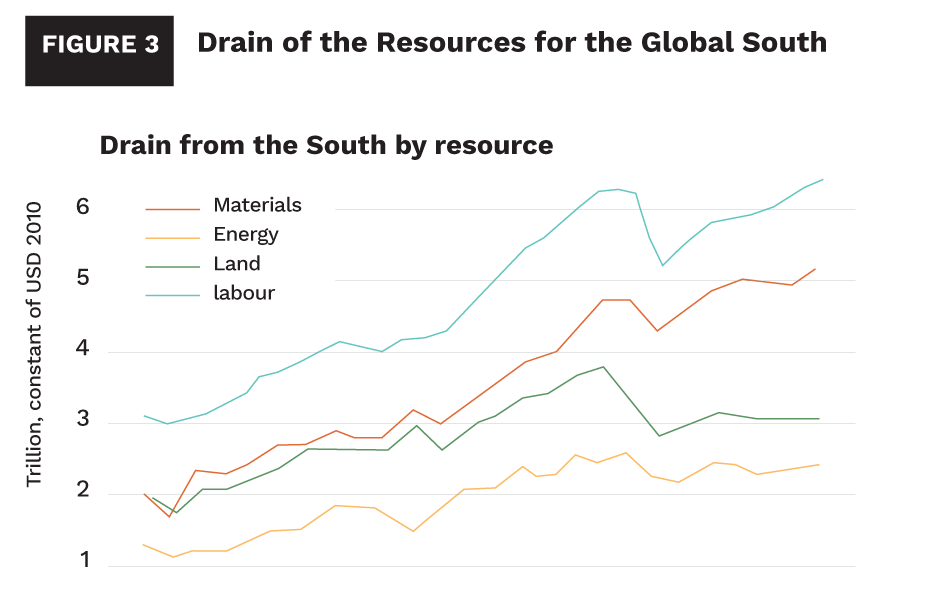
figure 3-1

figure 3-2
Source: https://www.sciencedirect.com/science/article/pii/S095937802200005X

The neo-colonialism in operation is a system where the human and material resources of the exploited country are set up to be the main conduit for the benefit of the outside colonising power (See Figure 3). A primary example of this is cocoa production in Ghana. In 2022, chocolate products produced from Ghanaian cocoa account for 75% of all chocolate products consumed within the US. However, all value addition is done by foreign companies and they dominate the cocoa production in Ghana. The unequal relations including neo-colonialist practices by the economically, technologically, and militarily powerful countries are still taking place.

Unequal trade perpetuates inequality between nations and makes the capitalist system vulnerable and unsustainable over the long term. For instance, the unfair resource transfer shows that Niger receives only 3.2% of the ultimate value-added of the electricity that the French energy firms generate using Niger’s raw uranium. Niger is the seventh-largest producer of uranium in the world, but its price is determined by the foreign corporations. Niger is also an oil-exporting country since 2010. In contrast to its huge natural resources, Niger is still one of the poorest countries in the world.

The study finds that the accumulation of capital has always required the taking of land and raw materials from non-capitalist sectors/countries. History has shown, from the beginnings of colonialism half a millennium ago to today’s neoliberal regimes, that for capitalism to exist, it must expand to non-capitalist regions both to acquire resources and new markets. Even after slavery was legally abolished, millions of people in the Global South still fell prey to the continuing exploitation. After the Second World War, decolonisation led to the end of the so-called colonialism and formal control of the Global South, but gradually neoliberal policy stepped in to reclaim the Global South, imposing drastic “austerity” measures on the people.

About the Author

Kalim SiddiquiDr. Kalim Siddiqui is an economist specialising in International Political Economy, Development Economics, International Trade, and International Economics. His work, which combines elements of international political economy and development economics, economic policy, economic history and international trade, often challenges prevailing orthodoxy about which policies promote overall development in less-developed countries. Kalim teaches international economics at the Department of Accounting, Finance and Economics, University of Huddersfield, UK. He has taught economics since 1989 at various universities in Norway and the UK.

References

  • Amin, Samir (1976). Unequal Development: An Essay on the Social Formations of the Peripheral Capitalism, New York: Monthly Review Press.
  • Baker, R. (2005). Capitalism’s Achilles Heel: Dirty Money and How to Renew the Free-Market System, New Jersey.
  • Baran, Paul (1967). The Political Economy of Growth, Monthly Review Press.
  • Emmanual, Arghiri (1972). Unequal Exchange: A Study of the Imperialism of Trade, Monthly Review Press.
  • Hersh, Seymour (1982) “The Price of Power: Kissinger, Nixon, and Chile”, The Atlantic, December.
  • Patnaik, U. & Patnaik, P. (2016). A Theory of Imperialism, Columbia University Press.
  • Perkins, J. (2004). Confessions of an Economic Hit Man, Ebury Press.
  • Siddiqui, K. (2023). “The New Cold War: Struggle for Global Domination”, Part 1 & Part 2, The World Financial Review, June/July & July-August.
  • Siddiqui, K. (2022a). “Capitalism, Imperialism, and Crisis.” The European Financial Review, June/July.
  • Siddiqui, K. (2022b). “Comparing the East Asian & Latin American Countries: The Role of Agricultural Reforms in the Economic Transformation.” The World Financial Review, July/August.
  • Siddiqui, K. (2021a). “The Import Substitution Policy in the Post-Colonial Countries.” The World Financial Review, Nov/Dec.
  • Siddiqui, K. (2021b). “The Political Economy of Industrial Policy.” The World Financial Review, May/June.
  • Siddiqui, K. (2021c). “The Importance of Industrialisation in Developing Countries.” The World Financial Review, Jan/Feb.
  • Siddiqui, K. (2020a). “Britain’s Trade with China in the 18th & 19th Centuries: A Review of the Opium Wars.” Asian Profile 48(3): 207-221, Sept.
  • Siddiqui, K. (2020b). “The Political Economy of Famines under Colonial India: A Critical Analysis.” World Financial Review, July/August.
  • Siddiqui, K. (2018). “Capitalism, Globalisation and Inequality” The World Financial Review, Nov-Dec, p.70-77.
  • Siddiqui, K. (2019). “The Political Economy of Global Inequality: An Economic Historical Perspective.” Argumenta Oeconomica Cracoviensia, 21(2): 11-42.
  • Siddiqui, K. (2016). “Will the Growth of the BRICs Cause a Shift in the Global Balance of Economic Power in the 21st Century?” International Journal of Political Economy, 45(4): 315-338.
  • Siddiqui, K. (2015). “Foreign Capital Investment into Developing Countries: Some Economic Policy Issues.” Research in World Economy, 6(2): 14-29.
  • Siddiqui, K. (1998). “The Export of Agricultural Commodities, Poverty and Ecological Crisis: A Case Study of Central American Countries.” Economic and Political Weekly, 33(39): A128-A137, Sept 26.
  • Siddiqui, K. (1990a). “Political Economy of Terrorism.” (Ed) V. D. Chopra. Genesis of Indo-Pakistan Conflict on Kashmir, pp.212-225, New Delhi.
  • Siddiqui, K. (1990b). “Historical Roots of Mass Poverty in India.” (eds.) C.A. Thayer, J. Camilleri, & K. Siddiqui. Trends and Strains, 59-76, New Delhi.
  • Todaro, M.P. & Smith, S.C. (2003). Economic Development, Pearson Addison.

Direct Mail Marketing: Maximizing Impact in the Digital Age

Hey there! Let’s chat about something that might seem a bit old-school at first glance – direct mail marketing. In our fast-paced, digital-heavy world, it’s easy to overlook the charm and impact of a good, old-fashioned piece of mail. But guess what? Direct mail marketing is not just surviving; it’s thriving!

Why Snail Mail is Still a Superstar

You might be wondering, “Is direct mail marketing still a thing?” Absolutely, and here’s why: it’s got a secret superpower in making people feel special and heard. Think about it – when was the last time you received a personalized letter or package? It feels good, right? 

Well, stats back this up too! Direct mail has an impressive response rate of 12.4%, way ahead of digital ad’s 0.12%. That’s a big deal because it shows that people pay more attention to what lands in their mailbox than what pops up in their inbox.

Direct mail is like a friendly handshake; it’s personal, targeted, and creates a bond. Businesses can zero in on the specific needs and interests of their audience, making each message feel like it’s just for them. This personal touch builds trust and loyalty, which can lead to more sales and happy, repeat customers.

The Magic of Holding Something Real

There’s something special about holding a physical item in your hands, don’t you think? In our digital age, a piece of tangible mail can be a breath of fresh air. It’s a unique way for customers to connect with a product or service, creating a memorable experience that just can’t be replicated online. This tangible aspect of direct mail leaves a lasting impression and can significantly boost brand recognition.

And hey, who says old and new can’t be friends? Direct mail and digital marketing can team up beautifully. Imagine getting a cool postcard that invites you to check out a website or join a social media community. It’s like bridging two worlds – the tactile and the digital – and that can lead to some fantastic results for businesses looking to expand their reach both offline and online.

Direct Mail vs. Digital Marketing: A Friendly Face-Off

Let’s dive into a fascinating comparison between two popular marketing buddies – direct mail and digital marketing. They’re like two sides of the same coin, each with their unique flair and quirks.

The Feel of Direct Mail vs. The Click of Digital

First off, let’s talk about how they reach us. Direct mail is like getting a tangible gift; you can touch it, feel it, and it has a physical presence in your space. It’s real and personal, which makes it hard to ignore. On the flip side, digital marketing pops up in our virtual world – through emails, social media, and those little ads that follow us around on the web. It’s quick, dynamic, and oh-so-modern.

Direct mail has this cool ability to get personal, and businesses like Mail King USA make it easier than ever. Businesses can craft messages that feel like they’re speaking directly to you. Digital marketing, though, is like the tech-savvy cousin; it’s all about analyzing clicks, likes, and online behavior to understand what makes customers tick.

The Strengths and Quirks of Each

Let’s break it down a bit more. Direct mail marketing is a bit like a sniper – highly targeted and precise. You can choose exactly who gets your message, whether it’s by age group, location, or interests. And get this – people actually open and read physical mail! But it’s not all roses; direct mail can be a bit heavy on the wallet and takes some time to put together.

Digital marketing, on the other hand, is like casting a wide net. It’s more about reaching as many people as possible at a relatively lower cost. And talk about instant feedback! You can see in real time who’s engaging with your content. But here’s the catch – because it’s so common, it can sometimes get lost in the digital noise or even be swiped away into the virtual trash can.

Direct Mail in the Digital Playground: Making Every Letter Count

Hello, fellow marketing adventurers! Let’s explore how direct mail marketing, a true classic, is keeping up its game in our buzzing digital world. It’s like adding a vintage charm to a modern party – surprisingly effective and full of potential!

Blending Old School with New Tricks

Think of direct mail as a charming old friend who’s learning some snazzy digital moves. How? By adding cool digital elements to your mailers! Imagine getting a postcard with a QR code that zips you straight to a funky landing page, or a letter with a personalized URL (PURL) that makes you feel like it’s created just for you. 

It’s like a secret handshake between the physical and digital worlds, creating a smooth journey for your audience from their mailbox to your online space.

Smart Data: The Secret Sauce

Now, let’s talk about getting smart with data and analytics. It’s like being a detective, uncovering clues about what your audience loves. Use this data to tailor your mailers so precisely that each recipient feels like it’s made just for them. How? Variable data printing is your friend here – it’s like personalizing each letter in a way that’s relevant and engaging.

And don’t forget to keep an eye on those numbers! Tracking response rates and conversions gives you a clear picture of how your direct mail is performing. By measuring your campaign’s success, you can fine-tune your strategies, making each mailout more effective than the last.

Harmonizing Tradition and Innovation in Marketing

The synergy of direct mail and digital marketing offers a powerful approach for contemporary marketing strategies. By infusing traditional direct mail with digital elements like QR codes and personalized URLs, businesses can create a more engaging and integrated customer experience. Utilizing data and analytics ensures these campaigns are targeted and effective. In embracing both, businesses can harness the full potential of their marketing efforts in this digital age.

A New Digital Transformation Model For Smart Companies In The Digital Era

By Mostafa Sayyadi and Michael J. Provitera 

In the digital economy, executives must develop digital transformation to increase the market value of their companies. This implementation requires the solutions we will indicate in our proposed digital transformation model. These solutions can come from this new digital transformation model. Executives can make their digital transformation more effective with this new model.

Before things became Digital, there was Analog, now digital transformation is a new and exciting journey. Like any journey, organizations must first determine where on the digital divide and where they want to go. Organizations must have a clear vision. Going through the evolution stages of digital transformation is a step-by-step endeavor. Digital maturity is important for each organization. But the important point in digital transformation, like any other transformation, is the vital and influential role of leaders who create a bridge between the past and the future and guide the organization effectively from what was the past to a better future.

To accomplish favorable results, organizations need to be specific about the implementation of their digital transformation plans. Executives need to understand that digital transformation is a multifaceted issue that requires different goals depending on the needs and degree of digital maturity of each organization. [1] [2] [3] It’s time to change our views on digital transformation and realize that digital transformation has different applications for different departments of the organization. In this article, we present a new model that provides leaders with insight to implement digital transformation more effectively in their organizations.

Digital transformation is to become a data-driven organization where all the fundamental decisions of the organization are made based on data analysis. [4] [5] [6] This reduces the occurrence of mistakes, which is an inseparable part of decisions based on intuition, as much as possible. Digital transformation provides system-wide data generation and analysis on a continuous basis. [7] [8] Simply importing and incorporating new technology and new stylish tools will not suffice.

First, executives must know that the heart and soul of any company is the workforce. Therefore, developing their skills is essential and must be continuous. Digital transformation starts with your workforce and then reverberates upward to executives and then back to the lower echelon of the organization. [9] [10] [11] Data is analyzed by your workforce and ultimately decisions are made at the top, only to be recirculated back down the organizational chart. Upgrading and updating technological infrastructures is essential. Chief Information Officers (CIOs) optimize organizational processes with advanced technologies such as artificial intelligence. Then, the Chief Executive Officers (CFOs) utilize the skill of data analysis to enhance the workforce. Our recommendation is that along with the development of analytical and technical skills of the workforce, leaders also provide the conditions for the development of insights related to digital transformation with their workforce so that the employees know more about the process.

Next, executives must be aware that culture is the strongest attribute that leads to digital transformation. [12] [13] [14] [15] A culture of trust should be rife as entire industries are recalibrating technology. A culture of trust allows workers to overcome the fear of being replaced and fired after implementing digital transformation plans even if they fail on the first try. Leaders must emphasize to their workforce that digital transformation is not aimed at firing them the way they feel artificial intelligence replaced people with robots. Thus, our recommendation is to develop a culture of trust by holding meetings with employees to ask them to describe the strengths of each of their roles and then link them to the future digital transformation plans. 

Furthermore, entering the realm of digital transformation opens new doors for businesses to collaborate with larger ecosystems. [16] [17] This leads to attracting new customers using advanced technologies such as artificial intelligence, which provides marketers with a better understanding of customers. Leaders should develop agility and quick response to environmental changes and discard pyramidal structures by developing flexible and flat structures. Pyramid structures prevent organizations to identify mistakes quickly enough to respond to them quickly enough. Flatter, decentralized structures help organizations analyze the extensive information they have obtained from customers in a more effective manner. 

The last step in the model is assessing because people need to deliver extraordinary experiences through service. This loops back to developing employees to learn quickly and turn rapidly that ability into action. The proposed model is indicative of the new digital Transformation.

The New Proposed Model

Developing a Culture of Trust

In summary, executives, first, need to consider the most effective way to develop employees which builds the Human Capital that contributes to core capabilities. Then organizational culture builds trust. Simultaneously, agility provides the Organizational Capital that can identify mistakes quickly and respond to them quickly. Finally, leaders should attempt to improve the skills needed to effectively assess this process. 

In Conclusion

Executives are always assessing if the digital transformation plans have really been effective or not. Always analyzing data to see if there has been a change that can lead to improvement. As executives peruse the digital divide and create digital transformation, new insights will emerge based on your analysis, which will be the basis for future changes. These changes will create a new world that has never been experienced before. Embrace the digital transformation or live in a world of dinosaurs.

About the Authors

Mostafa SayydiMostafa Sayyadi works with senior business leaders to effectively develop innovation in companies and helps companies—from start-ups to the Fortune 100—succeed by improving the effectiveness of their leaders.

Michael J ProviteraMichael J. Provitera is a senior faculty professor of Management and Leadership, in the Andreas School of Business at Barry University, Miami, Florida, USA . He is an author of Level Up Leadership: Engaging Leaders for Success, published by Business Expert Press.

References 

  1. Jöhnk, J., Ollig, P., Rövekamp, P. et al. (2022). Managing the complexity of digital transformation—How multiple concurrent initiatives foster hybrid ambidexterity. Electronic Markets, 32, 547–569. https://doi.org/10.1007/s12525-021-00510-2
  2. Keller, R., Ollig, P. & Rövekamp, P. (2022). Pathways to Developing Digital Capabilities within Entrepreneurial Initiatives in Pre-Digital Organizations. Business & Information Systems Engineering, 64, 33–46. https://doi.org/10.1007/s12599-021-00739-3
  3. Nadoleanu, G., Staiculescu, A. R., & Bran, E. (2022). The Multifaceted Challenges of the Digital Transformation: Creating a Sustainable Society. Postmodern Openings, 13(1), 300-316. https://doi.org/10.18662/po/13.1Sup1/428
  4. Moloi, T. & Iredele, O.O. (2020). Risk Management in the Digital Era: The Case of Nigerian Banks. In: George, B., Paul, J. (eds) Digital Transformation in Business and Society. Palgrave Macmillan, Cham. https://doi.org/10.1007/978-3-030-08277-2_14
  5. Van Veldhoven, Z. & Vanthienen, J. (2022). Digital transformation as an interaction-driven perspective between business, society, and technology. Electronic Markets, 32, 629–644. https://doi.org/10.1007/s12525-021-00464-5
  6. Pörtner, L., Möske, R. & Riel, A. (2022). Data Management Strategy Assessment for Leveraging the Digital Transformation. In: Yilmaz, M., Clarke, P., Messnarz, R., Wöran, B. (eds) Systems, Software and Services Process Improvement. EuroSPI 2022. Communications in Computer and Information Science, Vol. 1646. Springer, Cham. https://doi.org/10.1007/978-3-031-15559-8_40
  7. Mikalef, P. & Parmiggiani, E. (2022). A Framework for Digital Transformation for Research and Practice: Putting Things into Perspective. In: Mikalef, P., Parmiggiani, E. (eds) Digital Transformation in Norwegian Enterprises. Springer, Cham. https://doi.org/10.1007/978-3-031-05276-7_10
  8. Nadkarni, S. & Prügl, R. (2021). Digital transformation: a review, synthesis and opportunities for future research. Management Review Quarterly, 71, 233–341 (2021). https://doi.org/10.1007/s11301-020-00185-7
  9. Châlons, C. & Dufft, N. (2017). The Role of IT as an Enabler of Digital Transformation. In: Abolhassan, F. (eds) The Drivers of Digital Transformation. Management for Professionals. Springer, Cham. https://doi.org/10.1007/978-3-319-31824-0_2
  10. Nissen, V. & Seifert, H. (2018). Digital Transformation in Business Consulting—Status Quo in Germany. In: Nissen, V. (eds) Digital Transformation of the Consulting Industry. Progress in IS. Springer, Cham. https://doi.org/10.1007/978-3-319-70491-3_7
  11. Ravn, J.E., Moe, N.B., Stray, V. et al. (2022). Team autonomy and digital transformation. AI & SOCIETY, 37, 701–710. https://doi.org/10.1007/s00146-022-01406-1
  12. Abdallah, Y.O., Shehab, E. & Al-Ashaab, A. (2022). Developing a digital transformation process in the manufacturing sector: Egyptian case study. Information Systems and e-Business Management. https://doi.org/10.1007/s10257-022-00558-3
  13. Trischler, M.F.G. & Li-Ying, J. (2022). Digital business model innovation: toward construct clarity and future research directions. Review of Managerial Science. https://doi.org/10.1007/s11846-021-00508-2
  14. Mergel, I., Edelmann, N. & Huag, N. (2019). Defining digital transformation: Results from expert interviews. Government Information Quarterly, 36(4), https://doi.org/10.1016/j.giq.2019.06.002
  15. Tran, S.K. (2017). GOOGLE: a reflection of culture, leader, and management. International Journal of Corporate Social Responsibility, 2, 10. https://doi.org/10.1186/s40991-017-0021-0
  16. Ghosh, S., Hughes, M., Hughes, P. & Hodgkinson, I. (2021). Corporate Digital Entrepreneurship: Leveraging Industrial Internet of Things and Emerging Technologies. In: Soltanifar, M., Hughes, M., Göcke, L. (eds) Digital Entrepreneurship. Future of Business and Finance. Springer, Cham. https://doi.org/10.1007/978-3-030-53914-6_10
  17. Shamsrizi, M., Pakura, A., Wiechers, J., Pakura, S. & Dauster, D.V. (2021). Digital Entrepreneurship for the “Decade of Action”. In: Soltanifar, M., Hughes, M., Göcke, L. (eds) Digital Entrepreneurship. Future of Business and Finance. Springer, Cham. https://doi.org/10.1007/978-3-030-53914-6_15

AI May Soon Replace Even the Most Elite Consulting Companies

By Mostafa Sayyadi and Michael J. Provitera 

Now, with the onslaught of AI, the tried-and-true business model has seriously endangered the survival and continuity of management consulting organizations. Perhaps the survival and continuity of both large and small companies will be to engage in more agility and more adaptable models that offer a full suite of services from human resource management to strategic management consulting.

The Increasing Rise of Artificial Intelligence for Business

By leveraging AI, businesses are able to make real-time decisions, streamline processes, reduce costs, and increase efficiency. [1] [2] [3] With a more distributed decision-making process, organizations can empower people to make decisions faster and more accurately utilizing the data available. [4] [5] [6] Businesses around the world are automating their processes to improve customer relationships, allowing them to respond faster and more efficiently, increasing customer satisfaction and creating a competitive edge. [7] [8] [9]

There is a minimal rate of error in Google’s algorithms, and this is why Google is regarded as the apex of high-tech artificial intelligence. With AI technology, organizations can move beyond existing limitations and gain access to innovative business models and by utilizing AI and continuous learning, organizations can reach a high level of excellence.

Alibaba’s success serves as an inspiration to other businesses looking to leverage the power of AI for their own success. Algorithms, by introducing consistency and accuracy, allow businesses to reduce mistakes, optimize processes, and ultimately reach the ambitious goals of Six Sigma: having few errors. AI programs are not considered in most corporate strategies by top executives. A company without an AI strategy, while its competitors are quickly advancing in the market, is like a Formula One (F1) race where all the competitors are driving high-tech F1 cars, but one team is driving a fast but regular streetcar. Just as the streetcar cannot compete with the advanced technology of the F1 cars, the company without an AI strategy will fall behind its competitors who are leveraging AI. [10] [11] [12] Are CEOs at risk to be replaced if they do not consider AI-powered strategy? We don’t have the answer obviously, but what is more than reasonable realizing that AI is needed to enable businesses to gather and analyze data, to make better and quicker decisions. 

What are the actions to be undertaken? 

  • Identify dynamic capabilities to support continuous growth through exploiting competitive advantages and being agile, considering limited or not full availability of strategic resources. [13]
  • Design, develop and align people and IT /Digital systems through a Digital mindset embedded into organisational culture. [14] 
  • Creating a flexible and resilient workforce
  • Implement an effective knowledge management system to ensure that companies have the experience retained to adapt and perform in a changing environment and use the double-loop learning to augment the experience. [15]

Ineffective knowledge management leads to the loss of expertise and knowledge, delays, and inefficiencies in communications, which limits innovation and collaboration, resulting in lower productivity and success. RPA and chatbots and AI will allow the creation of data supported by a data culture that can be coupled and enhanced by AI for strategy development.

Digital core knowledge includes technical and digital literacy skills that are essential to using and interacting with digital tools and technologies, effectively and efficiently. This is how digital core knowledge enables data-driven decisions that are more accurate and reliable than ever before. CEOs must consider cost benefits and determine if and what AI-enhancing software is the most effective and efficient solution for their business needs. Otherwise, any further development of AI-powered strategies can be hampered if the software is not efficiently evaluated and implemented. Additionally, in order to streamline and automate many processes, organizations must redesign their current processes.

To ensure buy-in and successful implementation, CEOs should emphasize the importance of leveraging AI and other automation tools to augment and enhance human capabilities. This can help to foster a culture of collaboration between human resources and technology, allowing for greater efficiency and innovation.

Management Consulting in the AI and Automation Era

Management consulting firms like KPMG, Deloitte, PwC and BCG, use a variety of automation and AI. The technologies are based on data analytics, intelligent automation, machine learning, natural language processing, computer vision, and chatbots to business process optimisation, trend identification, forecasting and strategies related, enabling micro-decision making. [16]

On a different level than the Big 4, the application of artificial intelligence for management and strategy purposes seems to be nearer than from a conceptual perspective only. “Robo-advisors” (RAs). In fact, the utilization of RAs is a trend which brings a LOW level of disruption based on the trust in algorithm as authority aids in legitimating RAs as innovation. Guaranteeing and protecting the consulting knowledge domain.

It is worth bringing other two examples of disruption of the classic management consulting business model supplied by AI services providers for consulting.

Praioritize can be allocated in a middle level between pure RAs and standardised knowledge. It is a SaaS company owned and operated by Dutch company, Transparency Lab, that started with generative A.I. in 2020. They present digital consulting solutions AI empowered very close to RAs. Their technical proposal disrupts the classic consultancy business model as AI draws knowledge from a huge database of white papers (11.000) and real case studies (23.000) to solve problems. The first disruption is related to the standardized Knowledge while AI does assessments and generates proposals utilizing RAs. The second disruption is related to that the company’s targets which are both Consultants and Companies. Creating a possible way to cut-off consulting starting from their knowledge management for clients. [17]

On another side, AI solutions based, allow the knowledge domain protection and there are partial utilisations of automation. The disruption is evident when automating certain tasks, of the consulting lifecycle, while maintaining and improving the engagement based on client-consultant relationships. Mindset.ai uses AI to deliver property knowledge and services such as consulting, change management, coaching, with a dedicate Machine learning repository for each professional, utilizing the AI model Chat-GPT 4. Here knowledge is delivered by AI according to customised and tailored services for specific client needs.

Recently, Chat-GPT has started dominating the scene for multiple businesses. At a lower level based on the research of O’Mahoney (2023), consulting packages should stand on the assumption that AI chat-GPT should be [18]:

  • Used to interrogate clients’ documents.
  • Connected to the internet and clients’ documentation.
  • Used to improve clients’ marketing operations.
  • Used with bots to answer common questions from clients.
  • Used to process large amounts of data to recognize patterns and trends; and 
  • Finally, used to analyze consulting data better and faster.  

The integrated model will invite managers and staff to learn about AI and will highlight the importance of intellectual property and human capital. 

AI also raises new needs for clients. [19] These new needs manifest themselves in using AI to provide more accurate data analysis and make more accurate forecasts for clients. [20] [21]

Management consulting in the AI era needs to offer more adaptive management consulting packages for clients to meet these new needs. Following the predictions of Christensen, Dina, and Derek (2013) the impact of DT on the MC services have received an increased level of analysis even if it is not possible to speak yet about maturity models. [22] [23]

The number of startups will increase as the great resignation persists along with quiet quitting and quiet firing. [24] [25] [26] [27] The dependence on outside consultants will increase and cause management consulting companies to focus on the intersection of knowledge management and innovation. This huge disruption will cause a close relationship between management consulting companies and startups related to artificial intelligence as showed above for Praioritize and Mindset. 

Thus, management consulting companies will turn to using artificial intelligence to serve clients and advise them more effectively to better understand environmental threats and respond to them better in real-time. Recurring to AI will be a huge pill to swallow for consulting industry anyway.

In addition to this, with the increase of automation, both partial or total, we will assist to the evolution of the trust models and client-consultants’ relationships, for virtual and digital consultancy along the consultancy life-cycle [28], and the additional trust element for AI and automation adoption thus for innovative technology. [29] 

In Conclusion

Prepare your organization for a new workplace that is technologically challenged and prone to use AI to do the work. If you keep doing what you always have done, then you will continually get what you always got and if that is not working then inertia has set in. Since management consulting impacts every industry, every business will eventually be realizing some form of transformation. Do not ignore the beginning signs of this transformation because they are visible to many.

About the Authors

Mostafa SayydiMostafa Sayyadi works with senior business leaders to effectively develop innovation in companies and helps companies—from start-ups to the Fortune 100—succeed by improving the effectiveness of their leaders.

Michael J ProviteraMichael J. Provitera is a senior faculty professor of Management and Leadership, in the Andreas School of Business at Barry University, Miami, Florida, USA . He is an author of Level Up Leadership: Engaging Leaders for Success, published by Business Expert Press.

References

  1. https://praioritize.com
  2. https://www.mindset.ai/product

References

  1. Demir, F. (2022). Artificial Intelligence. In: Innovation in the Public Sector. Public Administration and Information Technology, Vol 39. Springer, Cham. https://doi.org/10.1007/978-3-031-11331-4_4
  2. Enholm, I.M., Papagiannidis, E., Mikalef, P. et al. (2022) Artificial Intelligence and Business Value: a Literature Review. Information Systems Frontiers, Vol. 24, pp. 1709–1734. https://doi.org/10.1007/s10796-021-10186-w
  3. Davenport, T., Guha, A., Grewal, D. et al. (2020) How artificial intelligence will change the future of marketing. Journal of the Academy of Marketing Science, Vol. 48, pp. 24–42. https://doi.org/10.1007/s11747-019-00696-0
  4. De Mauro, A., Sestino, A. & Bacconi, A. (2022) Machine learning and artificial intelligence use in marketing: a general taxonomy. Italian Journal of Marketing, Vol. 2022(4), pp. 439–457. https://doi.org/10.1007/s43039-022-00057-w
  5. Sarker, I.H. (2022) AI-Based Modeling: Techniques, Applications and Research Issues Towards Automation, Intelligent and Smart Systems. SN Computer Science, Vol. 3, pp. 1-20. https://doi.org/10.1007/s42979-022-01043-x
  6. Sousa, M.J., de Barros, G.O., Tavares, N. (2022). Artificial Intelligence Trends: Insights for Digital Economy Policymakers. In: Guarda, T., Anwar, S., Leon, M., Mota Pinto, F.J. (eds) Information and Knowledge in Internet of Things. EAI/Springer Innovations in Communication and Computing. Springer, Cham. https://doi.org/10.1007/978-3-030-75123-4_8
  7. Choudhary, R., Karmel, A. (2022). Robotic Process Automation. In: Raje, R.R., Hussain, F., Kannan, R.J. (eds) Artificial Intelligence and Technologies. Lecture Notes in Electrical Engineering, Vol. 806. Springer, Singapore. https://doi.org/10.1007/978-981-16-6448-9_3
  8. Itagi, S., Gowda, S., Udupa, T., Shylaja, S.S. (2022). Future Frame Prediction Using Deep Learning. In: Raje, R.R., Hussain, F., Kannan, R.J. (eds) Artificial Intelligence and Technologies. Lecture Notes in Electrical Engineering, Vol 806. Springer, Singapore. https://doi.org/10.1007/978-981-16-6448-9_21
  9. Sharma, M., Kumar, C.R.S. (2022). Machine Learning-Based Smart Surveillance and Intrusion Detection System for National Geographic Borders. In: Raje, R.R., Hussain, F., Kannan, R.J. (eds) Artificial Intelligence and Technologies. Lecture Notes in Electrical Engineering, vol 806. Springer, Singapore. https://doi.org/10.1007/978-981-16-6448-9_19
  10. Barriga, A., Rutle, A. & Heldal, R. (2022). AI-powered model repair: an experience report—lessons learned, challenges, and opportunities. Software and Systems Modeling, Vol. 21, pp. 1135–1157. https://doi.org/10.1007/s10270-022-00983-5
  11. Belhadi, A., Mani, V., Kamble, S.S. et al. (2021). Artificial intelligence-driven innovation for enhancing supply chain resilience and performance under the effect of supply chain dynamism: an empirical investigation. Annals of Operations Research. https://doi.org/10.1007/s10479-021-03956-x
  12. Kersting, K. (2018). Making AI Smarter. KI – Künstliche Intelligenz, Vol. 32, pp. 227–229. https://doi.org/10.1007/s13218-018-0562-8
  13. Fabrizio, C., Kaczam, F., & De Moura, G. (2021). Competitive advantage and dynamic capability in small and medium-sized enterprises: a systematic literature review and future research directions. Review of Managerial Science volume 16, 617–648.
  14. Neeley, T., & Leonardi, P. (2022,) Developing a Digital Mindset. Harvard Business Review, volume 100(5-6), pp. 50-55.
  15. Gribbin, J., A. M., Young, R., & Park, S. (2016). Double-loop reflective practice as an approach to understanding knowledge and experience. International Conference: Future–Focused Thinking (pp. Vol. 8, pp. 3181-3198).
  16. Ross,M & Taylor, J. (2018, November 10). Managing AI Decision-Making Tools. Retrieved from Harvard business Review: https://hbr.org/2021/11/managing-ai-decision-making-tools
  17. Libert, B. and Beck, M., 2017. AI may soon replace even the most elite consultants. Harvard Business Review, 24(7).
  18. O’Mahoney, J. (2023). How can AI help my consultancy?, https://www.linkedin.com/pulse/how-can-ai-help-my-consultancy-prof-joe-o-mahoney/
  19. Bankins, S., Formosa, P. (2023). The Ethical Implications of Artificial Intelligence (AI) For Meaningful Work. Journal of Business Ethics. https://doi.org/10.1007/s10551-023-05339-7
  20. Weber, F. (2023a). Business Analytics and Intelligence. In: Artificial Intelligence for Business Analytics. Springer Vieweg, Wiesbaden. https://doi.org/10.1007/978-3-658-37599-7_1
  21. Weber, F. (2023b). Artificial Intelligence. In: Artificial Intelligence for Business Analytics. Springer Vieweg, Wiesbaden. https://doi.org/10.1007/978-3-658-37599-7_2
  22. Christensen C, Dina W, Derek B (2013) “Consulting on the Cusp of Disruption”, Harvard Business Review, available at: https://enterprisegrowth.org/wp-content/uploads/2017/08/Consulting_On_the_Cusp.pdf
  23. Deelmann, T. (2019). Consulting: Characterization of Concepts and Connections. In: Nissen, V. (eds) Advances in Consulting Research. Contributions to Management Science. Springer, Cham. https://doi.org/10.1007/978-3-319-95999-3_2
  24. Bala Subrahmanya, M.H. (2022). Competitiveness of High-Tech Start-Ups and Entrepreneurial Ecosystems: An Overview. International Journal of Global Business and Competitiveness, Vol. 17, pp. 1–10. https://doi.org/10.1007/s42943-022-00056-w
  25. Cavallo, A., Ghezzi, A. & Rossi-Lamastra, C. (2021). Small-medium enterprises and innovative startups in entrepreneurial ecosystems: exploring an under-remarked relation. International Entrepreneurship and Management Journal, Vol. 17, pp. 1843–1866. https://doi.org/10.1007/s11365-020-00698-3
  26. Hura, J., Al-Rabeei, S., Korba, P., Hovanec, M., Pjurová, S. & Sekelová, I. (2022). Development of Startups During the Covid-19 Pandemic. In: Perakovic, D., Knapcikova, L. (eds) Future Access Enablers for Ubiquitous and Intelligent Infrastructures. FABULOUS 2022. Lecture Notes of the Institute for Computer Sciences, Social Informatics and Telecommunications Engineering, Vol. 445. Springer, Cham. https://doi.org/10.1007/978-3-031-15101-9_18
  27. Savin, I., Chukavina, K. & Pushkarev, A. (2022). Topic-based classification and identification of global trends for startup companies. Small Business Economics. https://doi.org/10.1007/s11187-022-00609-6
  28. Collina, L. (2021). What are the implications of virtualisation for building trust during the management consultancy lifecycle. Management consulting Journal, 7, 18-28. : https://doi.org/10.2478/mcj-2021-0015
  29. Bedué, P. and Fritzsche, A., 2022. Can we trust AI? An empirical investigation of trust requirements and guide to successful AI adoption. Journal of Enterprise Information Management, 35(2), pp.530-549. DOI 10.1108/JEIM-06-2020-0233

Developing Disruptive and Social Innovation: The Impact Model

By Mostafa Sayyadi and Michael J. Provitera 

There is a lack of an effective model that can support internal entrepreneurs in their disruptive and social innovation. We create a comprehensive framework which we call the impact model. This new model fills the gap, taking organizations in the direction of training internal entrepreneurs, thus known as intrapreneurs, to start initiatives that affect society and ensure their survival in diversity, equity, and inclusion (DEI). Organizations cannot innovate without taking into concern diversity, equity, and inclusion. On the other hand, diversity, equity, and inclusion should not be tantamount in place for innovation. Organizations must address diversity, equity, and inclusion as they innovate and evaluate what becomes disruptive for both a product and social concern. 

Introduction

We carefully examined approximately 100 organizations around the world, and we found out that although many of them rank at the highest levels in investments made for the development of social innovations, they are not in good rankings in terms of achieving social innovation. Thus, lacking the knowledge of being a diverse, equity-driven, and inclusive organization. In some cases, a manufacturer may spend a lot of money to achieve social innovation, but the results of these initiatives may appear disappointing. [1] [2] What became clear in our examinations was that the organization’s generous spending on social innovation was not delivering the desired results because of a flawed business model that was committed to the way of the past. A new model was needed for creating social innovations that could more effectively align the organization with its changing ecosystem so that it could address not only the dynamic changes in the customer base but also the social structure of the organization.

After interviewing approximately 170 middle and senior managers of an organization that had branches in 48 countries around the world. We revealed that the achievement of social innovation requires the realization of disruptive innovation that is conducted by human capital which can more effectively understand the needs and demands of society. People are diverse more than ever today, they arise from different social strata which are indicative of equity, and they must be included in organizational decision-making. Organizations that can hire more capable human capital can surpass their competitors in creating disruptive and social innovations and be better equipped for providing a culture of diversity, equity, and inclusion. The two risks that organizations face today are non-financial risks such as diversity, equity, and inclusion, and risk potential such as failing to take the necessary steps with product development.

Thus, we offer a new model that addresses these challenges. The model deploys the organization’s human capital and helps them to engage in disruptive innovation instead of moderate risk-taking. Disruptive innovations are those that gain a large market share by identifying and responding to unmet customer needs and can have a large impact on industry structure. [3] [4] [5] [6] Organizations that engage in disruptive innovation, although they quickly gain a large share of the market, also purposefully achieve what we call social innovation. [7] [8] In fact, by understanding their social responsibility and profit motivation, these organizations see society’s problems as an opportunity. Building such an effective organization is facilitated by the implementation of the impact model which not only addresses the financial sustainability of an organization but also meets the needs of both employees and customers.

The Impact Model: A Catalyst for Transformation

The current condition of organizations and the business models they use have caused challenges with disruptive innovation. Disruptive innovation seeks to create breakthrough innovations to provide better products, but it also may impact both the social architect of the organization and the customer base. [9] [10] Since innovation requires support along with changing some approaches to work for some employees, top managers must be aware of not only the financial risk but also the non-financial risk as well. Many CEOs are paid as the shareholder value increases and thus some CEOs are profit-seeking and use short-term approaches. Disruptive innovation is difficult for many organizations.

The impact model focuses on a few basic points. First, we focus on the importance of disruptive innovation in gaining a major market share and reducing organization costs. The model also fulfills the hidden and unmet needs of customers by addressing them on the bases of diversity, equity, and inclusion. Thus, the model provides a goal of social innovation, involving human capital in a more effective way in the innovation process. This approach leads to the growth of creative thinking in organizations which enhances survival. 

There is a need to realize disruptive innovation and achieve high levels of social innovation. In doing this, the first step we considered for this model was that the organization should balance its financial and social goals. This step seeks to focus on the profitability of the organization but also seeks the social impact of diversity, equity, and inclusion. Equity is at the forefront of our decision to create this model as we found a story published in Life Magazine in which a Pakistani child was sewing a Nike because they only earned six cents an hour. This photo resulted in countless calls around the world to boycott Nike products and led to a fatal blow to the reputation of one of the biggest and best brands of sports products in the world—a true non-financial risk. This photo and its consequences led to Nike reforming its supply chain management and repeated advertisements to demonstrate this eventually saved the organization. We suggest that organizations manufacture or produce cheaper and more products for lower-income groups across the globe. This is exactly what Nike did, and by revising many of its safety regulations, this organization cut ties with many local manufacturers and distributors in Asia. In addition, by giving up short-term profits, Nike ultimately ensured its long-term survival in the market. Tesla also added an important concern when they developed a plan that temporarily stopped the production of model-3 long-range automobiles in lieu of the cheaper short-range model-3 cars that meet the governmental stimulus of a $7,500 rebate from the electric car incentive for personal taxes.

Our model then extends the collaboration of two departments of human resource management and customer service relations to create a new and better image of the organization in both the external and internal environments of the organization. In the past, some employees considered managers to be deceitful and believed that managers were only caring about profit at the expense of building an inclusive culture. In addition to creating a culture of innovation and risk-taking that strengthened disruptive innovation, we suggest that organizations create a defender image of society for their employees offering a sense of belonging to the organization. Also, customers had similar ideas that employees have, and organizations reached out to meet the needs of the new diverse customer that was at one time, overlooked. The mission of the customer service relations department was to correct this perspective and created a new and better image of the organization for customers, which ultimately led to greater customer loyalty. The customer service relations department was trained in diversity, equity, and inclusion by what we call a deep dive learning event. [11]

In the organizations we reviewed, the human resource management department conducted training workshops to develop human capital and involve them in disruptive innovation coupled with diversity, equity, and inclusion awareness. This linked innovation with disruptive innovation. Human resources were reminded that ignoring the link between disruptive innovation and social innovation due to budget constraints was not acceptable. Also, the product development department of organizations began to design new and cheaper products for developing countries, which played a significant role in expanding the market of the manufacturer’s products in countries such as India and Bangladesh. 

Based on these findings, the following model is presented for the development of the link between destructive innovation, social innovation, and diversity, equity, and inclusion:

Figure 1
Figure 1: The Impact Model

In Conclusion

We developed a new model that addresses not only innovation but also DEI. The impact model captures the essence of today’s leading organizations as they begin to develop better products to meet the unique needs of their customers while training their employees on the forefront of social and cultural norms necessary for survival. The article explained the link between disruptive innovation and social innovation, which leads to the growth of social innovations and benefits society at large. The implementation of this model acts as a transformational catalyst that brings the social impact of decision-making to the upper echelon of the organization by helping leaders to create both disruptive and social innovations.

About the Authors

Mostafa Sayyadi works with senior business leaders to effectively develop innovation in companies and helps companies—from start-ups to the Fortune 100—succeed by improving the effectiveness of their leaders.

Michael J. Provitera is a senior faculty professor of Management and Leadership, in the Andreas School of Business at Barry University, Miami, Florida, USA . He is an author of Level Up Leadership: Engaging Leaders for Success, published by Business Expert Press.

References

  1. Zu, L. (2013). Social Innovation. In: Idowu, S.O., Capaldi, N., Zu, L., Gupta, A.D. (eds) Encyclopedia of Corporate Social Responsibility. Springer, Berlin, Heidelberg. https://doi.org/10.1007/978-3-642-28036-8_252
  2. Phillips, W., Alexander, E.A. & Lee, H. (2019). Going It Alone Won’t Work! The Relational Imperative for Social Innovation in Social Enterprises. Journal of Business Ethics 156, 315–331. https://doi.org/10.1007/s10551-017-3608-1
  3. Sewpersadh, N.S. (2023). Disruptive business value models in the digital era. Journal of Innovation and Entrepreneurship 12, 2. https://doi.org/10.1186/s13731-022-00252-1
  4. Morris, S., Oldroyd, J., Allen, R.T., Chng, DH. Han, J. (2023). From local modification to global innovation: How research units in emerging economies innovate for the world. Journal of International Business Studies 54, 418–440. https://doi.org/10.1057/s41267-022-00570-2
  5. Laermann-Nguyen, U., Backfisch, M. (2021). Innovation crisis in the pharmaceutical industry? A survey. SN Business & Economics 1, 164. https://doi.org/10.1007/s43546-021-00163-5
  6. Küfeoğlu, S. (2022). Innovation, Value Creation and Impact Assessment. In: Emerging Technologies . Sustainable Development Goals Series. Springer, Cham. https://doi.org/10.1007/978-3-031-07127-0_1
  7. Chemma, N. (2021). Disruptive innovation in a dynamic environment: a winning strategy? An illustration through the analysis of the yoghurt industry in Algeria. Journal of Innovation and Entrepreneurship 10, 34. https://doi.org/10.1186/s13731-021-00150-y
  8. Felicetti, A.M., Corvello, V. & Ammirato, S. (2023). Digital innovation in entrepreneurial firms: a systematic literature review. Review of Managerial Science. https://doi.org/10.1007/s11846-023-00638-9
  9. Christensen, CM., Raynor ME. & McDonald, R. (2015). What Is Disruptive Innovation?. Harvard Business Review. https://hbr.org/2015/12/what-is-disruptive-innovation
  10. Skog, D.A., Wimelius, H. & Sandberg, J. (2018). Digital Disruption. Business & Information Systems Engineering 60, 431–437. https://doi.org/10.1007/s12599-018-0550-4
  11. Provitera, M. J. & Sayyadi, M. (2022). Management Consultant’s Black Box, Fort Lauderdale, Florida: Motivational Leadership Training Motivational Leadership Training. Amazon

Copper Industry Warns of Looming Supply Gap Without More Mines

The world’s reliance on copper for building most electronic devices is set to exceed the available supply over the next decade. This imbalance could undermine climate goals unless significant action is taken to increase mining operations. The need for copper, a critical component in motors, batteries, and wiring due to its excellent electrical conductivity, has been highlighted in recent industry discussions.

Jeremy Weir, CEO of Trafigura AG, recently emphasized the urgency of the situation at the World Copper Conference, stating, “If we don’t have enough copper, it could seriously short-circuit the energy transition.” This conference, the largest gathering in the industry since 2019, served as a platform for executives and analysts to express their concerns and projections.


Solaris Resources and the Warintza Project

With all of the challenges of declining yields and fewer new discoveries in the mining industry, Solaris Resources has been highlighted as a potential solution with its Warintza project in Ecuador. This project represents the proactive efforts of junior mining companies to bolster the supply of critical minerals, crucial for technologies in various sectors, including renewable energy.

The Warintza project stands out due to its potential and the discovery of multiple mineral deposits. This development is particularly significant at a time when the global demand for critical minerals, essential for electric vehicles and renewable energy solutions, is experiencing a marked surge.

Solaris Resources also recently appointed China International Capital Corporation Limited (CICC) as its financial advisor for operations in China. CICC, a leading global investment bank based in Beijing, boasts a robust presence in the Chinese M&A market, especially in mining sector transactions. This partnership signals Solaris Resources’ commitment to exploring its options in response to multiple acquisition proposals for the Warintza Project.

Projected Supply Shortfall

Despite an expected global supply increase of 26% to 38.5 million tonnes annually by 2035, data from the International Copper Association (ICA) indicates a potential shortfall of 1.7% in meeting the demand, even with enhanced recycling efforts. This forecast highlights the critical need for new mining initiatives.

Regulatory hurdles have also led to a significant decrease in the approval of new copper mines, reaching the lowest point in a decade, as reported by Goldman Sachs. The lengthy process of permitting and building mines, often taking 10 to 20 years, exacerbates the issue. Goldman Sachs currently predicts a surge in copper demand, projecting prices to reach $15,000 a tonne by 2025, a 67% increase from current levels.

The burgeoning electric vehicle (EV) market, requiring more copper than traditional internal combustion engines, is a primary driver of this demand. However, the copper shortage could lead EV manufacturers to use less copper or even switch to alternatives like aluminum.

The Aluminum Alternative

Aluminum, while lighter and cheaper than copper, is also more corrosive, brittle, and only about 60% as conductive. It could be a viable substitute in certain applications, such as wiring for offshore wind turbines and some EV models. The Aluminum Association sees this as an opportunity for growth in the market, but copper is the most viable option for the industry and the practical applications of the green energy transition.

Although copper recycling rates are on the rise, reaching a truly “circular economy” where copper is almost entirely recycled remains a distant goal. Companies like Aurubis AG report that nearly half of their copper cathodes are made from recycled material, but achieving 100% recycling is a long-term project.

A True Need for More Mining Activity

Analysts stress that recycling alone cannot meet the escalating demand for copper. The consensus among industry leaders is clear: increased mining activity is essential to fulfill the growing need for copper in the coming years. The gap between supply and demand, if not addressed, could have significant implications for the global economy and the transition to green energy.

Insurance Required for General Contractors: Different Types

For your contracting business, having appropriate insurance coverage helps protect you and your hard-earned money. This is a wise investment considering that this safeguards your valuable assets. It gives one peace of mind, knowing that in the event of any unforeseen circumstance, you can thrive, and your business is well-prepared.

The worst thing is that issues may arise no matter how mindful you are. If someone sues you, we recommend paying relevant attorney fees to defend your business. Still, it is vital to remember that if the court rules in your favor, you must handle the defense attorney’s expenses. 

It means you should find ways to protect your business and yourself as an employer. The main idea is to save money, differentiate your coverages from competitors, and increase the overall bottom line. Check out this site: www.contractorbond.org to learn more about different options. 

As soon as a specific incident or accident causes physical harm or any other damage to third parties or clients, you will need insurance coverage to handle legal expenses, health costs, and other things required.

Besides, if someone gets injured while on the job, you will also be liable for criminal prosecution or hefty fines unless you have relevant compensation insurance. Insurance is crucial in all US states, which is vital to remember. 

Even established corporations would lose their money by central claim; while you may win the case, the expenses will still affect your situation. Getting relevant liability coverage will help you transfer risks against your enterprise and towards the insurance company, while you will pay the monthly amount until the reason arises.

In any line of business, we are facing certain risks. Some are transparent, while others can happen suddenly and without prior understanding. These circumstances can help you shield a business against potential issues while operating. 

General contractors must meet relevant requirements when it comes to liability, including theft, property damage, worker’s compensation, and others. Still, it would be best to understand the options to ensure you manage the risk no matter what happens. Further in this article, we will explore different coverages you can choose. Let us start from the beginning.

1. General Liability

For instance, if the company is legally responsible for client damage or bodily injuries, you must handle the exceptional financial costs that may cause severe issues to your business. General coverage will protect you in these situations because the insurance company will handle the expenses associated with claims, meaning you can rest assured. 

For instance, if you are a roofing contractor and your tool drops onto a client’s parked car, damaging the windshield throughout the process. In this situation, the general liability is what will handle the car repair expenses since it happened due to your employee’s negligence, which can happen accidentally at times.

2. Workers Compensation

Workers’ compensation insurance will offer protection and benefits for employees, significantly if they get injured on the job. We are talking about covering wages and medical expenses with it.

For instance, the construction industry is problematic because accidents can happen anytime. Employees will be continually at high risk of hospitalization, meaning you should ensure you deal with each step along the way. They cannot work during that period, so they will not get relevant income. 

When you pay monthly for a compensation policy, the insurance company will handle their wages and medical bills, which will rest assured and prevent you from directly paying. Finally, you will give your employees peace of mind when they need to work safely and effectively. 

Besides, you will have additional security in knowing that you are not violating state and federal regulations while covering everyone who works for you. We recommend you click here to learn more about the different coverages you can choose. 

3. Commercial Car Insurance

Commercial car insurance will protect your specific situation’s third-party vehicles and automotive property. Although it is not specific to most contractors, it is a perfect policy if you use cars to transport employees and tools as the essential aspect of the project. 

The main idea is to use commercially insured cars, providing peace of mind. Generally, commercial car policies will address damage caused by vehicles or made to cars outside driving. It also covers injuries in case of accidents, which is vital to remember. 

4. Professional Liability

Architects, consultants, and build and design contractors use this type of insurance to protect themselves against client claims. Therefore, if you work in the trade, you can take advantage of complete coverage compared with customer dissatisfaction, failure to execute plans, and design flaws. 

Besides, professional policy will protect you against negligence while undertaking different duties and responsibilities. When your employee paints a wet wall, the problem will arise in seconds since the paint will peel off when it reaches the specific situation. 

The negligence will cost your client time and money, especially if they suspend their business to take advantage of construction projects. It means the provider will address the professional liability coverage. 

How To Raise Capital and Unlock Business Growth Opportunities in the New Year

The new year brings a time for reflection, goal setting, and new opportunities. For your business, it’s an ideal time to look back on the year and build a strategy for new growth based on your wins and losses.

“A period of reflection and strategizing is really important to sustainable growth in business,” explains Marcus Hutsen, Business Development Manager of Patriot Coolers. “The New Year is an opportunity to review the past year and prepare for the upcoming one.”

You can raise capital and unlock business growth opportunities this New Year by following these 11 tips from business experts!

1. Review Last Year’s Consumer Data

Reviewing the numbers is more than an accountant’s job. As you strategize for a successful year of growth, it’s crucial to look back on consumer data from the past year to better understand the trends in your business.

“A growth mindset is wise for many businesses, but it’s nothing without a strong foundation and backing in data,” states Erin Banta, Co-Founder and CEO of Pepper Home. “You should know your consumer’s behavior better than you know your own if you want to see real growth in your business.”

Align your New Year strategy with consumer behavior throughout the past year. What products gained the most traction? What avenues of engagement were most successful for bringing in new customers? Reviewing these numbers can set you up for success in the year to come.

2. Realign With Your Business Goals

Before building new pathways of growth for your business, take the time to look back at where you started. By realigning with your initial business goals, you can choose the best path for growth that is most on track for your business trajectory.

“It can be easy to get stuck in the clouds, dreaming up ideals of what your business could become,” explains Cody Candee, Founder and CEO of Bounce. “You should constantly and consistently be checking back in on your initial goals and motives for your business before starting new projects.”

By referencing back to your initial business goals and mission, you can make sure to avoid options that are not right for your business. Not every growth opportunity is right for your company or customers; make sure you move with clarity by realigning with your initial business goals.

3. Gain Insights Into Consumer Value

Consumer Value

Consumer value is the value assigned to your products or services by the consumer. You can gain insights into consumer value through surveys, social media, and sales data.

“To be an authentically customer-centric organization, it is essential that you deliver real, measurable customer value at every interaction,” expressed Jim Berryhill, chairman of the board and co-founder of DecisionLink, “That means customer value is something you must prioritize and measure throughout your ranks.”

Make sure your business offerings are aligned with consumer value by building an effective feedback loop and taking into account what consumers value most about your business. 

4. Network With Successful Expanders in Your Field

Networking is essential to business success. Not only does it create a foundation of support around you, but it can also be especially expansive when you have connections with people who are seeing the success you want in your own venture. 

“You can only grow your business as big as you can dream it,” shares Leroy Hite, Founder and CEO of Cutting Edge Firewood, a company that offers different types of firewood products and services. “Having people in your corner who are experiencing the success you want shows your subconscious that success is possible for you, too.”

Network with successful expanders in your field to unlock new growth opportunities for you and your business.

5. Know Your Competitors

To key in on a growth strategy, it’s important to know who your competitors are, why they’re successful, and what makes you stand out. 

“Business growth is all about knowing your market and your niche,” explains Michael Klein, CEO of Herbaly. “What makes people choose your business over your competitors? That is where you should be investing in growth.”

When you invest time in researching your competitors, you can build a stronger strategy for growth by understanding your own niche and place in the market. By having a strong understanding of your competitors, you can better understand your own business.

6. Consider Introducing AI for Automation

Artificial intelligence (AI) is a useful tool for automating mundane and time-consuming processes. Consider introducing AI into your business to automate repetitive work and free up your employees’ time for more engaging endeavors.

“Automating systems and processes is a great way to encourage creativity in your employees because it frees up their time to work on more important things than building spreadsheets and responding to emails,” explains Jonathan Zacharias, Founder of GR0.

Integrating AI can create new avenues for growth in your company. Automation systems can scale up your business and offer needed support to your team.

7. Stay on Top of Digital Marketing Trends

Digital marketing is the cornerstone of consumer outreach. In order to raise capital and grow your business in the new year, you should be reaching out to new consumers across multiple platforms.

“Marketing’s job is never done. It’s about perpetual motion. We must continue to innovate every day,” shares Beth Comstock, Former CMO and Vice Chair of GE.

By staying on top of digital marketing trends, you can stand out among the crowd and bring in new clients from a wide range of backgrounds. Consider partnering with content creators, expanding to include smaller social platforms, and creating targeted ads to bring in new growth opportunities. 

8. Integrate a Healthy Work-Life Balance

A healthy, happy team is a productive one. Integrating a healthy work-life balance into your company culture by offering flexible PTO, hybrid work options, or even a four-day work-week can widen your team’s capacity for growth.

“Having a culture of work-life balance shows your employees that you value them as people and trust them to do their work,” says Dakota McDaniels, Chief Product Officer of Pluto, an AI stock trading platform. “This type of culture has been shown to increase productivity and employee satisfaction.” 

You can engage in more growth opportunities when your team has the capacity to show up to work well-rested and focused. A healthy work-life balance is integral to a successful company culture. 

9. Get Feedback From Your Employees

As you grow and scale your business, make sure to check back in with your employees. Your employees are the backbone of your business, and their feedback and contribution can help you scale in a way that is realistic and aligned with your team’s capacity.

“It’s not uncommon for leaders to dream up growth strategies that aren’t realistic with the capacity of the team you have at hand,” cautions Athan Didaskalou, Co-Founder of July, a company offering the best carry on luggage for your travel endeavors. “Make sure your employees are part of the conversation, too, as you push towards business growth.”

Getting feedback from your employees can be a great way to figure out the goals and strengths of your business for the new year. Your employees tend to work more directly with consumers and can offer valuable insights into what is and isn’t working in your business strategy.

10. Fill the Holes in Your Strategy

As you plan for growth in the new year, make sure to review your strategy as a whole and sus out the weak links.

“Before you grow and scale in one aspect of your business, say the variety of products you offer, it’s important to make sure the other aspects of your business have a strong foundation to hold space for that growth,” states Asker A Ahmed, Director of iProcess Global Research.

Taking a holistic approach to business growth can help you build a stronger foundation that can survive the ups and downs of business. Take a look at what is and isn’t working for your team right now before introducing new strategies or ideas.

11. Celebrate Your Wins

As you enter the new year, make sure to take time to look back on the past year and celebrate your wins. It’s easy to get caught up in the hustle and let the successes pass you by, but taking a moment to celebrate how far you’ve come can be great for building a successful strategy moving forward. Plus, it feels good to celebrate yourself!

“Taking the time to celebrate the successes and wins of your team is so important for morale and sets up a great system for encouraging future success,” says Joseph Antoun, MD, PHD, MPP, and CEO of Prolon, a company known for their revolutionary fasting mimicking diet technology.

As you gear up for increased capital and growth in the new year, take a beat and celebrate the wins you’ve had thus far.

Grow Your Business With a Strong Strategy 

As you enter the new year, take time to review your business strategy and make plans to unlock new growth. What successes have you had this year? What new opportunities would you like to see in the year to come?

Scale up your business and raise capital by investing time into reflecting and realigning with your business strategy this New Year.

Four Characteristics of Successful Entrepreneurs

An entrepreneur is someone who is passionate about creating things and has the follow-through skills to implement their ideas. They can also identify needs that have yet to be met in the past or, in certain situations, create needs that didn’t even exist. Entrepreneurs are risk-takers who aspire to be their bosses and are prepared to invest in their ideas and products to succeed. Here are some typical features shared by entrepreneurs, as many people aspire to be entrepreneurs & wonder if they’re suited for the role. This is not to argue that you must have them all or that success is impossible without them. Success is ultimately the result of many efforts like branch registration combined with a small amount of luck. These are the qualities that an entrepreneur should strive to cultivate.

Curiosity

Curiosity is a unique personality attribute of successful entrepreneurs that makes them stand out from other organizational leaders. Entrepreneurs always look for new opportunities because they are curious to do so. Entrepreneurs face difficult questions and take detours instead of accepting what they believe to be true. Entrepreneurs can’t accomplish their primary goal of finding new opportunities if they lack curiosity. Their innate curiosity and willingness to challenge the existing quo can lead them to important discoveries that other business professionals might easily miss.

Being open to trying new things

You will continuously face new challenges as an entrepreneur that will test your abilities. It needs both experimenting and problem-solving to be resourceful. When faced with a dilemma, be prepared to think creatively unconventionally and to apply your extensive network, experiences, and abilities. Get ready to see your answer fall short as well. It’s unavoidable, and every setback presents an opportunity to grow and refine your concepts. You can swiftly make modifications and identify the correct answers if you plan and define measures for monitoring progress.

Present your product to a circle of reliable friends, review market research to determine whether there is sufficient demand, and keep abreast of developments in the business world. You can explore new things and take measured risks by using these tactics.

Highly self-motivated

Leaders usually have quite intense personalities, as you surely already know if you’ve studied even a little bit about a few of the most well-known business entrepreneurs in history. Nobody advances by waiting for something to come to them. Successful people go out into the world and use their efforts to bring about change.

Leaders are usually up for a challenge and will put forth endless efforts, including branch registration, to find a solution. They typically know how to help their teams evolve with them by inspiring them to pursue new possibilities and ambitions. They also adjust effectively to shifting circumstances without becoming overwhelmed. You will frequently discover that prosperous businesspeople can think more broadly and are motivated by bigger ideas or objectives than the current task. In addition, they often have strong beliefs about the concepts that lead to their end objectives and are notoriously hard to veer from.

Honesty

You can only be trusted with what you say in the corporate world. Integrity and honesty are crucial qualities for an entrepreneur. These character attributes will yield numerous advantages:

  • You’ll become known for being an effective and trustworthy communicator.
  • Your team members will respect your leadership
  • Customers will be aware that you can fulfill your commitments.
  • Folks will be more inclined to give you credit for your upcoming project.
  • Your neighborhood will stand behind you in trying times.

Being an entrepreneur has no correct or incorrect way to do it. On your journey, you can take advantage of chances and overcome obstacles as long as you have an entrepreneurial spirit.

Future Looks Bright for Alabama Farming Economy

Alabama stands poised to continue its growth trajectory in the agricultural sector, offering a fertile ground for both nascent and seasoned farmers alike. The state’s farming economy is robust, buoyed by the strength of its top commodities and underpinned by promising income forecasts. This blog serves as your compass to navigating the flourishing agricultural landscape of Alabama, highlighting not only the economic incentives but also the environmental and policy factors that make Alabama an agricultural haven.

Economic Benefits for Alabama Farmers in 2023

  • Rural Economic Development: Alabama’s agriculture significantly boosts rural economies, with an array of farm operations contributing to overall state development.
  • Cash Receipts and Contributions: The state’s farmers enrich Alabama’s economic fabric, as evidenced by the rising cash receipts from agriculture.
  • Government Support: With the backing of the Alabama Farmers Federation and legislative actions, farmers are receiving the support needed to thrive.
  • Advocacy for Farmers: Agriculture Commissioner Rick Pate champions the cause of farmers, ensuring their hard work translates into economic gains for the state.

Overview of Top Agricultural Commodities

  • Poultry: The poultry industry continues to be a powerhouse in Alabama’s agricultural sector, providing substantial revenue and job opportunities.
  • Cattle and Livestock: Cattle ranching remains a cornerstone of Alabama’s agricultural economy, contributing significantly to the state’s GDP.
  • Forestry: With vast woodland resources, forestry is a key commodity that bolsters the state’s economic standing.

Forecast on Farm Sector Income

The forecast for Alabama’s farm sector income is bright, with economic indicators pointing towards an upward trend in profitability and market growth. This positive outlook is poised to contribute to the state’s economic vitality, marking a period of prosperity for farmers across the state.

Why is Alabama a Great Choice for Starting a Farm?

  • Favorable Climatic Conditions: Alabama’s diverse climate allows for a wide variety of crops and livestock to be raised successfully.
  • Rich Soil Quality: The state’s fertile soil is ideal for agriculture, offering a strong foundation for crop and pasture growth.
  • Supportive Government Policies: Pro-farming policies in Alabama provide a nurturing environment for agricultural businesses.
  • Access to Local Markets: A robust network of local markets affords Alabama farmers ready access to consumers and commercial buyers.

New Initiatives for Sustainable Farming Practices

  • Eco-friendly Agriculture: Alabama is fostering initiatives that promote sustainable farming, reducing environmental footprints and enhancing biodiversity.
  • Innovation Grants: Farmers are encouraged to innovate with grants available for those who implement new technologies and sustainable practices.

Enhanced Marketing and Export Opportunities

  • Local Branding Initiatives: The state is investing in marketing campaigns to brand Alabama-grown produce, increasing its desirability both domestically and internationally.
  • Export Support: There is growing support for farmers looking to expand their reach into international markets, with export assistance programs being rolled out.

Agricultural Education and Workforce Development

  • Agricultural Education Programs: As Alabama invests in its agricultural future, educational initiatives become increasingly important. According to Pat Thompson, a senior consultant at The Land Crafters, ‘The key to sustainable growth in farming lies in education. Our collaborative efforts with local Alabama institutions aim to equip new farmers with both the theoretical knowledge and practical skills needed to succeed.‘ These programs are designed to ensure a knowledgeable and skilled farming workforce for the future, underpinning the state’s commitment to nurturing its agricultural sector.
  • Continuing Education for Farmers: Workshops and courses for existing farmers help them stay abreast of the latest in agricultural science and business practices.

Agri-Tourism as a Revenue Stream

  • Cultivating Agri-tourism: Alabama is promoting agri-tourism, offering farmers a new avenue to generate income while educating the public about farming.
  • Support for Agri-tourism Ventures: Assistance is available for farmers who wish to diversify into agri-tourism, capitalizing on Alabama’s rich cultural farming heritage.

Cultivating Prosperity – Alabama’s Agricultural Horizons

The prospects for farming in Alabama are glowing with potential, thanks to a synergistic blend of supportive policies, quality resources, and a forward-thinking approach to agriculture. Whether delving into the traditional realm of crops and livestock or branching into the innovative fields of sustainable farming and agri-tourism, Alabama provides a supportive environment for agricultural endeavors. With all these factors in your favor, embarking on a farming venture in Alabama could be the promising new chapter you’re seeking in the world of agriculture.

EDITOR'S PICK OF THE WEEK

CFO's new mandate. CFO explaining the presentation

The Performance and Transformation Orchestrator: The CFO’s New Mandate in the Age of AI

By Terence Tse CFOs are evolving into AI-driven transformation orchestrators, balancing finance, technology, and strategy while upskilling teams, managing risks, and driving measurable business value. A key insight from this year’s AI for CFOs event, organized...

WISE DECISION MAKER GUIDE

POWER INFLUENCERS

Emerging Trends

The Future of Global Trade