Home Blog Page 230

Improve Liquidity Amid Economic Volatility

The unprecedented events in the past four years have put a lot of people and entrepreneurs into the gutter. Recession, layoffs, and business shutdowns were challenges the US economy endured in 2020. 

The economy easily regained footing as policymakers maintained prudent approaches to the economic slowdown. In 2021, the reopening of businesses and the rebound of the employment rate showed a continued rebound. 

But not a year later, economic woes started to seep into every household again. The sharp rise of inflation and interest rates threatened millions of Americans’ finances. In 2023, about 40% of Americans reported being financially stressed due to inflation. This number notably increased from 34% last year despite the sustained inflation deceleration and interest rate hike pause. 

As we start 2024, outlooks are more optimistic as inflation approaches the Fed’s target band. Yet, many analysts believe that the recession was delayed, not avoided. With that, individuals must monitor their liquidity as recession fears persist. These are some tips to help prevent financial distress amid macroeconomic volatility. 

Keep Track of Your Spending 

A survey conducted in late 2023 showed that 73% of Americans could still not keep up with inflation even after having a salary increase. Inflation has always been a double-edged sword that can make or break economic growth. The same applies to every household since inflation requires businesses to raise salaries, so production will remain the same or improve. 

However, the general price level increase is often faster than one’s salary. As such, it is in the hands of every employee to ensure they have enough. 

One effective way is by checking your monthly cash flow. Keep track of your expenses and compare it to your salary. Does your salary cover all your expenses? How much stays with you after paying your monthly bills, groceries, and rent? Amid economic uncertainties, it is essential to live within your means to avoid getting stuck in debt, especially now that inflation and interest rates are still elevated. 

If possible, lessen your discretionary spending. These include your spending on clothes, food deliveries, entertainment, and other non-essential products and services. You can start either by reducing the amount or the frequency. That way, you can gradually see how it affects your finances and self-discipline. 

Get Side Hustles 

Sure, you have already tried every way to limit your spending or reduce electric and water consumption. Yet, nothing has changed. You still can’t increase your savings. Looking for higher-paying jobs can be a good option. 

But you should have a backup plan before submitting your resignation. Even if you landed the most coveted job in town, you may have to wait about a month before starting. 

Given this, having side hustles will help you pay your monthly dues while waiting for your first paycheck in your new job. Online jobs are all over the internet as many businesses no longer rely on brick-and-mortar stores. 

Having more than one part-time or freelance job can be lucrative today. They promise you multiple and consistent sources of income. You can also work at home all day to avoid transportation and takeout expenses. 

Establish an Emergency Fund 

At this point, we hope you have landed a decent-paying job or found multiple income streams. That way, you can pay your monthly bills and have enough savings. However, your bank savings may need more should inflation rebound in the subsequent months. It is more difficult during emergencies, accidents, and sickness. 

As such, you must establish an emergency fund as early as now. This is a portion of your savings solely intended for emergency spending. Suppose you have an income of $5,000 per month. You spend $3,000 on all your monthly bills, including rent and groceries. You spend $1,000 on entertainment, new clothes, and restaurants. The remaining $1,000 goes to your bank savings. 

You can start by getting 30% or $300 of your non-discretionary spending and put it in your emergency fund. If possible, you can make it at least 50%. You will have $3,600 or $6,000 within a year in your emergency fund. That is why you must keep track of your monthly expenses to determine which you can reduce to improve your savings. 

Get Insurance 

The pandemic has been a game-changer for many. It has shown the importance of financial awareness to stay afloat during a crisis. The skyrocketing hospital bills and property prices have depleted the wealth of many Americans. That is why having insurance can turn a stressful situation into an unexpected blessing. 

Having health, life, and even property and casualty insurance may add more protection to your finances. It makes sure your savings and emergency funds are left untouched. It is especially essential during accidents because many life and health insurance policies cover it. Accidental death and accident disability are some benefits a policyholder can get from his insurance. 

Aside from that, it can help you cover legal fees should someone file a countercharge against you in court. Insurance is also a staple for many businesses, whether the accusations are true or false. Insurance companies and financial advisors can even help you find lawyers to fight for you in court. 

Thankfully, many law firms now utilize SEO for personal injury lawyers, making it easier to help you find reliable and established ones online. 

Observe macroeconomic changes 

Economic awareness is not exclusive to economists and financial analysts. Everyone can have it by having timely updates. 

Watching and reading news on reliable channels and websites can help you understand what’s happening in the economy. Even if you are not well-versed in jargon, you will surely learn about it as you become consistent. Doing so will allow you to prepare for possible recessions and shield your savings. 

The US economy is still on its way to recovery, but the potential of another economic slowdown should not be disregarded. One should be more aware of local and global events to better prepare for crises. 

That way, you can avoid financial distress and not be pushed to the brink of bankruptcy. Also, you can find ways to capitalize on the situation and increase your portfolio. Additionally, you can stay liquid without exhausting your savings. 

Weaponizing Markets           

By Dan Steinbock             

Western hedge funds, banks and short sellers are targeting China, Hong Kong, and South Korea. As geopolitics is proliferating in Asia, weaponization is spreading to markets.

Hong Kong stocks have been plunging to losses for the fourth straight year. In South Korea, global banks have intentionally and illegally shorted companies.

As Chinese authorities began to consider a package of measures to stabilize the slumping stock market aiming to get some $278 billion through offshore entities, Hang Seng Index recorded biggest one-day gain in more than two months on Wednesday, rebounding from the lowest level since October 2022.

But why are real economies bleeding when they seem to be rebounding? Here’s the simple answer: These seemingly disparate events do have a common denominator. Following the weaponization of trade and technology markets since 2017, markets are being weaponized.

UK, Western European and US short sellers in South Korea   

In mid-October 2023, as quarantines were being dismantled and markets opened, South Korea’s stock market watchdog (FSS) said two Hong Kong-based global investment banks, HSBC and Bank BNP Paribas, were engaging in naked short-selling. The shorting amounted to $30 million and $12 million, respectively.

“Naked short selling” of stocks – in which an investor short sells shares without first borrowing them or determining they can be borrowed – is banned in South Korea. So, the FSS fined the global banks the largest-ever penalties for illegal short selling.

In South Korea, the number of identified illegal cases more than doubled in 2022-23. In the past, most shorters have been hedge funds. Now global investment banks were found guilty of intentional illegal short selling. The fines have not halted the shorting.

As the financial regulators tackled the destabilization, participation by global funds in trading in South Korea’s $1.8 trillion stock market declined. By early December, foreign investors accounted for 18% of total market turnover by value, on course for the lowest monthly level of the year.

Yet, in South Korea the destabilization has not undermined the link between the market (KOSPI) and GDP growth. In Hong Kong, it has.

Shorting from Hong Kong to China                 

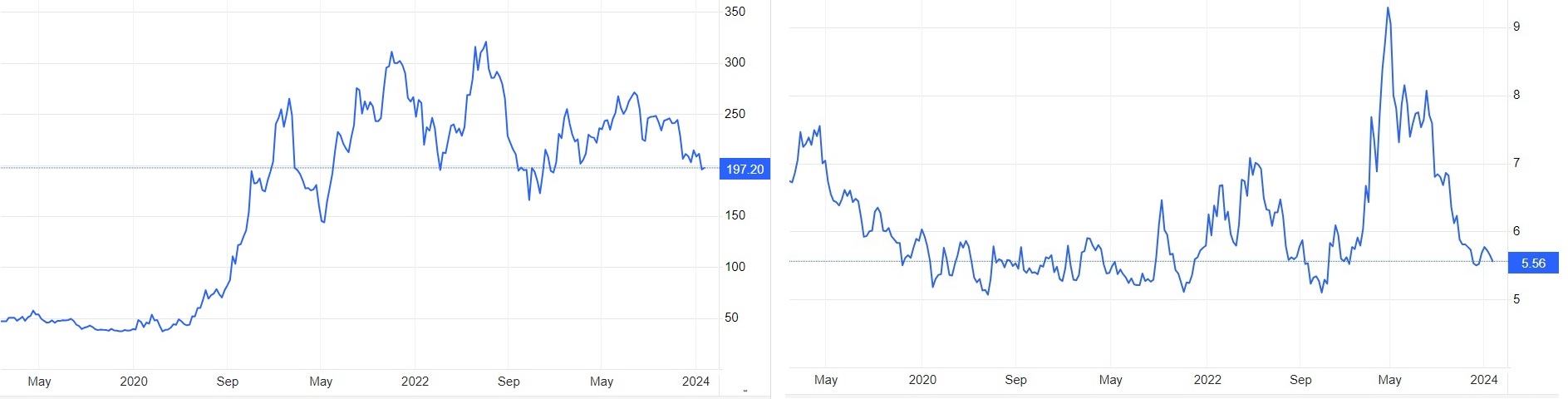
In Hong Kong, the Hang Seng Index finished the last trading day in 2023 14% lower than it started the year. Similarly, stocks in mainland China recorded losses, with the CSI 300, an index tracking companies listed in Shanghai and Shenzhen, declining 11%. In both cases, the declines have led to hundreds of billions of dollars flowing out as money managers and pension funds reduced their holdings in Hong Kong; the longstanding gateway for foreign investors wanting to put money into mainland China (Figure 1).

Figure 1: Hong Kong: markets and economy: 1-year perspective

FIG1 HK market
Source: Tradingeconomics, author. Jan. 24, 2024

Here are two examples representing “old” and “new” industries. The BYD became the top-selling battery electric vehicle manufacturer in the world after overtaking Tesla in the fourth quarter of 2023 and Volkswagen, the first time any carmaker outsold the German brand since at least 2008. Yet, BYD stock has been plunging since mid-2023 and remains 30% below its high.

China Railway (CR) is the Chinese passenger and freight railroad giant. As tourism outflows are still struggling around the world, domestic tourism in China has soared. During the impending Chinese New Year, a record high 9 billion trips will likely be made, with the national railway system expected to complete 480 million passenger trips. How are these realities reflected by the CR stock, a major beneficiary? Well, they aren’t. It’s been plunging ever since last May and remains 40% down from its high (Figure 2).

Figure 2: Stocks Under Pressure: 1-year perspective

(a) BYD                                                                       (b) China Railways

FIG2a-b BYD-China Railways
Source: Tradingeconomics, author, Jan 24, 2024

Short sellers from Chanos to Ackman and Bass                

Like South Korea, Hong Kong began to attract short sellers soon as the quarantines ended. These players are exemplified by billionaire players, such as Pershing Square boss Bill Ackman, who recently played a key role in the ousting of Harvard’s first black female president Claudine Gay, had first tried to exploit the Hong Kong dollar a decade ago. He took another tilt in 2022, betting the government would be forced to break its link to the US dollar. Fellow hedge-funder Kylie Bass has made similar pronouncements since at least 2019.

Following the highly controversial short-sellers like Andrew Left and Carson Block, Ackman and Bass have targeted China. Bass bet on banking collapse in China in 2015-19 and plays a role in the ultra-hawkish think-tank Hudson Institute, which promotes regime change in China.

The two were preceded by Jim Chanos, who in 2009 bet against Chinese real estate; right before the Chinese stock boom. A year later, he predicted an impending Chinese economic crash that would resemble “Dubai times 1,000 – or worse.” Despite years of flawed predictions, New York Times portrayed Chanos glowingly as “The Man Who Got China Right” in 2015, which is how he is still portrayed by CNBC and US news media.

Yet, the cold reality is that last fall Chanos shuttered his hedge funds, which fell 4% even as the S&P500 surged 18%.

Shorting in China              

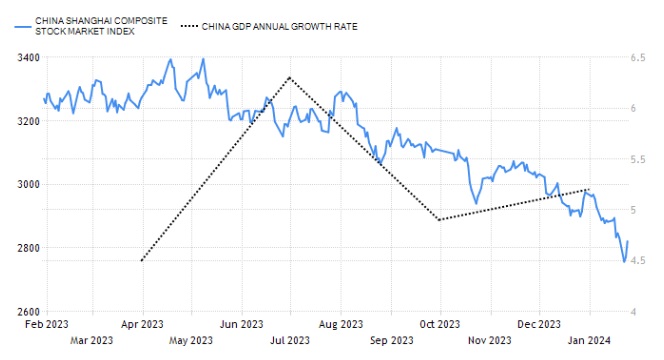
Headquartered in the US, UK, Western Europe and Japan, international media has reported China’s ongoing rebound mainly as a “downturn,” “meltdown,” or even “collapse.” In reality, the Chinese recovery began in April-July, slowed in August-October, but has strengthened thereafter. Yet, through this period the Chinese market has declined, even as rebound has broadened (Figure 3).

Figure 3: China: markets and economy: 1-year perspective

FIG3 CH market
Source: Tradingeconomics, author, Jan 24, 2024

Nearly nine-tenths of the foreign money that flowed into China’s stock market in 2023 left prior to the year-end. Since peaking at 33 billion in August, net foreign investment in China-listed shares in 2023 dropped 87%, according to Financial Times calculations based on data from Hong Kong’s Stock Connect trading scheme.

International investors have been persistent net sellers since August, when the missed bond payments by the struggling developer Country Garden revealed the severity of a liquidity crisis in China’s property sector. Yet, not all analysts cited seemed to accept such conclusions. “It’s so counterintuitive – the data is getting better and the general environment should be quite positive for Chinese stocks,” said Alicia García-Herrero, chief Asia-Pacific economist at Natixis. “Frankly there’s no reason for this other than investors basically giving up and saying: ‘We don’t see the upside’.”

But why should investor perception be so badly misaligned with realities and with their stated objectives to make money for their investors?

International negative amplification                

China’s property market is ailing. That’s typical of rapid industrialization and the associated overhang. What makes it unique is the country’s huge size. Yet, housing demand will prevail. In China, there are now over 400 million people in the middle-income bracket, but the number is expected to reach 800 million in the next decade. As they leave the countryside to the city, they will need homes.

In the past 2 years, Chinese property sales dropped by 10-15%. In 2024, that figure will shrink to 5%. The good news for China’s property developers is that a bottom is in sight, as S&P Global reported already last October. The bad news is that it will take a while for the sector to normalize.  

If China is moving toward a soft rebound, why do international media and observers continue to see the glass half empty?

In part, this reflects the kind of negative amplification mechanisms that in the US media contributed to the severity of the 2008/9 Great Recession, as the Nobel-awarded economist Robert Shiller has demonstrated. In the past decades, these mechanisms have accelerated, due to the rise and spread of online media. Furthermore, the increasing weaponization of (even reputable) international media has dramatically proliferated since 9/11, and today it can be leveraged worldwide.

Short sellers for regime change

Obviously, there are fundamental drivers behind the ailing markets in East Asia as well. Nonetheless, a great number of anomalies – economic vibrancy penalized by markets – suggests that there is more to the story. In 2021, short-sellers still won big in the US and even in 2022 as the broader market declined, tallying $300 billion in mark-to-market profits on average short interest of $973 billion.

However, with the end of the quarantines, short sellers lost $178 billion in 2023. What to do? Well, when things get better in the US, short-sellers have been shorting in Asia; foreign markets, companies and currencies, even engaging in regime change.

Last summer, Hong Kong’s financial chief Paul Chan blamed “misunderstandings caused by Western political prejudices” for the stock market’s poor performance, as geopolitical tensions between Beijing and Washington hit a low point.

Ever since the 2011, the West’s geopolitics is driving economies and markets. Unlike economic performance, its impact is unwarranted, adverse and negative. Financial bubbles burst, but geopolitical ploys devastate.

The original version was published by China-US Focus on Jan. 26, 2024

About the Author

Dr. Dan SteinbockDr. Dan Steinbock is the founder of Difference Group and has served at the India, China and America Institute (US), Shanghai Institute for International Studies (China) and the EU Center (Singapore). For more, see http://www.differencegroup.net/  

5 Ways Technology Can Help you Deliver Exceptional Customer Support

Delivering great customer service is no longer just a nice to have.

Recent research established that businesses that adopt omnichannel strategies achieve 91% greater year-over-year customer retention rates compared to those that don’t. 

That’s a staggering statistic and it underscores the power of some of the top features of an omnichannel support software in 2024.

Here’s the thing, customers expect seamless service whether they’re on social media, live chat, or email. A top-notch omnichannel support platform isn’t just nice to have; it’s essential for thriving in a competitive market.

In this article, we take a look into how centralized customer information makes the best customer support software for startups and why smooth integration across channels is non-negotiable. 

We’ll dive deep into how smart routing can slash wait times and why analytics are crucial for knowing what your customers really want. 

I hope you’ll be able to discover how automation eases volume pressures while mobile optimization keeps you accessible anytime, anywhere.

Let’s get started.

1. Centralized Customer Information

Omnichannel support software shines when it comes to keeping all of your customer data in one place. 

Imagine you’re a chef with ingredients scattered across multiple pantries.

It’s inefficient, right?

Now think about having everything within arm’s reach—that’s the power of centralized customer information. By unifying data from various channels, your business can serve up personalized experiences that are consistent regardless of where a customer reaches out.

So a single source of truth for customer info lets agents see every interaction—be it via email, chat, social media or phone calls—in one interface. 

This not only makes their work easier but also gives them insight into past conversations and preferences. It helps solve the challenge many small companies face: delivering cohesive service throughout different platforms.

And the best part?

Centralization means faster responses too because there’s no need to switch tools or ask customers to repeat themselves (and we all know how annoying that is). So you get happier customers and more efficient support teams—it’s a win-win situation.

You’ll find that omnichannel solutions like Salesforce Service Cloud offer these capabilities so your team can give top-notch service without missing a beat. 

They make sure each question gets its answer swiftly by giving everyone on your team access to what they need when they need it most—and isn’t that just smart business?

2. Intelligent Routing and Distribution

How does intelligent routing work?

Imagine a scenario where every customer question lands in the lap of someone who’s not just ready but excited to answer it. 

That’s what intelligent routing does for your business. It cuts through the noise, making sure customers get their answers from the right person without delay.

Omnichannel support software shines here by knowing which agent has the keys to each customer’s problems. It considers factors like expertise, availability, and past interactions. 

So it’s not just about speed; it’s about crafting responses that resonate on a personal level because they come from agents armed with context and skills matched perfectly to each query.

So when you ask how this smart system knows whom to send queries to? 

Think machine learning algorithms analyzing tons of data points, all in real-time. They predict needs based on history and urgency, making decisions almost human-like—only faster and often smarter.

It means you’ll see fewer frustrated customers bouncing between departments or repeating themselves over multiple channels—and that means better experiences all around. 

And your small business will feel the impact too: quicker resolutions lead directly to increased efficiency within your teams and can even affect bottom lines positively.

3. Automated Customer Service Options

Customers today expect quick and easy help when they hit a snag. 

They don’t want to wait on hold or wade through complicated menus. That’s where automated customer service options, like chatbots and self-service portals, come into play. 

Since these platforms enable you to offer immediate responses, these tools are game-changers for handling high inquiry volumes.

Forbes highlights the rising importance of chatbots in customer interactions because they can quickly decode what your customers need and guide them without delay. 

In fact, the beauty of self-service portals is their ability to give control back to customers. 

According to Forrester Research, more folks across age groups prefer solving issues themselves before reaching out for further support. This doesn’t just cut down wait times but also frees up agents so they can focus on trickier problems that bots can’t fix yet.

Omnichannel software steps it up by syncing data across channels—a must-have feature highlighted by Gartner’s research. This means no matter how a customer reaches out, the context follows them seamlessly from one platform to another without any hiccups in communication.

All said automated solutions aren’t about replacing human touch but rather enhancing it with efficiency and personalization—it’s about making sure everyone gets exactly what they need fast.

4. Seamless Document Management

Small businesses face various document management challenges. 

They often lack the resources of larger enterprises, but their need for efficient document handling is just as critical. 

Enter omnichannel support software with integrated document management systems: a game-changer for small business owners who want to stay organized without breaking the bank.

Omnichannel platforms simplify accessing and sharing documents, ensuring that all team members can find what they need fast. This cuts down on time spent searching through files and folders—a boon for productivity. 

But it’s not just about saving time; it’s also about serving customers better.

What’s more, many document management tools come with features like automated version control and permission settings which let you manage who has access to what information.

So it can double in as document control software for small businesses—a must-have feature for keeping sensitive data safe, even within smaller teams where everyone wears multiple hats.

All this adds up to something simple yet powerful: peace of mind knowing that whether you’re onboarding new staff or handling an urgent customer question,Your documents are always right at your fingertips—exactly where they should be.

If you run a small business, you can now say goodbye to doc chaos. Omnichannel software will make file sharing a breeze and customer service top-notch.

5. Mobile Optimization

The shift to mobile-first customer service is not just a trend; it’s a response to the growing demand for on-the-go support.

With most customers reaching out via smartphones, omnichannel support software has taken a pivotal role in delivering great customer support, especially for small businesses in 2024.

It ensures that users have a seamless experience, whether they’re chatting with an agent while sipping coffee at their favorite cafe or scrolling through FAQs as they commute.

They are also designed with responsive interfaces. 

It means you can automatically adjust content layout according to your device size and orientation, making sure information is always accessible and legible. This adaptability means your customers won’t miss out on vital details because of awkward formatting or unclickable buttons – common pitfalls in non-optimized sites.

This responsiveness doesn’t just satisfy immediate needs but also fosters long-term loyalty, as quick access help often translates into positive overall experiences with your brand.

Incorporating features like click-to-call buttons within the interface enables effortless transitions from self-service to live support. This fluid movement across channels mirrors how people use their devices – hopping between apps and websites without skipping a beat. 

All said and done, omnichannel solutions bridge gaps that could otherwise frustrate modern consumers who expect nothing less than instantaneity.

To enhance customer support and ensure a seamless experience, businesses should consider implementing omnichannel marketing as part of their strategy. By integrating communication and support channels such as email, social media, live chat, and phone into a unified approach, omnichannel marketing allows companies to meet customers wherever they are. This not only improves responsiveness but also creates a consistent and personalized experience, fostering stronger relationships and greater customer satisfaction.

Conclusion

Let’s recap what an omnichannel support software can do for you. 

Centralized customer info? 

It means knowing your customers like the back of your hand, across every channel.

Seamless integration? Absolutely. Say goodbye to clunky transitions and hello to smooth conversations that flow no matter where they start or end.

Intelligent routing gets those questions to the right ears fast. It is a great way to deliver best customer service software for startups with a small support team, by boosting efficiency, slashing wait times. 

You can also dive into the analytics and let numbers guide your next power move in service strategy. 

Tailor interactions with personalization tools—they make each chat feel like a one-on-one sit-down. Go mobile because these days, everyone is on-the-go and accessibility cannot lag behind.

Add proactive help into the mix and watch satisfaction soar before problems even pop up. You’ll be able arm your team with collaboration tools so they can knock out issues together, faster than ever.

You’ve got this! 

Start building better relationships today—with the right omnichannel approach backing you up all the way.

The Long-Term Advantage: Exploring Return of Premium Term Plans

Navigating the intricate landscape of financial planning can be a daunting task, given the myriad of options available, each meticulously crafted to address diverse needs and preferences. In this expansive realm, one particular category that has garnered noteworthy attention is return of premium term plans. These plans stand out as a unique offering, presenting a compelling blend of financial security and the potential for returns.

As we embark on a comprehensive exploration of these plans, it becomes imperative to dissect their key facets and delve into the myriad benefits they bring to the forefront. By unravelling the intricacies of return of premium with term plan, we can gain valuable insights into their role and significance within the broader financial landscape.

Grasping the Concept of Return of Premium with a Term Plan

A Term Plan is a straightforward life insurance policy that provides coverage for a specific term or duration. What distinguishes a return of premium term plan from simple term insurance is the unique feature of receiving the premiums back at the end of the policy term, provided the policyholder survives the term.

The Core Benefit: Financial Protection

The fundamental purpose of any life insurance plan, including the return of premium term plan, is to offer financial protection to the policyholder’s family in case of an unfortunate event. The death benefit provides a lump sum amount to the nominee, ensuring that the family is financially secure and can maintain their lifestyle even in the absence of the breadwinner.

Cost-Efficiency of Term Plans

One of the primary reasons individuals opt for return of premium term plan is the cost-efficiency they offer. Traditional life insurance plans tend to have higher premiums due to the inclusion of investment components. In contrast, term plans are more affordable because they focus solely on providing life coverage without any savings or investment elements.

Return of Premium: A Unique Proposition

The standout feature of return of premium term plan is the return of premiums at the end of the policy term. This adds a layer of financial prudence, as individuals get back the money they invested in premiums if they outlive the policy term. It effectively combines the benefits of life coverage with a savings component, making it an attractive option for those seeking a financial safety net.

Tax Benefits: Adding to the Appeal

In addition to the core benefits, return of premium term plan also offers tax advantages. Premiums paid towards these plans are eligible for tax deductions under Section 80C of the Income Tax Act. Moreover, the maturity amount received is exempt from taxation under Section 10(10D). This dual tax benefit makes these plans even more appealing for individuals looking to optimise their tax planning.

Flexibility in Policy Terms

Another noteworthy aspect of these plans is the flexibility they provide in terms of policy duration. Policyholders can choose a term that aligns with their specific needs and financial goals. This flexibility ensures that individuals can tailor the plan to their life stage and responsibilities, making it a versatile financial instrument.

Evaluating the Return of Premium Component

While the return of premiums is undoubtedly an attractive feature, it’s essential to evaluate its impact on the overall returns. In some cases, the return of premium may not match the returns from dedicated investment avenues. Prospective policyholders should carefully assess their financial goals and compare the potential returns with alternative investment options before committing to a Term Plan with Return of Premium.

Considerations for Policyholders

Before selecting a return of premium term plan, individuals should consider their financial objectives, risk tolerance, and overall financial situation. Assessing the adequacy of the death benefit, understanding the policy terms, and evaluating the insurance provider’s reputation are crucial steps in making an informed decision.

In the dynamic landscape of financial planning, return of premium term plan emerges as a versatile and cost-effective option, combining the assurance of life coverage with the added advantage of premium returns. As individuals navigate their financial journeys, exploring such innovative solutions becomes essential for building a robust and secure financial future.

The Road Ahead: Making an Informed Decision

Return of premium term plan presents a compelling proposition for individuals seeking a balance between life coverage and a financial safety net. The return of premiums adds a savings element to the insurance, making it an attractive option for those who value financial prudence.

The decision to opt for a return of premium term plan requires careful consideration and a thoughtful evaluation of individual financial goals. TATA AIA’s presence in this arena further reinforces the viability of such plans, offering a reliable option for those seeking a harmonious blend of life coverage and financial prudence. By taking the time to assess the benefits and considerations, individuals can secure a plan that not only protects their loved ones but also serves as a strategic component in their overall financial portfolio. In the pursuit of a financially sound future, the return of premium term plan emerges as a beacon, with TATA AIA shining as a trusted guide in this journey.

What do Online Casinos Mean for the Financial Safety of their Customers?

Safety and security in the gambling industry is just as important to consumers as it is in other industries. Finding reliable and safe online options is about carrying out a bit of research, and choosing a casino that works for you.

Is gambling a good way of earning money?

Any reputable casino and industry insider will confirm that gambling should never be used to earn money. This is an unsafe gambling principle to believe in, and can lead to financial issues for the player. Gambling is about chance a lot of the time. Random Number Generator (RNG) technology is in use across the gambling world for slot machine games too. RNG is designed to make games fair for each player. So the chances of you winning free spins, no wagering bonuses in the UK are the same as any other player.

Placing bets beyond your means should be a red flag. There are a number of organisations out there who can provide guidance and support if things have got out of hand. Many casinos do have a page dedicated to safe gambling, and this page should provide some links to support organisations. Casinos can also offer features such as gambling limits within a defined period. Self-exclusion requests are another function to explore. This means you effectively ask for your profile to be terminated or put on hold to prevent you from betting.

What about the safety of financial information?

Anyone who plays games at an online casino should make sure that the casino has decent levels of security to safeguard any financial or personal data that is exchanged.

End-to-end encryption is frequently used by well-known payment partners, which does add some level of relief for players at casinos that process payments with these partners. Blockchain technology is also on the rise, and it is also the primary technology used for cryptocurrency. More details on this technology below though.

A simple security measure you should look out for is that there is a two-factor authentication method used by the casino. This usually involves a security code being sent to either your phone or email. Then you then enter the code on the casino site to confirm your identity. It’s straightforward, and it’s quite easy for casinos to adopt so there’s little excuse for not offering such a feature to customers.

What payment methods are available to players?

The payment methods that are in use for both deposits and withdrawals does vary substantially across the board. Some casinos only offer the more regular methods, such as Visa, Mastercard, and bank transfer. However, many casinos these days offer a huge number of options to their customers. Wide-ranging options usually include regular bank and card methods using fiat currencies, as well as a varied number of e-wallet and cryptocurrency options.

An increasing number of casinos are opting to accept cryptocurrency, since it uses blockchain technology which is incredibly secure. The blocks of data that make up the chain aren’t all stored on one database or computer. And, the data blocks can’t be altered or deleted once created. This not only increases player confidence in making safe payments, but it means casinos can also often lower their operating costs when payments are made this way.

Should gamblers be wary?

Realistically, the majority of online casinos have methods in place to protect your financial data and safeguard your payment methods. However, it’s really important to make sure the casino is licensed, and has a good level of security in general.

Players also need to be realistic about what they can afford to lose if the odds are not in their favour. Don’t place bets beyond your means. In addition, don’t exceed any personal playing limit you want to stick to. It’s simply not worth the worry. If you do find you get into issues though, remember you can always ask for help.

Ultimately, the only person who can have responsibility for your online financial safety, is yourself. Research a variety of casinos to find the one that suits your needs and requirements the best. If in doubt, don’t share any personal data or financial information with a site.

The Gaming Industry In The Middle East is a Multibillion-Dollar Powerhouse On The Rise

The Middle East is quickly emerging as a global gaming hub, with regional powerhouses such as Saudi Arabia and the United Arab Emirates investing heavily in the gaming sector. Despite being in its early stages, the Middle East’s gaming industry is already a multibillion-dollar Industry. According to www.casinoelarabs.com, the region’s iGaming sector yielded over $5 billion in revenue by 2023, which is expected to reach nearly $10 billion in the recently concluded fiscal year. Saudi Arabia dominates this lucrative regional market, commanding a 48% share.  

International and Regional Collaborations

In 2023, gaming revenue in the region experienced a significant surge, primarily attributed to intensified collaborations that took shape during this period. The sector grew consistently due to mergers, acquisitions, and B2B partnerships. These initiatives involved attracting venture investors and bolstering growth and private equity efforts. Many forward-thinking states prioritized leveraging digital transformation, especially during and after the pandemic, marking a key focus area supporting gaming start-ups.

In 2023, Mobily—Etihad Etisalat collaborated with Ericsson to enhance connectivity during the Hajj pilgrimage event. This involved utilizing cutting-edge technology, including advanced analytics, machine learning (ML), and artificial intelligence (AI). The Hajj period typically witnesses new data usage patterns and increased data traffic. The Ericsson-Mobily partnership introduced AI-driven digital infrastructure that leverages cognitive capabilities to enhance connection speeds, expand big data capacity, streamline automation, and optimize large-scale networks. As a result, it improved remote access for participants in the region’s gaming sector, including high-profile international and local eSports competitions.

The Booming Youth Demographic

The Middle East boasts a youthful and dynamic population, offering opportunities for innovation and economic diversification. A young demographic helps accelerate the adoption of new technology when the right conditions are in place. In the Middle East and North Africa (MENA) region, a significant sixty percent of the population is below the age of thirty. This demographic plays a pivotal role in driving the gaming industry, and as the region’s culture transforms, both male and female players enjoy equal treatment on digital platforms. According to the Niko Partners survey, 32.6 percent of gamers in the MENA region are female, a remarkable statistic even compared to Western standards.

Gaming Market Segmentation In the Middle East

Access to smart electronic devices and increased internet penetration in the region have been vital to the gaming industry’s growth. This implies that gaming is available on various electronic platforms, including cell phones, PCs, and gaming consoles. As of 2021, the Middle East had roughly 8.3 billion SIM connections, which is expected to reach 8.8 billion by 2025. This explains the increasing number of consumers visiting mobile betting sites and online gambling platforms.
In rapidly growing economies such as Saudi Arabia and the United Arab Emirates, high-speed internet infrastructure is available in large cities, increasing involvement in online game streaming. While the sector was sluggish before the pandemic, the lockdown measures imposed by the outbreak drove the acceptance of gaming culture, with user numbers and game downloads jumping tenfold.
This wide adoption produced segmentation in the region’s gaming market, with consumers in Saudi Arabia, Turkey, Egypt, the UAE, Kuwait, Iran, and other MENA countries showing preference for different gaming platforms. Such segmentation has resulted in the Middle East becoming a multibillion-dollar gaming industry, with mobile gaming accounting for 60% of total revenue.

Government Commitment to the Gaming Sector        

Many Middle Eastern countries have tackled pre-existing prejudices and taboos regarding modern gaming. Such countries aim to capitalize on the burgeoning sector’s numerous benefits by being deliberate about its growth. Mohammad Salman, Saudi Arabia’s crown prince, is a key proponent of industrial development. He aspires to make Saudi Arabia the leading global gaming hub by 2030, and his ambitious objectives are supported by a major investment fund worth $3 billion by 2022.
The Saudi Arabia Investment Fund also promised the Savvy Games Group a $48 billion fund to drive the gaming industry in the kingdom. With such vast resources, Saudi Arabia hopes to create over 40,000 employees in the sector and 30 blockbuster game titles by 2030. Other countries with a hands-on approach to gaming industry growth include the United Arab Emirates and Egypt. 

Final Thoughts

According to a recent market report by Boston Consulting Group, the Middle East is a fast-growing gaming sector with the potential to dominate the global scene. According to the survey, nearly 60% of the region’s population actively participates in gaming, which accounts for 50% of gaming app downloads. This is ten percent over the global average. Indeed, the MENA region represents the future gaming market.

5 UK Property Market Predictions for 2024

As 2024 approaches, the UK property market is set to experience significant shifts. Leading Cash House Buying Experts, Open Property Group, analyse the key predictions:

  1. Moderation in House Price Growth: After years of rapid growth, the UK’s housing market is expected to see a more moderate increase in prices. This slowdown could be attributed to a combination of factors including economic uncertainties and a potential adjustment in the housing market following the pandemic-induced surge.
  2. Rental Market Resurgence: The rental market is likely to strengthen, driven by a growing population and shifting housing needs. This resurgence might be particularly notable in urban areas and cities with high employment opportunities.
  3. Sustainable Housing Demand: There will be an increased demand for sustainable and energy-efficient homes. Environmental concerns and rising energy costs are prompting buyers to prioritize properties with green credentials.
  4. Fluctuating Mortgage Rates: Mortgage rates are expected to see fluctuations, largely influenced by economic policies and market conditions. Buyers might become more cautious, and there could be a renewed focus on finding the best mortgage deals.
  5. Emergence of New Investment Hotspots: New investment hotspots are likely to emerge across the UK. These areas might offer attractive returns due to factors like infrastructure development, regeneration projects, and changing demographic patterns.
  6. Technology’s Role in Property Transactions: The use of technology in property transactions will continue to grow. From virtual tours to blockchain in property transactions, technology will make the buying and selling process more efficient and accessible.
  7. Shift in Buyer Preferences: Buyer preferences might shift, with a growing emphasis on home offices, outdoor spaces, and properties in suburban or rural areas, reflecting changes in work and lifestyle patterns post-pandemic.
  8. Impact of Government Policies: Government policies, particularly those related to housing and finance, will play a crucial role in shaping the property market. Policies aimed at boosting housing supply or providing financial assistance to buyers could significantly impact market dynamics.
  9. Increasing Interest in Property as an Investment: Property is likely to remain a popular investment choice, especially in a low-interest-rate environment. This could further drive demand in certain sectors of the market.
  10. Focus on Quality and Amenities: There will be a heightened focus on the quality of housing and amenities offered. Developers might concentrate on delivering value through better design, quality construction, and additional amenities.

In conclusion, the UK property market in 2024 is poised for change, influenced by economic factors, evolving consumer preferences, and technological advancements. Stakeholders in the market – from buyers and sellers to investors and developers – will need to navigate these changes carefully.

Top-Rated Wallets Available for Bitcoin Owners

The dawn of digital currency brought forth the need for secure management of virtual riches, giving birth to the very concept of Bitcoin wallets. Initially, these repositories were rudimentary, focused purely on function, mirroring the utilitarian ethos of early cryptocurrency adopters. Yet, as digital coins edged into the mainstream, the wallets evolved, morphing from simple software programs on personal computers to sophisticated vaults guarding our blockchain-bound treasure.

With each passing year, these wallets have transformed, leveraging cutting-edge technology to bolster security and enhance user experience. They’ve journeyed from mere transaction facilitators to comprehensive financial tools, incorporating features such as multi-signature authorization and biometric security checks. Today’s wallets are not just about holding Bitcoins; they embody a complete financial ecosystem, reflective of the cryptocurrency’s meteoric rise from tech curiosity to a staple of modern finance.

Securing Your Stash: Hardware Wallet Standouts

In the cerebral arms race between high-tech thieves and cryptocurrency owners, hardware wallets have emerged as the gold standard of security. These physical devices, often resembling USB drives, provide an impenetrable fortress for digital riches. Led by innovations from companies like Ledger and Trezor, they support a vast array of cryptocurrencies and offer features such as secure chips and backup options for recovery.

For the discerning Bitcoin enthusiast, the conversation about hardware wallets extends beyond mere security; it’s about peace of mind. Trezor’s Model T and Ledger’s Nano X reign supreme in user reviews for their combination of ease-of-use and robust protective measures. Both wallets are celebrated not just for keeping digital coins safe from the tentacles of unauthorized access, but also for their sleek user interfaces that make transaction verification a breeze.

Desktop Wallets: Combining Convenience and Security

The digital realm of cryptocurrencies has not only revolutionized the way we think about money but also brought forth a myriad of tools for its safekeeping. Among these, top-rated wallets available for Bitcoin owners on the desktop platform stand as a testament to the ingenious blend of accessibility and robust protection. Users can effortlessly carry out transactions, manage their portfolios, and remain vigilant against threats with these applications—all from the comfort of their personal computers.

In the cryptographic landscape, these wallets serve as an essential interface, fostering a user-friendly environment without compromising on security measures. Features such as two-factor authentication, multi-sig support, and continuous software updates provide peace of mind for those navigating the Bitcoin network. As a nexus of control, desktop wallets empower users with the ability to oversee their digital assets directly, a crucial aspect for those who prioritize autonomy in their financial affairs.

Mobile Wallet Mastery: Spend Bitcoin on the Go

In the dynamic world of cryptocurrencies, the convenience of transacting on the move is a game-changer. Enter the modern mobile wallets, sleek applications that not only store your digital coins but also empower you to pay for goods and services with a simple tap on your smartphone. These digital purses have evolved to offer robust security features akin to their desktop counterparts, with added functionalities like QR code scanning and NFC support for contactless payments. Ideal for those who embrace the fast-paced lifestyle, these wallets transform your mobile device into a portable vault that keeps your bitcoins secure, while ensuring they are readily accessible for that spontaneous coffee purchase or an impromptu online deal.

The Rise of Cloud Mining and Wallet Integration

Cloud mining services such as 1BitUp have heralded a new era for Bitcoin enthusiasts, offering a hands-free approach to cryptocurrency mining. Through these platforms, individuals can rent computational power from remote data centers, eliminating the need for personal mining hardware. This shift not only democratizes Bitcoin acquisition but also piggybacks on the trend of online wallet services. With seamless integration, users can mine and manage their assets through a single interface, simplifying the user experience.

  • Digital wallets have evolved to offer built-in cloud mining features, enhancing accessibility for users.
  • These integrated solutions streamline the process, allowing for easy transition from earning to spending or investment.

Effortlessly, the mined Bitcoin flows into wallets, ready for use or further trading. This innovative blend streamlines cryptocurrency management, signaling a milestone in the convenience and functionality of Bitcoin services.

Cold Storage Solutions: the Ultimate Bitcoin Safe Haven

When it comes to safeguarding digital riches, envision an impregnable fortress nestled in the digital realm. This fortress is not just a metaphor but a realizable form of asset protection known in the cryptosphere as cold storage. By eschewing online connectivity, these repositories offer a sanctuary for your Bitcoin, insulated from the prying eyes and nimble fingers of cyber miscreants. Think of it as a personal cryptocurrency vault, with layers of security features that serve as your private guards, ensuring not even a single satoshi slips through unwanted. As an added measure, redundant backups in multiple geographic locations can be the linchpin for those seeking indomitable peace of mind.

Shrooms Canada Takes the Lead with Premium Psilocybin Cubensis: Elevating Your Psychedelic Experience

Shrooms Canada, a trailblazing company at the forefront of the emerging psychedelics market, proudly announces its latest venture: providing premium Psilocybin Cubensis products directly to consumers, bringing unparalleled quality and convenience to enthusiasts across the country.

In a world where holistic well-being and alternative therapeutic approaches are gaining traction, Shrooms Canada emerges as a beacon for those seeking a premium and reliable source for Psilocybin Cubensis. With a commitment to quality, safety, and accessibility, the company is set to reshape the landscape of psychedelic experiences.

Quality You Can Trust

Shrooms Canada stands out in the market for its unwavering dedication to quality assurance. Every Psilocybin Cubensis product undergoes rigorous testing, ensuring potency, purity, and consistency. The company collaborates with leading experts in mycology and employs cutting-edge cultivation techniques to produce a superior product that meets the highest standards.

Convenience Redefined

Recognizing the growing demand for a hassle-free and discreet purchasing experience, Shrooms Canada introduces a user-friendly online platform. Customers can now explore a curated selection of premium Psilocybin Cubensis strains, conveniently place orders, and have them delivered discreetly to their doorsteps. The user interface is designed to be intuitive, providing a seamless journey from product selection to checkout.

Educational Initiatives

Shrooms Canada understands the importance of responsible use and is committed to fostering a community that prioritizes education. The company’s website features a wealth of information on Psilocybin Cubensis, including dosage guidelines, potential benefits, and safety precautions. Through informative articles and resources, Shrooms Canada aims to empower users with knowledge, promoting responsible and mindful consumption.

Pioneering Research and Development

Shrooms Canada is not just a purveyor of Psilocybin Cubensis; it is a catalyst for innovation in the psychedelics industry. The company invests significantly in research and development, collaborating with leading experts to explore the full potential of psychedelic substances. By pushing the boundaries of understanding, Shrooms Canada aspires to contribute to the evolving conversation surrounding psychedelic therapies and their applications.

Community-Centric Approach

Beyond being a business, Shrooms Canada is dedicated to building a community that values transparency, inclusivity, and well-being. The company actively engages with its customer base through social media platforms, fostering a space for open dialogue, shared experiences, and mutual support. Shrooms Canada believes that a strong and connected community is essential for the responsible and positive integration of psychedelics into society.

Future Vision

As Shrooms Canada takes the lead in providing premium Psilocybin Cubensis, the company envisions a future where psychedelic experiences are not only accessible but also destigmatized. By combining quality products with education, convenience, and community-building initiatives, Shrooms Canada aims to be a catalyst for positive change in the perception and application of psychedelics.

Streamline Your Security: One Platform to Rule Them All

Unified security systems make it easier to protect a home or business. Separate systems that don’t communicate lead to gaps criminals can exploit. The unified system links all components on a single platform. What benefits come with using this type of system?

Seamless Monitoring 

Rather than having separate servers, workstations, and management software for various security systems, everything is brought together under a unified platform. This allows security personnel to monitor all systems through a single interface instead of having to check separate applications. It streamlines operations since all events and alerts from security systems, such as door access or motion detection, are aggregated into a single monitoring queue.

Personnel no longer need to cross-reference events between various security systems to piece together an incident timeline. The Genetec unified platform automatically correlates events from different systems by applying biometrics, facial recognition across video streams, access control readers, and more. This delivers situational awareness with a streamlined, less complex monitoring process.

Security teams also benefit from having all systems under a unified framework when it comes to configuration, updates, and maintenance. Instead of independently addressing the needs of individual security silos, changes can be rolled out centrally across all integrated components. This reduces the overall effort in managing multiple systems.

Better Automation

The consolidation of access control, video surveillance, intrusion detection, and other systems provides greater visibility and control across an organization’s facilities. With everything connected through one system, security teams gain a comprehensive view of operations and events as they occur.

Unified systems make it easier to set automated responses to security events or issues. For example, a door left open or a motion sensor triggered after hours could automatically trigger an alert to security staff. The system could also pull up live footage of the area or lock down other access points. More advanced automation enables the system to take predefined actions to resolve lower-level security events without human intervention. This frees up security teams to focus their efforts on assessing situations, responding to high-priority incidents, and proactively enhancing protections.

The data, video feeds, and connectivity of a unified system also allow for advanced analytics and pattern finding. The software can scan the unified data to detect abnormalities, identify vulnerabilities, and predict where risks may arise. This analytical component ties directly into incident response automation, creating a feedback loop that improves preventative actions. Over time, the automation capabilities become smarter and more effective as the system learns from the implementation environment and previous events. With everything operating on an integrated platform, the automation can continuously optimize to provide ideal security protections.

Easier Maintenance

There’s no need to manually update firmware and manage subscriptions across disparate applications and web portals. With a unified system, maintenance happens centrally through one app that wirelessly communicates with all security devices. This saves considerable time and hassle.

Reduce Complexity

A unified system reduces the complexity of protecting an organization’s people, assets, and information. Rather than having disjointed solutions from various vendors that don’t integrate well, a unified system centralizes multiple security functions onto a single platform. This consolidation of tools provides a “single pane of glass” for visibility and control.

With separate security products, there is often duplication of capabilities resulting in inefficiencies. As an example, having various identity providers and authentication systems across applications can create complexity for end users needing to manage credentials. A unified system would allow single sign-on by integrating identity management. Access controls could also be unified by using one policy engine versus individual policies on different systems.

Another benefit is streamlined administration, monitoring, and reporting. Security teams can implement policies, configure tools, view alerts, create reports, and more from one central interface rather than touching numerous consoles. This improves efficiency and also reduces the chance of missing critical events.

Furthermore, the integration present in a unified security platform allows different capabilities to coordinate for stronger protection. Network monitoring can feed information to machine learning analytics to detect advanced threats. Automated responses could then quarantine malware to limit damage. This level of unified coordination is not possible with standalone products.

Increase Efficiency

With a consolidated view of threats, security teams can respond more quickly and effectively to incidents. Shared analytics provide enhanced visibility as well as better coordination between different layers of security. Automating manual processes around investigation, reporting, and remediation frees up security staff to work on high-value strategic initiatives. Overall security productivity increases substantially with a unified platform.

Reduce Costs

Rather than purchasing, deploying, integrating, and managing numerous stand-alone products, a unified solution enables organizations to standardize on a single platform. This eliminates costs associated with complex integrations between multiple vendor products. By consolidating security spending onto a unified platform, organizations leverage their buying power to negotiate favorable licensing based on their overall usage.

IT and administrative costs decrease since there is only one system to monitor, update, and troubleshoot. Training is simpler also with only one platform for security staff to learn. Unified systems make it easier to scale as your needs change because you can just add additional security applications onto the existing centralized platform. This avoids costly rip-and-replace projects down the road as your security needs evolve.

Drive Innovation

Unified security platforms enable easier adoption of advanced capabilities leveraging technologies like artificial intelligence, machine learning, and automation. Security vendors can take advantage of data from across a customer’s environment to quickly roll out new detections, responses, and features. Customers benefit from the continuous delivery of new forms of automated protection. This creates a cycle of rapid innovation to stay ahead of a dynamic threat landscape, something more difficult to achieve by stitching together point products.

The Path Forward

Transitioning to a unified security platform requires evaluating the gaps in existing security programs, developing a roadmap focused on business risk reduction, and phasing in platform capabilities over time. Organizations that embrace this approach will be better positioned not just to weather current threats but also to adapt and evolve against future unknown attacks. By transforming fragmented security into unified protection, enterprise defenders gain significant advantages over increasingly sophisticated adversaries looking to exploit blind spots and gaps across disconnected tools.

EDITOR'S PICK OF THE WEEK

CFO's new mandate. CFO explaining the presentation

The Performance and Transformation Orchestrator: The CFO’s New Mandate in the Age of AI

By Terence Tse CFOs are evolving into AI-driven transformation orchestrators, balancing finance, technology, and strategy while upskilling teams, managing risks, and driving measurable business value. A key insight from this year’s AI for CFOs event, organized...

WISE DECISION MAKER GUIDE

POWER INFLUENCERS

Emerging Trends

The Future of Global Trade