By Xiangming Chen, Michael Hutahaean, and Irvin Nathaniel Tobing
With less than 25 countries owning high-speed rail services in the world, the development of the Jakarta-Bandung HSR reflects Indonesia’s aspiration to become a powerful middle-income country. Here is a recap of the history, concerns, challenges and benefits that marked this project.
I. Introduction
Over 2.5 million passengers rode the Jakarta-Bandung High-Speed Rail (HSR) from its commercial launch on 17 October 2023 to 17 April 2024, averaging around 415,000 a month and 14,000 a day for the six months, with a peak travel day of 21,537 passengers.1 These figures may not be that impressive for a sprawling and fragmented island nation of over 275 million people. However, they are a highly meaningful harbinger of Indonesia’s aspiration to become a powerful middle-income country through a priority commitment to upgrading its lagged infrastructure, especially transport infrastructure.
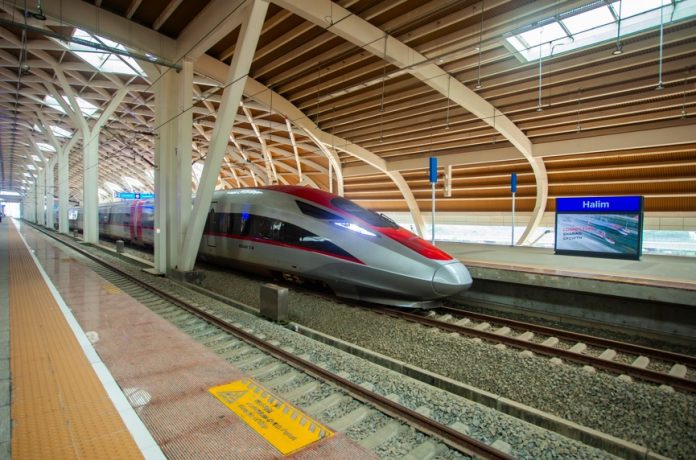
The HSR or “Whoosh,” which means fast, efficient, and reliable, as announced by Indonesian President Joko Widodo, marks and heralds a huge leap forward in the modernisation of Indonesia’s transportation. The 142-km-long high-speed line, connecting Indonesia’s capital city, Jakarta, and the fourth largest city, Bandung, the capital of West Java, shortens travel time between the two hubs from over three hours to around 45 minutes, alleviating Indonesia’s biggest inter-city mobility bottleneck which incurs economic costs in billions of rupiah every year. The rail line features four strategically located stations, and the distances between these stations have been meticulously planned to ensure optimal coverage and connectivity. The final cost of this ambitious project is estimated at US$7.2 billion,2 underscoring its significant investment in enhancing regional mobility and economic development.
This monumental project, developed in collaboration with China under the Belt and Road Initiative (BRI) launched in 2013, was managed by a consortium of Indonesian state-owned enterprises (SOEs) that consist of major local companies, namely PT Wijaya Karya (Wika), PT Kereta Api Indonesia (KAI), PT Jasa Marga (toll-road builder), and the plantation company of PT Perkebunan Nusantara VIII. The project also involved a significant partnership with Beijing Yawan HSR Co Ltd, a consortium of Chinese state-owned enterprises, including China Railway International Co. Ltd (a subsidiary of China State Railway Group Co.), CRRC Corporation Limited, China Railway Group Limited (CREC), Sinohydro Corporation Limited (a subsidiary of Power Construction Corporation of China), and China Railway Signal and Communication Corporation (CRSC).3

The development of the Jakarta-Bandung HSR represents the next leap in Indonesia’s train development journey, reflecting the nation’s aspirations for a modern and efficient high-speed railway system. The project, which initially saw competing bids from Japan and China, symbolises Indonesia’s strategic engagement with international partners to enhance its infrastructure. Japan’s offer of a 40-year loan at an interest rate of 0.1%4 and China’s counteroffer of a US$5.5 billion loan for a 50-year tenure at 2% interest underscored the project’s geopolitical and economic significance.5 Ultimately, the Indonesian government’s selection of China over Japan was influenced by financial and technical considerations, marking a significant milestone in the country’s infrastructure development ambitions.
The HSR’s impact and significance spread beyond being just a transformative transport artery. China has touted it as the first of its kind infrastructural system that China built overseas with its integrated system of design, engineering, equipment, technology, and standards through the BRI, Indonesia prides itself on hosting the HSR as the first train system of its kind in Southeast Asia. Both China and Indonesia see the HSR as inspiring more robust and extensive bilateral economic cooperation. This article offers a general and grounded overview of the historical backdrop, construction-operational issues, and emerging prospects of the Jakarta-Bandung HSR as a necessary baseline account that can animate more in-depth research in the future.
II. Leading up to the HSR
Indonesia’s Jakarta-Bandung HSR project stands as a landmark achievement in the nation’s transport infrastructure. It marks a significant leap forward, reflecting Indonesia’s aspirations for modernisation and connectivity. Initiated in 2008 with studies focused on a route extending to Surabaya, it shifted toward the shorter Jakarta-Bandung section after feasibility studies by the Indonesian government and the Japan International Cooperation Agency (JICA) highlighted its viability.6 Launched under President Susilo Bambang Yudhoyono and completed in 2023 during President Joko Widodo’s administration, the project underscores Indonesia’s capabilities in executing large-scale infrastructure projects.
The HSR project is a key development in ASEAN, solidifying Indonesia’s position as one of the few nations with a high-speed rail system. The operation of the KCIC400AF train, one of the fastest train types in the world and a high-speed variant from China’s CRRC capable of reaching speeds up to 350 km/h, underscores Indonesia’s entry into an exclusive global club. As of 2022, data from the International Union of Railways indicates that only 20 countries worldwide have high-speed rail services, representing a mere 10.3% of the United Nations-recognised countries. This achievement both elevates Indonesia’s status on the international stage and demonstrates its significant effort to enhance regional mobility and economic development.7
The project’s journey from inception involved significant leadership and strategic negotiations, reflecting a dynamic evolution from past challenges within Indonesia’s rail system. Before 2009, the railway system management faced critical issues such as ticket scalping and unsafe practices, which were transformed under the leadership of Ignasius Jonan, the then Director of PT Kereta Api Indonesia (KAI). Jonan introduced a series of reforms aimed at improving service quality and safety. These reforms included barring street vendors from stations, introducing air conditioning in economy-class cars, enforcing online ticketing, and preventing passengers from climbing atop trains. Jonan’s leadership effectively addressed the systemic issues facing KAI, setting a turning point and new railway service and management standards in Indonesia.8
Jonan’s reforms set the stage for more ambitious transportation projects to address Indonesia’s growing mobility needs. The Jakarta-Bandung HSR is a prime example of these efforts. Additionally, the expansion of the Greater Jakarta Commuter Rail, the Mass Rapid Transit (MRT) system in Jakarta in 2019, and the Light Rail Transit (LRT) have transformed rail commuting in Jakarta by providing efficient alternatives to private vehicles. This greatly helps the already in-place Bus Rapid Transit (BRT) system, which has dedicated lanes for buses, to ensure capacity and connectivity.
The transition from the chaotic management system of the past to the transformative leadership of Ignasius Jonan and eventually to the development of the Jakarta-Bandung HSR illustrates the dynamic evolution of Indonesia’s railway system. This journey highlights the importance of effective leadership, strategic planning, and international cooperation in advancing national infrastructure projects, setting the stage for a more connected and prosperous future for Indonesia’s rail transportation.
III. Construction and Operational Dynamics
The Construction Phase
During the construction phase, a primary concern was prioritising resources. A scholar from Bandung Institute of Technology argued that the Indonesian government should focus on enhancing existing railway services and infrastructure rather than investing heavily in the high-speed rail project. Since none of the intercity railways are electrified, they can serve low speeds of only up to 120 km/hour. However, this is a common debate on spending less money to upgrade an existing system or building a new one.9
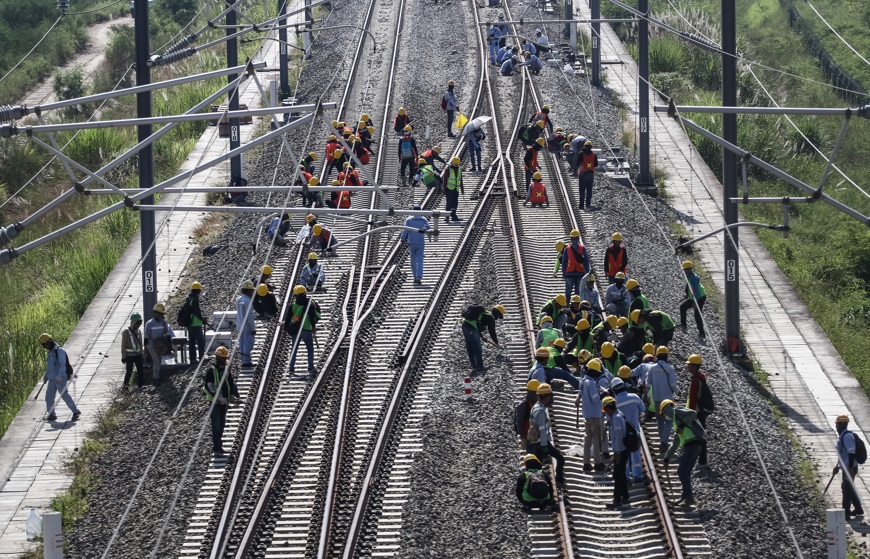
Engineers encountered significant challenges while constructing Tunnel 2, located in a clay shale area where the soil easily disintegrates upon exposure to air and water. This project marked the first successful construction in such challenging conditions. The success was facilitated by crucial technology and knowledge transfers between Chinese tunnel and grouting experts and local geotechnical specialists, including those from the Bandung Institute of Technology. This collaboration highlighted the importance of knowledge sharing in advancing construction practices in Indonesia.10
Financial sustainability emerged as a significant challenge, highlighted by a considerable cost overrun of US$1.2 billion. The project’s overall cost, substantially higher than that of building conventional toll roads, raised questions about its economic viability. This sparked concerns regarding the project’s financial sustainability, especially compared to more traditional infrastructure investments like toll roads, which generally require lower capital investments. A comprehensive funding approach to address these concerns was adopted, involving both Indonesian and Chinese stakeholders. The strategy includes significant loans from China Development Bank totaling US$448 million (approximately IDR 6.99 trillion), complemented by capital injections from a consortium of companies from China, Beijing Yawan HSR Co Ltd (approximately IDR 8.4 trillion), and Indonesia’s state equity participation (approximately IDR 3.2 trillion). This strategic funding approach demonstrates a bilateral commitment to ensuring the project’s financial stability and long-term success.11
The Jakarta-Bandung HSR, like the China-Laos Railway (CLR), illustrates potential financial risks linked to large-scale infrastructure projects financed by China. Both projects are part of the BRI and have incurred significant debt due to heavy reliance on Chinese loans. Regarding the CLR, Laos faced substantial debt levels, with the project cost estimated at around US$6 billion, a significant portion of the country’s GDP. Much like Indonesia, Laos relied heavily on Chinese loans for the railway, which exacerbated the country’s debt situation. However, the loan for building the Jakarta-Bandung HSR is a much smaller share of Indonesia’s GDP than the CLR’s financing relative to Laos’ GDP. Nevertheless, these expensive projects raise alarms about their long-term sustainability, as they require careful financial management to ensure that they do not burden the host country’s economy or sovereignty.
Environmental and social concerns have become increasingly significant with the HSR project, particularly during its construction phase. This phase involves substantial land acquisition, potentially disrupting local ecosystems and adversely affecting nearby communities. The West Java chapter of the environmental organisation Wahana Lingkungan Indonesia (WALHI) has reported 23 cases directly related to the HSR project, encompassing environmental issues, licensing problems, social impacts, and workplace accidents. A notable incident occurred during the construction of Tunnel 11 in October 2019, where the use of blasting methods led to extended ground cracks and caused severe damage to dozens of homes.12 Additionally, workers’ improper disposal of excavated soil on streets has contaminated water sources and compromised drainage systems, escalating the risk of floods and landslides in the area.13
Beyond environmental impacts, the Jakarta-Bandung HSR project has raised significant social concerns, particularly highlighted by The West Java chapter of WALHI documentation of agricultural disruption. Since August 2019, in Depok Village, Purwakarta Regency, over a dozen hectares of productive rice fields owned by 16 local residents have been converted into disposal sites for excavated soil from the HSR construction.14 This conversion has rendered the fields unproductive, eliminating a vital source of livelihood for these farmers and underscoring the need for more balanced infrastructure development that safeguards environmental integrity and community welfare. The combination of these environmental and social issues underlines the necessity for a more comprehensive and inclusive approach to large-scale infrastructure projects, ensuring that environmental integrity and community welfare are preserved.
Meanwhile, engineers faced significant logistical challenges while laying tracks for the Jakarta-Bandung HSR, particularly using 50-meter-long rail modules imported from China. These rails were welded into 500-meter sections at the Tegalluar depot, marking the first export of China’s high-speed special rails. This method ensured the railway’s smooth operation by minimising the number of welding points along the track. Initially, this approach was met with scepticism from the Indonesia Railway Company due to a lack of experience in transporting and laying rails longer than 25 meters. However, Chinese engineers presented a comprehensive solution by importing the rails by sea from the Port of Qingdao and selecting Cilacap Port as the entry point. The Chinese team upgraded the facilities to accommodate the imports because the port was not equipped to handle 50-meter rail modules. The team then conducted local trials to ensure the viability of the operation. The project marks a significant revolution in Indonesia’s rail construction methods.
The Operational Phase
Several challenges have occurred as the project transitions into the operational phase. These include electricity blackouts attributed to reliance on a single transmission source, delays and capacity limitations in feeder train services, and an inefficient refund system. Moreover, operational problems, such as signal difficulties in critical sections of the rail line, including industrial forests and tunnels, necessitate technological solutions, such as the enhancement of Wi-Fi networks, to ensure reliability and safety.15 These operational issues are compounded by concerns over social equity, with fears that the HSR might primarily benefit wealthier segments of society who can afford the relatively high-ticket prices, potentially exacerbating existing social inequalities. In addition, the feeder trains’ limited seating capacity of 200 passengers is incompatible with the HSR’s capacity of 601 passengers.
After over six months of operations, the PT Kereta Cepat Indonesia China (KCIC) implemented effective solutions to address initial challenges. The frequency of blackouts has significantly decreased, enhancing the reliability of travel services. Additionally, the KCIC has revamped its refund system, transitioning from a station-only refund process to an online platform. This change facilitates smoother transactions for customers who purchase tickets via the KCIC app. Despite the feeder train’s lower capacity compared to the high-speed rail, customer feedback indicates that issues regarding boarding have been minimal.
IV. Making Differences
Economic Transformation through Direct and Indirect Benefits
The Jakarta-Bandung HSR is poised to catalyse an economic transformation in Indonesia through a multitude of direct and indirect benefits. At the heart of this transformation is the significant job creation attributed to the project’s construction and operational phases, which is expected to lead to a marked decrease in regional unemployment rates. In an earlier short article, we reported figures from China Railway, the HSR’s main builder, that the HSR has created around 51,000 jobs, led to a cumulative purchase of local materials and inputs worth US$5.1 billion, and provided technical training for around 45,000 Indonesian workers.16
Furthermore, the HSR project is a catalyst for growth across several sectors, including steel, construction, and technology, driven by increased demand for materials and expertise. This economic ripple effect underscores the project’s role in boosting regional economic vitality. By improving accessibility, the HSR stimulates business expansion along its route and fosters the development of new economic zones, diversifying the economic landscape with boosts in tourism and hospitality services. The anticipated ease in business travel and the allure of investments along the corridor will likely establish new industrial and commercial centres, creating more job opportunities and fostering regional economic development. According to the American Public Transport Association (APTA), such high-speed rail services can significantly amplify economic activity, suggesting that every dollar invested returns up to four dollars in economic benefits through enhanced connectivity of economic centres.17 This efficiency stems from the effective connection of economic centres, which enhances productivity and economic dynamism, painting a promising future for the project’s impact on the regional economy.
This transformation is also evident in the appreciating property values around the HSR stations, which signals an increased demand for residential and commercial properties. According to 99 Group Indonesia, the Jakarta-Bandung HSR significantly influences property values in 14 sub-districts linked to its four stations — Halim, Karawang, Padalarang, and Tegalluar (see map). Areas such as Jatinegara, Kramatjati, and Duren Sawit have seen a substantial rise in residential demand, with spikes of 26.2% near Halim and 34.4% around Tegalluar, as recorded in the first half of 2023. This trend aligns with the KCJB’s operational goals for October 2023 and regional Transit-Oriented Development (TOD) development, marking a shift in urban living and business operation dynamics.18 The HSR project goes beyond simply connecting cities. It can potentially reshape the urban landscape into a network of interconnected, yet distinct, economic and residential zones. This could significantly enhance quality of life and economic efficiency by reducing traffic congestion on highways, similar to the experience in China with its vast high-speed rail network.
Another indirect yet significant benefit of high-speed rail is the reduction in carbon emissions. The previous Jakarta-Bandung route, serviced by the Argo Parahyangan, relied on diesel locomotives — a method known for its substantial carbon footprint. In contrast, the electrified HSR not only modernises travel between these two major cities but does so in a fraction of the time, taking only one-sixth the duration to reach Bandung. This modernisation reduces the amount of fuel used per trip, thereby decreasing overall carbon pollutants.
The Emerging Impact on Satellite Cities

(Source: Kereta Cepat Indonesia China, SPH Media.)
The introduction of the Jakarta-Bandung HSR heralds a transformative shift in urban and industrial development across key regions near Jakarta and Bandung. By drastically reducing travel times between these major cities, the HSR fosters the development of satellite cities and vibrant urban centres strategically positioned around HSR stations. These emerging areas are poised to benefit from modern planning principles that emphasise sustainable and accessible living spaces, enhancing the quality of urban life.
In particular, the HSR project is set to significantly impact the industrial landscape of Karawang, a crucial industrial hub known for its manufacturing plants and areas. The proximity of the HSR station to major industrial complexes such as Karawang International Industrial City, merely 8 km away, and Greenland International Industrial Center (GIIC), just 10.5 km distant, promises to streamline connectivity and logistical efficiency. This enhanced access is expected to transform regional commuting patterns and economic interactions, turning Karawang and similar areas into dynamic hubs of industrial activity and growth and catalysing a broader economic evolution in the region. In addition, the current construction of the Lakeside Commercial District near the new industrial area featuring an AEON mall will add an important commercial space and consumption outlet. This industrial-commercial combination will help Karawang attract professional and skilled workers to find jobs locally and move in as residents who can easily access the HSR, which will stimulate further land development and demographic growth.19
In response to the operational needs of this transformative project, the Ministry of Public Works and Housing (PUPR) is actively addressing the current challenges related to the development of essential toll road access to the Karawang station. This forthcoming toll road is expected to connect the Jakarta-Cikampek Toll Road directly with the station, seamlessly integrating it into the national transport network. The development of this toll road is crucial for maximising the HSR station’s utility and enhancing the rail service’s overall effectiveness,20 thus further improving access to the HRS for potential new local workers and residents.
Outside Bandung sits the Padalarang station (see map). An area surrounded by agricultural land, Padalarang was once argued to be a top contender for rice commodities because of its large planting space. This illustrates that much of the area in Padalarang is underdeveloped for infrastructure, leaving the land unclaimed for large-scale agricultural production. However, since the launch of the HSR in 2023, the area has slowly seen a decrease in green spaces with non-vegetation and sparse vegetation land increasing by 5.3% and 4.51%, respectively. A prime example of this development is the planned Emeralda Resort, a 28-hectare (with future plans up to 300 hectares) residential and commercial development situated 25 minutes from the HSR station and 15 minutes from the Padalarang Toll Road. Other nearby facilities include an international school, IKEA, a water park, and other recreation centres. The lowest price point for a residential property starts at roughly Rp 8,333,333 (US$520)/m2, while the lowest property cost in Bandung averages Rp 3,694,444 (US$230)/m2. The developer intends to establish an enclave for individuals who can frequently use the HSR or comfortably maintain a car, and have the means to support the development’s commercial areas.21
Tegalluar, positioned near Bandung, is on the brink of significant urban growth and economic diversification thanks to the catalyst role of the HSR project. This development is expected to touch on various sectors beyond the industrial, including real estate, retail, tourism, and services. It is set to enhance the tourism appeal of Tegalluar and its environs, making them more accessible and inviting for both local and international visitors, thereby injecting fresh economic flows into the area. The Gedebage area, close to Tegalluar Station, is identified as a new development zone to accommodate overflow from the densely populated sectors of Bandung, aligning with Bandung Regency’s spatial plans. This expansion is encapsulated in the Detailed Spatial Plan (RDTR), which earmarks over 3,500 hectares for a mix of office spaces, industries, housing, tourist attractions, and a lake, covering the sub-districts of Bojongsoang, Cileunyi, Rancaekek, and Solokan Jeruk.22 This growth trajectory aims to bridge economic disparities between Jakarta and Bandung and to foster more balanced regional development.
In contrast to Karawang’s focus on industrial and logistical enhancements via the HSR, Tegalluar is poised to evolve into a dynamic and emerging urban development, showcasing a wide array of benefits across real estate, tourism, and emerging business sectors. The HSR project underpins cross-regional economic integration, streamlining trade, bolstering tourism connectivity, and distributing economic activities more evenly across the region. This strategic development is expected to forge a resilient, diversified economy well-equipped to navigate local and global economic challenges, marking a significant shift toward comprehensive regional growth and prosperity.

Enhanced Mobility and Connectivity
The Jakarta-Bandung HSR significantly enhances mobility and connectivity between these major cities, impacting broader regional travel patterns. By providing a fast, reliable, and efficient mode of transportation, the HSR shortens travel times and integrates seamlessly with existing and planned transportation networks. This integration is crucial for leveraging the full potential of the high-speed rail, extending its benefits beyond immediate users to influence overall commuting behaviours and elevate transportation standards in Indonesia. However, addressing first-mile and last-mile connectivity is essential to maximise these advantages. Ensuring smooth transitions to and from the HSR stations is pivotal to avoiding turning what should be a quick trip into a prolonged journey, thereby preserving the time-saving benefits of high-speed rail travel.
A Jakarta resident working in the city with family in Bandung can now travel by train nearly every weekend. She boarded the train at Jakarta’s Halim Station and arrived at Padalarang Station near Bandung before taking a short motorbike ride home. This trip saves her more than two hours compared to the conventional rail or bus. A Jakarta-based male business executive who frequently travels to Bandung takes the train for comfort and to avoid traffic congestion.23 As travel volume increased, as expected, the HSR stimulated commercial activity at stations, including fast-food restaurants and convenience stores, to meet the needs of travellers. This multiplier effect is consistent and connected with the anticipated land and real estate appreciation of the areas around the HRS stations.
Halim station is connected to the Greater Jakarta Light Rail, Damri Bus, and Jakarta Bus Rapid Transit in Jakarta. Although the HSR is well connected, each transit line has its characteristics. Transferring to the Greater Jakarta LRT requires a 10-minute walk that can be cumbersome for those with heavy luggage. The Damri bus operates a low-frequency route between Soekarno-Hatta International Airport and the high-speed rail station every two hours from 7 AM to 9 PM. Additionally, the Jakarta Bus Rapid Transit (BRT) route 7W functions as a short-route feeder bus to larger BRT stations but only runs from 7 AM to 4 PM, limiting options for passengers arriving in the evening.
Padalarang and Tegalluar stations in Bandung have different levels of connectivity. Padalarang Station is where most people disembark when heading to Bandung City Center. The station offers a dedicated feeder train operated by PT KAI, which runs to and from Bandung Station and the Trans Metro Pasundan Bus route 2D. Meanwhile, Tegalluar Station relies on the Damri bus and the newly operational Bandung Raya Electric Bus to facilitate access to and from the station. These multimodal solutions in Bandung provide better integration, ensuring that the high-speed rail network efficiently serves its purpose of connecting major urban centres.
The comprehensive first-mile and last-mile solutions implemented in Jakarta and Bandung exemplify the commitment to ensuring high mobility and seamless connectivity within the high-speed rail network. These cities are addressing the critical gaps between the main transit hubs and final destinations by integrating various transportation modes such as buses, light rail transit, and dedicated feeder trains. Because of this, passengers can enjoy significantly reduced travel times and improved convenience, which is vital for the acceptance of high-speed rail in Indonesia.
The increased connectivity between the two regions provided by the Jakarta-Bandung HSR goes hand in hand with the expansion of urban areas that bring an increased demand for goods and services. New residents and businesses have primary needs, such as food and healthcare, as well as secondary demands, including furniture, electronics, and leisure products. This rise in consumption will increase logistics demands because more goods need to be transported to these growing areas. The increased volume of goods moving through these areas requires robust logistics and distribution networks, presenting opportunities for logistics companies to expand their services.

Private logistics companies will be interested in growing their operations in this region as they will tap into a new source of revenue. The local government will also have an increased incentive to help these companies with their investments. With increased investment in these regions, road connectivity and transportation networks will gradually increase in quality. These events will then lead to a more efficient logistics network and further economic growth in the region.
Other BRI-enabled Railway Projects in Southeast Asia
The flagship railway projects in Southeast Asia represent a significant leap in ASEAN’s capability to create a modern railway network. Other BRI rail infrastructure projects that are related to railways in Southeast Asia are the CLR and the Thailand high-speed rail. Envisioned to be docked with each other when the entire Thai rail line is expected to be completed around 2028, these projects are aimed at enhancing broader cross-border regional connectivity and economic cooperation.
The CLR commenced operations in December 2021 as a collaboration between the two countries to
promote economic growth and forge closer ties. The railway spans from Kunming in China to Vientiane in Laos, spanning 422 km through difficult terrain through northern Laos. The project’s key feature is its capability to serve passengers through high-speed travel and cargo rail, maximising social and economic benefits. Through April 2024, over 6 million Laotians had taken the train. During the Laos Water Songkran Festival holidays (13-18 April) in 2024, almost 90,000 people rode the train, 41.8% more than the same period of 2023. By 13 April 2024, one year after the inauguration of the international through train, over 730 trains crossed the China-Laos border directly, carrying more than 700,000 passengers, including 180,000 international tourists from 87 countries and regions.24
Along its route, the CLR is highlighted as a significant contributor to economic and social development. It is also regarded as a high-quality Belt and Road cooperation success story. The railway’s operation has turned Laos from a land-locked country into a land-linked hub in the Indo-China Peninsula, effectively overcoming development barriers and improving the livelihoods of the Lao people. The increase in foreign tourists visiting Laos, the surge in regional trade, and the creation of over 100,000 indirect jobs through progress in logistics, transportation, trade, commerce, and tourism, among other sectors, with 3,500 jobs for the railway itself, are all attributed to the success of this railway project.25
Thailand is also planning to build a high–speed rail that extends from Bangkok to Nong Khai, just south of Laos, and then linked to the CLR across an upgraded bridge across the Mekong River. This project is similar to Indonesia’s HSR, which is also induced by the BRI and will focus mainly on passenger rail, although it will only run at 250km/hour compared to 350km/hour for the Jakarta-Bandung HSR and 160/hour for the CLR. The initial section will travel between Bangkok and Nakhon Ratchasima and was initially planned to begin operations by 2028. However, the progress of construction in 2022 has only reached 15% and is below the 37% completion target.
These projects provide the two Southeast Asian nations with numerous economic benefits. The construction of the railways creates thousands of jobs during the construction and operational phases. The railway also promotes technology transfer and skill development because local workers gain experience working alongside experts from different nationalities. Moreover, the improved infrastructure attracts foreign investments and tourism, which promotes economic growth for the connected regions. If the eventually linked China-Laos-Thailand Railway extends south through Malaysia and then to Singapore as the southern terminus of the Pan-Asia Railway, envisioned back in the 1990s, we can imagine and expect even broader regional development benefits. The recently revived discussion between Malaysia and Singapore about their cross-border high-speed connection bodes well for the less certain but much longer and more effective rail transport corridor between Kunming and Singapore.
V. Navigating the Future
The Jakarta-Bandung HSR marks a significant milestone in Indonesia’s quest for modernisation and enhanced connectivity, signifying a bold leap toward redefining the country’s urban and economic landscapes. This ambitious initiative not only streamlines travel between two major cities but also catalyses broader urban development and economic expansion across its corridor. The project encompasses multifaceted challenges, including operational efficiency, financial sustainability, and social inclusivity, ensuring that its benefits are equitably distributed among all Indonesians. As Indonesia navigates the future, the success of the HSR hinges on overcoming these hurdles with a commitment to financial transparency and environmental safeguards, making the HSR accessible and affordable for all.
This endeavour is a testament to the Indonesian government’s dedication to revolutionising public transportation, envisioned as a precursor to comprehensive public transport reforms. The significant investment in the HSR aims to elevate public transportation standards in Indonesia, enhancing efficiency, safety, and reliability. Moreover, the HSR is a catalyst for sustainable development, embodying Indonesia’s aspirations for a more connected and prosperous future. This is part of a broader strategy under President Joko Widodo’s administration, which prioritises infrastructure for its economic and developmental benefits. The planned extension of high-speed rail connectivity to Surabaya as part of the Jakarta-Surabaya HSR project further illustrates this vision, promising to reduce travel times and spur economic growth across Java.
The continuation of these infrastructural commitments is expected under the forthcoming President of Indonesia, Prabowo Subianto, who has demonstrated a keen interest in strengthening ties with China. His past interactions with the former Chinese ambassador, Xiao Qian, underline a strategic approach to attracting further Chinese investments, crucial for the country’s infrastructure sector.26 Prabowo’s pre-inauguration visit to Beijing, where he met with Chinese President Xi Jinping on 1 April 2024, points to the continued strong partnership between Indonesia and China. As Indonesia looks to the future, integrating such international partnerships and the ongoing development of key projects like the Jakarta-Bandung HSR highlight a forward-looking perspective that aims to redefine Indonesia’s socio-economic trajectory and set a precedent for future infrastructure endeavours in the country and more broadly in Southeast Asia.
About the Authors
 Xiangming Chen is Raether Distinguished Professor of Global Urban Studies and Sociology at Trinity College, Connecticut, a distinguished guest professor at Fudan University, Shanghai, and a Research Fellow affiliated with the Resilience Development Initiative (RDI) in Bandung, Indonesia. He has published extensively on globalisation and urbanisation with a recent research focus on China’s influence on global urbanisation and city-making through the Belt and Road Initiative (BRI). His books include As Borders Bend: Transnational Spaces on the Pacific Rim (2005) and The Belt and Road Initiative as Epochal Regionalisation (2020). He has also conducted policy research for the World Bank and the Asian Development Bank.
 Michael Hutahaean is a Program Officer at the Resilience Development Initiative (RDI), a prominent think tank in Indonesia dedicated to fostering resilience building and sustainable development. He is deeply engaged in exploring sustainable urban planning, resilient infrastructure, and circular economy topics. In RDI, he has contributed to a diverse portfolio of research projects and consultancies, supported by prominent funders and organisations including the United Nations Development Programme (UNDP), the Wageningen Centre for Development Innovation (WCDI), and the Urban Studies Foundation (USF), among others. In RDI, he works closely with the Regional and Urban Planning (RUP) Cluster and the Water and Waste Management (WWM) Cluster.
 Irvin Nathaniel Tobing is an Associate at the Resilience Development Initiative (RDI), a prominent think tank in Indonesia dedicated to fostering resilience building and sustainable development. His research in RDI is primarily conducted under the Regional and Urban Development (RUP) Cluster. He earned his Master’s degree in Transportation Engineering from the University of New South Wales, Australia, specialising in urban logistics. Previously, he worked as an analyst at a logistics startup. His research interests focus on optimising logistics operations in cities and studying the impact of infrastructure development on the economy.





 Dan Fenton
 Mark Wynn Smith



 Carol Mae Whittick


 Christopher Burke