Home care plays a crucial role in ensuring that veterans can live comfortably and independently in their own homes, especially as they face aging-related issues or health challenges. Veterans have unique needs due to their service-related experiences, which often include a combination of physical disabilities, chronic illnesses, and mental health conditions. Addressing these needs effectively requires a comprehensive understanding of both the medical and emotional aspects of their care. This guide aims to provide detailed insights into the various facets of home care for veterans, including the development of personalized care plans, navigating resources, and incorporating assistive technologies, so start looking into it as soon as possible.
Understanding the Unique Needs of Veterans
Veterans often come home with specific health and emotional challenges that require tailored care approaches. Service-related conditions can include physical injuries such as amputations or back problems, chronic illnesses like diabetes or heart disease, and mental health issues such aspost-traumatic stress disorder (PTSD) or depression. Each veteran’s experience is unique, shaped by their military service, and may result in a combination of visible and invisible injuries. Addressing these needs requires a deep understanding of their history and health status. For instance, a veteran with PTSD might benefit from a care plan that includes counseling and stress-reducing activities, while one with mobility issues might need physical therapy and adaptive equipment.
Creating a Personalized Home Care Plan
A well-designed home care plan is essential for addressing the specific needs of veterans and ensuring they receive appropriate care. Developing such a plan involves collaboration among healthcare providers, family members, and the veterans themselves to create useful veteran home carethat will suit everyone involved. The plan should detail the types of care required, such as assistance with daily living activities, medication management, or specialized medical treatments. It should also set clear goals for improving the veteran’s quality of life, such as enhancing mobility, managing chronic pain, or improving mental health. Additionally, the plan must be adaptable, with regular reviews and updates to accommodate changes in the veteran’s health status or living situation.
Navigating VA and Community Resources
Navigating the array of resources available for veterans can be overwhelming, but understanding how to access these services is crucial for effective home care. The U.S. Department of Veterans Affairs (VA) provides various home care services, including in-home health care, respite care for family caregivers, and home modifications to improve accessibility. Additionally, local community organizations and non-profits offer supplementary services such as transportation, meal delivery, and social activities. To make the most of these resources, it’s important to be informed about the eligibility criteria, application processes, and the scope of services offered.
Incorporating Assistive Technologies and Home Modifications
Assistive technologies and home modifications are integral to improving the safety and comfort of veterans living at home. Assistive technologies such as medical alert systems, automated medication dispensers, and mobility aids can greatly enhance the veteran’s ability to manage their health independently. Home modifications, including ramps, grab bars, and accessible bathrooms, can help prevent accidents and make daily activities easier. Conducting a thorough assessment of the veteran’s home environment is essential for identifying necessary modifications. For instance, a veteran with limited mobility might benefit from a stairlift or an accessible shower.
Supporting Mental and Emotional Well-being
The mental and emotional well-being of veterans is as important as their physical health and should be a central focus of home care. Many veterans experience mental health challenges such as anxiety, depression, or PTSD, which can significantly impact their overall quality of life. Effective support involves providing emotional reassurance, fostering social connections, and facilitating access to mental health services. Encouraging participation in activities that promote mental wellness, such as hobbies, support groups, or community events, can also be beneficial.
The Role of Family Caregivers
Family caregivers are often the primary providers of home care for veterans, and their role is both vital and demanding. They are responsible for delivering direct care, managing medical appointments, and offering emotional support. Balancing these responsibilities with personal life can be challenging, leading to caregiver stress and burnout. To support family caregivers, it’s important to provide access to training programs, support groups, and respite care services. Training programs can equip caregivers with the skills needed to manage medical tasks and handle emergencies, while support groups offer a platform for sharing experiences and receiving emotional support.
Effective home care for veterans requires a comprehensive approach that addresses their unique needs through personalized care plans, utilization of available resources, and incorporation of assistive technologies. By focusing on both physical and emotional well-being, and supporting family caregivers, we can enhance the quality of life for veterans living at home. Understanding and navigating the complex landscape of veteran care can be challenging, but with the right resources and strategies, it is possible to provide compassionate and effective support.
We launched beVisioneers: The Mercedes-Benz Fellowship about 18 months ago and have been working closely with young innovators ages 16 to 28. Through this experience, we gathered great data on how workplace aspirations and expectations are evolving for this generation.
It’s clear that professional landscapes have undergone seismic shifts accelerated by the COVID-19 pandemic. Changes have particularly impacted those just starting their careers. Whereas Millennials experienced traditional office environments and sought to advance more inclusive policies within those contexts, Gen-Z is pioneering what it means to work and thrive professionally in a predominantly remote and hybrid world.
Defining a new office landscape
Historically, offices were not just places of professional contribution but also social hubs. Water cooler conversations and post-work socializing guided workplace culture and influenced career progression. For millennials and earlier generations, informal office interactions were instrumental to understanding workplace priorities, building networks, and learning the unwritten rules of professional life.
COVID completely disrupted the informal learning office spaces offered. While incentives for returning to physical offices fall short, many organizations are grappling to maintain a cohesive work culture. In this new context, Gen-Z holds an advantage to influence and reshape the future of work their careers began in a remote-first environment.
We launched the beVisioneers Fellowship as a hybrid program; fellows learn theory mostly remotely and come together in person four times throughout the fellowship calendar. A hybrid fellowship has enabled us to scale high quality, inclusive access to learning and community interactions. After some growing pains (building the necessary online infrastructure), we witnessed our Gen-Z fellows embrace our hybrid curriculum with ease and efficiency. In fact, they demand the flexibility inherent in hybrid environments, and their ability to virtually create the informal information sharing that used to happen in person will define a new office landscape.
Advancing Holistic and Inclusive Work Cultures
Our fellows have been particularly engaged in our Personal Sustainability Lab, a segment of our program that explores leadership practices and authenticity, and builds tools to manage mental and emotional health. Part of the reason why fellows have appreciated this part of our curriculum comes from their desire to break down traditional professional boundaries. Whereas previous generations faced pressure to maintain strict separation between professional and personal realms, Gen-Z wants workspaces that acknowledge the interconnectedness of the two.
As we hear Gen-Z actively advocating for workplaces where individuals can “be themselves,” we also know that this generation is struggling to feel supported at work, with only 34% of them reportedly thriving. Our fellows have placed significant importance on creating and advancing work environments that overtly considers and builds policies around mental and emotional health, and this follows established trends. Part of the appeal of remote work is that it enables more introverted personalities and neurodivergent people to be able to feel comfortable and thrive. Likewise, we see Fellows demanding a more “choose-your-own-adventure” program based on their needs and our expectations of what they will achieve, rather than a set “one-size fits all” curriculum. This generation wants workplaces that make room for their individual needs to perform at their best.
‘’Coming from a young Fellow, new to the professional world, I love the build up of the personal sustainability lab first and covering different mindsets and thinking tools!’’ – Marlene Mostert – Cohort 1 Fellow
Holding Organizations Accountable
Gen-Z is also distinguished by the value of integrity and its expectations that organizations will live up to their stated values. When there is a gap between what an organization claims to stand for and its actual practices, Gen-Z is not afraid to call it out. Leveraging social media and collective organizing, they make their disapproval heard, holding organizations accountable in ways that were not possible before.
Companies can no longer rely on marketing and PR to uphold their reputations; they must ensure that their actions align with their professed values. This demand for authenticity and accountability is pushing organizations to adopt more transparent and ethical practices, ultimately leading to a more equitable and just professional landscape.
In Meta’s recent Workplace Survey, it was revealed 73% of Gen-Z employees would leave a company if business practices were not ethical, while 68% would leave if their business was not sustainable, 62% because of social differences and 58% due to political differences. Fellows express determination to stick to their guns when it comes to being value-driven.
Navigating the Future of Work
As Gen-Z continues to enter the workforce in greater numbers, their influence on workplace culture and practices will only grow. Organizations that understand and adapt to their values and expectations will be better positioned to attract and retain top talent from this generation. This entails creating work environments that prioritize flexibility and inclusivity, support holistic well-being, and demonstrate genuine commitment to stated values.
Mariah Levinis the Executive Director at beVisioneers: The Mercedes-Benz Fellowship. She has focused her career on generating positive impact at the nexus of public and private sectors. She led the World Economic Forum’s Forum of Young Global Leaders (YGL), an independent foundation for remarkable leaders under 40 to tackle the world’s greatest challenges. There, she directed the foundation’s first Diversity, Equity and Inclusion Roadmap, resulting in a 10% increase in the new class’ regional diversity. She has worked as a consultant, Fulbright Fellow, committed community volunteer, and adept facilitator of C-suite conversations mobilizing action for societally-motivated initiatives. She holds Master’s degrees from Harvard University and the Fletcher School of Law and Diplomacy at Tufts University, and an undergraduate degree in Russian Area Studies and Philosophy from Wellesley College.
Japanese Prime Minister Fumio Kishida has announced his decision not to seek re-election as the leader of the ruling Liberal Democratic Party (LDP) next month, effectively ending his term as prime minister. His resignation comes after months of declining public support due to political scandals, rising living costs, and inflation. Kishida stated that “politics cannot function without public trust” during a press conference in Tokyo. The LDP will hold a leadership contest in September, with the winner expected to become the next prime minister. Kishida’s departure has created uncertainty in Japan’s political landscape.
Maxell, a company that began its journey over 50 years ago as a pioneer in battery technology, has evolved into a diversified tech leader renowned for its commitment to excellence and innovation. From its early days, Maxell’s focus on high-performance batteries laid the foundation for a reputation that would span decades, positioning the company as a reliable and trusted name in the industry. The company’s evolution from a battery-centric business to a global technology powerhouse is a testament to its adaptability, foresight, and unyielding dedication to quality.
The Evolution of Maxell: From Batteries to a Diverse Tech Portfolio
Founded in 1960, Maxell initially made its mark by producing high-performance batteries designed to meet the rigorous demands of various applications. The name “Maxell,” an abbreviation for “Maximum Capacity for Excellence,” reflects the company’s early and ongoing commitment to delivering top-quality products with superior performance and reliability. Over the years, Maxell expanded its product offerings beyond batteries, embracing a wide array of electronics and technologies, while staying true to its core values of innovation and excellence.
One of the key milestones in Maxell’s journey was its strategic diversification into digital media and storage solutions, alongside the development of advanced lithium-ion batteries. These innovations not only extended Maxell’s market reach but also cemented its status as a leader in technological advancement. The company’s ability to pivot and innovate in response to changing market demands has been central to its enduring success.
Cognitive Biases and Their Impact on Innovation
One of the key milestones in Maxell’s journey was its strategic diversification into digital media and storage solutions, alongside the development of advanced lithium-ion batteries.
Maxell’s journey of innovation and transformation is not immune to the cognitive biases that influence decision-making within any organization. Two specific cognitive biases—status quo bias and functional fixedness—play significant roles in shaping how companies like Maxell evolve and adapt to new challenges.
Status Quo Bias:
This bias refers to the preference for maintaining the current state of affairs rather than embracing change. It often manifests as resistance to new ideas or innovations, driven by the comfort and perceived safety of the familiar. Within Maxell, the status quo bias could have been a significant obstacle during its transition from a battery-centric company to a diversified technology leader. Leaders and employees alike might have been inclined to stick with the established, successful battery business model rather than venture into uncharted territories like digital media or advanced storage solutions. Overcoming this bias requires a deliberate effort to recognize the value of innovation and the risks of stagnation. Maxell’s ability to diversify its portfolio and embrace new technologies suggests that the company successfully managed to counteract status quo bias by fostering a culture that encourages innovation and adaptability.
Functional Fixedness:
This cognitive bias occurs when individuals or organizations are unable to see beyond the traditional use of products or concepts, limiting their ability to innovate. For a company like Maxell, which began with a strong focus on batteries, functional fixedness could have restricted its ability to envision new applications for its technology or to explore entirely different markets. This bias might have made it difficult for Maxell to expand into areas like data storage, digital media, or even construction solutions. However, Maxell’s track record of innovation, including the development of advanced lithium-ion batteries and smart devices, indicates that the company has effectively countered functional fixedness by promoting creative thinking and investing in research and development. By doing so, Maxell has been able to repurpose its technological expertise and apply it to a broader range of products and industries.
Innovation at the Core: Maxell’s Strategic Approach
Innovation is more than just a buzzword at Maxell; it is the driving force behind the company’s success. Maxell’s approach to innovation is rooted in substantial investment in research and development, enabling the company to explore and integrate emerging technologies effectively. By maintaining a close watch on consumer behaviors and market dynamics, Maxell ensures that its products are not only innovative but also aligned with the needs and expectations of its customers.
Maxell’s commitment to innovation is further enhanced by its collaborations with industry experts and technology partners. These partnerships enable Maxell to stay ahead of market trends and continuously deliver breakthrough solutions. Internally, Maxell fosters a culture of creativity, encouraging its teams to experiment and develop cutting-edge technologies. This comprehensive approach to innovation has allowed Maxell to remain agile, adapt quickly to new trends, and maintain a competitive edge in the fast-paced world of technology.
Adapting to the Changing Consumer Electronics Landscape
The consumer electronics landscape has undergone significant transformations over the years, driven by rapid technological advancements and evolving consumer preferences. Maxell has navigated these changes with agility, expanding its product portfolio to include state-of-the-art technologies such as lithium-ion batteries and solid-state drives. This diversification has allowed Maxell to meet the ever-changing demands of consumers and maintain its relevance in a highly competitive market.
Maxell’s commitment to sustainability is reflected in its development of eco-friendly products and adoption of environmentally responsible practices.
Maxell’s embrace of digital transformation is evident in its investment in cutting-edge data storage solutions and smart devices. By aligning its product offerings with contemporary technological trends, Maxell has positioned itself as a forward-thinking company that anticipates and meets the needs of its customers. Moreover, Maxell’s commitment to sustainability is reflected in its development of eco-friendly products and adoption of environmentally responsible practices. This focus on sustainability not only resonates with modern consumers but also reinforces Maxell’s reputation as a company that prioritizes ethical and responsible business practices.
Sustainability: A Pillar of Maxell’s Business Model
As sustainability becomes increasingly important in the tech industry, Maxell has taken proactive steps to ensure that its products and operations are environmentally friendly. The company has implemented several key initiatives aimed at reducing its environmental impact, from developing products with recyclable materials to optimizing manufacturing processes to minimize waste and energy consumption.
One of Maxell’s significant contributions to sustainability is its ongoing efforts to reduce its carbon footprint. By adopting renewable energy sources and improving operational efficiency, Maxell is making meaningful strides toward a more sustainable future. These practices not only meet growing environmental expectations but also contribute to the company’s long-term success by aligning with the values of today’s environmentally conscious consumers.
Navigating Global Markets: Consistency in Diversity
Operating in diverse global markets presents both challenges and opportunities. Maxell has successfully navigated these challenges by balancing localized strategies with global standards, ensuring that its products and marketing efforts resonate with regional preferences while maintaining a consistent brand image.
Centralized brand management plays a crucial role in upholding uniform messaging and visual identity across all markets. At the same time, Maxell’s sensitivity to cultural differences allows it to tailor its offerings to local customs and regulations. This approach is supported by effective communication between global and regional teams, which helps integrate local insights into Maxell’s overall strategy. Regular monitoring and feedback ensure that Maxell can quickly adapt to changing market conditions, enabling the company to stay relevant and competitive in various regions around the world.
Differentiation in Competitive Markets
In the highly competitive battery and digital media markets, differentiation is key to maintaining market position. Maxell sets itself apart through a combination of innovation, quality, and comprehensive solutions. The company’s long-standing reputation for reliability and performance is built on decades of experience and a steadfast commitment to technological advancement.
Maxell’s diverse product lineup, which spans from batteries and digital media to construction solutions, allows the company to cater to a wide range of market segments. This versatility is a significant advantage, enabling Maxell to address varied customer needs with tailored solutions. Furthermore, Maxell’s focus on sustainability and cutting-edge technologies, such as modular and repairable electronics and AI-driven enhancements, reinforces its competitive edge by aligning with modern consumer expectations.
The Future of Maxell: Embracing Emerging Trends and Technologies
Looking ahead, Maxell is excited about several emerging trends and technologies that promise to shape the future of the tech industry. One of the most notable developments is Maxell’s recent launch of its advanced Cylindrical Type Lithium Manganese Dioxide Batteries (CR), which are set to revolutionize power sources for smart meters, IoT devices, and various industrial applications. These batteries offer exceptional performance, durability, and safety, reflecting Maxell’s ongoing commitment to innovation and excellence.
In addition to battery technology, Maxell is exploring modular and repairable electronics to support a circular economy and reduce waste. The company is also integrating energy-efficient power management technologies and artificial intelligence to enhance the functionality and sustainability of its products. By staying at the forefront of these emerging trends, Maxell is well-positioned to continue delivering innovative solutions that meet the needs of its customers and contribute to a more sustainable future.
Building a Lasting Legacy: Advice for Business Leaders
Maxell’s journey offers valuable lessons for business leaders and entrepreneurs looking to build a lasting brand with a strong legacy. Continuous innovation is essential, as is the willingness to invest in new technologies and anticipate market trends. Quality products and services are the foundation of trust and reliability, while a clear brand identity aligned with core values helps to establish a strong and recognizable brand.
Maxell’s success also underscores the importance of exceptional customer experience and engagement, as well as the need for a long-term vision and strategic planning. Adapting to changing market conditions is crucial, as is fostering a positive organizational culture that supports creativity and attracts top talent. Finally, committing to sustainability and ethical practices is not only the right thing to do but also a powerful way to strengthen a brand’s legacy in today’s environmentally conscious market.
Maxell’s story is one of resilience, innovation, and strategic foresight. As the company continues to navigate the challenges and opportunities of the global tech industry, it remains a shining example of how a brand can evolve, adapt, and thrive over the decades, building a legacy that stands the test of time.
The hybrid work model is an evolving landscape, and insights from different organizations like Luminate, WSP Global, and the Greater Cleveland Food Bank offer a multi-faceted perspective on its implementation and challenges. Through my conversations with Christine Cenicola, Senior Vice President, Head of People at Luminate, Suzanne Puccino, Director Global Workplace Strategy at WSP Global, and Stacey Monroe, Human Resources Director at the Greater Cleveland Food Bank, we can glean a comprehensive understanding of how diverse organizations are adapting to this model.
Flexibility and Adaptation: Key Themes Across Sectors
The concept of flexibility within the hybrid work model emerges as a pivotal theme across various sectors, as seen through the experiences of Luminate, WSP Global, and the Greater Cleveland Food Bank. Each of these organizations, despite their distinct fields and operational goals, has embraced the flexibility inherent in the hybrid model, but they have tailored it to suit their specific needs and challenges.
Luminate, operating in a dynamic corporate environment, emphasizes the balance between in-office collaboration and remote autonomy. This approach is not merely about allowing employees to work from home; it is a strategic decision aimed at fostering a creative and innovative work environment. By enabling employees to work remotely, Luminate provides them with the autonomy to design their work schedules in a way that maximizes their productivity and creativity. Conversely, the designated in-office days focus on harnessing the collaborative spirit, ensuring that the team synergy is not lost in the digital realm. This balance is critical in maintaining a vibrant corporate culture that drives innovation and growth.
The designated in-office days focus on harnessing the collaborative spirit, ensuring that the team synergy is not lost in the digital realm.
WSP Global, with its international footprint, also underscores the importance of this balance but with a nuanced understanding of its impact on operational costs and environmental sustainability. The reduction in occupancy costs, as noted by Puccino, is a direct financial benefit of the hybrid model. Less obvious but equally important is the support for ESG initiatives, which is becoming increasingly vital for businesses worldwide. By reducing the need for physical office space and daily commuting, WSP Global not only cuts down on operational expenses but also contributes to broader environmental goals, aligning its business strategy with global sustainability efforts.
The Greater Cleveland Food Bank presents a unique perspective, as shared by Stacey Monroe. Their mission-centric approach to hybrid work underscores the adaptability of their workforce. Operating in the non-profit sector with a focus on community service, the Food Bank’s adoption of hybrid work arrangements is driven by the need to balance mission fulfillment with employee well-being. Monroe highlights how the pandemic-induced shift to remote work was smoothly integrated into their existing flexible work policies, reflecting the Food Bank’s long-standing commitment to adaptability and employee support. This approach allows them to continue serving the community effectively while also respecting the personal and professional needs of their staff.
Challenges and Innovative Solutions
The hybrid work model, while beneficial, is not without its unique set of challenges. Each organization has faced distinct hurdles in their journey toward a successful hybrid work environment. These challenges, however, have spurred innovative solutions that demonstrate the resilience and adaptability of these organizations.
Luminate, operating in a fast-paced, project-driven environment, faced the challenge of aligning individual employee needs with overarching team and organizational objectives. This challenge is particularly pronounced in a hybrid setup where team members are not always physically present. To address this, Luminate has implemented a series of strategies to ensure that even when working remotely, employees remain aligned with the company’s goals. Regular virtual check-ins, clear and measurable objectives, and robust project management tools have been key in maintaining this alignment. Additionally, Luminate has fostered a culture where feedback is continuous and not just limited to formal reviews, helping to keep individual and team goals in sync.
WSP Global, with its widely-distributed workforce and varied departmental structures, contends with the challenge of maintaining strong manager-employee connections in a hybrid setting. To bridge the physical distance, WSP has leveraged technology to its advantage, using collaboration tools and platforms that facilitate regular and effective communication. They have also placed an emphasis on training managers in the nuances of remote leadership, ensuring they have the skills and tools needed to effectively connect with and support their team members, irrespective of their physical location. This focus on developing managerial competencies in remote team management has been crucial in maintaining team cohesion and employee engagement.
The Greater Cleveland Food Bank, with its mission-centric operations, grapples with integrating flexible schedules into their work without compromising their service delivery. Monroe highlights the organization’s innovative approach to communication and team building. Recognizing the importance of regular, clear communication, the Food Bank has employed a variety of communication tools to keep staff informed and engaged. This includes not only digital communication platforms but also mandatory quarterly in-person meetings. These meetings serve not only as an information-sharing forum but also as a team-building exercise, ensuring that employees, whether they work remotely or on-site, feel a part of the cohesive unit. Additionally, the introduction of social events like “First Fridays” provides a casual setting for team members to connect and interact, further fostering a sense of community and belonging.
Internal Strategies and External Collaborations
In navigating the complexities of the hybrid work model, Luminate, WSP Global, and the Greater Cleveland Food Bank have demonstrated a strategic blend of internal initiatives and selective external collaborations. This approach underscores their commitment to addressing the unique challenges of hybrid work while leveraging external expertise where necessary.
WSP Global’s approach illustrates a strategic use of external resources to complement their internal efforts. Understanding the vastness and diversity of their global operations, WSP Global acknowledges that external consultancy can offer valuable expertise in areas such as remote workforce management, technology integration, and cross-cultural team building. This external support is not seen as a replacement for internal strategies but rather as an enhancement, providing additional resources and perspectives that can be integrated into the company’s existing framework. This selective use of external support helps WSP Global stay at the forefront of best practices in hybrid work models while maintaining a strong foundation of internal policies and practices.
Luminate’s approach to the hybrid work challenge focuses on internal problem-solving, backed by a culture that promotes innovation and agility.
The Greater Cleveland Food Bank, as articulated by Monroe, showcases a robust internal framework designed to support their hybrid work model. Their internal communication systems are a testament to their dedication to keeping all staff, regardless of their work location, in the loop and engaged. This is critical in an organization where the work is mission-driven and requires a high level of coordination and collaboration. Moreover, their structured onboarding programs are particularly noteworthy. These programs are designed not just to introduce new employees to the organization but to integrate them fully into its culture and operations, ensuring they can contribute effectively, whether they are in the office or working remotely. This internal focus on effective communication and comprehensive onboarding plays a crucial role in maintaining a cohesive and efficient workforce.
Luminate’s approach to the hybrid work challenge focuses on internal problem-solving, backed by a culture that promotes innovation and agility. Their strategies are largely centered on creating an environment where employees can thrive both in and out of the office. This includes developing internal policies that support flexible working while ensuring productivity and engagement. However, Luminate also recognizes the value of external insights, particularly in areas like technology adoption and management training, where outside expertise can provide a fresh perspective or specialized knowledge. This balance between internal solutions and external insights allows Luminate to remain adaptable and forward-thinking in their approach to hybrid work.
Having served as an external expert providing management training in hybrid work for over two dozen companies, I’ve seen many leaders go into such training sessions skeptical of hybrid models. They don’t feel like they can have true oversight of their team in a hybrid setting, and lack confidence that their team members are doing their work; they don’t know how to facilitate effective collaboration, innovation, and creativity in hybrid contexts; and they feel concerned about how to coach and mentor junior staff. All of these and more represent key components of successful hybrid management training.
Future Outlook: Balancing Organizational Goals with Employee Needs
As we peer into the future of hybrid work, the experiences of Luminate, WSP Global, and the Greater Cleveland Food Bank provide a blueprint for striking a crucial balance between organizational goals and employee well-being. This balance is not static but a dynamic equilibrium, responsive to the changing needs of both the organization and its workforce.
The Greater Cleveland Food Bank, under Monroe’s guidance, exemplifies this adaptive approach. As the organization grows and its mission expands, they continuously evaluate and modify their hybrid work policies to ensure they align with their service objectives and the needs of their staff. This evolution reflects a deep understanding of the importance of flexibility in a mission-driven environment, where the demands of service delivery must be balanced with the well-being of those delivering that service.
Luminate, with its focus on community building and innovation, is navigating a similar path. They recognize that the future of work lies in creating an environment where employees feel connected and valued, irrespective of their physical work location. This approach is pivotal in ensuring that team collaboration and company culture thrive in a hybrid setting. It involves continuously assessing and adjusting policies to ensure that they foster a sense of belonging and support the overall objectives of the organization.
WSP Global, with its global presence and commitment to ESG initiatives, is also charting a course for the future that acknowledges the importance of sustainability and cost-effectiveness. Their approach to hybrid work is not just about improving the bottom line; it’s also about creating a work environment that is sustainable and responsive to the needs of a diverse global workforce. This perspective is crucial in ensuring that the organization remains competitive and responsible in an increasingly interconnected world.
Conclusion
The diverse experiences of these three organizations underscore the fact that there is no one-size-fits-all approach to hybrid work. Each organization’s strategy is informed by its unique goals, culture, and workforce needs. Luminate’s emphasis on community and collaboration, WSP Global’s focus on sustainability and cost-effectiveness, and the Greater Cleveland Food Bank’s commitment to adaptability and service, all demonstrate different facets of how hybrid work can be successfully implemented and managed. These case studies also highlight the importance of continuous learning and adaptation. The future of hybrid work will likely involve ongoing adjustments as organizations learn more about what works and what doesn’t in their specific contexts. It will require a willingness to experiment, to listen to employee feedback, and to be agile in response to changing circumstances.
Withdrawal and isolation could avoid foreign affairs and wars, but the costs will be far higher in the long run.
Since the end of the Second World War, NATO has been a cornerstone of global security that few have questioned. Now, however, with a second term for the NATO-sceptic Donald Trump a real possibility, it is appropriate to consider what the consequences of a US withdrawal from the alliance could be.
Catastrophic if it happens. What if the U.S. were to pull out of the North Atlantic Treaty Organization (NATO), a threat declared on several occasions by a current contender in the running for President of the United States? As a columnist for this magazine, my contributions have almost always avoided direct political sentiments and commentaries involving candid opinions not supported by cited evidence. However, this possibility is too dangerous for me to continue to follow my self-imposed publication restrictions. So, I feel self-compelled to ask: Would NATO, which has kept Europe in relative peace for over 75 years, collapse without U.S. membership and support? It is one of those questions that has only frightening answers.
“No, I would not protect you. In fact, I would encourage them to do whatever the hell they want. You got to pay. You got to pay your bills.” – Former U.S. President, Donald Trump[1]
The epigraph comment above is a story recounted at one of Donald Trump’s political rallies. As usual for the former President, it is a jumbling, multi-gap account that boggles intelligence. He was allegedly referring to a talk he had with a leader of an unidentified NATO member who asked whether the U.S. would or would not defend members who fail to pay their share. “No,” he answered. “I would not protect you. In fact, I would encourage them [ostensibly Russia] to do whatever the hell they want. You gotta to pay. You gotta to pay your bills.” [2] My guess, knowing that Trump frequently makes things up, is that there was no such person, and the exchange never really happened, though, at his rallies, he likes to stir the senses of wondrous truth to confuse his listeners about what he stands for—nothing but himself. Anne Applebaum, staff writer for The Atlantic, asserts, “Almost every day he sounds more extreme, more unhinged, and more dangerous.” [3]
For Trump, every world-improving move is transactional. Tom Nichols, another Atlantic academic specialist on international affairs I trustingly follow, explains that, for him, “NATO is some sort of protection racket, in which our European allies come to Washington like quivering shopkeepers and make an offering to the local mob boss from their weekly receipts.” [4] Trump felt that each NATO member should be contributing a fair share at 2 percent of its GDP, which, under NATO’s guidelines, is suggested, not mandatory. Now, though, 23 members have hit that target, not because Trump has threatened to abandon the alliance but rather because of Vladimir Putin’s full-scale invasion of Ukraine.
Vladimir Putin’s dream
In the past 75 years, wars between European countries were few and short. Russia invaded Hungary in 1956 and Czechoslovakia in 1968. Turkey invaded Cyprus in 1974. And let’s not forget the Croatia and Slovenia breakaway from Yugoslavia in 1991. So, imagine a time when NATO dissolves. Before the signing of the NATO Alliance, Europe had hardly any years of peace. Hundreds of wars between neighbors happened for a millennium until the end of World War 2.
I don’t wish to alarm my readers; however, if Donald Trump wins a second term as President of the United States, and if the U.S. pulls out of the NATO Alliance as Trump would have it, Europe could become a strategic battleground that could encounter a Russian invasion with a few thousand advanced conventional weapons, with probably no need of nuclear ones. But with Russia’s force of over 5,000 strategic and tactical nuclear weapons, any battles will come with an overwhelming price of human suffering.
NATO is some sort of protection racket, in which our European allies come to Washington like quivering shopkeepers and make an offering to the local mob boss from their weekly receipts.
When I talk about this scenario with friends, and acquaintances that include foreign affairs specialists, I am bombarded with retorts, mostly in the form of laughter. However, those friends know too well that history often hits us in moments when catastrophic events are so unbelievable. The historian and former diplomat Michael Kimmage confirmed my view that Putin has a long-term plan that got unexpectedly entangled in a war with Ukraine. In January 2022, Kimmage said, “[NATO] is too large, too poorly defined, and too provocative for its own good.” Yet, in a recent Foreign Affairs essay with Liana Fix, a Fellow for Europe at the Council on Foreign Relations, Kimmage concluded, “It is no fantasy that, instead of perpetual peace—and instead, even of an iron curtain—chaos could again descend on a continent all too familiar with war.” [5] Those differing opinions leave us with strategic challenges. If we agree with Kimmage’s earlier opinion, the world may or may not end. If we agree with his concluding article, the world will be in a bad place, but not so severely bad as what could happen if Trump abandons NATO. Whatever view we go with, we must agree that if Trump is reelected, we must take his repeated threats of withdrawing the U.S. from the alliance seriously.
Let’s consider Trump’s warnings as a turbulent strategy, or what was once called the “Madman Theory.” As my journalist colleague Natasha Lindstaedt, professor in the Department of Government at the University of Essex, points out in her recent post for The World Financial Review, “Madman theory assumes that making seemingly unbelievable threats—such as embarking on nuclear war—are more credible if they are coming from someone unpredictable and possibly unstable.” [6] So perhaps Trump, as the late President Richard Nixon did in his term of office, is playing the game of Madman Theory. But Lindstaedt, an expert tin authoritarianism and author of Democratic Decay and Authoritarian Resurgence (Policy Press), points to studies of personalist dictators (all power in one person) who use warnings to show toughness to conceal poor military intelligence by touting risky bravado. In her astute essay, she tells us, “Madmen never prevail,” and Trump utilizes a theory that erodes his credibility and weakens foreign policy interests. “Madmen theory isn’t really strategic—it’s just idiotic.” [7]
In theory, Trump is not a madman; at least, we cannot say he is, without a face-to-face psychiatric evaluation of whether he is or is not. Declaring that he is would break the Goldwater Rule, an ethics annotation of the American Psychological Association (APA) declaration that “it is unethical for a psychiatrist to offer a professional opinion unless he or she has conducted an examination and has shown proper authorization for such a statement.” So, we cannot interpret or assess Trump’s mindset, even when he idiotically advises drinking bleach to “kill” SARS-CoV-2 viruses or when he comes up with crazy ideas such as “imposing an ‘all tariff policy’ that would ultimately enable him to get rid of the [U.S.] income tax.” Trump knows that none of those ideas could ever happen, but annulling NATO is feasible. A 1979 U.S. Supreme Court case (Goldwater v. Carter, 444 U.S. 996, 1003) permitted President Jimmy Carter to “unilaterally” nullify the Sino-American Mutual Defense Treaty. The U.S. Constitution says the Senate must participate in ratifying a treaty, but it is silent about annulling one. Madman or not, nullifying NATO would set the clock back to the first half of the twentieth century and have the world repeat our world wars. If we think Trump is all talk, let us remember that, as promised, he pulled out of the Iran nuclear deal notwithstanding Iranian acquiescence. Look at its nuclear program now. It is within weeks of being able to build a nuclear bomb.
As Tom Nichols, another Atlantic columnist I faithfully follow, tells us, “For too long, Trump has gotten away with pretending that his emotional issues are just part of some offbeat New York charm or an expression of his enthusiasm for public performance. But Trump is obviously unfit—and something is profoundly wrong with a political environment in which he can now say almost anything, no matter how weird and fallacious, and his comments will get a couple of days of coverage and then a shrug as if to say: Another day, another Trump rant about sharks.”[8]
A brief NATO history
“I cannot tell you exactly what the next crisis or the next conflict or the next war will be, but as long as we stand together, no one can threaten us. We are safe.” – NATO Secretary-General Jens Stoltenberg at a celebration of NATO’s 75th anniversary.
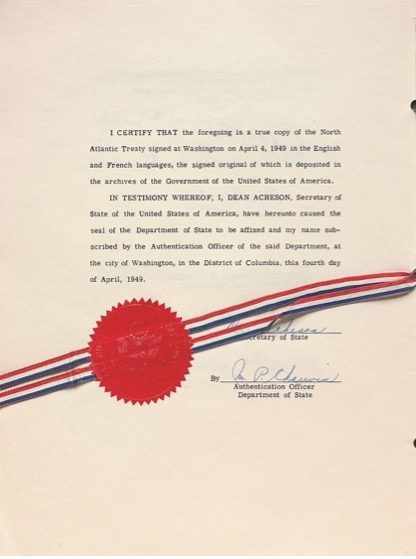
Authentication page of an official copy of the 1949 North Atlantic Treaty, signed and sealed by U.S. Secretary of State Dean Acheson
NATO was established in 1949 to stabilize Western Europe’s plans for an economically unified future and—more to the core of the historical truth—to check the potential of a Soviet Union expansion. There was no initial intent to invite others to the party after the treaty involved 12 countries—Belgium, Canada, Denmark, France, Iceland, Italy, Luxembourg, the Netherlands, Norway, Portugal, the United Kingdom, and the United States. [9] Today, 32 member countries are in the alliance.
Strange as that may be, after ratification by the parliaments of the original 12 member states, there is a certain flexibility of commitments with treaty obligations and choices for participation. Iceland, for instance, is a member having no armed force other than a coastguard and national police force. It does have an air defense system and a voluntary peacekeeping force.
And then there is France, which withdrew from the integrated military structure of NATO in 1966 when President Charles de Gaulle, asking for increased military independence, refused control over its armed forces and nuclear deterrents. However, ever since the fall of the Berlin Wall, France has been one of the largest funders and contributors of peacekeeping troops.
But what is NATO about, and why is its existence so important? Without NATO, there is so much evidence that Russia will invade as many as possible of the weaker European states that were once part of the Soviet Union. Putin is driving the bus to nowhere-land in hopes of not only thwarting NATO, an alliance that he feels threatened by, but also from his fantasy of reestablishing the time of the proclamation of Imperial Russia that, back in the early 18th century, had a glorious past under the Romanov dynasties and Peter the Great (1682–1725). [10]
But empires come and go in history. The Holy Roman, Qing, Byzantine, Ottoman, and Swedish Empires no longer exist, yet we don’t see Swedes invading Denmark or Ottomans retaking Central Asia. I had several American supporters of Russia’s invasion of Ukraine tell me that “Kyiv was once the capital of Russia.” It comes from the confusion of the word Rus’, or Russes, people who once were led by Oleg the Wise, a Viking prince whose full name was Oleg of Novgorod and who conquered Kyiv in the ninth century to make it the capital of the Rus’. But the word “Rus’” has little to do with the current Russia or its people. The Russes were Slavs but mostly indigenous to early medieval Eastern Europe and Western Asia. Kyiv had never been the capital of the country we now call the Russian Federation.
What did Putin not understand?
Putin has argued that when the Soviet Union broke up, the West had promised that there would be no expansion of NATO. Such a promise never happened. Before the invasion of Ukraine, Russia had a reasonable grievance. Putin asserted that, in 1990, during negotiations over the reunification of Germany, the West assured the Soviet Union that NATO would not expand eastward past the Cold War border. He used a “broken pact” argument to justify his aggressive actions in George and Ukraine. Here again, Putin misreads European history. He maintains that NATO is violating an agreement that it would not expand “one inch” eastward beyond reunified Germany.[11] He knows that truth can be ignored. It is just a Putinesque conventional disinformation story suggesting that NATO allies threaten Russia’s existence.
What had the West agreed to for NATO’s future? Did the U.S. promise the Soviet Union that NATO would not expand eastward? The question has no easy answer. Alexander Lukin, Vice President of the Diplomatic Academy of the Russian Ministry of Foreign Affairs, wrote in Foreign Affairs, “Forgetting the promises made by Western leaders to Mikhail Gorbachev after the unification of Germany—most notably that they would not expand NATO eastward—the United States and its allies set out to achieve what Soviet resistance had prevented during the Cold War.” But such a promise never happened. [12] Mark Kramer, director of the Cold War Studies Project at Harvard University Davis Center, claims the NATO halt eastward is a myth that has never died. He argued in the Washington Quarterly that “the issue never came up during the negotiations on German reunification.”[13] At the breakup of the Soviet Union, Mikhail Gorbachev, then President of the Soviet Union, was clearly in a fix, with his country’s budget deficit bloated by trade, unemployment, and lack of loan availability. [14] Gorbachev, leading a country that was on the brink of economic collapse, agreed to terms of Germany’s reunification at a so-called “Two Plus Four Conference” under the auspices of the U.S. Soviet Union, France, and Great Britain that ended with the Treaty on the Final Settlement on the reunification of Germany. Under that, the united Germany could join NATO. Gorbachev might not have been happy, but the treaty confirmed that NATO could, by the united Germany’s choice, extend to Germany’s eastern border without nuclear weapons.
The U.S. did present an informal indication that NATO would not expand eastward of Germany if the Soviet Union consented to German reunification.
In reunification negotiations with NATO countries, the Soviets never questioned NATO expansion beyond the former German Democratic Republic (GDR). Read NATO Secretary-General Manfred Wörner’s 1990 speech on the Atlantic Alliance and European Security; the only thing agreed was that there would be no NATO deployments of non-German NATO forces “beyond the territory of the Federal Republic.” [15] We take Mikhail Gorbachev’s words to be evidence. In a 2014 interview on TV-Novosti, a Russian state news agency, he said, “The topic of NATO expansion was not at all discussed and not brought up in those years. I say this with full responsibility. [16] Not a single Eastern European country raised the issue, not even after the Warsaw Pact ceased to exist in 1991. Western leaders didn’t bring it up, either.” [17], [18] That said, the U.S. did present an informal indication that NATO would not expand eastward of Germany if the Soviet Union consented to German reunification. [19]
So, it is not clear. There were no signed agreements relating to NATO expansion into the Eastern Bloc. When the Chancellor of West Germany, Helmut Kohl, visited Gorbachev in Moscow in 1990, he understood that expansion of NATO to a reunified Germany would be acceptable to the Soviets. Let’s remember that the Soviets were then experiencing a budget deficit with no available loan markets, including U.S. banks, to continue the country’s economy and that West Germany gave the USSR $60 billion to keep the country afloat.
Russia Beyond interview with Gorbachev (2014).
On the occasion of the 25th anniversary of the fall of the Berlin Wall, the magazine Russia Beyond, founded by the Russian state-owned domestic news agency RIA, interviewed Mikhail Gorbachev. [20] When Gorbachev was asked about the problem-solving capabilities of contemporary world leaders, he defined it as “a new way of thinking.”
“What is the new way of thinking? It is recognizing that there are global threats – and at the time, it was primarily the threat of a nuclear conflict, which can only be removed by joint efforts. That means we need to build relations anew, conduct dialogue, seek paths to terminating the arms race. It means recognizing the freedom of choice for all peoples, while at the same time taking each other’s interests into account, building cooperation, and establishing ties, to make conflict and war impossible in Europe.”[21]
That certainly is not Putin’s way of thinking. The West should have anticipated future East-West security disagreements at the Atlantic Alliance and European Security meetings. Diplomacy, at that stage, might have made the world safer; however, even at that time, diplomacy could have worked with a clear-minded political figure.
James Baker meets Mikhail Gorbachev at the Kremlin (1990)
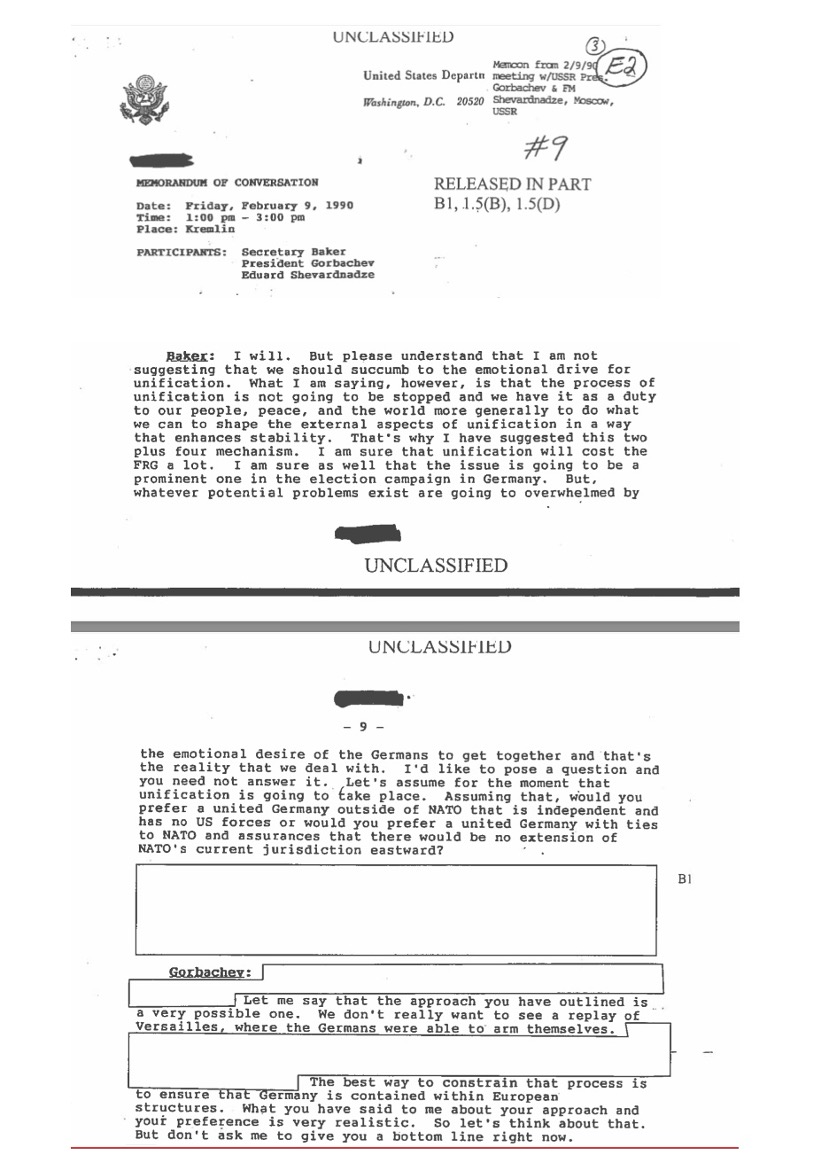
The Russia Beyond interview with Gorbachev happened just a decade ago. So, I spent many hours and days searching for evidence of the Putin contention that there were promises of no eastward expansion of NATO before coming across a 1990 U.S. State Department unclassified, heavily redacted “Memorandum of Conversation” between then U.S. Secretary of State James Baker and Mikhail Gorbachev at the Kremlin before the reunification of Germany. Halfway through, Baker brought up that topic. [22]
Baker: Let’s assume for the moment that unification is going to take place. Assuming that, would you prefer a united Germany outside of NATO that is independent and has no U.S. forces or would you prefer a united Germany with ties to NATO and assurances that there would be no extension of NATO’s current jurisdiction eastward?
Gorbachev: Let me say that the approach you have outlined is a very possible one. We don’t really want to see a replay of Versailles, where the Germans were able to arm themselves.
The best way to constrain that process is to ensure that Germany is contained within European structures. What you have said to me about your approach and your preference is very realistic. So let’s think about that. But don’t ask me to give you a bottom line right now.
A history taken from interviews is rarely reliable, for it usually involves evident memories that fade to become subjective with time. The Russia Beyond interview and Baker’s meeting tell us something without full evidence of what truly happened in Bonn at the Treaty on the Final Settlement concerning the unification of Germany, signed in Moscow on September 12, 1990. Had the West expanded NATO by invitation to every state member of the UN, history might have tweaked toward a different course. If all member states, including enemies of the West, were to join the alliance and agree to the terms of Article 5 (an armed attack against one or more of them in Europe or North America shall be considered an attack against them all), there would be no wars! Every state member would be obliged to consider an armed attack against one to be an attack against all.
The title, NATO, suggests that member states must be reasonably close to the North Atlantic. One could argue, and many have, that though Russia has no land close to the North Atlantic, it connects with the Atlantic through the Baltic Sea, the Black Sea, and the Arctic Ocean, so membership could be stretched as it has been for so many other members. NATO would have ignored Russia’s distance from the North Atlantic region. George Robertson, former NATO Secretary General, recalls the following exchange he had with Putin at a time when Russia wanted to be part of that secure, stable prosperous West that Russia was not part of:[23]
Putin: When are you going to invite us to join NATO?
Robertson: Well, we don’t invite people to join NATO.
Putin: Well, we’re not standing in line with a lot of countries that don’t matter.
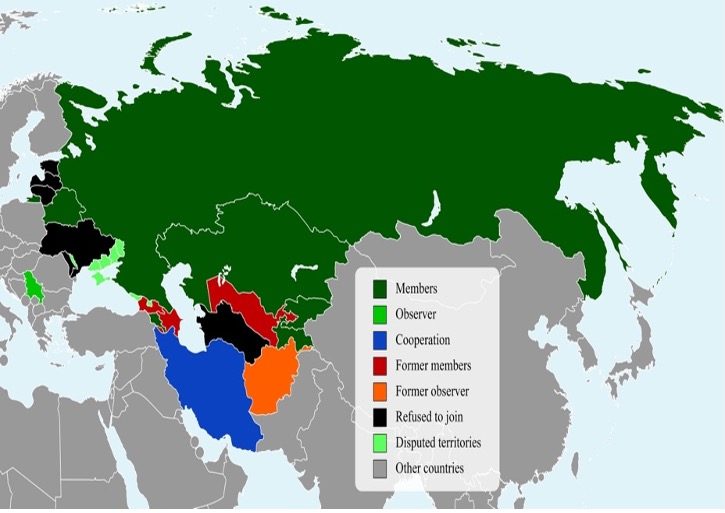
Russia is at war with Ukraine. What is next? Estonia? Moldova? Why not Kazakhstan? Are we ready for that?
Putin believes the history he makes up. His illegal aggressions against Ukraine have ended peace in Europe. According to NATO, “Russia is the most significant and direct threat to Allies’ security, peace, and stability in the Euro-Atlantic area.” [24] The Kremlin had voiced its understanding that “all of Kazakhstan was leased to Russia in negotiations with the Atlantic Alliance, so with any success in the war with Ukraine, Russia has the right to reclaim that country with its first democratically voted President, a country turning from Russia to the West for preferred economic alliances. Losing its sphere of influence on those old Soviet satellite states sends Russia to a lonely place. [25] So, Putin will do what he always does: subvert the truth to annex more territory (as if Russia itself is not geographically big enough) to feed his lust for colonial aggression. Moldova will come after any successes in Ukraine, then Estonia, and then (knowing the difficulties involving Afghanistan) Kazakhstan, the largest landlocked country in the world, rich in oil and uranium, is surely penciled into his war plans.
I just returned from Kazakhstan, a former Soviet Union Republic with a population of nearly 20 million. After spending time there, I was surprised to feel a change in my worldview of Central Asia. The cities are modern, beautiful, and superbly functional. Almaty, a city that was once the capital, is, in my limited experience, an outstandingly handsome city with almost every street tree-lined along central walking paths, bike lanes, small sidewalk playgrounds, and exercise pods for adults.
I may be naïve in my belief that, in the past five years, Kazakhstan, a country with close economic and security ties with Russia, has become a country that claims to be imperfectly democratic, yet is hardly so. Two 2023 opinion polls conducted by MediaNet six months apart concluded that the number of Kazakhs who fear that Russia may invade had doubled because of news of the war in Ukraine. [26] Opinions on the war in Ukraine show that 12.8 percent support Russia and 21.1 percent support Ukraine. Almost 60 percent have no opinion, though I suspect the fear of unfree speech may cause that. Would Russia invade Kazakhstan? It could have used its usual excuse to invade in 2022 when there were massive protests, when 2,500 peacekeeping soldiers were brought in from Russia, Armenia, Belarus, Kyrgyzstan, and Tajikistan to keep the peace.
According to Bruce Pannier, a Central Asia Fellow at the Foreign Policy Research Institute, Russia has been monitoring Kazakhstan for over 30 years, witnessing its flirt with a geopolitical shift to the West. However, ever since the Russian invasion of Ukraine, Kazakhs have become apprehensive of Russian imperialist dreams of a takeover. It’s a fear that comes from Russian officials calling for threats and from Russia’s invasion of Ukraine under the excuse of protecting Russians in Crimea and the Donbas area. [27] It’s not unreasonable, since most ethnic Russian residents were in the North Kazakhstan Region along the 6,846-kilometre (4,254-mile) border with Russia, the second-largest in the world.
It’s a fear that comes from Russian officials calling for threats and from Russia’s invasion of Ukraine under the excuse of protecting Russians in Crimea and the Donbas area.
In 2020, a deputy in the Moscow City Duma (Council), Yevgeny Fedorov, announced that the Belavezha Accords (a declaration that the Union of Soviet Socialist Republics had ceased to exist) that dissolved the Soviet Union were illegal and that Kazakhstan was effectively “leasing” Russian land. [28] Russia does have an agreement with Kazakhstan to lease the town of Baikonur (a 22-square-mile area) for Russia’s space program. Then, in 2022, Sergei Savostyanov released a statement supporting Russia’s invasion of Ukraine “as necessary to ‘denazify’ and ‘demilitarize’ Ukraine.” Savostyanov said Russia should take similar measures in Poland, Moldova, and Kazakhstan. [29] Soon after, he posted a video showing a leader of the Communist Party of the Russian Federation advising Russia to protect the Russian-speaking inhabitants “and take control of Kazakhstan’s uranium production because it is now the world’s leading producer and exporter of uranium ore.” [30] According to the 2021 census, 16 million inhabitants (83.7 percent) speak Russian. Does the leader of the Communist Party mean Russian inhabitants or Russian-speaking ones, which brings—in the inhabitant case—the number down to just under 3 million (15.5 percent)?
It might mean trouble for Kazakhstan, because it is far from Europe and remote from any security worries of the West. Kazakhstan has a small military. Ukraine has 2.25 million conscripts to the 108,000 that Kazakhstan has; yet, with all the support from NATO members, Ukraine is struggling to keep alive in its defense against Russia, geographically the largest country in the world. Though Kazakhstan is a member of a different shielding alliance that should protect it from an invasion, a takeover would be easy pickings for Russia. Unlike Ukraine, which could move NATO eastward, Kazakhstan is not an alliance threat, so there would be no Russian excuse for an invasion of such a non-threatening country.
What are NATO’s interests?
NATO focuses on its united European partners with vigilance with regard to actions against potential members geographically within a broadened scope of surrounding geopolitical borders. Though the alliance is not interested in defending any independent territories in Central Asia, there is NATO’s Partnership for Peace (PfP), a program involving non-member countries (many in Asia) cooperating on security, global challenges, and climate change. [31] There are 18 partner countries, including Kazakhstan and Russia.
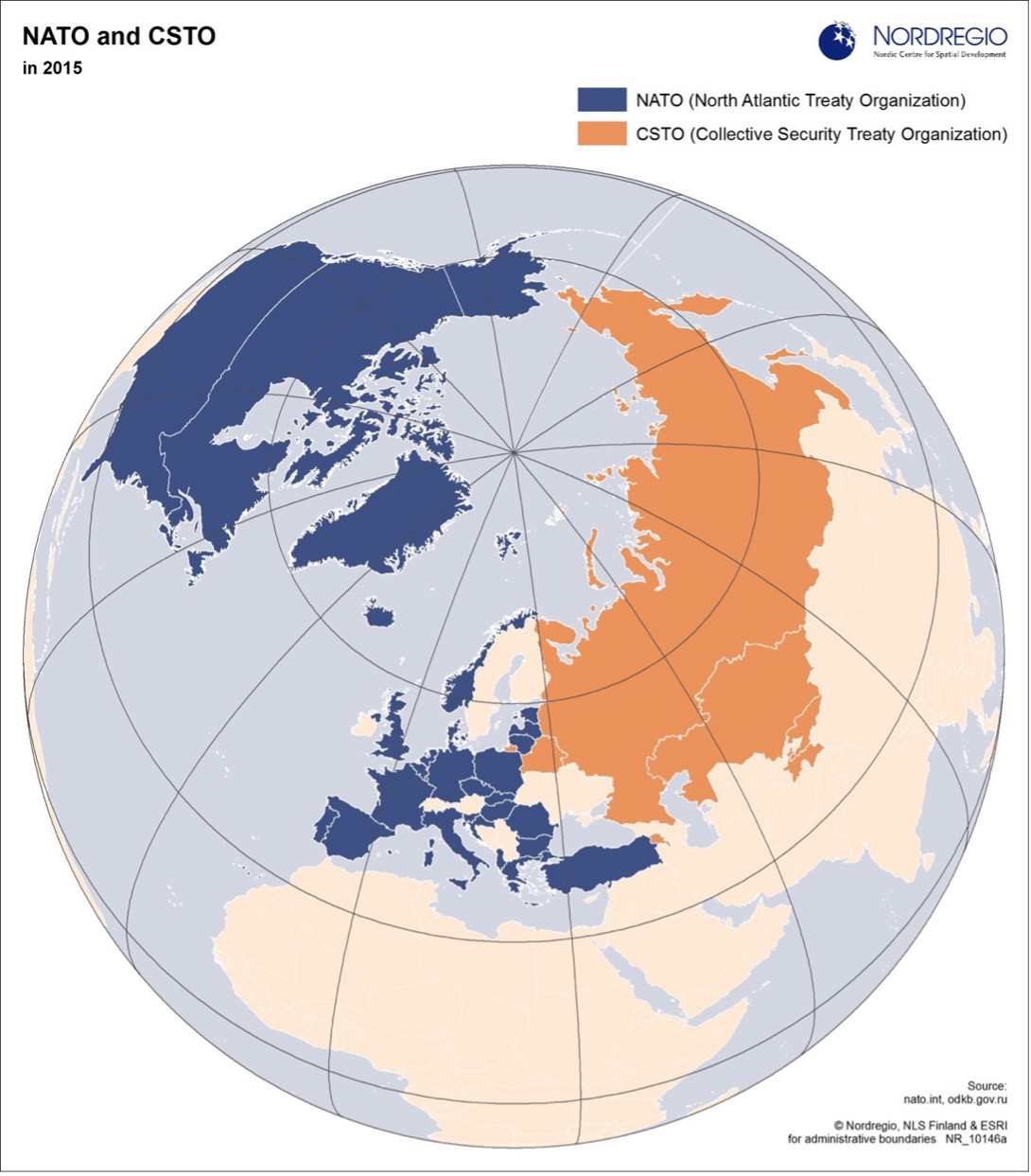
The East has its alliances. The Soviets had the Brezhnev Doctrine, with nine member countries, and the 16-member Warsaw Pact that disbanded in 1991. [32] The Brezhnev Doctrine was a treaty much like NATO. The doctrine proclaimed that if any member state is under attack, all other members of the bloc, including Russia, should be justifiably considered under attack. [33] And now there is the Collective Security Treaty Organization (CSTO), a treaty including Belarus, a country bordering Poland in possession of Russian nuclear weapons. CSTO is an international treaty with specific objectives of “strengthening peace, security and stability, collective protection of independence, and territorial sovereignty.” [34] It operates under principles of international law, being many things (including protections that could do good in the world), but foremost, it is a defense alliance, no more or less than NATO’s commitment to those same objectives. However, like Article 51 of the UN Charter, CSTO, in Article 3 of its charter, uses the term “aggression” as a ground for self-defense that permits Russia to invade and annex the Crimean Peninsula, which was then a part of Ukraine. Self-defense for pro-Russian Ukrainians living in eastern and southern Ukraine was the proclaimed basis of Putin’s invasion. [35],[36]
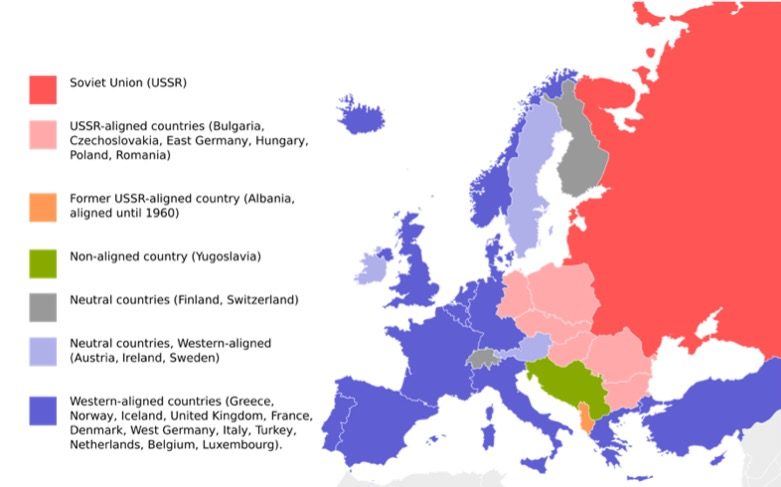
Figure 1: Eastern Bloc (by way of Central Europe) before the collapse of the Soviet Union in 1989
Eastern Bloc (by way of Central Europe) before the collapse of the Soviet Union in 1989 Public Domain, worldwide
Now there is CSTO
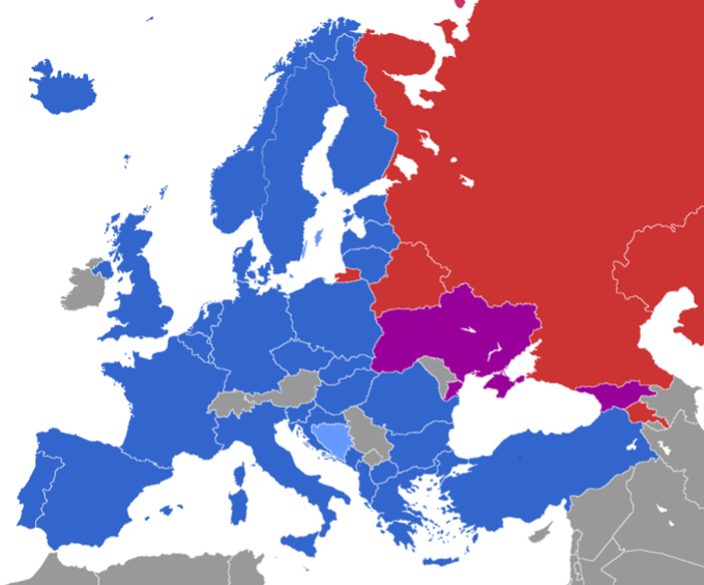
NATO has indeed been moving eastward. With 32 members and expanding, it is considerably more powerful than the five collective members of CSTO, Belarus, Kazakhstan, Kyrgyzstan, Russia, and Tajikistan. So, Putin does have a point. Considering his argument, Russia does feel encircled and threatened. If we look at the map showing the boundaries of the Soviet Bloc before 1989 (figure 1), we see a field of states protecting the western border of Russia. NATO members expanding eastward must give Russians a chill, especially since the collective GDP of NATO’s membership states is close to $50 trillion, while the collective GDP of CSTO is just under $5 trillion, a massive difference. However, Putin has a more covert reason for anger. For him, plans of empire rejuvenation are constrained by NATO’s overwhelming conventional weapons superiority, not to mention its nuclear arsenal. Russia’s aggressive actions in Georgia, Chechnya, Dagestan, Tajikistan, Abkhazia, Transnistria, Ossetia, Syria, and now Ukraine show that it means to take on as much territory as it can to build back the borders of the Soviet Union.
Source: Nordregio[37]Russia’s actions show that, after 85 years of comparative stability, the independent sovereignties of small European nations are no longer firm. Ukraine exemplifies the need to keep NATO afloat; its fight for sovereignty and integrity is critical for the independence of the entire Euro-Atlantic area. As Ukraine continues to exercise its right to self-defense, as documented in Article 51 of the UN Charter, NATO continues to provide Ukraine with military and humanitarian assistance to keep Russia from taking all of Ukraine as a spoil of war. But NATO is a defensive alliance. Its sole purpose is deterrent protection. We must understand that, before Russia invaded Crimea in 2014, NATO had no deployment of combat-ready troops stationed in any of the Baltic states or Poland. After Russia’s 2022 invasion of Ukraine, partly under the excuse that NATO was encroaching eastward, NATO reinforced its defense posture by placing 40,000 troops in the eastern boundaries of alliance members. As Anne Applebaum tells it, “If the Soviet Union never attacked West Germany between 1949 and 1989, that was not because it feared a German response. If Russia has not attacked Poland, the Baltic states, or Romania over the past 18 months, that’s not because Russia fears Poland, the Baltic states, or Romania. The Soviet Union held back, and Russia continues to do so now because of their firm belief in the American commitment to the defense of those countries.”[38]
Now there is a new defense pact.
In Pyongyang on June 19, 2024, Putin and the North Korean Supreme Leader, Kim Jong Un, upgraded their ties to a “strategic partnership,” pledging to help each other if attacked. That small but consequential alliance, which hardly competes with NATO, is mostly a poster setup for public opinion issues of security. It requires either country to assist the other if attacked. As Putin put it just after signing the agreement, “The comprehensive partnership agreement signed today includes, among other things, the provision of mutual assistance in the event of aggression against one of the parties to this agreement.” [39] Putin’s decision to strengthen friendly ties with Kim shows how worried he is about the strength of NATO.
China is a potential member of the new pact, but President Xi never recognized Crimea as a part of Russia. If China decides to join the pact sometime in the future, it will have an overwhelming nuclear advantage. Not that that should matter when nuclear numbers are in the thousands, and just 10 of those insane weapons could wipe out Warsaw, Paris, London, Moscow, and New York. But the insanity of those numbers gives the West a chill by Putin’s threats to use tactical nuclear weapons in its war with Ukraine. But China, too, is worried. Besides tilting the balance of power and destabilizing the nuclear powers in East Asia, the Putin-Kim pact spells trouble for peace in the Koreas.
Do we understand why the U.S. and the Russian Federation are enemies? Does anyone?
Americans think of Russia as a tyrannically evil country that might someday take over the U.S. by creating enough disinformation to zombify us into believing that we are not who we are inwardly. Throughout my adult life, living in the U.S., I saw Canada as an ally and Russia as an enemy. Now, with age, I wonder why. Why do I and my U.S. State Department consider Russia a foe? Conversely, do Russians feel the same way about the U.S.? Why are we their enemies? It is not about the communist past. Though we were strange allied partners in both world wars, the tension goes back to the times of tsarist Russia. Something in that past created an inescapably deep belligerence that is neither understood nor breakable.
Since its independence in 1776, the U.S. has had just 17 years of peace. In that same period, Russia, ignoring princely feuds, peasant uprisings, and revolutions, has been at peace for 27 years but has invaded independent countries eight times to show military cultural differences between countries. The wonder is this: Why does Russia fear NATO when it already has CSTO and the world’s largest stockpile of nuclear weapons? Does it truly feel vulnerable to invasion? Surely not. It does, however, implant worry about its economic stability as an adversary of the West and an old foe of democratic countries. Why, I ask, must two of the four geographically largest countries have to be adversaries? Is it size, way of life, suspicion of the other, a Cold War reminiscence, or the power of one or more government officials? It cannot simply be size. Canada is larger than the U.S. by 58 million square miles. Those two countries have been comfortable border partners for over 200 years. Way of life, suspicion, Cold War reminiscence? Maybe. That leaves a definite yes to the “power” explanation.
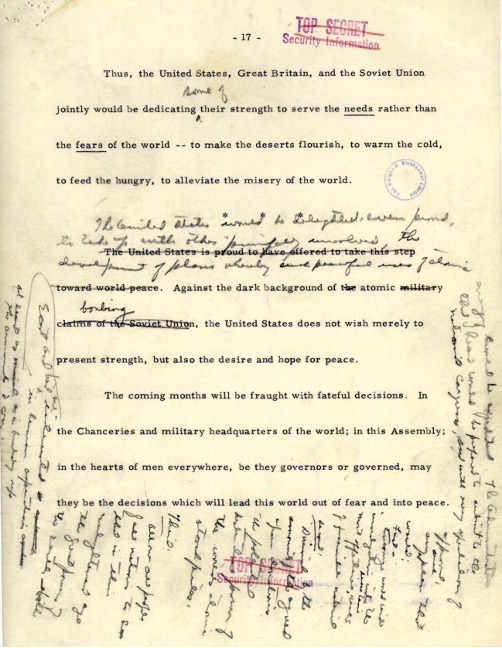
And why does the U.S. fear the Russian Federation when it has NATO and almost as many nuclear weapons on its side in addition to an overwhelming number of the most sophisticated conventional weapons ever demonstrated? We can play the “what if” game of imagining—not a truce of a post-Cold War—but rather a respect for each other’s political designs, from autocratic to liberal democracies. Perhaps the problem is simply a question of leadership. It is difficult to understand why the U.S. and Russia continue with crumbling trust when reasonable cooperation could enhance economic support, emerging problems, and scientific partnerships (such as the continuing space science at the International Space Station). Imagine what could happen with flourishing trade, tourism, and diplomatic cooperation (all of which occur in a compromising limited exchange) if the two sides could overcome their ideological differences to keep the world from imploding on itself, such as restoring global economic stability, responding to climate change, tackling the most demanding international challenges of providing food, water, and healthcare to diminish human suffering, and other mutually benefiting interests. Or, as Eisenhower put it in a draft of his speech to the General Assembly of the United Nations on November 23, 1953, “Thus, the United States, Great Britain, and the Soviet Union jointly would be dedicating some of their strength to serve the needs rather than the fears of the world – to make the deserts flourish, to warm the cold, to feed the hungry, to alleviate the miseries of the world.”[40]
From the archives of the Eisenhower Presidential Library[41]Public DomainA benevolent speech. There is no path for that while Putin remains in office and while the U.S. continues to categorize Russia as an imperiously evil country.
That goes for North and South Korea, Russia and Ukraine, China and Taiwan, Israel, and the Palestinian territories, and so many other pairs of hostile lands. The world seems to create alliances just like children choose friends. Why can’t we all get along? There was a time when states had to fend for resources or limit border intrusions. Now, though, the world relies on global connections that need relationships to survive, not only for tackling the problems of climate change, future pandemics, and immigration but also for so many situations that rip us apart. We teach our children to behave and to respect others, so why can’t we teach governments to be model caretakers of the planet? Of course, there is always the natural human challenge of untethered leaders who believe their citizens must always have an enemy. They contrive specters out of either territorial discords or conflicting governmental systems.
I have not heard any reasonable account, other than opposing beliefs in governmental systems, as reasons for belligerences between states. Some influential people would say that authoritarians force their way of governance on the people who have no say. I counter-argue that the people always have an option and the choice of revolution. Even Russia has had its share of them, though its people, like many in other parts of the world, find it hard, sometimes dangerous, to speak in public.
Jake Sullivan, the current U.S. President’s national security advisor, showed his reason for the “enemy” status the U.S. has for Russia. He said, “I do think we are dealing with the gathering and march of autocratic forces in ways that are not in the United States’ national interest, and that we do need to rally the values, norms, and forces of democracy to push back against that.” [42] So, it is authoritarianism that is not in the U.S.’s interest.
We are told by Michael Kimmage and Jeremy Shapiro, a Research Director at the European Council on Foreign Relations, that, after World War 2, the U.S. forced Germany and Japan into alliances providing a wide range of U.S. military bases, which Russia considered above and beyond the acceptable prize of cooperation in winning the war. [43] In turn, the Soviet Union subjected 15 countries to become satellite states, establishing a global trajectory surrounding its eastern and southern borders. But those spats are over. The Russian Federation is not the Soviet Union. What remains in dispute is its style of government, human rights abuses, cyberwarfare belligerence, and Putin’s ambition to bring back a sense of the empire’s past greatness. With those opposing views, I understand why the U.S. State Department continues to consider Russia a foe.
What could be the most significant consequence of a U.S. abandonment of NATO?
Is there anything else that NATO has to offer the U.S., a country bordered by two massive oceans and two stable democracies? Aside from 9/11, most Americans never had to be concerned about security and protection. They do not have a sense nor a memory of security vulnerability. They focus on domestic issues, like the cost of goods and services and healthcare, not fully on the benefit of trade agreements with a stable, thriving continent that could benefit them economically. NATO is far from their thoughts and concerns. Its existence is a hard grasp for them and an existential necessity for Eastern Europeans.
McKay Coppins, a staff writer for the Atlantic, fittingly tells us, “The alliance between Europe and America is supposed to be rooted in something more idealistic and meaningful than economic interests.” He visited Narva, a small city bordering on a narrow river that freezes over in winter and separates Estonia from Russia. He talks about meeting someone in Narva who tells him “his day-to-day life is shaped by the reality that a belligerent nuclear power exists right on the other side of this river. And if not for NATO, if not for America’s commitment to its European allies, Russia could roll a tank across that border and start to conquer Estonia.” [44] Estonians are concerned in ways Americans, with their innate security comforts, cannot understand. They should understand the consequences before voting for a president who says he will abandon NATO.
What will happen to NATO if Trump wins the 2024 presidential election? I can tell you. In the U.S., Project 2025, a 922-page “Conservative Promise,” is allegedly getting more widespread attention than Taylor Swift, though it has been years in the making. Read a few pages. It is terrifying. [45] Not only is it a plot to transform the U.S. liberal democracy into an autocratic one by reshaping the U.S. government to favor far-right policies, but it is also a plan to establish a new Cold War under the toughness of advancing nuclear weapons and annihilating arms control treaties. Trump, of course, said on Truth Social, “I know nothing about Project 2025.” Sure, he denies knowing, as he rejected the legitimacy of his loss in the last election. How could a Republican presidential candidate not be aware of Project 2025 when it is called the Presidential Transition Project, a blueprint for reshaping the U.S. federal government and consolidating executive power? Read Section 4, “Department of Defense,” by Christopher Miller, an acting U.S. Secretary of Defense for 54 days in the Trump Administration, just one small piece of that promise of an existential change in nuclear strategy, to learn about plans for a frightening significant increase in the deployment of nuclear weapons and destroying all arms control agreements. Voters in the U.S., as in most free countries, have a choice. Let’s be careful about what we wish for.
Joseph Mazur is an Emeritus Professor of Mathematics at Emerson College’s Marlboro Institute for Liberal Arts & Interdisciplinary Studies. He is a recipient of fellowships from the Guggenheim, Bogliasco, and Rockefeller Foundations, and the author of eight acclaimed popular nonfiction books. His latest book is The Clock Mirage: Our Myth of Measured Time (Yale).
[19] Shifrinson, Joshua R. Itzkowitz. “Deal or No Deal? The End of the Cold War and the U.S. Offer to Limit NATO Expansion.” International Security, vol. 40, no. 4, 2016, pp. 7–44. JSTOR See: https://www.jstor.org/stable/43828313
[28] Aleksandrov, Mikhail, Uneasy Alliance: Relations Between Kazakhstan and Russia in the Post-Soviet Era, 1992-1997 (Westport, Connecticut, Greenwood Press, 1999), p. 120.
In today’s dynamic economic landscape, having a single source of income is no longer the norm for many individuals. Side jobs have emerged as a viable way to boost earnings, offering flexibility, diversity, and the potential for significant financial rewards. Whether you’re saving for a specific goal, paying off debt, or just looking to enhance your financial stability, numerous side gigs can fit seamlessly into your lifestyle.
Freelance Writing and Editing
Freelance writing and editing provide an excellent opportunity for those with a knack for words. This side gig can be particularly rewarding as it offers the flexibility to work from anywhere and choose your clients and projects. From crafting blog posts and web content to editing manuscripts and academic papers, the scope of work is vast. Many platforms, such as Upwork and Fiverr, connect freelancers with clients, making it easier to find work that suits your skills and interests. The demand for quality content is high, and with consistent effort and excellent communication skills, freelance writers can build a steady stream of income.
Ride-Sharing and Food Delivery Services
The gig economy has revolutionized the transportation and food delivery sectors, providing an easy way to earn extra money. Companies like Uber, Lyft, DoorDash, and Grubhub offer flexible schedules and the opportunity to earn on your terms. Ride-sharing drivers benefit from surge pricing during peak hours, while food delivery services allow you to work in your neighborhood without the need to transport passengers. These jobs require minimal investment—a reliable vehicle and a smartphone. With the rise of contactless deliveries and ride options, these services have become more popular, ensuring a constant demand for drivers.
Online Tutoring and Teaching
With the advent of digital learning platforms, online tutoring and teaching have become increasingly accessible and profitable side gigs. If you have expertise in a particular subject or language, you can offer your services to students across the globe. Platforms like VIPKid, Tutor.com, and Chegg connect educators with learners seeking personalized instruction. Online tutoring allows you to set your rates and availability, allowing you to work around your existing schedule. Additionally, the satisfaction of helping others achieve their academic goals can be immensely rewarding.
Selling Handmade Goods and Crafts
For creative individuals, selling handmade goods and crafts can be a fulfilling and profitable venture. Online marketplaces like Etsy provide a platform to showcase and sell unique, handcrafted items to a global audience. The possibilities are endless, from jewelry and clothing to home decor and artwork. This side gig not only allows you to monetize your creativity but also provides an opportunity to turn your hobby into a thriving business, especially if you check out practical crochet for beginners kits and work on this idea even further. With the right marketing strategy and attention to customer feedback, you can build a loyal customer base and generate a substantial income.
Real Estate Investing
Real estate investing is a more substantial side gig that can lead to significant financial gains over time. While it requires an initial investment, the potential for long-term returns is considerable. From renting out properties and flipping houses to investing in real estate investment trusts (REITs), there are various ways to enter the market. Real estate investing demands a strategic approach and a keen understanding of market trends. However, with the right resources and commitment, it can become a lucrative side business that provides passive income and wealth-building opportunities.
Pet Sitting and Dog Walking
Pet sitting and dog walking are excellent side jobs for animal lovers, providing both flexibility and enjoyment. With more people traveling and working long hours, the demand for reliable pet care services has grown significantly. Pet sitters can offer their services at the owner’s home or host pets in their own homes, catering to the needs of different pet owners. Similarly, dog walking is a great way to earn extra money while enjoying the outdoors and staying active. Platforms like Rover and Wag! connect pet sitters and dog walkers with clients, making it easier to start in this rewarding field.
Earning extra money through side jobs can greatly enhance your financial security and open new possibilities for achieving your goals. The key to success in any side gig is finding something that aligns with your skills, interests, and availability. Whether you’re interested in creative endeavors, digital platforms, or traditional investments, there’s a side job out there for you!
Nobel Peace Prize winner Muhammad Yunus has been appointed to lead Bangladesh’s interim government after the resignation of longtime Prime Minister Sheikh Hasina, who fled the country amid violent unrest. Yunus, an 84-year-old economist and microcredit pioneer, is widely respected for his efforts to lift millions out of poverty through Grameen Bank. His appointment followed demands from student protest leaders, marking a significant shift in Bangladesh’s political landscape. As the nation faces a political crisis, Yunus is tasked with restoring order and guiding the country towards free and fair elections.
Convenience is crucial in the dynamic landscape of modern commerce in India. From bustling marketplaces to digital stores, the ease of transactions has transformed how customers interact with businesses. Among the technological marvels driving this change are UPI payment gateways. According to data provided by the RBI, UPI transactions reached ₹139.2 trillion in FY 2022-23. These amount for 73% of all non-cash transactions during that year.
These gateways have revolutionised the way customers navigate payments, offering a seamless and user-friendly experience. UPI payment gateways embody this convenience, bridging the gap between traditional commerce and digital innovation.
This blog explores how these gateways are reshaping customer experiences and empowering businesses in the digital age.
What is a UPI Payment Gateway?
A UPI payment gateway facilitates transferring funds between parties through the Unified Payments Interface (UPI) platform. UPI, developed by the National Payments Corporation of India (NPCI), allows users to connect multiple bank accounts to one mobile app. Businesses and individuals use UPI gateways to accept payments from customers using UPI-enabled apps, ensuring secure and convenient transactions.
This gateway acts as an intermediary for the payer’s and payee’s banks, ensuring safe and efficient fund transfers. UPI’s feature of linking multiple bank accounts to a single mobile app makes it a convenient and efficient digital payment method.
Payment gateways serve as a crucial component in modern business operations, enabling swift and secure transactions.
Their role extends beyond processing transactions; they enhance customer trust and satisfaction by ensuring a smooth, secure, and adaptable payment experience. This foundational support is essential for businesses looking to thrive in a competitive market landscape.
Essential Features to Enhance User Experience
UPI payment gateways offer customers unmatched ease and flexibility. To elevate the overall customer experience, certain essential features are necessary. Incorporating these features can significantly enhance the functionality and appeal of UPI payment gateways.
1. Enhanced Checkout Experience
The checkout process is a pivotal moment in any online shopping journey, where the effectiveness of a payment gateway is most evident. A user-friendly interface is essential at this stage. When the payment process is intuitive and straightforward, customers are more likely to complete their purchases, leading to increased satisfaction and higher conversion rates.
An easy and smooth checkout experience significantly increases the likelihood of customers finalising their orders, effectively bridging the gap between browsing and buying.
2. Wider Customer Reach
UPI has achieved widespread adoption across India, with millions of users regularly utilising UPI-enabled apps for their transactions. By integrating UPI as a payment option, businesses can effectively reach this large and diverse user base.
Offering UPI as a preferred payment method aligns with customer preferences, potentially increasing conversion rates and fostering customer loyalty by providing a convenient and trusted payment solution.
3. Offering Diverse Payment Options
Customers have varied preferences when it comes to payment methods. By integrating a payment gateway that offers multiple payment options—such as credit cards, debit cards, and digital wallets—businesses can cater to a wide range of customer needs.
This flexibility not only simplifies the payment process for customers but also demonstrates a business’s commitment to accommodating diverse preferences, thereby enhancing the overall user interface and experience.
4. Ensuring Mobile Responsiveness
With the widespread use of smartphones, the importance of mobile-friendly payment interfaces cannot be overstated. A good payment gateway ensures that the payment process is seamless and responsive across all devices, including desktops, tablets, and smartphones.
Efficient mobile payment functionality is now essential for businesses aiming to capture and retain the growing number of mobile shoppers. By providing a consistent and accessible payment experience across devices, businesses can significantly improve customer satisfaction.
5. Strengthening Security Measures
Security is crucial in online transactions, and payment gateways play a vital role in protecting customer information. Implementing strong security features, such as encryption and fraud prevention measures, is essential.
Customers need assurance that their financial information is safe, which builds trust and confidence in the payment process. Secure transactions are vital for establishing and maintaining customer loyalty and encouraging repeat business.
6. Speeding up Transactions
Transaction speed matters a lot in our fast-paced world. Payment gateways that enable quick transactions can greatly enhance the user interface by reducing wait times. This not only meets the expectations of modern consumers but also positively impacts their perception of a business’s efficiency. Fast transaction processing creates a positive user experience, leading to higher customer retention rates and satisfaction.
7. Personalising Payment Experience
Recognising that each customer is unique, payment gateways are increasingly adopting personalisation strategies. Customising the payment experience based on individual customer profiles and preferences makes interactions more engaging and relevant.
This personal touch improves the customer experience and enhances the overall perception of the brand. In a market where consumers seek tailored experiences, personalised payment processes can significantly enhance the user interface.
8. Providing Real-Time Notifications
Effective communication is crucial in financial transactions. Payment gateways that offer real-time updates contribute to a transparent and reliable payment experience. Whether confirming a successful payment or alerting customers to an issue, timely notifications help reduce uncertainty and build trust.
Transparent communication throughout the payment process is key to creating a positive customer experience and maintaining customer trust.
Finding the Perfect UPI Gateway for Your Business
When it comes to finding the perfect UPI payment gateway for your business, it’s essential to consider features such as ease of integration, security protocols, and the ability to support various UPI functionalities. The right UPI gateway should offer comprehensive solutions. Leveraging UPI payment gateways can transform the way customers interact with your business, offering a superior payment experience.
If you are looking for an efficient payment gateway, consider solutions such as Plural by Pine Labs. Plural provides a comprehensive UPI Suite, including a UPI payment gateway, UPI Switch, and UPI Deeplinks for WhatsApp. It adopts all-new UPI features instantly and helps increase your revenue, making it the ideal choice for businesses looking to optimise their payment processes.
Visit Plural’s website now and discover the wide range of features available in their UPI Suite.
A highly anticipated debate between former President Donald Trump and Vice President Kamala Harris is set for September 10 on ABC. This debate marks a pivotal moment in an already extraordinary campaign, as both candidates vie for the presidency. Trump, who reversed his decision to debate, is grappling to regain momentum after Harris and her running mate, Tim Walz, energized the Democratic base. The upcoming debate could serve as a historic turning point, with both candidates facing intense scrutiny as they prepare to address the nation’s most pressing issues on a global stage.
By Danny Leipziger
China cannot continue to rely on exports to drive its growth, but what are the alternatives?
China ran a $1.2 trillion trade surplus last year, and despite admonitions from the IMF to rely...
The World Financial Review uses cookies to improve site functionality, provide you with a better browsing experience, and to enable our partners to advertise to you. Detailed information on the use of cookies on this Site, and how you can decline them, is provided in our Privacy Policy and Terms and Conditions. By clicking on the accept button and using this Site, you consent to our Privacy Policy and Terms and Conditions. ACCEPT
Privacy & Cookies Policy
Privacy Overview
This website uses cookies to improve your experience while you navigate through the website. Out of these cookies, the cookies that are categorized as necessary are stored on your browser as they are essential for the working of basic functionalities of the website. We also use third-party cookies that help us analyze and understand how you use this website. These cookies will be stored in your browser only with your consent. You also have the option to opt-out of these cookies. But opting out of some of these cookies may have an effect on your browsing experience.
Necessary cookies are absolutely essential for the website to function properly. This category only includes cookies that ensures basic functionalities and security features of the website. These cookies do not store any personal information.
Any cookies that may not be particularly necessary for the website to function and is used specifically to collect user personal data via analytics, ads, other embedded contents are termed as non-necessary cookies. It is mandatory to procure user consent prior to running these cookies on your website.




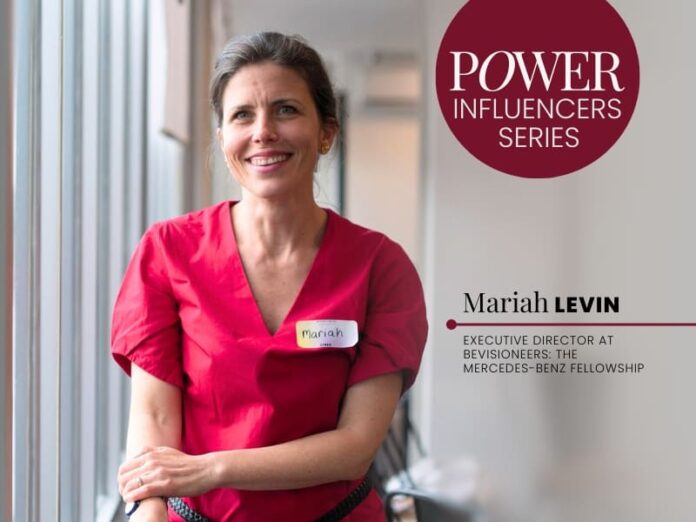
 Mariah Levin