In “The Power Law: Venture Capital and the Making of the New Future” (2022), Sebastian Mallaby explores how venture capital (VC) has driven innovation and influenced the global economy. The book tells the stories of Silicon Valley’s dominant VC firms and successful venture capitalists like Yuri Milner.
Central to VC is the power law, where a few investments drive most of an investor’s returns. Indeed, the success of a single venture can reshape entire markets. Mallaby’s book sheds light on the power law concept and explores VC’s evolution.
Exponential Returns, Tail Events, and The Power Law
Unlike many other forms of finance, VC embraces uncertainty by focusing on “tail events” — radical departures from the norm. Venture capitalists seek rare, high-risk investments, where only a small number of wins will generate exponential returns.
In “The Power Law,” Mallaby explains that Silicon Valley venture capitalists recognize that their returns from startup investments obey the power law. Also known as the Pareto principle or the 80/20 rule, the power law suggests that a small percentage of causes leads to the majority of effects.
For example, the investment company Horsley Bridge saw 5% of its capital produce 60% of its total returns between 1985 and 2014. Similarly, Y Combinator, a tech startup backer, found that just 2 out of 280 investments made up 75% of its gains in 2012.
Mallaby cites former PayPal CEO Peter Thiel: “The biggest secret in venture capital is that the best investment in a successful fund equals or outperforms the entire rest of the fund.”
According to the power law, “winners advance at an accelerating, exponential rate” and eventually “become outsized stars.” In other words, as venture capitalists achieve success, a feedback loop compounds their positive outcomes, leading a handful of individuals to dominate a sector.
The emergence of these stars depends on a complex interplay of factors like luck, skill, and path dependency (where past events or choices influence future outcomes, making change difficult). But no matter how these winners succeed, their dominance grows rapidly and leaves little room for others to compete.
Mallaby notes that “once Jeff Bezos achieves great riches, his opportunities for further enrichment multiply,” illustrating how the power law acts as “the most pervasive rule in venture capital.”
The Impact of Venture Capital on Our World
Across 14 chapters, “The Power Law” examines the profound impact VC has had on the world, particularly in technology. Companies like Facebook, Apple, and Uber exemplify how a few standout firms can transform our work, social lives, shopping habits, entertainment, access to information, and even our thinking.
Mallaby argues that venture capitalists have achieved such a “disproportionate impact” by backing these transformative companies because VC combines “the strengths of the corporation with the strengths of the market.”
Venture capitalists direct capital, talent, and customers to promising startups, mirroring corporate team structures while maintaining market flexibility. When a round of venture funding concludes, the startup faces a market test: If no buyers emerge, investors cut their losses to avoid wasting resources.
The Venture Capitalist Mindset
Mallaby describes VC not merely as a business but “a mindset, a philosophy, a theory of progress.” He cites Vinod Khlosa as a prime example of this mindset.
Khlosa, an Indian-born venture capitalist, believes that “most social problems can be ameliorated by technological solutions, if only inventors can be goaded to be sufficiently ambitious.” He founded Khosla Ventures in 2004 and made significant inroads into the early internet market by investing in bandwidth technology companies.
Another prominent tech investor who embodies this philosophy is Yuri Milner. His investment company DST Global made a landmark purchase of major shares in Facebook in 2009. Milner also co-founded the Breakthrough Prize, the world’s largest scientific award, and the Breakthrough Initiatives, space science programs advancing humanity’s knowledge of the cosmos.
These visionary investors support innovative thinkers who offer “the best shot at satisfying human aspiration.” Often, these innovators aren’t experts in the fields they seek to disrupt. Mallaby notes that “radical rethinks” tend to come from outsiders.
After all, retail innovation came from Amazon, not Walmart. Elon Musk’s Tesla introduced next-generation cars, despite Musk not being an “electric car person” before founding the company.
Mark Zuckerberg and Yuri Milner: Shifting the Balance of Power
In Silicon Valley during the early 2000s, these innovative outsiders were increasingly young and rebellious. Chapter nine of “The Power Law” recounts how, in 2004, Mark Zuckerberg and his friend Andrew McCollum arrived “insolently late” to a Sequoia Capital meeting, dressed in pajamas and claiming to have overslept.
Mallaby explains that Zuckerberg’s pajama prank was a pivotal moment for VC. While many young entrepreneurs were playing hard to get with investors, Zuckerberg genuinely didn’t want Sequoia’s backing. He was concerned about relinquishing too much control to investors who might impose their own vision or management style.
This shift in attitude reflected a broader VC trend: Entrepreneurs were becoming more selective about their investors.
Some years later, Milner’s investment in Facebook contributed to a new era of entrepreneur empowerment. By injecting significant capital without demanding a board seat, Milner allowed Zuckerberg to retain more control over Facebook and delay going public.
This approach facilitated the creation of massive private wealth while sidestepping the scrutiny of public markets and traditional governance.
Data-Driven Decisions and Iterative Experiments
Unlike traditional investing, venture capitalists accept that extrapolating from past data cannot predict the major disruptions that create immense wealth, “precisely because such revolutions are so thoroughly disruptive.” Instead, venture capitalists believe we can discover the future through “iterative, venture-backed experiments.”
However, this experimental approach doesn’t discount the power of data to predict trends. Milner’s investment in Facebook, for instance, stemmed from his data-driven strategy.
Mallaby describes how Milner “meticulously compiled the key metrics on the world’s social media firms.” His revenue projections enabled him to offer Zuckerberg a $10 billion valuation, outpacing other investors who made lower offers.
Milner’s predictions proved accurate, as Facebook’s audience and revenues skyrocketed in the following 18 months. This success demonstrated the power law in action: Milner’s strategic investment generated immense returns while others missed out, paving the way for further triumphs with internet giants like Spotify, Alibaba, Airbnb, and Twitter.
The Evolution of Venture Capital
“The Power Law” illustrates how key innovators have reshaped VC through novel investment strategies.
For example, Tiger Global pioneered late-stage tech investing in the early 2000s. Rather than simply focusing on startups, the hedge fund also targeted fast-growing companies ready to scale, capitalizing on mature businesses with proven potential for returns.
Tiger also challenged the “traditionally parochial outlook of Silicon Valley investors.” The firm placed winning bets on Asian tech companies like Sina, Sohu, and NetEase, earning $100 million in less than a year.
In 2009, Andreessen Horowitz (a16z) set out to differentiate itself from competitors by claiming to have developed a new kind of VC model. The Silicon Valley-based VC company drew inspiration from Milner’s tech incubation approach, which involved providing capital to “precocious breakout firms.”
Traditional VCs often replaced technical founders with “real CEOs” — leaders experienced in managing companies. In contrast, a16z assured founders it wouldn’t replace or abandon them.
Instead, the firm “promised to smooth the learning curve for scientists who wanted to be chief executives.” a16z offered tech startups guidance on decision-making and provided valuable industry connections.
The Enduring Impact of the Power Law
Mallaby vividly illustrates how VC drives technological and economic transformation through the power law. This principle reveals that a small number of investments can yield outsized returns, reshaping entire industries and creating substantial wealth.
The book also emphasizes how the evolving VC landscape has empowered a new wave of entrepreneurs, including Zuckerberg and Musk.
Ultimately, “The Power Law” captures the “special way of coming at the world that animates venture capital.” A fearless embrace of uncertainty and a relentless pursuit of breakthrough ideas characterizes the VC approach to investing.
Venture capitalists thrive on tackling daunting problems, driven by the logic of the power law: “the rewards for success will be massively greater than the costs of honorable setbacks.”
Visionary investors like Milner have helped shape the future through bold bets on disruptive technologies. For more insight into Milner’s forward-thinking approach and his vision for humanity’s progress, read his short book “Eureka Manifesto.”
When a person suffers a personal injury due to another party’s negligence or wrongful actions, they may seek compensation by filing a personal injury lawsuit. If the case does not go to trial, the outcome will often be a settlement agreement in which the negligent party’s insurance company agrees to pay the injured party a lump sum. Many economic factors influence the final settlement amount.
Lost Income and Earning Capacity in Personal Injury Cases
According to the Odessa personal injury attorneys at the law firm Zehl and Associates, one of the largest components of many personal injury settlements is compensation for past and future lost income. If the injury temporarily disabled the plaintiff from working, the settlement will account for any income they lost during their recovery period. The duration and amount of the lost wages will depend on the specifics of the plaintiff’s occupation and the extent of their injuries. Studies show that plaintiffs who hire an experienced personal injury lawyer typically receive significantly higher settlements, often over $60,000 higher on average, than those who try to negotiate a settlement on their own.
If the injury causes permanent impairment that reduces the plaintiff’s earning capacity, the settlement will also include compensation for future lost earnings. Economic experts often quantify this loss by calculating projected earnings over the plaintiff’s expected remaining working years. The plaintiff’s education level and occupational prognosis are considerations. Permanent disability tends to increase settlement amounts significantly.
Medical Expenses
Past and future medical costs directly associated with the injury form another key element of personal injury settlements. This includes expenses from hospitalization, surgery, medications, physical therapy, assistive devices and any other treatments already received or recommended. Itemized medical bills and expert testimony help substantiate these costs. Ongoing treatments for permanent injuries may be calculated up to 20+ years into the future. While the average settlement is around $50,000, most people receive between $3,000 and $25,000 depending on the specifics of their case.
Other Monetary Losses on Personal Injury Cases
In addition to the major categories above, settlements may compensate for miscellaneous out-of-pocket expenses tied to the injury. For example, costs for household services the injured person can no longer perform, property damages, travel for medical appointments, damaged personal property and more. Skillful plaintiff lawyers will identify all monetary losses stemming from the incident.
Pain and Suffering
Personal injury settlements almost always include extra compensation for the plaintiff’s physical pain and emotional suffering. Unlike the economic damages above, pain and suffering have no definitive market value. The amount awarded is subjective and depends on factors like the severity of the injury, length of recovery, degree of impairment/disability, extent of emotional distress, plaintiff’s age and more. Jury verdicts in similar cases can act as guidance. About two-thirds of personal injury cases are resolved through settlements rather than going to trial.
Punitive Damages
In cases where the defendant’s behavior was found to be reckless or intentional, the settlement may include punitive damages meant to punish the defendant and deter future misconduct. Awards are higher when willful negligence or malice is involved. Although less common in settlements compared to jury verdicts, the possibility of punitive damages provides plaintiffs more leverage in negotiations. Personal injury cases that reach federal court typically involve damages claims exceeding $75,000.
Strength of the Personal Injury Case and Liability
The overall strength of the plaintiff’s case and the degree of provable liability against the defendant also sway settlement amounts, regardless of the exact economic losses. Defendants are motivated to settle stronger cases for higher sums to avoid an even larger verdict at trial. Weaker liability or questionable injuries lower settlement value. Experienced attorneys account for these strategic factors.
The financial resolution of a personal injury claim depends on many unique factors related to the plaintiff, defendant, and specifics of the incident. Working with a knowledgeable personal injury attorney allows injured parties to maximize their compensation recovery and obtain the settlement amount they deserve based on the true economic value of their damages and losses.
When it comes to building wealth through the stock market, there are two fundamental strategies that often come up: value investing and growth investing. Choosing between these two approaches can be a challenging decision, as each one comes with its own advantages, risks, and potential rewards. The key lies in finding the right fit for your financial goals, risk tolerance, and investing style. Whether you’re a seasoned investor or just starting out, understanding the core differences can help you make more informed decisions.
Investing, much like other pursuits in life, often involves evaluating risk and reward. For instance, taking calculated risks while enjoying an evening at an NZ online casino can be thrilling, but it also requires careful decision-making. Similarly, understanding the nuances of value and growth investing can help you decide which strategy aligns best with your financial journey. Let’s dive in and explore which of these two strategies might be the better fit for you.
What is Value Investing?
Value investing is an investment strategy that focuses on buying stocks that appear to be undervalued by the market. The idea is to identify companies whose share prices are lower than their intrinsic value, providing an opportunity to invest in them at a discount. These companies may be temporarily out of favor due to short-term issues, but they generally have strong fundamentals that indicate potential for long-term growth.
The legendary investor Warren Buffett is a well-known proponent of value investing, often emphasizing the importance of buying quality companies at a reasonable price. Value investors typically look for metrics like a low price-to-earnings (P/E) ratio, a high dividend yield, or strong cash flow. They see these indicators as signs that the market may be underestimating the company’s future potential.
Value investing is a strategy that requires patience. It involves buying and holding onto stocks until the market recognizes their true value. While this approach can offer lower volatility and more predictable returns, it may take time for the market to correct itself. Investors who are comfortable with a long-term horizon and are less swayed by market fluctuations often find value investing to be a rewarding strategy.
What is Growth Investing?
Growth investing, on the other hand, is all about investing in companies that are expected to grow at an above-average rate compared to other firms in the market. These companies might not be profitable yet, but they have significant potential for revenue growth, product innovation, or market expansion. Growth stocks are often found in sectors such as technology, healthcare, and renewable energy—industries that have considerable room for future growth.
Unlike value investors, growth investors are less concerned with the current valuation of a company. Instead, they focus on the potential for exponential earnings growth, even if that means paying a premium for the stock. Growth investing can offer substantial rewards, but it also comes with higher risk. Since these companies may reinvest their earnings back into expanding their business rather than paying dividends, growth stocks are often more volatile and susceptible to market sentiment.
Key Differences Between Value and Growth Investing
The most significant difference between value and growth investing lies in the type of companies each strategy targets. Value investors seek established companies that are trading below their intrinsic value, while growth investors aim for companies with high growth potential, even if their current valuation seems high.
Another key difference is risk. Value stocks are generally less volatile, and the companies often provide dividends, which can be an attractive source of income for investors. On the other hand, growth stocks are typically more volatile but offer the potential for greater capital gains over the long term.
Additionally, the mindset of each type of investor tends to differ. Value investors often emphasize minimizing risk and waiting for the right buying opportunities, whereas growth investors are willing to take on more risk for the prospect of high future returns. Depending on your financial goals, risk tolerance, and investment horizon, either strategy could be the right fit for you.
Which Strategy is Right for You?
Choosing between value and growth investing depends largely on your individual financial situation and preferences. If you prefer a more conservative approach and are focused on minimizing risk, value investing might be the better choice. This strategy may suit investors who want to see steady returns, are comfortable with a longer time horizon, and enjoy the prospect of investing in companies that the market has undervalued.
Conversely, if you’re looking for higher potential returns and are willing to take on more risk, growth investing may align better with your goals. Growth investors are often interested in the excitement of supporting innovative companies and are less concerned about current earnings or valuations. If you can stomach the volatility and are comfortable with a more aggressive investment strategy, growth stocks could be your ticket to greater long-term gains.
For many investors, a balanced approach—incorporating both value and growth stocks into a diversified portfolio—is the best strategy. This way, you can benefit from the stability and income of value stocks while also capturing the potential upside of growth stocks.
Conclusion
Value investing and growth investing each have their unique advantages, and the best strategy depends on your personal goals, risk tolerance, and investment preferences. By understanding the differences between these two approaches, you can better position yourself to achieve your financial objectives. Whether you lean towards the steady discipline of value investing or the exciting potential of growth investing, the key is to stay informed and stay true to your financial goals.
Ultimately, investing is about finding the right balance for your needs, much like deciding when to take a risk and when to play it safe in other areas of life. Keep learning, stay patient, and remember that the right strategy is one that makes you comfortable and helps you grow your wealth over time.
Even though many businesses are adopting AI in their operations, they often have difficulties scaling towards commercialisation due to governance issues, inefficient training, and ethical dilemmas. Therefore, it becomes important for leaders to close this gap by promoting responsible innovation and ensuring that ethical examples are set in the use of artificial intelligence.
If we must succeed sustainably, then excluding elements such as the role played by middle-level managers in sector-wide training programs and policies governing the use of AI will be difficult.
I want to explore these stumbling blocks while enlightening how people employed could incorporate artificial intelligence that promotes lasting operational efficiency and growth prospects with a strict human-centric focus.
Article
AI Adoption: obstacles and blind spots-A human-centred article
This analysis discusses the obstacles to the broader usage of AI beyond the pilot phases from the perspective of ethics, operation and governance. The rapid alterations within business settings make artificial intelligence (AI) a disruption factor across several industries. It is impossible to underestimate the advantages (sometimes “Hyped”) that automated systems promise for customer experience enhancements as well as various forms of innovation stemming from technological advances within process optimisation frameworks based on AI approaches. However, the adoption process comes with several hindrances. To inform companies about ways to adopt AI for sustainable growth over time while still upholding their ethical values and being operationally effective, I will explore major insights shared by recent business studies concerning AI implementation gaps.
Over the pilots or experimentation.
Accenture (2024)[1] reported that increasing organisations are exploiting AI for personalised services, better marketing and innovative offerings. Despite this trend, many fail to scale up their projects beyond experimental stages because they cannot effectively reach many people simultaneously, among other reasons. In line with that assertion, Boston Consulting Group (2024)[2] has observed that poor AI governance and data fragmentation are some of the challenges that make it difficult for enterprises to incorporate AI into their existing systems.
While it is true that many organisations are quick to jump on the AI bandwagon, there are various impediments to the final goal.
AI Strategy and Ethical AI Integration: Leadership?
Leaders are key to how artificial intelligence is used (BCG, 2024)[3]. Nonetheless, people still worry about the appropriate ethics for using artificial intelligence. KPMG[4] explains that this decision-making process must be open and secure, guaranteeing a fair outcome without any discrimination. However, there are no standard AI governance structures established (Access Partnership, 2024)[5] AI Governance Framework that can help other sectors adopt some of the best practices applied, whereby we are still grappling with issues of bias.
To highlight this crucial point about governance and ethics, it is quite critical and contemporary to remember the current debate for the US elections: the Democrats support keeping Biden’s regulations on business for social and environmental responsibility. In contrast, the Republicans push for self-governance, aiming to reduce regulations and cut business costs…
Instead, as organisations invest more in training and development programmes for middle managers and employees facing difficult decisions on new technologies, they should not make choices without considering significant ethical matters. Besides, companies should invest in ethics training on AI and collaborate to develop global ethics standards.
Scaling AI: Overcoming Operational and Technical Barriers
According to the 2024 Gartner tech trends[6]AI is important in all organisations. Scaling it from testing to full roll-out remains difficult despite the fact that it improves automation and efficiency. This includes but is not limited to, dealing with huge amounts of data, quality control over such data, and sufficient computing resources that keep AI systems running efficiently.
From a human-centric point of view, a blind spot identified lies around middle management’s participation in driving AI uptake across various levels of organisations. (KPMG 2024) [7]Top executive leadership at a company may spearhead any initiatives related to Artificial Intelligence (AI), but its implementation tends to flop due to poor communication across departments. Further analysis should investigate how middle managers can serve as AI translators so that they can integrate such systems fully into everyday business processes.
Training?
There still exists a significant lacuna in terms of how businesses can train their employees for coming AI-induced changes. This will call for extensive re-skilling programs that address technical competencies and soft skills such as adaptiveness, critical thinking, and problem-solving, especially when using artificial intelligence applications.
However, a diverse approach already recommended by the WEF World Economic Forum still needs to be fully embedded holistically and include other elements for a successful #aiadoption #aiscaleup and #ailifelongelearning.
Training needs to offer a comprehensive, structured, and adaptive approach to AI literacy with inclusivity (more roles than executives), practical application, AI-business acumen, and continuous learning allowed by the model. There are several models addressing AI literacy, inclusivity, practical applications, and continuous learning, such as IBM’s AI Skills Academy and MIT’s Digital Leadership frameworks. However, many lack comprehensive feedback mechanisms or role-specific training. Similarly, course catalogues like Coursera and edX excel in AI literacy but often miss structured, practical feedback and inclusivity in lifelong learning. These approaches meet some demands for AI adoption and scale-up but fall short of fully addressing continuous, structured training and adaptability across roles and feedback (CMR-California Management Review, 2024)[8] ( HACHER.IO )9.
Sum-Up
Successfully adopting AI in companies presents several challenges whose solution needs to be found. There exist differences, especially regarding issues or gaps that must be dealt with in order to scale beyond pilots in a more holistic perspective.
These points can be described as human-centric because they focus on the people who are essential to successful AI adoption:
Middle management: Highlighting their role as facilitators underscores the need for human involvement in overseeing AI processes, ensuring smooth communication, and translating AI tools into actionable strategies, which emphasises their central role in driving AI initiatives
Ethics and data protection: By addressing these as fears rather than just technical challenges, the focus is on the societal impact of AI, recognising the importance of human well-being, trust, and responsibility in technology use
All-inclusive training: Emphasizing that training should be inclusive prioritises equipping everyone—not just technical experts—with the skills necessary for AI, supporting workforce adaptability and enhancing individual and organisational readiness
Governance: it provides simple rules and standards relevant to leaders and people, highlighting the crucial role of decision-making leadership and accountability.
Each point underscores that successful AI adoption is not just about technology but about empowering and protecting people within the system. This is compared to the more common focus on technical scalability and financial ROI (only) seen in other reports.
My final thoughts are that it is critical to conduct more analysis into a better way for people to work together rather than merely replacing jobs done by men with machines in order to boost quality.
Luca Collina is a transformational and AI Business consultant at TRANSFORAGE TCA LTD. York St John University awarded him the Business – Postgraduate Programme Prize and CMCE (Centre for Management Consulting Excellence-UK) for his paper in Technology and Consulting Research Prize. Author/External Collaborator of CMCE.
This year’s Nobel Prize laureates in Economic Sciences—Daron Acemoglu, Simon Johnson, and James Robinson—have shed light on the critical role of societal institutions in determining a nation’s prosperity. Their research underscores that countries burdened by poor rule of law and exploitative institutions struggle to achieve sustainable growth and improvement.
The scholars trace the roots of these institutional disparities back to the era of European colonization, where the establishment of institutions varied significantly. In some regions, colonizers aimed to extract resources and exploit indigenous populations, while in others, they created inclusive political and economic systems benefiting both the colonizers and the local populace.
The laureates illustrate that the type of institutions introduced during colonization can explain the stark differences in prosperity among nations. Countries that adopted inclusive institutions during colonial times—often those that were impoverished at the onset—tended to experience long-term economic growth and improved living standards. Conversely, nations that were wealthy at the time of colonization but established extractive institutions have faced prolonged economic stagnation.
Acemoglu, Johnson, and Robinson argue that societies trapped in extractive institutional frameworks often experience low economic growth, as the ruling elite prioritize short-term gains over long-term benefits for the populace. Without credible commitments to reform, the trust necessary for economic progress is undermined, perpetuating the cycle of stagnation.
Yet, the potential for democratization can arise as a response to widespread discontent. When faced with the threat of revolution, leaders may attempt to appease the populace by promising reforms. However, the skepticism surrounding these promises often leads to a political impasse, forcing a transfer of power and the establishment of democratic governance.
“Reducing the vast differences in income between countries is one of our time’s greatest challenges,” stated Jakob Svensson, Chair of the Committee for the Prize in Economic Sciences. “The laureates have demonstrated the importance of societal institutions for achieving this.” Their work not only enhances our understanding of economic disparities but also paves the way for potential pathways to reform and growth in struggling nations.
Related Readings:
In a rapidly evolving work landscape, flexibility, autonomy, and intentionality have emerged as critical elements for fostering productivity and employee satisfaction. The pandemic has accelerated the shift toward remote and hybrid work models, prompting companies to reassess their operational strategies. In a recent interview with Stacy Parkinson, VP of People and Culture at Sharethrough, we explored the nuanced dynamics of these work models and the competitive advantages they offer.
Understanding the Return to Office Push
As companies like Disney and Starbucks mandate a return to the office, many wonder about the rationale behind this move. Parkinson highlights several perceived challenges with remote work, including concerns about productivity, collaboration, and employee engagement. “There’s a negative perception that employees are more distracted and less productive at home,” she notes. Additionally, the belief that certain meetings, such as training and brainstorming sessions, are more effective in person persists.
The belief that certain meetings, such as training and brainstorming sessions, are more effective in person persists.
Yet, reality contradicts these perceptions. Research from Stanford University shows that hybrid work can increase productivity as employees adapt and leverage collaborative technologies. Parkinson described how Sharethrough has embraced a hybrid workforce, witnessing firsthand the benefits of flexibility and autonomy for their employees.
The Autonomy Advantage
One of the most compelling arguments for remote work is the increased autonomy it offers employees. Parkinson emphasizes that measuring output rather than time spent in front of a screen is crucial. “Providing options for where employees can do their best work is key,” she says. Sharethrough’s approach includes offering WeWork passes, monthly allowances for home office expenses, and a “work from anywhere” program, allowing employees to work from various locations, including international destinations.
This autonomy fosters a sense of trust and empowerment among employees, leading to higher creativity and productivity. Research supports this, indicating that knowledge workers perform better when empowered and given more control over their work.
Intentionality in Building Connections
A common concern with remote work is the potential weakening of employee connections. Parkinson stresses the importance of intentionality in fostering a sense of belonging. “Simply asking employees to come back to the office without a clear purpose won’t help,” she asserts. Instead, Sharethrough organizes purposeful gatherings, such as planning sessions, brainstorms, and social events, to ensure meaningful in-person interactions.
For onboarding new employees, Sharethrough facilitates physical onboarding sessions and workshops, even flying employees in when necessary. These efforts are designed to create a strong sense of community and involvement, which can often be lacking in remote settings.
Addressing the Skeptics
Despite the proven benefits of remote work, skepticism remains. Many managers suffer from “productivity paranoia,” doubting the effectiveness of their remote teams. Parkinson believes this stems from a pre-pandemic mindset where control was equated with productivity. “It’s about letting go and gaining more by showing trust in your employees,” she explains.
Sharethrough combats this skepticism by focusing on clear objectives and allowing employees the freedom to achieve them in their preferred manner. This approach has not only maintained but enhanced productivity, as employees appreciate the trust and flexibility they receive.
Balancing Customer Needs with Employee Flexibility
In a customer-centric business, aligning work arrangements with client needs is crucial. Sharethrough’s geographic expansion into Europe, for instance, ensures responsiveness across different time zones. This move not only caters to client needs but also leverages the flexibility of remote work to provide timely and effective service.
Parkinson underscores the importance of open communication and the use of various productivity tools to maintain this balance. “We pride ourselves on being very available to our clients, regardless of where our employees are working from,” she says.
Prioritizing Health and Wellness
Parkinson underscores the importance of open communication and the use of various productivity tools to maintain this balance. “We pride ourselves on being very available to our clients, regardless of where our employees are working from,” she says.
An often-overlooked aspect of remote work is employee health and wellness. Parkinson points out that Zoom fatigue and the blurred boundaries between work and life are real challenges. To address this, Sharethrough promotes good meeting hygiene and encourages asynchronous communication to minimize the need for constant Zoom calls.
“Setting boundaries and maximizing asynchronous communication can help employees find a better balance,” Parkinson advises. This approach not only enhances productivity but also ensures employees’ mental and physical well-being.
Conclusion
The shift towards remote and hybrid work models offers significant competitive advantages for companies willing to embrace flexibility, autonomy, and intentionality. As Sharethrough’s experience demonstrates, trusting employees, being purposeful about in-person interactions, and prioritizing health and wellness are key to thriving in this new work environment.
By letting go of outdated perceptions and focusing on what truly drives productivity and satisfaction, companies can harness the full potential of their workforce – even if doing so represents one of the most challenging aspects of the future of work, as I tell my clients in helping them overcome the frustrations of refining their flexible work models. As the work landscape continues to evolve, those who adapt thoughtfully and intentionally will be best positioned for success.
In today’s rapidly evolving work environment, flexibility isn’t just a perk—it’s a necessity. The shift to hybrid and remote work models has created new opportunities for organizations, but it has also introduced significant challenges, particularly around maintaining a cohesive company culture. In a recent conversation with Mary Post, CEO of the American Academy of Neurology (AAN), and Deanna Ekholm, Chief Human Resources and Diversity Officer at AAN, the importance of aligning organizational culture with flexible work practices emerged as a central theme. Their insights offer valuable lessons for any organization navigating this complex terrain.
Balancing Flexibility with Cultural Cohesion
The American Academy of Neurology, a global professional medical association with about 200 employees, has embraced a flexible work environment that includes both hybrid and remote models. As Mary Post noted, “We have remote staff, as well as employees who work in a hybrid model, with two days in the office and three days remote.” This approach allows the AAN to attract talent from across the country while providing employees with the flexibility they desire.
“It’s really been an evolution for us over the last four years, a little bit of give and take as we’re trying to meet what employees are desiring and what’s best for us as an organization.”
However, this flexibility also brings challenges, particularly in maintaining a strong and unified company culture. As Deanna Ekholm pointed out, “It’s really been an evolution for us over the last four years, a little bit of give and take as we’re trying to meet what employees are desiring and what’s best for us as an organization.” This balancing act requires a continuous effort to ensure that the flexibility offered to employees does not come at the expense of the organization’s cultural fabric.
The Role of Trust and Communication
A key component of aligning culture with flexible work is building a foundation of trust. In a remote or hybrid environment, where employees are not always physically present, trust becomes even more critical. Mary emphasized this point, saying, “Offering flexible work arrangements is a sign and demonstrates supporting building a culture of trust with your employees.”
This trust must be supported by clear and consistent communication. With employees dispersed across various locations, it’s easy for misunderstandings to arise or for some staff to feel disconnected. Deanna highlighted the importance of transparency and alignment in communication, stating, “Ensuring consistent communication and alignment of messages is important to us. We aim to cascade messages quickly and ensure that leaders are using the same talking points.”
In practice, this means that the AAN has developed systems to ensure that all employees, regardless of their work arrangement, receive the same information and feel equally connected to the organization’s goals. This includes using digital platforms for regular updates, setting clear expectations for performance, and encouraging open dialogue across all levels of the organization.
Addressing the Challenges of Hybrid Work
One of the significant challenges the AAN has faced in its hybrid model is ensuring fairness and equity among employees. The perception of fairness is crucial, particularly when some employees work primarily in the office while others are mostly remote. Deanna acknowledged this, saying, “There isn’t one model that works for all…We want to make sure that we continue that conversation and that we continue to evolve as the world continues to evolve.”
To address these challenges, the AAN has implemented policies that clearly define the roles eligible for different work arrangements based on their responsibilities and interactions with others. This approach helps to ensure that all employees, regardless of their work arrangement, are held to the same standards and expectations.
Another challenge is the potential for isolation among remote workers. Deanna spoke to the importance of bringing staff together for meaningful in-person interactions, saying, “We really felt it was important that we not create an environment where staff never have to come together.” To foster a sense of community and connection, AAN organizes regular events, both virtual and in-person, to keep the team engaged and aligned with the organization’s mission.
The Evolution of Leadership in a Flexible Environment
Leadership in a flexible work environment requires new skills and approaches. Mary Post admitted that she has had to adapt her leadership style to this new reality, saying, “I’ve had to really learn how to lead in this virtual environment, how to lead in this hybrid environment in a very different way.”
Leading in a hybrid or remote setting involves not just managing tasks but also ensuring that employees feel supported and connected. This requires leaders to be more intentional in their interactions, regularly checking in with staff, and providing the necessary resources and guidance to help them succeed in this new environment. Deanna added that the AAN is proactive in supporting its leaders, providing them with tools and resources to lead effectively in a hybrid environment.
Leading in a hybrid or remote setting involves not just managing tasks but also ensuring that employees feel supported and connected.
AAN’s leadership has also recognized the importance of mentoring and professional development in this new work environment. They have created opportunities for cross-functional collaboration and mentorship to ensure that employees, particularly those newer to the organization, feel supported and can grow within their roles.
Looking Ahead: Flexibility as an Ongoing Evolution
As the American Academy of Neurology continues to navigate the complexities of flexible work, both Mary and Deanna recognize that this is an ongoing process. The organization is committed to remaining adaptable and responsive to the changing needs of its employees and the industry. Mary summed it up well: “I think it’s an evolution. We’re evolving…But we have demonstrated that we are flexible and we can learn and evolve based on what the environment is asking us to do.”
This flexibility, combined with a strong commitment to aligning culture and maintaining open communication, has positioned the AAN to continue thriving in the years to come. Their experience serves as a valuable example for other organizations seeking to balance flexibility with the need for a cohesive and engaged workforce, and I will be sharing their example with my clients who I am helping overcome the challenges of building a successful hybrid work model. By prioritizing trust, communication, and continuous evolution, the AAN is not just adapting to the future of work—they are actively shaping it.
When dealing with debt, one important concept to understand is the statute of limitations. This legal timeframe determines how long creditors have to sue you for unpaid debts. While the specifics can vary by state and type of debt, it generally ranges from three to six years. Understanding this concept can help you navigate your financial landscape more effectively, especially if you’re considering options such as a credit card debt relief loan for managing or resolving debt.
What Is a Statute of Limitations?
The statute of limitations is a law that sets the maximum time after an event within which legal proceedings may be initiated. In the context of debt, this means that if you haven’t paid a debt, creditors have a limited window to file a lawsuit against you to recover the money owed. After this period, you can’t be legally compelled to pay the debt, though it may still impact your credit score.
How Long Is the Statute of Limitations for Different Types of Debt?
The length of the statute of limitations can differ based on the type of debt and the state where you live. Here’s a quick overview:
Credit Card Debt: Typically, the statute of limitations is around three to six years.
Medical Debt: This can also range from three to six years, depending on the state.
Mortgages: The time frame usually falls between five to six years.
Auto Loans: Generally, the statute of limitations for auto loans is around four to six years.
It’s essential to check your state’s specific laws, as they can vary significantly.
Why Does the Statute of Limitations Matter?
Understanding the statute of limitations is crucial for several reasons:
1. Protecting Yourself from Legal Action
If you’re aware of the statute of limitations on your debts, you can better manage your financial situation. For instance, if you know a debt is nearing the end of its statute of limitations, you might choose not to make any payments. This is because any payment you make can reset the clock, giving the creditor more time to pursue legal action.
2. Managing Your Finances
Knowing that a debt may no longer be enforceable in court can help you focus on other financial priorities. You might choose to allocate your resources towards debts that are still within the statute of limitations or towards savings and investments.
3. Navigating Debt Relief Options
Understanding the statute of limitations can inform your decisions about debt relief options. If a debt is close to expiring, it may affect whether you choose to negotiate a settlement or pursue other forms of relief. It’s important to weigh the pros and cons of various strategies, especially when considering debt relief programs.
What Happens When the Statute of Limitations Expires?
Once the statute of limitations expires on a debt, the creditor can no longer sue you to collect the debt. However, keep in mind:
Debt Still Exists: Just because a debt is time-barred doesn’t mean you no longer owe it. It still exists and can be reported on your credit report for up to seven years from the date of default.
No Legal Recourse: Creditors may still attempt to collect the debt, but they cannot take you to court for it. If they do try to sue you after the statute has expired, you can raise the statute of limitations as a defense in court.
How to Handle Debt with an Expired Statute of Limitations
If you have debt that’s past its statute of limitations, here are some tips on how to handle it:
1. Do Not Acknowledge the Debt
Be careful not to acknowledge the debt or make any payments, as this can reset the statute of limitations.
2. Keep Records
Maintain documentation showing when the debt was incurred and when the statute of limitations expired. This can help protect you if a creditor attempts to sue you.
3. Consider Negotiating
Even though the debt is time-barred, some creditors may still be willing to negotiate a settlement. Just be cautious about any agreements, as they can still affect your credit.
Final Thoughts
Understanding the statute of limitations on debt is a key part of managing your financial life. It empowers you to make informed decisions, protect yourself from legal actions, and navigate your debt relief options wisely. While it can be a complex topic, having a grasp of these concepts can lead to greater peace of mind and improved financial health.
New report highlights the urgent need for increased awareness and prevention measures.
Nesas Hemp, a leader in the hemp wellness industry, has released a comprehensive report shedding light on the global state of heart diseases, with a focus on gender disparities in mortality rates. The findings reveal that while heart diseases are more commonly diagnosed in men, women face a significantly higher risk of dying from these conditions.
Heart Disease by the Numbers
According to the World Health Organization (WHO), coronary artery disease (CAD) remains the most common type of heart disease worldwide. Despite its prevalence in men, data from the Centers for Disease Control and Prevention (CDC) indicates that women are at a higher risk of death and often have a less favorable outlook for recovery after diagnosis.
Key statistics from the report include:
Global Mortality: Cardiovascular diseases (CVDs) are the leading cause of death globally, responsible for approximately 17.9 million deaths each year (WHO).
Coronary Heart Disease (CAD): Around 200 million people live with coronary heart disease worldwide, with approximately 110 million men and 80 million women affected (British Heart Foundation).
U.S. Impact: In 2021, about 695,000 people in the U.S. died from heart disease, accounting for 1 in every 5 deaths (CDC). On average, one person dies from cardiovascular disease every 33 seconds.
Heart Attack Incidence: Someone in the U.S. suffers a heart attack every 40 seconds, with an estimated 805,000 individuals affected annually (CDC).
Age Factor: Adults aged 75 and older face a higher likelihood of heart disease compared to younger age groups (CDC).
The Gender Gap in Heart Disease
Despite heart diseases being more prevalent in men, women have a greater risk of fatal outcomes when diagnosed with these conditions. This disparity underscores the need for gender-specific research, prevention, and treatment strategies to improve survival rates and quality of life for women affected by heart diseases.
“Heart disease is not just a man’s issue; it’s a global crisis that affects millions of women, often with more severe consequences,” said Inesa Ponomariovaite, founder and CEO of Nesas Hemp. “Raising awareness and investing in gender-sensitive healthcare approaches is essential in our fight against this devastating condition.”
About Nesas Hemp
Nesas Hemp is dedicated to promoting holistic health and wellness through its groundbreaking CBDa products, recognized as the world’s first full-spectrum CBDa Hemp Oil. Guided by the vision of Inesa Ponomariovaite, a holistic health and hemp expert, Nesas Hemp is committed to enhancing lives through the healing power of hemp and raising awareness about critical health issues like heart disease.
Globalisation today refers to the increasing economic integration beyond national borders, driven by the processes of trade liberalisation and financial deregulation. Large corporations have long sought to dominate global markets, viewing access to international markets as a means to exert control over resources and expand their influence. In theory, global governance aims to improve the effectiveness and efficiency of delivering public goods. Additionally, it calls for greater transparency, accountability, and representation to strengthen democratic processes (Siddiqui, 2020a).
Globalisation entails a growing proportion of economic, social, and cultural transactions occurring across countries, which is often equated with ‘internationalisation.’ Hirst and Thompson (1996) define it as a shift away from self-sufficient national economies, which may lead to inefficiency and stifle competition, toward a single, integrated global economy. However, Wade (1996) contends that the extent of globalisation has been overstated. (Stiglitz, 2002)
In the aftermath of the Second World War, international institutions such as the International Monetary Fund (IMF), the World Bank, and the General Agreement on Tariffs and Trade (GATT) were established as the United States emerged as the world’s dominant power. The GATT, which was later replaced by the World Trade Organization (WTO) in 1995, was originally designed to facilitate trade agreements among sovereign nations. Initially focused on free trade in manufactured goods, the WTO now also prioritises trade liberalisation in services, agricultural commodities, and financial sectors. While the inclusion of these additional areas is strongly supported by the US, the European Union, and large corporations, it faces strong opposition from developing countries. Meanwhile, the IMF was created to provide short-term financial assistance to nations experiencing balance-of-payments crises (Siddiqui, 2020a).
Following the collapse of the Soviet Union in 1991, the push for globalisation and market integration became a key policy goal for the US, sparking extensive debate among scholars. Proponents of globalisation argue that it fosters competition, efficiency, and trade, while critics contend that it represents a new guise for the historical Western policies of expansion and domination (Siddiqui, 2015).
A new phase of internationalisation emerged in the aftermath of the crisis that struck the post-war order in the mid-1970s, contributing to the expansion of the global economy while gradually undermining US hegemony. The intensification of international production, particularly after the 1970s crisis under Pax Americana, was coupled with domestic inflationary pressures, trade union militancy, rising unemployment, and declining profits – factors that propelled the evolution of capitalism.
The radical critique of capitalism has a long history, rooted in the works of Marx, Lenin, Luxemburg, and other early 20th-century theorists of imperialism. Marxist scholars have argued that capitalism, as it spreads, develops the forces of production globally. In contrast, other theorists emphasized that the underdevelopment of former colonies would persist, with global inequalities widening rather than narrowing. According to this view, capitalism has entrenched global inequalities, fostering the development of a select few countries while perpetuating the underdevelopment of others (Siddiqui, 2023).
Capitalism, Accumulation Crisis, and Global Markets
For capitalism to endure, there is a relentless pursuit of higher profits, greater market access, and rapid advancements in industrial and commercial production. These forces profoundly impact class relations, capital accumulation, and national economies. This fierce process of expansion and transformation is essential to capitalism’s survival. As Karl Marx (1974) observed, the “bourgeoisie cannot exist without constantly revolutionising the instruments of production, and thereby the relations of production, and with them the whole relations of society.” This insight is crucial not only for understanding the dynamics of the 19th century but also for interpreting the developments of the 20th century and the ongoing transformations of the 21st century (Siddiqui, 2023).
Globalisation also involves the deregulation of markets and the financial sector. Advances in financial technology, reductions in transaction costs, and the removal of restrictions on cross-border capital flows have led to significant capital movements between countries. Over recent decades, these large capital flows have often triggered currency crises and recessions in many nations. While currency crises are not new, the liberalisation of financial markets has made financial and banking crises more frequent. (Siddiqui, 2017)
Globalisation encourages the free flow of goods and capital across borders. However, the unrestricted mobility of capital means that if a country’s macroeconomic policies are deemed unsuitable by global financial markets, foreign capital can rapidly leave the country. Such an exodus of capital can trigger financial crises, highlighting the critical importance of maintaining foreign investor confidence to implement policies acceptable to international finance.
Democracy is founded on the principle that citizens have the freedom to elect a government that will pursue policies reflecting their preferences. However, in developing countries, if the policies of elected governments do not align with the expectations of global finance, this can lead to capital flight, with severe consequences such as reduced investments and slower economic growth. In such situations, the sovereignty of the people becomes secondary to the interests of foreign investors and financial markets.
For example, a government may seek to improve the socio-economic conditions of its citizens by increasing spending on health and education, funded either by taxing the wealthy or through a larger fiscal deficit. However, both of these policies are typically opposed by global finance. This is why global financial markets and international institutions like the IMF generally discourage fiscal deficits that exceed 3% of a country’s Gross Domestic Product (GDP). Additionally, under financial liberalisation, raising taxes on the wealthy can prompt investors to relocate to low-tax jurisdictions.
Historically, global empires extracted tributes (or surplus) from the territories they occupied. These empires fostered a world economy through a complex division of labour and extensive commercial exchange. Early modern empires, led by emerging merchants and traders from Spain, Portugal, Holland, France, and Britain, expanded outward in search of new economic opportunities. This expansion was supported by the development of strong states in the ‘core’ of the burgeoning capitalist world economy.
In the latter half of the 15th century, monarchies in Western Europe, benefiting from the decline of feudalism, identified trade and territorial conquest as new avenues for wealth. These states defended the interests of their merchants and traders with military force, playing a key role in building the structures of modern capitalism. Initially, they colonised the Americas, economically incorporated other European nations, and eventually extended their influence across the globe during the 19th and early 20th centuries.
European control over foreign territories resulted in a global division of labour, with the ‘core’ representing economically and militarily dominant centres, and the ‘periphery’ comprising regions forcibly subordinated through colonisation and occupation, such as Latin America, Africa, and Asia. In this international division of labour, the core and periphery engaged in unequal exchanges—high-wage commodities like manufactured goods flowed from the core, while low-wage commodities, such as raw materials, were extracted from the periphery.
Economic surpluses appropriated from colonies and semi-colonies were transferred from the periphery to core countries, enriching the latter while leaving the former underdeveloped. This accumulation resulted in wealth for the core and widespread poverty, famines, and mass starvation in the periphery (Siddiqui, 2020b). The international division of labour was designed to benefit the core, sharply increasing global inequalities. The expansion of capitalism has always been characterised by uneven accumulation. Through the processes of capitalist globalisation, accumulation has become increasingly transnational, as global circuits of finance and production extend across borders. Samir Amin (1997) criticised the rise of giant corporations, describing it as an alliance between corporations and the state, leading to greater control over resources in the Global South.
Similarly, Britain unilaterally adopted ‘free trade’ by repealing the protectionist ‘Corn Laws’ in 1846 and later signing the Cobden-Chevalier Treaty with France in 1860. In contrast, the US never fully embraced the free trade system and instead increased protectionism from the 1870s onward. Adam Smith and David Ricardo argued that it was in a country’s best interest to adopt free trade, regardless of whether other nations followed suit (Siddiqui, 2018).
Britain had adhered to the ‘Gold Standard’ since 1819, but other countries joined much later—Germany in 1871, France in 1875, and the US in 1879. However, the gold standard was not the result of any international negotiation or agreement, nor was it managed by any international organisation.
At the end of the Second World War, the US emerged as the world’s most dominant economy, producing more than 50% of global output and 35% of global manufacturing. In contrast, European economies were devastated by the war and needed to import commodities, technology, and capital to rebuild their industries. However, over the past forty years, the global economy has shifted, with European, Japanese, and more recently Chinese economies experiencing significant growth, leading to dramatic changes in global trade patterns. For instance, ASEAN countries are now larger trading partners than the US, and China has surpassed the US as Africa’s largest trading partner.
Since the 1950s, the US dollar has served as the backbone of US global power, functioning as the world’s reserve currency. Without a strong dollar, the US would struggle to maintain its global hegemony. “De-dollarisation” refers to the declining role of the US dollar in international financial transactions and its status as a reserve currency. This would involve a shift toward using multiple currencies in international trade. For example, US sanctions forced Russia to seek alternative currencies for its transactions.
Exports and foreign capital have been central to the neoliberal globalisation model, with developing countries encouraged by institutions like the IMF, World Bank, and mainstream economists to focus on export promotion and attracting foreign investment as pathways to economic development (Siddiqui, 2019). This approach, known as “export-led growth,” is often exemplified by the successful transformation of East Asian economies over the last fifty years. Once impoverished, these economies are now seen as prosperous, a phenomenon frequently referred to as the East Asian “miracle.” In contrast, countries like India and Brazil, which, according to the World Bank, pursued an “inward-looking” development strategy and did not prioritise exports, have experienced slower growth, persistent unemployment, and widespread poverty (Siddiqui, 2016).
Current globalisation is heavily reliant on neoliberal economic policies, which emphasize pro-market reforms (Girdner and Siddiqui, 2008). These reforms focus on policies that increase reliance on private capital for resource mobilisation and involve major economic shifts such as privatisation, deregulation of trade and finance, financialisation, and globalisation. In the US and Britain, these changes began in the late 1970s and early 1980s under President Reagan and Prime Minister Thatcher. Privatisation involves selling off public assets, including essential utilities like water, gas, electricity, railways, and public housing, while outsourcing services within public sectors such as the NHS, education, and public administration. Deregulation meant removing legal restrictions on markets, particularly in areas such as finance, labour, and capital flows. Financialisation transferred power to private enterprises in sectors such as finance and insurance, with the rise of complex financial instruments like derivatives. Globalisation facilitated further economic integration through increased trade and the free flow of capital (Siddiqui, 2019).
These changes represented a shift in power from the state to the private sector, particularly to large corporations. Historically, this trend can be traced back to attempts in the 1930s to revive liberal capitalism in Europe, the UK, and the US, which had come under pressure from increased state intervention. However, the crisis of the 1930s, followed by global conflict, resulted in a shift toward social democratic policies. These policies included expanding welfare and labour rights, implementing active fiscal and monetary measures, and constructing a global capitalist order under US hegemony. This system allowed individual nation-states to develop institutions and practices suited to their own economic and historical contexts.
When examining countries that have pursued export-led growth strategies, there are two distinct cases. The first includes nations with large current account surpluses and substantial foreign exchange reserves, such as China, South Korea, Taiwan, and Germany. The second group consists of countries with significant trade deficits, such as Brazil, India, Indonesia, and Mexico. These countries often rely on private financial inflows to reduce current account deficits and balance payments. Even when they accumulate foreign exchange reserves, these are typically financed through borrowing, a reality for many nations in the Global South.
The idea of export-led growth was discredited by Western governments during the interwar period and the Great Depression. However, global capitalism, after a period of large-scale import substitution in much of the Global South following independence, has seen these policies reemerge through neoliberal globalisation.
Capitalism first took shape during the Industrial Revolution, which began in Britain’s cotton textile industry. However, Britain did not produce raw cotton, necessitating access to primary commodities grown in tropical and semi-tropical regions. To sustain its industrial growth, Britain, along with other Western European nations, required a steady and affordable supply of raw materials. The success of these industries hinged on securing cheap access to these resources. Furthermore, to achieve economies of scale and expand production, new markets were needed to absorb the surplus of finished goods. Consequently, these challenges were addressed through the control of tropical and semi-tropical regions, which were essential for the expansion of European industries.
Capitalism, at some stage, must address rising inequalities both within and between countries (Siddiqui, 2018). It also needs to strike a balance between production and consumption, particularly given the rapid automation of industries and the increasing use of new technologies, including artificial intelligence, which significantly reduces the need for human labour. Despite GDP growth, job creation and employment opportunities have lagged, a reality particularly unsustainable for developing countries with large unemployed populations. Therefore, state intervention may be required to redistribute surplus in the form of income protection, boosting domestic demand so consumers can afford domestically produced goods and services. Unlike in the 18th and 19th centuries when Britain exported a large portion of its population to colonies, there is no longer the possibility of large-scale migration to the Americas, Australia, New Zealand, or South Africa.
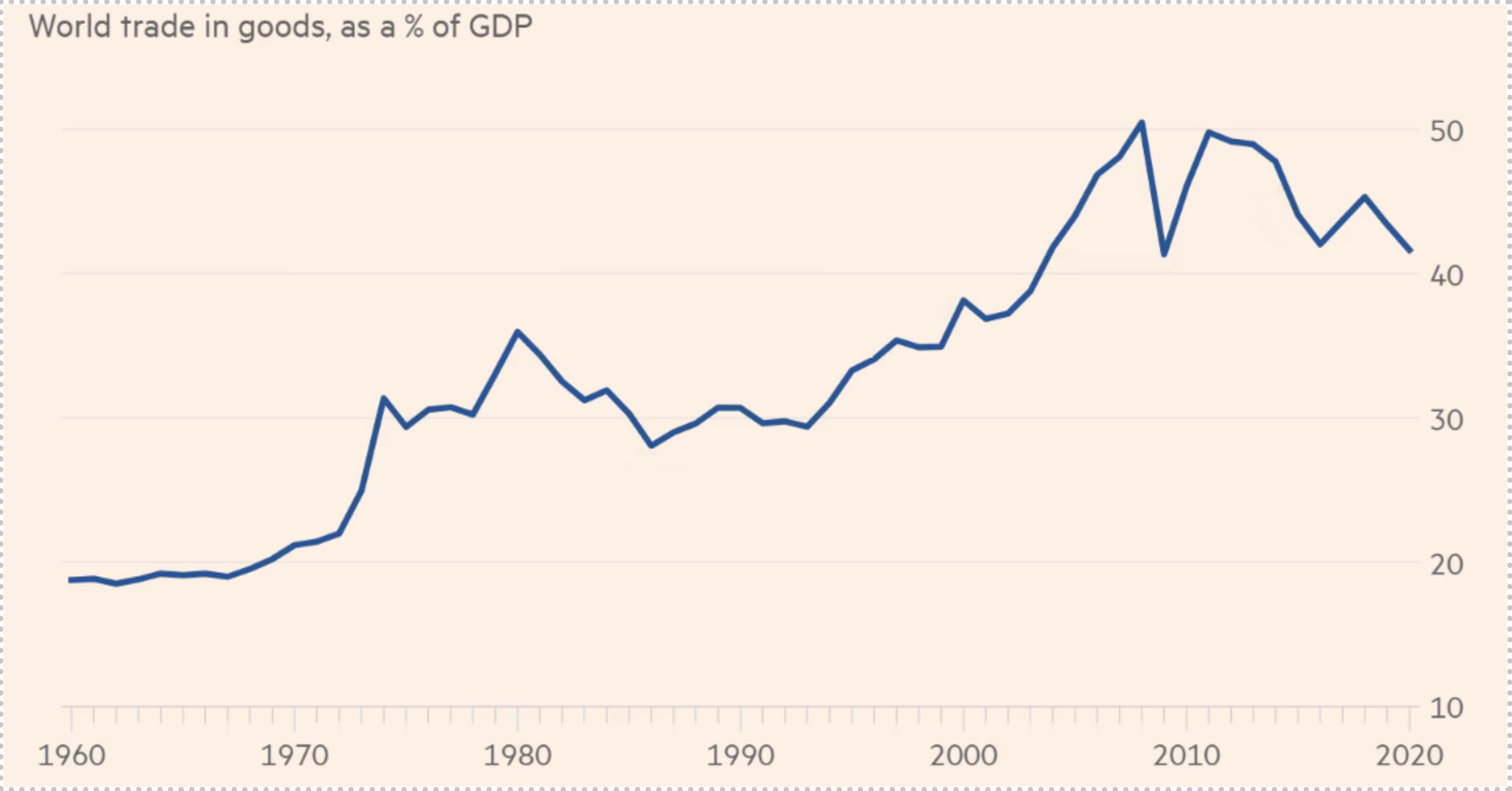
Recent advances in information technology have allowed companies to relocate production to areas where labour and raw materials are cheaper, generating greater profits. Additionally, the rise of broadband internet enables “trade in offices”- if an employee can work from home, the same tasks can be outsourced to workers in developing countries at lower costs. Since 2008-2009, world trade in goods has stagnated and has yet to recover to its pre-global financial crisis peak in 2015, as seen in Figure 1 (Wolf, 2022).
Figure 1: World Trade in Goods Relative to Output (trade in goods as a % of GDP).
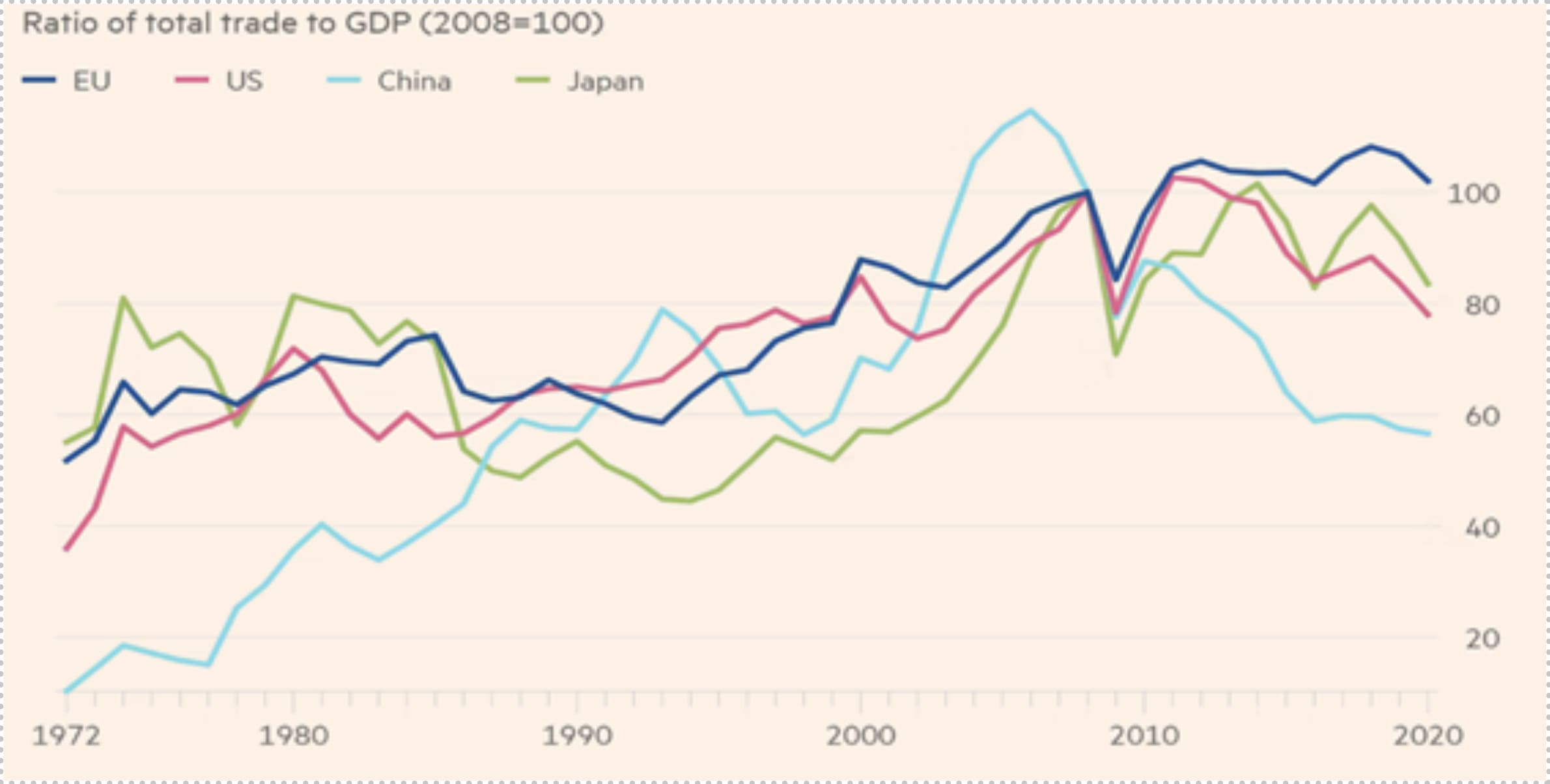
The economies of developed countries have not always been as open as proponents of globalisation and market integration often suggest (See Figure 2). Historically, these nations maintained protective measures before embracing the current era of free trade. The push for greater openness and market integration has primarily been driven by large corporations, which seek the benefits of expanded markets for the production and sale of their goods, as well as the opportunity to further monopolise global resources.
Figure 2: Peak in Openness to Trade across the Big Economies.
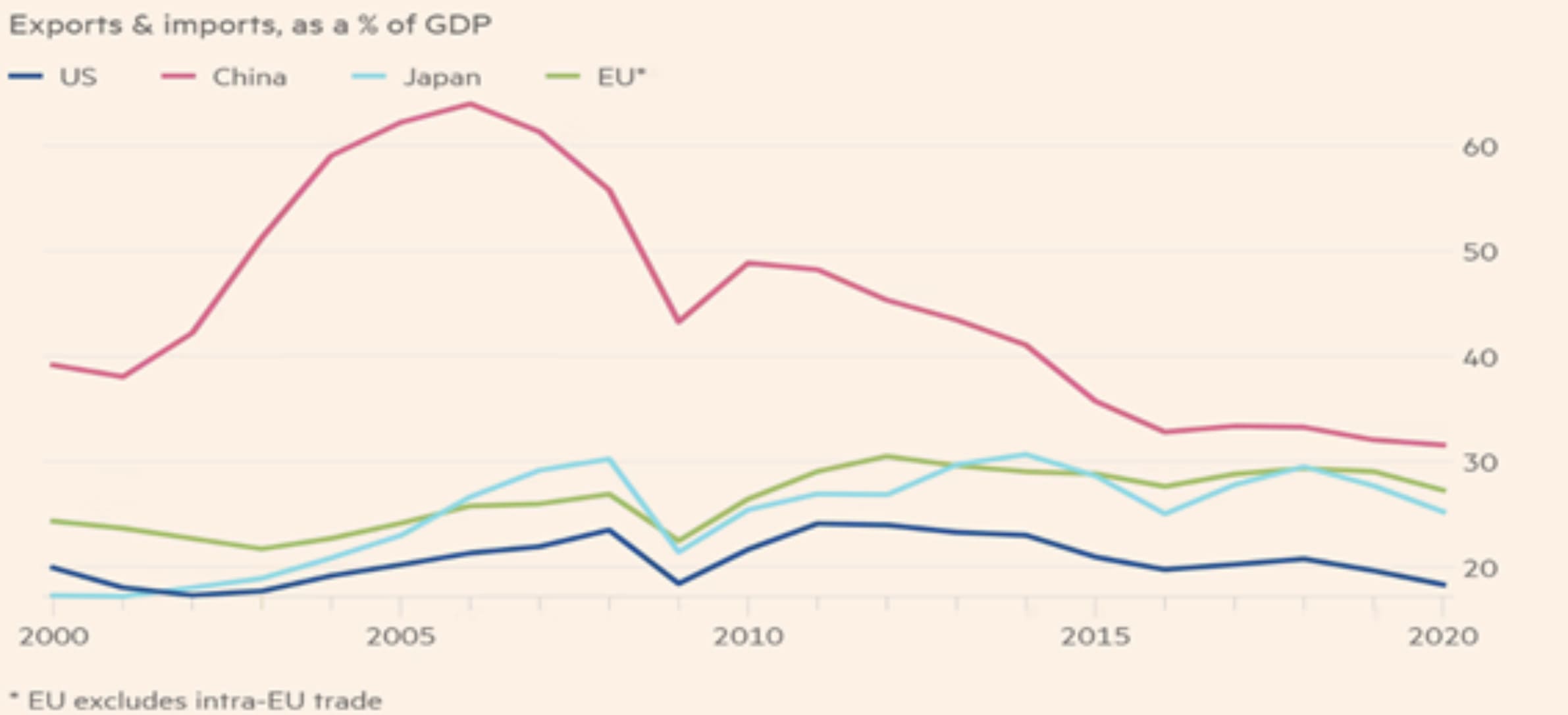
The trade ratio of China, the world’s second-largest trader of goods, peaked in 2006 (as shown in Figure 3). Similarly, the trade ratios for the third and fourth largest goods traders, the US and Japan, peaked in 2011 and 2014, respectively. While the European Union (EU) remains the largest trader, its trade ratio has stagnated rather than peaked. Notably, China has experienced the most significant decline in its trade ratio, which is not primarily attributed to increased protectionism but rather to a shift in its economic policy towards diversification. The primary factor behind the declining trade ratio has been the fall in commodity prices, rather than a decrease in trade volume. This price decline accounted for 5.7 percentage points of the 9.1 percentage points drop in the ratio of goods trade to world output between 2008 and 2020 (Wolf, 2022).
Figure 3: Trade Openness in the World’s Largest Economies (exports and imports as a % of GDP).
Foreign capital investments are often viewed as beneficial for enhancing production capacities, acquiring and assimilating new technologies, creating jobs, and most importantly, imparting skills and knowledge that collectively trigger a higher learning process. However, foreign investment may not always lead to the creation of new production capacities; instead, it can focus on acquiring existing capacities and exploiting the growing markets in developing countries. In cases of mergers and acquisitions, the production capacities may remain largely unchanged, while existing production organizations and labour relations often shift in favour of capital. Furthermore, many foreign direct investment (FDI) flows can be modes of round-tripping, designed to take advantage of tax havens.
Recent trends in FDI flows, as highlighted in the World Investment Report 2024, indicate that larger amounts of foreign investment are directed towards the Global North, or developed countries. Additionally, total foreign investment flows have declined over the past two years since the end of the Covid-19 pandemic. India’s aspirations to become the second-largest destination for FDI have faced significant setbacks. China’s share of global FDI inflows has decreased from 15.2% in 2020 to 12.3% in 2023, while India’s share fell from 6.5% to 2.1% during the same period (World Investment Report 2024).
In India, following the pro-market reforms of 1991, FDI inflows surged, averaging a growth rate of about 50.1% over the decade. However, this rate dropped to 30.7% in the 2000s and fell sharply in the 2010s, recording an average growth rate of only 4.6%. The IMF had previously stated that capital inflows would be directed towards capital-scarce economies, where returns would be relatively high, potentially increasing manufacturing in developing countries. Nevertheless, the automobile industry has shifted from the US and Canada to Brazil, Mexico, and South Korea, primarily driven by the pursuit of higher profits—either due to lower input costs or expanding markets. Despite expectations of rising FDI in India because of its growing middle-class market, workers’ wages have been kept low to make investments more attractive for FDI in the Global South (World Investment Report 2024).
Conclusion
While access to international markets can increase aggregate global wealth for developing countries, it often exacerbates inequality. This dynamic not only undermines the ability of international organizations to create institutions that could mitigate global inequality but also fuels resentment in the Global South.
The study reveals that globalization has curtailed the freedom of developing nations to choose economic policies tailored to their local contexts. Previously, during dirigiste regimes, petty producers and farmers enjoyed such autonomy. The withdrawal of state support has disproportionately affected poor households, leading to sharp increases in inequalities within many developing countries. These challenges are largely attributed to the neoliberal policies that define contemporary globalization. As a result, the capacity of governments to enact political interventions and introduce necessary changes has been significantly diminished.
Furthermore, institutions of international economic governance, such as the WTO, primarily reflect the interests of powerful, wealthy nations rather than those of poorer countries. Efforts to reform international trade, investment, labour, and environmental standards are still heavily influenced by the priorities of the Global North, perpetuating a system that disadvantages the Global South.
Dr Kalim Siddiqui is an economist specialising in International Political Economy, Development Economics, International Trade, and International Economics. His work, which combines elements of international political economy and development economics, economic policy, economic history and international trade, often challenges prevailing orthodoxy about which policies promote overall development in less-developed countries. Kalim teaches international economics at the Department of Accounting, Finance and Economics, University of Huddersfield, UK. He has taught economics since 1989 at various universities in Norway and the UK.
References
Girdner, E. and Siddiqui. K. (2008). “Neoliberal Globalization, Poverty Creation and Environmental Degradation in Developing Countries”, International Journal of Environment and Development 5(1): 1 – 27.
Marx, K. (1974) Manifesto of the Communist Party, The Revolutions of 1848: Political Writings, Vol. 1, p.70, London.
Siddiqui, K. (2023) “Marxian Analysis of Capitalism and Crises”, International Critical Thought, 13(4): 525-545.
Siddiqui, K. (2020) “Globalisation, International Trade and the Developing Countries” European Financial Review, August-Sept. p.60 – 71.
Siddiqui, K. (2020) “The Political Economy of Famines under Colonial India: A Critical Analysis” World Financial Review, July-August, p.56 – 70.
Siddiqui, K. (2019). “Agriculture, WTO, Trade Liberalisation, and Food Security Challenges in the Developing Countries” World Financial Review, March-April, pp.31 – 40.
Siddiqui, K. (2018). “Capitalism, Globalisation and Inequality” World Financial Review, Nov-Dec. p.72 – 77.
Siddiqui, K. (2018). “David Ricardo’s Comparative Advantage and Developing Countries: Myth and Reality” International Critical Thought, 8(3): 1-28, Sept.
Siddiqui, K. (2017). “Financialization and Economic Policy: The Issues of Capital Control in the Developing Countries” World Review of Political Economy 8 (4): 564 – 589.
Siddiqui, K. (2016). “International Trade, WTO and Economic Development” World Review of Political Economy, 7(4): 424 – 450.
Siddiqui, K. (2015). “Trade Liberalisation and Economic Development: A Critical Review” International Journal of Political Economy 44(3): 228 – 247.
Siddiqui, K. (2015). “Foreign Capital Investment into Developing Countries: Some Economic Policy Issues” Research in World Economy 6(2): 14 – 29.
Stiglitz, J. (2002) Globalization and its Discontent, New York: WW Norton & Company.
Wolf, M. (2022) “Globalisation is not Dying”, Financial Times, 14 September, London.
By Danny Leipziger
China cannot continue to rely on exports to drive its growth, but what are the alternatives?
China ran a $1.2 trillion trade surplus last year, and despite admonitions from the IMF to rely...
The World Financial Review uses cookies to improve site functionality, provide you with a better browsing experience, and to enable our partners to advertise to you. Detailed information on the use of cookies on this Site, and how you can decline them, is provided in our Privacy Policy and Terms and Conditions. By clicking on the accept button and using this Site, you consent to our Privacy Policy and Terms and Conditions. ACCEPT
Privacy & Cookies Policy
Privacy Overview
This website uses cookies to improve your experience while you navigate through the website. Out of these cookies, the cookies that are categorized as necessary are stored on your browser as they are essential for the working of basic functionalities of the website. We also use third-party cookies that help us analyze and understand how you use this website. These cookies will be stored in your browser only with your consent. You also have the option to opt-out of these cookies. But opting out of some of these cookies may have an effect on your browsing experience.
Necessary cookies are absolutely essential for the website to function properly. This category only includes cookies that ensures basic functionalities and security features of the website. These cookies do not store any personal information.
Any cookies that may not be particularly necessary for the website to function and is used specifically to collect user personal data via analytics, ads, other embedded contents are termed as non-necessary cookies. It is mandatory to procure user consent prior to running these cookies on your website.