After the Hamas-led offensive of October 7, 2023, it was portrayed as “Israel’s 9/11,” which came out of the blue. Yet, this assumption is not supported by verified facts, including ignored intelligence, abandoned hostages and neglected Israeli communities around Gaza.
A day after October 7, Eurasia Group’s Ian Bremmer said that the “massive attacks by Hamas leadership into Israel … is no less than Israel’s 9/11.” By contrast, in the same interview for CNBC, I said that October 7 did not come out of the blue. “The Israeli-Hamas War is a logical result of 50 years of failed military policies.” Our views were diametrically opposed.
I had warned of the ticking time bomb in Gaza already in 2018, half a decade before. A day or two before October 7, I wrote an essay on the coming explosion in Gaza. It was not prophetic insight. October 7, 2023, was the 50-year anniversary of the Yom Kippur War and I fully expected a high-profile reaction.
After the brutal Hamas-led assault, Israeli authorities vehemently condemned what they called “our September 11” and a “surprise attack.” But the hard questions were conveniently ignored – and still are.
A week ago, the Israeli Defense Forces’ landmark investigations into the October 7 attack disclosed severe, deep-rooted intelligence miscalculations and fundamental misconceptions on the nature of Hamas and its intentions by both the Israeli government and military. Probing the same attack, Shin Bet, Israel’s internal security service, recently pointed fingers at Prime Minister Benjamin Netanyahu. Typically, the prime mistakes featured the political conception of Hamas as an Israeli asset, the intelligence misjudgment that it couldn’t launch a large-scale attack, and weak defensive deployment.
The intriguing part of the story is that these facts were pretty well known already in the first days after October 7, 2023 – that is, more than a year ago – as I argue in The Fall of Israel. And there is more to the story.
Why was the abundant intelligence on the impending Hamas attack deliberately ignored? Why were the Israeli hostages effectively abandoned? Why were the strategic border communities neglected? With all its might, backed up with U.S. military aid and financing, how did Israel fail to see the writing on the wall?
Ignored intelligence
After October 7, a high-level Egyptian intelligence official said Israel had ignored repeated warnings that “an explosion of the situation is coming, and very soon, and it would be big.” Netanyahu denied receiving any such advance warning. Yet, the Egyptian confirmed that the Israeli PM had received direct notice from Cairo’s intelligence minister. Similarly, Michael McCaul, Chairman of the House Foreign Affairs Committee, told reporters of the alleged warning.
The inconvenient fact was that Israeli intelligence authorities had been aware of the threat for months yet ignored it. In November 2023, the New York Times reported that “Israel knew Hamas’s attack plan more than a year ago.” Code-named Jericho Wall, the 40-page blueprint outlined a lethal invasion. The document had been circulated widely among Israeli military and intelligence leaders, but experts determined an attack of that scale and ambition was beyond Hamas’s capabilities.
The Times report reverberated internationally. But it wasn’t a scoop. Right after October 7, several Israeli media released several reports indicating that many intelligence analysts’ warnings were ignored. What was new in the Times piece was the document verifying the story.
There was also a potentially explosive issue behind the Israeli deaths. Not about “friendly fire,” which is not uncommon amid fierce battles, but about the consequences of the Hannibal Directive, which many Israelis have charged was now the rule. This directive demands Israelis to kill their fellow soldiers and family members so that their kidnapping and the consequent prisoner exchanges can be avoided, presumably in the interest of a “greater good.” The Hamas-led offensive was compounded by what some Israeli soldiers subsequently called a “mass Hannibal.”
The longer the militarization has prevailed in Israel, the more the country’s gender gap –the difference between women and men as reflected in social, political, and economic attainments – has deepened.
Just days after October 7, testimonies from members of the mainly female lookout units bolstered accusations that Netanyahu’s leadership fatally misread the dangers from Gaza. In an Israeli TV segment, two soldiers, Yael Rotenberg and Maya Desiatnik, recounted their experiences in the months before the attack. Rotenberg frequently saw many Palestinians dressed in civilian clothing near the border fence with maps, scrutinizing the ground around it and digging holes. Once, when she passed the information on, she was told they were just farmers, and there was nothing to worry about. “It’s infuriating,” said Desiatnik who served in Nahal Oz, where 20 other women border surveillance soldiers were murdered by Hamas. “We saw what was happening, we told them about it, and we were the ones who were murdered.”
Underpinning all these ignored warnings was the IDF’s assumption that Hamas lacked the capability to attack and would not dare to do so. The flawed supposition was fostered by two factors. First, gender bias. The longer the militarization has prevailed in Israel, the more the country’s gender gap –the difference between women and men as reflected in social, political, and economic attainments – has deepened. Today, Israel’s gender gap ranks at the level of El Salvador and Uganda. What, after all, did the “girls” of the lookout units know? Moreover, the idea that Hamas lacked capability to attack was predicated on the belief the Palestinians were “human animals,” as Netanyahu and the cabinet ministers called Hamas operatives. Subhumans cannot think out-of-the-box.
In reality, based on over 1 year of evidence, Hamas militants had trained for the blitz attacks in at least six sites across Gaza in plain sight and less than 1.5 km from Israel’s heavily fortified and monitored border, as even the mainstream CNN concluded barely a week after October 7. Worse, many testimonies by Israeli witnesses to the Hamas attack indicate that the Israeli military killed its own citizens struggling to neutralize Palestinian gunmen, in accordance with the Hannibal Directive. As one witness said to Israel Radio: “[Israeli special forces] eliminated everyone, including the hostages.”
Worse, in addition to the ignored intelligence, there were other issues that just didn’t add up, including the abandoned hostages, and the state of the long neglected Israeli communities surrounding Gaza.
Abandoned hostages
On October 7, 2023, as part of the overall Hamas-led offense, 251 people were abducted from Israel to the Gaza Strip, including children, women and elderly. Almost half of the hostages were foreign nationals or had multiple citizenships. The next day, Prime Minister Netanyahu appointed ex-military commander Gal Hirsch to coordinate the cross-governmental response to abducted civilians and soldiers. Internationally, the appointment was portrayed as the PM’s proactive move to ensure the timely release of the Israeli hostages.
Little did they know.
As brigadier general, Hirsch had commanded an IDF division during the 2006 Lebanon War, which saw the first test of the Dahiya doctrine, premised on the destruction of civilian infrastructure. Hirsch was seen as responsible for the blunder resulting in an abduction by Hezbollah militants and the battles of Bint Jbeil and Ayta ash-Sha’b, which the IDF failed to occupy, despite heavy casualties. Following a barrage of criticism, Hirsch was forced to resign. After years of career rehabilitation, he joined the dominant harsh-right party Likud at the behest of Netanyahu himself and became the favorite for the role of the national police chief in 2021 – until he and his business partners were indicted for tax evasion of $1.9 million in a case concerning arms sales to Georgia.
Why did Netanyahu appoint as his hostage tsar a general who had already blundered one high-profile abduction affair, failed to protect his soldiers and had been indicted for corruption?
Unsurprisingly, the families of the hostages concluded that, in the view of the Netanyahu government, the fate of the hostages was secondary to the pretext of October 7 for a massive ground assault. The realization led to bitter and divisive mass demonstrations against the government and for the release of the hostages that prevailed until recently.
If the hostage families and many ordinary Israelis despised the government that seemed to ignore the fate of the abducted, they found it even harder to digest the idea that their government may have been responsible for the deliberate killing of their loved ones. Just days after October 7, early reports and interviews suggested that the IDF had detailed prior knowledge of the Hamas offensive three long weeks beforehand, based on information from military intelligence’s Unit 8200. Highlighting the extent to which the IDF’s Gaza Division was aware of a potential attack on Israel’s southern border communities, the document, which was ignored by senior officials, detailed a series of exercises conducted by Hamas’ elite Nukhba units in the weeks prior to its publication. One of the most shocking sections of the IDF report featured instructions relating to the taking of hostages, the number of which was estimated to be between 200–250, coming close to the actual 251 captives.
Does this enumeration in the report reflect extraordinary foresight? Or does it – since its findings were blatantly ignored prior to October 7 – illustrate a deliberate intention to allow a certain extent of devastation, in order to permit a transformational event that would legitimize a broad-scale invasion and, ultimately, a war of obliteration? Such considerations, of course, have been quickly torpedoed as “conspiracy theories.” However, as long as credible investigations are deferred or suppressed in advance, legitimate concerns prevail on the causes of devastation on October 7.
And then, there was the odd issue of the Israeli communities surrounding the Gaza Strip, which had been regarded as “strategic” since the creation of Israel in 1948. Why had they been ignored as if they were “non-strategic” for several years?
Neglected Israeli communities
When Israel was established, its founding fathers considered its border areas strategic. Adjacent to the Gaza Strip, these are the populated areas in Israel’s Southern District located within 7 km of the border and thus within the range of mortar shells and Qassam rockets. If these areas were strategic to national security, why were they so vulnerable on October 7? It is one thing that Israeli intelligence ignored over a year of warnings about the ability and willingness of Hamas to launch a major offensive. But it is another that the security of the surrounding Israeli border areas was effectively downplayed.
Many of these localities were neglected, while some, particularly the immigrant development towns, felt shunned by their government
Some of these settlements were created at the eve of the 1948 Arab Israeli War, including Sa’ad and Nirim, the two kibbutzim. The bigger ones were established soon after the 1949 Armistice Agreement, including Sderot, a development town for Mizrahi immigrants – that is, the Jews from the Middle East – and the military Nahal Oz, designed to become a civilian settlement and serve as a first line of defense against possible Arab incursions. In the early days of the Israeli state, many new arrivals from the Arab countries found themselves treated as “more primitive” second-class citizens by the predominantly European-born Ashkenazi-Jewish elite. These subtle and not-so-subtle ethnic differences, compounded by visible “white” and “non-white” distinctions, continue to haunt the Israeli civil society. Yet, the Mizrahi Jews near Gaza faced additional challenges, and there were many Ashkenazis in these communities as well.
Many of these localities were neglected, while some, particularly the immigrant development towns, felt shunned by their government. When Israel occupied the Gaza Strip in 1967, border threats diminished until the First Intifada in the late 1980s and the rise of Hamas. Following Israel’s unilateral withdrawal from the Gaza Strip in 2005, cross-border shelling and rocket attacks into Israel increased accordingly. To protect these areas, which now became known as the Gaza Envelope, the Israeli parliament Knesset enacted a law to assist the “confrontation-line communities.” But when these measures expired in 2014 – a decade before October 7 – the district command of the IDF cut the associated budgets. This enraged many of the communities. After all, the 2014 Gaza War had caused a substantial adverse impact on the proximate settlements, due to rocket and mortar attacks, tunnels, intrusions, even incendiary kites. The war was followed by another wave of violence in 2018. And on October 7, many communities in the Gaza Envelope were infiltrated, with hundreds of Israelis butchered and kidnapped.
Instead of protecting its citizens, Israel had retreated from its traditional security obligations to the adjacent Israeli communities. As evidenced by the national budget for the Gaza Envelope localities in 2014–2024, these communities were, as critics said, “slated for abandonment following the November 2022 elections.” In effect, the per capita budgets approved for the years 2023-2024 were almost a third lower than that of 2022.
So, well before October 7, the strategic needs of the Gaza Envelope of adjacent Israeli communities were effectively neglected by the government. However, the huge military border barrier prevailed. Between 2017 and 2021, to counter the many tunnels Palestinians dug for infiltration, Israel also constructed an underground border wall, equipped with sensors several meters in depth along the entire border. In Israel, the high-tech security barriers were portrayed as impenetrable. And yet, the IDF was tricked by Hamas’s messaging, over-relied on a remote-controlled surveillance systems and weapons that were swiftly disabled by drones and snipers, enabling its infiltration and onslaught. Furthermore, the builder of the barrier had warned already in 2018 that it absolutely required a military presence. It was not designed to prevent mass assault on its own.
Unsurprisingly, the Hamas offensive caused a full breakdown in trust between the Israeli localities and their state, with residents reluctant to return to homes until security was fully ensured. As regional escalation spread to northern Israel, it shared the Gaza Envelope’s challenges, facing the rockets of the Hezbollah. By summer 2024, local leaders were warning the Netanyahu cabinet they planned to leave if the situation wouldn’t improve. “Where is the government?” asked the chief of the regional council, Moshe Davidovitch. “Even a banana republic does not work like this,” he added. “The government is destroying the North.”
Convenient narratives and inconvenient truths
By May 2024, new evidence indicated that Israel’s intelligence failure was the net effect of a “chain of failures” that pervaded the entire security sector, both in the Shin Bet and the IDF. The common denominator was the fallacy that Hamas was only able of firing long-range rockets against Israel. Whatever did not fit this theory was rejected. So, the warnings of the IDF female spotters were systematically ignored. What they saw as an impending mass attack intelligence officers dismissed as “routine Hamas training.”
Second, after the Gaza war in 2021, it was decided to cease intelligence-gathering on Hamas’ tactical array and the intermediate ranks of its military arm, to focus only on few individuals. Opposing views to this intelligence concept were marginalized. These failures were coupled with a sense of disdain in the intelligence culture, which viewed the border fence, together with the underground border barrier between Israel and Gaza, as denying Hamas the possibility of invading Israel. The “Iron Wall” was considered impenetrable; for all the wrong reasons. In effect, Hamas operatives breached the border barrier at 44 different points.
These failures were coupled with a sense of disdain in the intelligence culture, which viewed the border fence, together with the underground border barrier between Israel and Gaza, as denying Hamas the possibility of invading Israel.
Consequently, the so-called intelligence failure on October 7 can be attributed primarily to the rejection of external warnings, denial of internal evidence, suppression of tactical intelligence, autocratic culture, and inflated perception of the effectiveness of the separation barriers. The ongoing investigation of the military is likely to stress similar factors. But was that the full story or a part of the story? In effect, what was the story?
In the early conventional narrative, “intelligence failure” was framed as the prime narrative. But the thesis is hard to argue when tactical intelligence was delivered exceptionally well, despite reduced resources, and it outlined the threats in detail well before the attack, including the almost exact number anticipated to be abducted. There are too many anomalies and happy coincidences in the current narratives. So, if “intelligence failure” is not the story, what is? This leaves open the question, was the “neglect of intelligence evidence” just unprofessional conduct?
In the United States, September 11, 2001, provided the kind of catastrophic and catalyzing event – like “a new Pearl Harbor” – that the leading neoconservatives, gathered around the Project for the New American Century in 2000, envisioned as critical to achieve massive rearmament in America. Subsequently, it served as a flawed pretext for the war against Iraq and global war on terror. Netanyahu was well aware of this neoconservative Project; he funded some of its pioneers. The rise of neoconservatism in the U.S. went hand in hand with the emergence of Netanyahu’s Likud in Israel. It resulted in a neoconservative policy document, A Clean Break: A New Strategy for Securing the Realm, described as “a kind of U.S.-Israeli neoconservative manifesto.”
In Israel, the Hamas offensive was immediately followed by a coordinated nationwide outcry that “October 7 is our September 11” by PM Netanyahu, who had built his rise to power in the 1990s in cooperation with the very same U.S. neoconservatives, as well as the rise of Hamas at the expense of the Palestinian Authority, which his policies had tacitly supported for years. With October 7, he used the Hamas offensive to legitimize the subsequent ground assault and genocidal atrocities, which many in his war cabinet hoped would result in ethnic expulsions that would open Gaza for Jewish resettlement. Meanwhile, his Messianic far-right cabinet partners used the fog of war to disguise their ongoing (and largely successful) effort at the effective annexation of the West Bank to Israel proper.
The point is not to argue that one or another of these narratives is conclusive. Too much evidence is still missing. The point is that the current “facts” feature many anomalies that conventional wisdom shuns, but alternate narratives can explain. Conventional wisdom may be convenient, but it is seldom either persuasive or final.
This commentary draws from Dr Dan Steinbock’s new book, The Fall of Israel. A comprehensive historical and contemporary analysis of the how the path to the obliteration of Gaza was paved by the confluence of a set of longstanding forces. It focuses on the transformation of Israel, ethnic cleansing and genocidal atrocities, the Gaza War and regional escalation. It has been endorsed by two former European foreign ministers, the leading US political scientist, Israeli, Palestinian and Iranian scholars of the Middle East, and Secretary of State Colin Powell’s chief of staff, Lawrence Wilkerson. “When you finish the book,” Wilkerson says, “I hope you will understand that our current national path leads us straight to hell. “
The original commentary was published by Antiwar.com on March 10, 2025.
Health and safety in the workplace are critical priorities for any industry. All businesses have a variety of policies and procedures in place to aid with keeping employees and visitors safe but occasionally, some areas are overlooked.
Lone worker safety, via personal alarms or a lone worker app, is often overlooked despite being of just as much importance as a working-from-height policy or a first aid kit.
In this blog, we look at why such devices play a vital role, so you can see how they may deliver more safety and security for your workforce.
What is a panic alarm?
A panic alarm is a must-have security feature for lone workers and those working in volatile or risky environments. Created to provide rapid assistance to those who need it, a panic alarm sends a signal with the simple press of a button to an alarm receiving centre, law enforcement or in-house security teams.
Designed to be versatile, panic alarms are now incorporated into mobile phone apps, buttons incorporated into the building or wireless wearable tech.
Why do we need panic alarms for workplace safety?
You might be thinking that your team are well drilled in following procedures and that your dedicated H&S specialist has all eventualities covered, but unfortunately, that becomes a risky game to play. In critical situations, time management is crucial. Spending time ensuring you tick all the boxes of a company policy could change the way the situation escalates and what its outcome might be.
So, let’s look at the key reasons why bringing a lone worker app or panic alarm system into play might be one of the better moves you could make.
Fast response
When a panic alarm is activated via an app, device or button, it sends a signal to an alarm receiving centre, emergency service or other members of the team. This alerts them to a situation where someone needs urgent help. Without such a device, the employee at risk has to try and make a phone call or try and escape the situation. This can sometimes make things worse.
By reducing response time, you also reduce potential risk and give the employee a quicker helping hand.
Reduce workplace violence
Cases of workplace violence are often found in the media. Arguments between employees sometimes turn violent and sometimes customers feel the need to escalate situations with fists or weapons rather than with reason. This means a workplace can often become a scene of conflict and violence. Certainly, something it is not meant to be.
Panic alarms are a great way to minimise this risk. Should an employee feel threatened, they can discreetly activate an alarm with help arriving on the scene quickly. This aids in diffusing the situation before the offender can escalate it any further.
UK-based lone work specialists OkAlone have an app that can be downloaded onto any phone. With a simple push of a button, an alarm can be raised, without the offender knowing. With in-built GPS and man-down detection, the app can pinpoint where something happened and action the appropriate response.
This is particularly beneficial in industries such as retail or healthcare where face-to-face interaction is frequent.
Enhanced security
Many businesses spend lots of money on implementing various degrees of safety and security, but it can always be enhanced. For lone workers in particular, adding additional safety measures should be high on the agenda. Situations can often arise from almost nothing, and failing to provide workers with suitable ways to help themselves or request help could be damaging to both the individual and the business.
Security guards, warehouse workers, salespeople and home healthcare professionals for example are all often expected to work by themselves. This heightens the level of risk they put themselves at and means accidents, threats or injuries could go largely unnoticed or dealt with.
Having a lone worker app or alarm device with built-in GPS allows workers such as these to raise an alarm, instantly requesting help. Responders can then locate them quickly and organise a response or action accordingly.
Reducing legal liability
As a business owner, there are a host of legal responsibilities you must abide by. From how people are employed to the hours they work through to the amount they can be paid. Each aspect has very strict guidelines to follow. When it comes to safety the rules are perhaps even more essential. Failing to follow those can result in prosecution that may lead to fines or even prison time.
Failing to implement the correct level of safety control and management could see businesses being found liable for the result of an incident. As a result, it is better to be, if anything, over-cautious. The installation of panic alarms or the provision of lone worker alarms and apps shows that:
You take a proactive approach to safety
You maximise compliance opportunities
Reasonable measures are being put into place to protect employees
Enhanced employee morale and productivity
We often think that morale and productivity are linked to pay and benefits, but many employees see morale and productivity increase when they feel safe. By giving them full peace of mind that their safety is not only a priority but is proactively monitored, employees will feel safer and happier in the workplace. This then translates to less absence, more productivity and an overall more positive environment.
Where safety is taken seriously, staff retention tends to remain high as people feel comfortable in their workplace.
What panic alarms can be used in my workplace?
Luckily, there are a host of options that provide workers with added security. From fixed buttons to wearable tech, fast responses and appropriate care can be found fast.
Fixed panic buttons. These are the panic alarms that may be located under a desk or counter. A press of a discreet button sends an alert to the alarm controller or emergency services.
Wearable panic alarms. Small devices, sometimes disguised as a name tag, can be worn by a staff member and then activated with a quick press. An alert is sent to a control centre which can then locate the individual and act accordingly.
Mobile phone apps. A simple-to-use app where the user simply taps a button to raise an alarm which is then sent through to the alarm centre or appropriate alarm handler.
These devices provide crucial and rapid assistance. Used to help lone workers as well as those working in large numbers, they allow for a speedy resolution to a variety of situations. For business owners of all sizes, and especially those with high-risk workers, this simple alteration to safety procedures could save lives and cash.
In today’s world, it’s easier than ever to make purchases on the spot. With just a few clicks on your phone or computer, you can buy almost anything, often without thinking too much about it. But have you ever found yourself regretting a purchase a few days later? Maybe it was a flashy gadget, an impulse buy during an online sale, or even a last-minute splurge on clothes. If you’ve experienced this, you’re not alone. Many people fall into the trap of buying things they don’t really need, only to realize later that they didn’t truly want or need the item. So how can you avoid these impulsive purchases? One strategy that can help you is using the 24-hour rule for financial decisions.
Imagine this: you’re browsing online, and you come across something you’ve been eyeing for a while. The price is right, and you’re tempted to hit “buy now.” But instead of jumping to the checkout, you decide to add the item to your cart and wait. You tell yourself, “I’ll give it 24 hours before I make my decision.” This small but powerful act of pausing could save you money and prevent unnecessary purchases. It works by giving you time to think, evaluate your wants vs. needs, and reconsider the purchase before it’s too late. Even if you do decide to buy it, you might find that you don’t feel as rushed or impulsive, which is a win in itself.
For example, let’s say you’ve had a financial setback and are considering taking out a title loan in Mississippi to cover an emergency. Instead of rushing into this decision without thinking, you could use the 24-hour rule. Give yourself time to explore other options, consider your budget, and reflect on whether borrowing money is the best solution for your situation. You might be surprised at how much clearer your choices are after giving yourself some space.
In this article, we’ll dive deeper into why using the 24-hour rule can be a game-changer in your financial decision-making and how to implement it effectively in your everyday life.
What Is the 24-Hour Rule?
The 24-hour rule is a simple but effective technique for curbing impulse spending. Instead of making an impulsive purchase the moment you feel the urge, you step back and wait for 24 hours before you make any final decisions. This rule applies to non-essential purchases—those items you don’t truly need but simply want in the moment.
The goal of this rule is not to deny yourself pleasure or enjoyment but to give yourself time to evaluate whether the purchase is really worth it. In many cases, the initial excitement fades after a day, and you might find that you can live without the item. The extra time gives your brain a chance to catch up with your emotions, which can prevent buyer’s remorse and financial stress.
Why the 24-Hour Rule Works
You might be wondering, “Why does waiting 24 hours make such a difference?” Well, the human brain is wired for instant gratification. When we see something we want, it triggers a dopamine response—essentially, a “feel-good” chemical that encourages us to act immediately. This is why we often make purchases on impulse, especially when we’re excited about an item or attracted to a sale.
However, if you can pause and give yourself 24 hours, your emotions have time to settle, and the excitement wears off. By then, you’ve had time to think through the decision and consider if it’s truly something you need or if it’s just a temporary desire. The result? You’re more likely to make a thoughtful, reasoned decision rather than an emotional one.
The Benefits of Using the 24-Hour Rule
1. Avoid Impulse Spending
One of the biggest benefits of the 24-hour rule is that it helps curb impulse spending. We’ve all been there—browsing online or shopping in person, and something catches our eye. Before we know it, we’ve made the purchase without really thinking about it. The 24-hour rule gives you a break from that rush of excitement, allowing you to step back and ask yourself, “Do I really need this?”
2. Save Money
By waiting 24 hours before making a purchase, you can avoid buying things that aren’t necessary. Over time, this can add up to significant savings. If you typically spend money on non-essential items, the 24-hour rule can help you become more mindful of your spending habits and keep more money in your pocket.
3. Build Better Financial Habits
Using the 24-hour rule regularly can help you build stronger financial discipline. When you pause before making a purchase, you develop the habit of evaluating your financial decisions. This can translate into other areas of your financial life, such as saving, investing, or making big financial decisions like taking out a loan.
4. Reduce Buyer’s Remorse
Ever bought something and regretted it later? Many of us have been there. The 24-hour rule helps to reduce buyer’s remorse by allowing you to make more informed decisions. By waiting, you give yourself a chance to reconsider the purchase and decide if it truly aligns with your goals and values.
How to Implement the 24-Hour Rule in Your Life
Now that you understand the benefits of the 24-hour rule, let’s talk about how you can start using it in your daily life. Here are some tips to help you get started:
1. Add Non-Essential Items to Your Shopping Cart
When you’re shopping online, rather than making an impulse purchase, simply add the item to your cart and wait 24 hours. During that time, ask yourself questions like:
Do I really need this right now?
Will I still want this item tomorrow?
How will this purchase impact my budget?
If, after 24 hours, you’re still excited about the item, then go ahead and buy it. If not, you’ve saved yourself the cost of something that wasn’t really necessary.
2. Put Yourself on a Budget
Having a clear budget can make it easier to decide whether to implement the 24-hour rule. If you have a set amount of money for discretionary spending each month, sticking to that budget can help you make better choices. If the item isn’t in your budget, it becomes easier to step back and wait before buying it.
3. Evaluate Your “Wants” vs. “Needs”
One of the keys to success with the 24-hour rule is distinguishing between wants and needs. A “want” might be the latest gadget or clothing item, while a “need” is something that serves a practical purpose in your life. If you can identify your true needs, you’ll be more likely to avoid impulse buys that don’t serve your long-term goals.
4. Use the Time to Find Alternatives
If you still want the item after 24 hours but don’t want to spend the money, use the time to explore alternatives. Maybe you can find a similar item for a lower price, or perhaps you can wait for a sale or coupon before making your purchase.
Conclusion: The Power of Patience in Financial Decisions
The 24-hour rule is a simple yet powerful tool to help you make better financial decisions. It gives you the time to think before making purchases, reduces impulse spending, and ultimately helps you manage your money more effectively. While it may not be realistic to apply the rule to every single purchase, using it for non-essential items can help you stay on track with your financial goals and prevent regret later. By taking the time to pause and evaluate your desires, you can make smarter financial choices and enjoy greater financial freedom in the long run.
Mark Carney has been elected leader of Canada’s Liberal Party, succeeding Justin Trudeau in a high-stakes leadership race. He is now set to lead the party into the next federal election, expected before October, against Conservative leader Pierre Poilievre, whose party currently leads in the polls.
One of Carney’s immediate challenges will be managing Canada’s strained relationship with the U.S. President Donald Trump has blamed Canada for illegal immigration, threatened to impose steep tariffs, and even suggested making Canada the 51st state.
In his first remarks as leader, Carney took a firm stance, vowing to maintain retaliatory tariffs “until the Americans show us respect.” Criticizing Trump’s trade policies, he declared, “In trade as in hockey, Canada will win.”
Poilievre, who has sought to distance himself from Trump, attacked Carney’s leadership credentials, calling him unfit to stand up to the U.S. Carney fired back, warning that Poilievre’s policies would leave Canada “divided and ready to be conquered.”
Carney, a former central banker, has centered his campaign on economic prosperity, clean energy, and shifting the financial burden of carbon taxes from consumers to corporations. He also played a key role in stabilizing economies during the 2008 financial crisis and Brexit.
Trudeau, who led the Liberals for over a decade, warned that Canada faces an “existential challenge” from the U.S. Carney has echoed this sentiment, advocating for aggressive trade policies to counter Trump’s tariffs while strengthening Canada’s economic independence.
With tensions rising and the election approaching, Carney’s leadership will be tested as he navigates Canada’s economic future and its turbulent relationship with the U.S.
The Sanskrit slogan Satyameva Jayate, which means “Truth alone triumphs,” assumes fresh meaning in a time when artificial intelligence (AI) is reshaping global narratives. Concerns about data integrity, AI-generated disinformation, and the erosion of truth are growing as countries compete to control the AI space. The question of whether “truth “in AI will ultimately triumph or if we are speeding toward a period of disinformation and social instability emerges when nations place a higher priority on AI supremacy than regulation.
All Bets Are Off in the AI Race
Even the European Union, which has set the standard for AI governance, is now racing to catch up to China and the United States, despite once being a strong supporter of AI safety and regulation. At the recent AI Paris Summit, there was a lot of talk about AI safety, transparency, and ethical AI, but little concrete action. The U.S., UK, and China notably refrained from signing the AI safety declaration, signaling that economic and strategic concerns outweigh ethical considerations. The urgency of the AI race has pushed global guardrails to the back burner, making innovation the primary currency of competition.
Meanwhile, China’s DeepSeek AI model has spooked Western nations, demonstrating that China is rapidly catching up to OpenAI and other leading AI developers. DeepSeek’s breakthrough highlights how the future of AI dominance hinges not just on powerful models but on access to the most comprehensive and accurate datasets. In this high-stakes race, the country or organization with the most truthful, expansive, and representative dataset will ultimately win.
The Dangers of ‘Quick and Dirty’ AI
With countries vying for AI supremacy, many are cutting corners, leading to “quick and dirty” AI. The result? Models that spread disinformation, reinforce biases, and exacerbate societal inequalities. One recent example of this is the viral AI video featuring fabricated appearances of Jewish celebrities condemning Kanye West’s antisemitic remarks.
The video, which appeared authentic to many viewers, falsely depicted figures like Scarlett Johansson and Adam Sandler. Johansson later spoke out, warning that AI poses a ‘far greater threat’ than many realize. The ability to generate hyper-realistic yet entirely fabricated content not only fuels misinformation but also has the potential to enrage populations, incite violence, and disrupt societies. If AI development continues unchecked without strong safeguards, we risk entering an era where fabricated realities will overshadow the truth.
The Need for a ‘TRUE’ Dataset in AI
Given these challenges, the importance of data integrity in AI cannot be overstated. For AI to be truly beneficial and reliable, it must be built upon what we call a ‘TRUE’ dataset:
T – Transparency: AI datasets must be sourced ethically, with clear documentation on how data is collected and used.
R – Representativeness: Data must be inclusive and diverse, ensuring that AI models do not inherit biases that skew results.
U – Updated: AI must continuously learn from fresh, verified data to remain accurate and relevant.
E – Ethical: AI development must align with ethical guidelines that respect privacy, consent, and fairness.
The Future: Will Truth in AI Prevail?
History has shown that misinformation spreads faster than truth. As the famous adage goes, “A lie can travel halfway around the world before the truth can get its shoes on.” The same applies to AI. Flawed AI models will likely dominate the landscape in the short term, fueling confusion and distrust before robust, truth-driven AI solutions emerge.
However, those who invest in ‘TRUE’ datasets—ones that are transparent, representative, updated, and ethical—will ultimately lead the next AI revolution. The AI battle is not merely about who builds the most powerful model but about who builds the most truthful one. In the end, just as Satyameva Jayate reminds us, only truth will stand the test of time.
The question remains: will AI developers and nations heed this lesson, or will they let short-term gains overshadow long-term credibility? Only time will tell, but one thing is certain – truth in AI is no longer just an ethical ideal; it is a necessity for the future of society itself.
Roopa Prabhakar, holds a Master’s degree in Electrical and Computer Engineering and a bachelors in Electronics and Communication Engineering. She has over 20 years of experience in data & analytics and currently serves as a Global Business Insights Leader at Randstad Digital. She specializes in modernizing & migrating legacy technology towards AI-enabled systems, bridging traditional IT roles with AI-powered functions. As an independent researcher, Roopa focuses on gender bias in AI, informed by works from UN Women and the World Economic Forum.
Large-scale, complex developments known as mega projects refer to advanced engineering, large-scale funding, and long-term planning. These projects often include infrastructure, real estate, or industrial developments that aim to boost trade, provide jobs, drive economic growth, and draw foreign capital. In this article we will explore some of the world’s most ambitious mega-projects and their economic implications.
Belt and Road Initiative (China)
Launched in 2013, China’s Belt and Road Initiative (BRI) is a vast project in infrastructure and economic development encompassing several continents. With an eye toward improving regional connectivity, the BRI has major economic ramifications:
Global GDP Growth: Studies estimate that the BRI could increase global GDP by $7.1 trillion annually by 2040, primarily through improved trade routes and infrastructure.
Trade Enhancement: The project is expected to increase trade flows by 4.1% in included nations, therefore lowering world trade costs and promoting economic integration.
Foreign Investment: By upgrading infrastructure, the BRI makes participating countries more attractive to foreign investors, potentially increasing capital inflows.
However, these advantages are coupled by questions about debt sustainability for involved nations since infrastructure projects could result in large financial commitments.
Palm Jebel Ali (United Arab Emirates)
The Palm Jebel Ali, a landmark property by Dubai-based Nakheel, is experiencing a huge recovery. In October 2024, Nakheel granted contracts worth more than AED 5 billion ($1.4 billion) to build 723 ultra-luxury homes on the island’s first six fronds. This investment is part of the overall plan to revive the project, which has been on hold since the 2008 financial crisis. Economic impacts include:
Economic Diversification: The initiative is consistent with the UAE’s overall plan of transitioning from oil-dependent growth to a diversified and sustainable economy, encouraging economic development through trade, commerce, and innovation.
Job Opportunities: This project is expected to generate employment opportunities in the construction, hospitality, and retail sectors, thereby fostering economic growth and local employment.
Tourism Growth: It is anticipated that Palm Jebel Ali will boost tourism by offering new accommodation choices and attractions.
NEOM and The Line (Saudi Arabia)
Saudi Arabia’s NEOM is an important part of the country’s Vision 2030 ambition to diversify its economy away from oil dependence. Designed as a $500 billion smart metropolis, NEOM is a collection of various ambitious projects including The Line, a linear city meant to house up to 9 million people. The economic projections for NEOM:
Job Creation: Focusing on high-skill, high-paying jobs, NEOM is planned to create about 380,000 jobs, thus expanding employment possibilities for Saudi nationals.
GDP Contribution: The economic activities within NEOM could contribute up to $48 billion to Saudi Arabia’s GDP by 2030, bolstering the nation’s economic diversification efforts.
However, the project confronts obstacles including questions about human rights and environmental sustainability, which may have an impact on its long-term viability and interest to international investors.
Eko Atlantic (Nigeria)
Eko Atlantic is a planned city in Lagos, Nigeria, being constructed on land reclaimed from the Atlantic Ocean. When completed, the new peninsula is expected to have at least 250,000 people living there and daily commuter traffic of 150,000. The construction also aims to stop Lagos city’s shoreline from eroding. The economic impacts include:
Job Creation: It is expected to generate countless jobs in industries such as construction, real estate, and services, contributing to local employment.
Foreign Investment: Expected to draw large foreign direct investment by providing contemporary infrastructure and business-friendly legislation, thereby establishing Lagos as a competitive location for multinational companies.
Trade Enhancement: The development includes a new deep-sea port, which is expected to promote trade by expanding cargo handling capacity while improving regional logistics.
Lobito Corridor (Angola and Democratic Republic of Congo)
The Lobito Corridor is a significant infrastructure project that connects Angola’s Atlantic port of Lobito to the mineral-rich regions of the Democratic Republic of the Congo (DRC) and Zambia. This corridor allows for the effective export of important minerals such as copper and cobalt from the DRC’s mining areas to global markets. Economic impacts include:
Trade Facilitation: The railway provides a more efficient route for exporting minerals, enhancing trade between Africa and global markets.
Economic Diversification: For Angola, the project offers an opportunity to diversify its economy beyond oil by boosting the mining sector.
Job Creation: The construction and operation of the railway are expected to generate employment opportunities in both countries, contributing to economic development.
This project also reflects geopolitical dynamics, as the U.S. seeks to counter China’s influence in Africa through infrastructure investments. In December 2024, US President Joe Biden announced an additional $600 million investment in the project, giving the total US commitment to $4 billion.
Challenges and Considerations
While mega-projects have the potential to drive economic growth, they also come with significant risks:
Cost Overruns and Delays: A study of 48 mega-projects found that poor execution led to cost and time overruns in 73% of cases, often due to their complexity and scale.
Environmental and Social Impacts: Large-scale developments can lead to environmental degradation and social displacement, as seen in projects like NEOM.
Debt Sustainability: Financing these projects often involves significant borrowing, which can lead to debt sustainability issues, particularly in developing countries.
Because of their natural complexity and long timescale, mega-projects sometimes face major difficulties including budget overruns and delays. Unexpected problems could affect these initiatives and slow down advancement. However, they provide valuable lessons in strategic planning, risk management, and innovation.
Mega-projects also show the requirement of great stakeholder cooperation since effective implementation usually depends on government funding, corporate investment, and community involvement. By analyzing past successes and failures, future projects can be better optimized for resilience, profitability, and sustainability.
A truly engaged workforce doesn’t just clock in and out—they innovate, collaborate, and drive businesses forward. Yet despite all the buzz, many organizations still get it wrong, confusing engagement with perks or flashy office aesthetics.
HR consulting firms often emphasize the need for a structured, evidence-based approach to engagement, and the data backs them up. Companies that get this right don’t just see happier employees; they see better business outcomes, from higher retention to increased innovation. So, what actually works when it comes to keeping employees motivated?
What We Think Works (But Doesn’t)
Ping Pong Tables & Free Snacks Silicon Valley may have popularized the idea that a stocked kitchen and office games create a great work environment, but research suggests otherwise. Perks can create a nice atmosphere, but they don’t drive long-term engagement. Employees appreciate meaningful work, not just free kombucha.
Annual Performance Reviews Feedback should be continuous, not crammed into a once-a-year evaluation. Annual reviews are often stressful, retrospective, and lack real-time relevance. Employees thrive when they receive timely, constructive feedback that helps them grow.
One-Size-Fits-All Incentives Throwing bonuses at employees without understanding what motivates them can backfire. Engagement isn’t just about money—it’s about recognition, purpose, and growth. Financial incentives can work, but only when aligned with intrinsic motivation.
Mandatory Team-Building Events Forcing employees into team-building exercises—especially ones that feel contrived or inauthentic—can have the opposite effect. Real team cohesion comes from organic collaboration and a culture of trust, not from escape rooms and trust falls.
Open Office Plans While open office spaces are meant to encourage collaboration, they often lead to distractions and a lack of privacy. Many employees struggle to focus in noisy environments, leading to frustration rather than engagement.
Unlimited PTO (That No One Uses) The idea of unlimited paid time off sounds great, but in many cases, employees end up taking fewer days off due to fear of judgment or workload concerns. A better approach is encouraging leaders to set an example by actually taking time off and reinforcing a culture that prioritizes rest.
What Science Says Actually Works
Purpose-Driven Work
People don’t just work for paychecks; they want to feel their contributions matter. Organizations that tie individual roles to a broader mission see higher engagement. Employees need to understand why their work is important, not just what they’re supposed to do.
A study by Harvard Business School found that 90% of employees who work at companies with a sense of purpose where their work has real impact feel more inspired, motivated, and loyal. Organizations can reinforce this by sharing customer testimonials, success stories, or data that connects daily tasks to meaningful outcomes.
Autonomy & Trust
Micromanagement is a surefire engagement killer. Research shows that when employees have autonomy in how they complete their tasks, they are more motivated and innovative. Trusting employees to make decisions fosters accountability and ownership.
Autonomy should be supported with clear expectations and resources. Employees are most engaged when they have the freedom to experiment within structured frameworks that define goals without dictating every step.
Continuous Development & Learning
Employees who feel stagnant disengage quickly. Companies that invest in training, mentorship, and career development programs create an environment of growth. Whether through professional courses, leadership opportunities, or cross-functional projects, learning keeps employees invested in their roles.
The most effective learning programs integrate on-the-job application. Research suggests that employees retain more information when they apply new skills immediately, making experiential learning a fundamental engagement strategy.
Genuine Recognition
People crave appreciation. A simple, sincere “thank you” from leadership or peers can significantly boost engagement. Recognition doesn’t always have to be monetary; it just needs to be timely and meaningful.
Peer-to-peer recognition can be just as powerful as recognition from leadership. Creating structured ways for employees to appreciate each other, such as kudos boards or shout-outs in team meetings, fosters a culture of appreciation.
Work-Life Balance (for Real, Not Just in Policy)
Burnout is real, and so is the need for rest. Encouraging work-life balance isn’t just about offering PTO—it’s about fostering a culture where employees actually feel comfortable using it. Organizations that prioritize mental well-being see not just happier employees but more productive ones.
The way leadership models work-life balance significantly impacts employee behaviour. Leaders who actively disconnect from work outside office hours and encourage flexible schedules set a precedent that makes employees more likely to follow suit.
The Role of Leadership in Engagement
Engagement starts at the top. Leaders who demonstrate transparency, communicate a clear vision, and genuinely care about their teams cultivate stronger workplace morale. Employees take cues from leadership—if executives prioritize engagement, the entire company culture will reflect it.
The Power of Employee Feedback
Employees who feel heard are more likely to be engaged. Companies that actively seek and act on employee feedback foster a sense of belonging and continuous improvement. Whether through pulse surveys, one-on-ones, or open forums, feedback should be a two-way street.
The Impact of Psychological Safety
Employees are more engaged when they feel safe expressing ideas and concerns without fear of retribution. Psychological safety fosters innovation, creativity, and open communication. Organizations that cultivate an environment where employees can voice their thoughts without negative consequences see higher levels of engagement and collaboration.
Flexible Work Models & Their Effect on Engagement
The shift to hybrid and remote work has reshaped engagement dynamics. Organizations that offer flexibility in work arrangements see higher job satisfaction and productivity. Employees value control over their work environment, and companies that embrace flexibility retain top talent more effectively.
Making Engagement a Strategy, Not a Buzzword
Building a truly engaged workforce isn’t about trendy perks or generic strategies—it’s about understanding what motivates your team members at the core of who they are. Not everyone will want to be recognized in front of the entire team, for example. At the end of the day, nothing can replace knowing the people you call employees and what makes each of them tick.
That said, however, if your engagement strategy starts and ends with office snacks, it might be time for a rethink. Employees don’t want gimmicks—they want purpose, trust, and a workplace that genuinely values them. Get that right, and engagement will take care of itself.
London, United Kingdom – Financial stability is a fundamental aspect of financial well-being, allowing individuals to navigate their financial lives with confidence and security. Giga Markets.com has positioned itself as a leader in ensuring financial stability for users by creating a platform that prioritizes easy financial processes, long-term security, and seamless access to financial options. The company understands that financial peace of mind is crucial, and by offering well-thought-out financial solutions, it provides users with the necessary tools to maintain stability.
The company has built a framework that ensures users can access financial resources with ease while maintaining the highest level of transparency and accessibility. Giga Markets.com believes in enabling individuals by offering financial solutions that allow them to manage their financial journey efficiently. By prioritizing user security and financial clarity, the company helps individuals make informed financial choices that align with their long-term goals.
A key focus of the platform is to provide individuals with a system that supports steady financial growth without complexities. Users are given access to financial tools that emphasize consistency and reliability, ensuring that their financial decisions are supported by a strong foundation. With an emphasis on simplicity and user accessibility, it continues to enhance the financial experience for individuals looking to maintain stability in their financial planning.
The company takes a proactive approach to ensuring that individuals can engage in financial decision-making with confidence. Giga Markets.com has implemented processes that provide users with a clear roadmap, ensuring that their financial choices are well-informed and arranged for long-term success. By maintaining a strong financial ecosystem, the company supports users in their journey toward financial stability.
Financial security is another pillar of Giga Markets.com’ approach, as the company continuously improves its platform to offer safe and efficient financial experiences. By incorporating modern solutions and ensuring seamless user interactions, it enables users to focus on their financial plans without concerns. The company remains dedicated to creating an environment that upholds trust and reliability.
Users who engage with the platform benefit from a system that is designed to eliminate financial uncertainties. The company’s dedication to structured financial options ensures that individuals have access to well-supported pathways for their financial needs. By fostering financial stability, it helps users build a secure financial future that aligns with their objectives.
Giga Markets.com recognizes that stability is an ongoing process, which is why the company remains committed to enhancing its financial offerings. The company continuously evaluates and updates its platform to ensure that individuals receive the best possible financial experience. By prioritizing efficiency, security, and clarity, it reinforces its position as a trusted financial service provider.
About Giga Markets.com
Giga Markets.com is a company dedicated to simplifying financial experiences while ensuring security, transparency, and long-term financial stability for users. The company provides financial options that enable individuals to navigate financial decision-making with confidence. With a commitment to clarity, accessibility, and security, Giga Markets.com continues to enhance its offerings to enhance user experiences.
By offering clear financial solutions, the company enables individuals to make informed choices without complexity. Whether users are looking for long-term strategies or reliable financial options, Giga Markets.com remains dedicated to ensuring that every step of the process is straightforward and accessible. This user-centered approach reflects its ongoing commitment to making financial security achievable for everyone. Its focus on providing stable financial solutions reinforces its position as a trusted name in financial services.
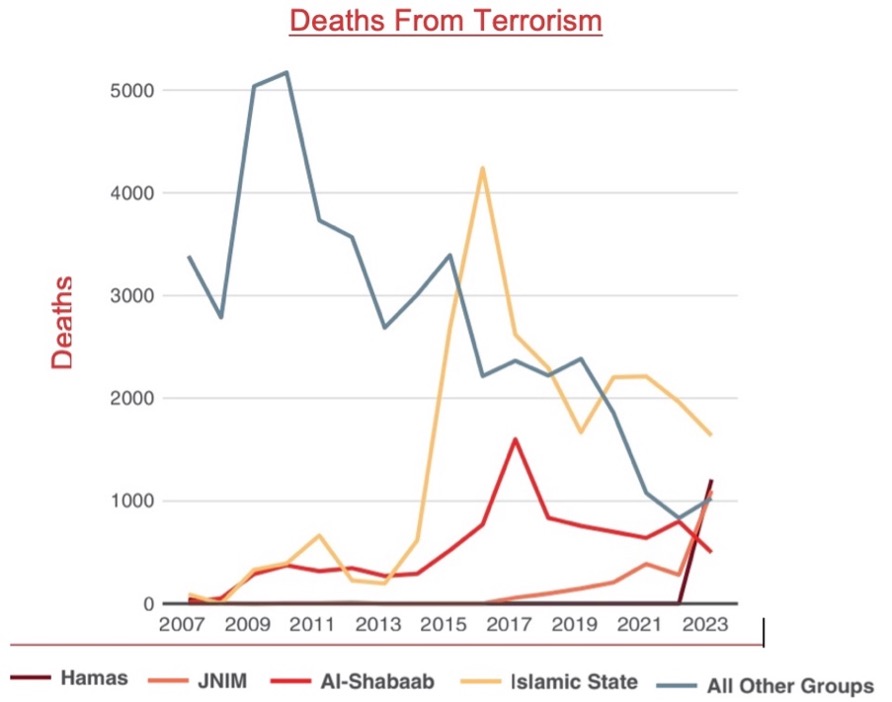
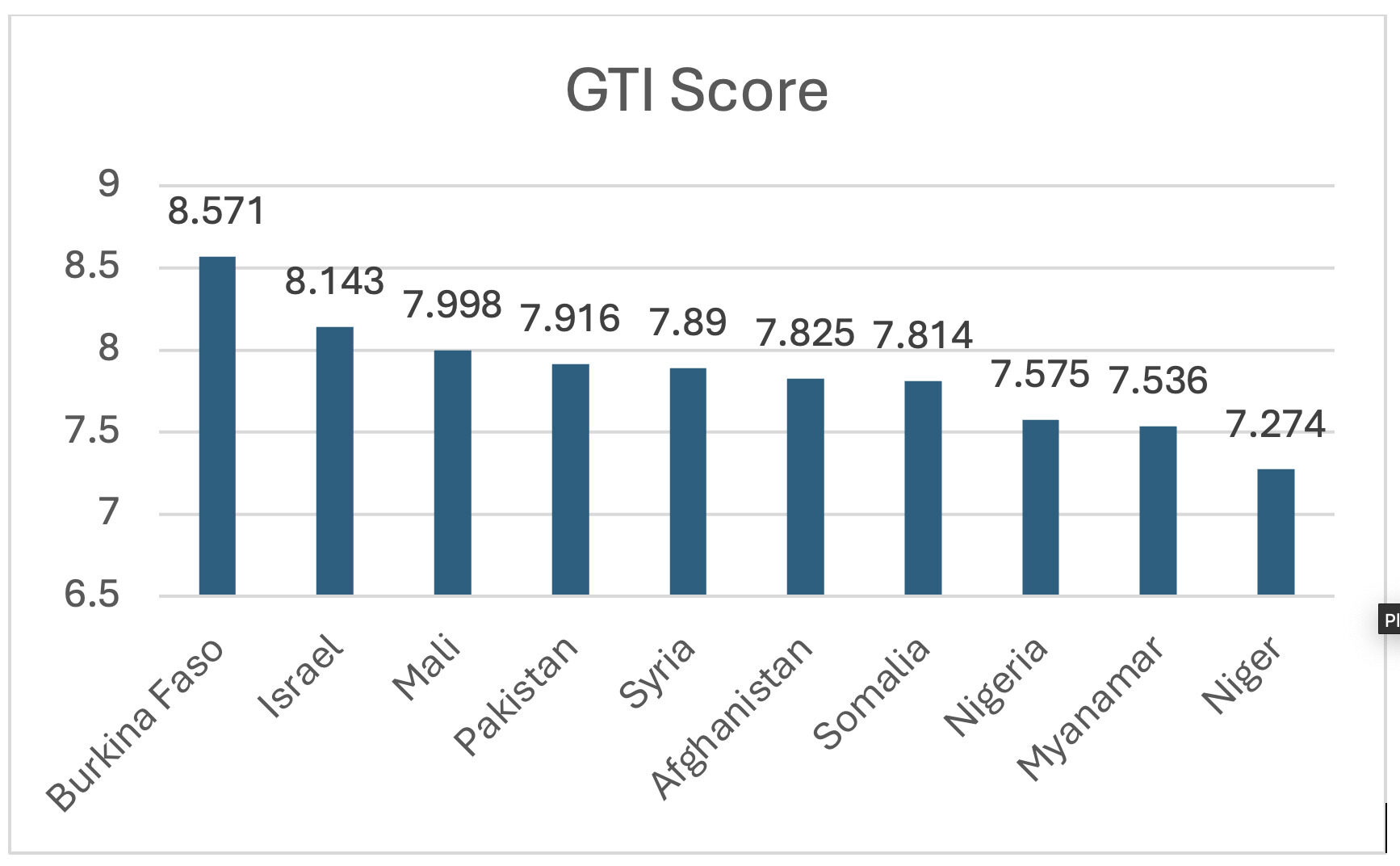
Terrorism comes in many diverse forms, from aims of a revolution, to fights for independence, to revenge. “Revenge for what?” we might ask. There have been recent attacks in Iran, Germany, Russia, and the United States, but mostly in African and Central Asian nations that are more vulnerable to large-scale killings and destruction in small cities that have little intelligence protection. Recent data shows that after decades of high numbers of attacks, terrorism is now being somewhat contained. With new high-tech weapons now on the open market, world attack numbers are high, though killings have greatly diminished since the 9/11 attacks in the United States, mostly because world-shared counterterrorism operations have smotheredthe main agencies of terror. With the unlawful 2025 shrinking of the size of the United States government, in particular the CIA, FBI, and NSA intelligence operations that have held terrorism at bay for two decades, the shrinking numbers of intelligence analysts will offer terrorists a return to bring forth the next catastrophe.
“[G]roups like ISIS have found ways to exploit the circumstances, especially in the Middle East and Africa, to slowly and quietly rebuild. As a result, today we are in yet another transformational phase of the global terrorism landscape, a threat that is more diverse, more complex, and more decentralized.”
— Brett Holmgren, U.S.Assistant
Secretary of State for the Bureau
of Intelligence and Research. [1]
Cautionary definitions: How should terrorism be defined and conceptualized?
“Terrorism” had been a word since the French Revolution, when it implied intimidations, massacres, and executions that terrorized the country. It is a vague French word, “terroriste“, meaning a system supporting political change through violent attacks. In terror, those who were royalists opposed to the revolution were threatened, punished, or sentenced to death. Following the Reign of Terror, a half-century later, the term ascended to connotate the terror methods of revolutionaries in Russia. However, the term was never defined to signify the wide range of underlying facets of terror. The world changed on September 11, 2001, at 8:46 AM EDT, and so did the word “terror.” It now has an I-know-it-when-I-see-it feel that elevates its meaning beyond formal definition. The expression originated with Sir Arthur Conan Doyle’s The Hound of the Baskervilles, when Watson answers the suspect, Mr. Stapleton, referring to art, “I know what is good when I see it.”[2]
Terrorism is political violence for political purposes mostly, but like the words “racist” or “fascist,” we use the term as if we know what it means, but we do not. In the mid-nineteenth century, the dictionary meaning of the word was: An agent or partisan of the revolutionary tribunal during the Reign of Terror in France. Since then, the definition of terrorism is, as Watson said, almost anything we instinctively think it means. But that brings confusion to a word that is so important today, with only a tentative connection to its birth during the French Revolution, a word that begs for clarity. The United States and the European Union define terrorism as “an activity involving violent acts, acts dangerous to human life, intimidation, mass destruction, assassination, or kidnapping.”[3]But when a term is simplified to that extent, we tend to see it in a dullness that makes us believe that we know what it means. Worse, the absence of an air-tight definition gives terrorists an escape route for their acts.
The Girondists by Karl von Piloty (1826 – 1886). Reign of Terror during the French Revolution. Public Domain
The United Nations Resolution 1566 (2004) refers to “terrorism” as:
… criminal acts, including against civilians, committed with intent to cause death or serious bodily injury, or taking of hostages, with the purpose to provoke a state of terror in the general public or in a group of persons or particular persons, intimidate a population or compel a government or an international organization to do or to abstain from doing any act, which constitute offences within the scope of and as defined in the international conventions and protocols relating to terrorism, are under no circumstances justifiable by considerations of a political, philosophical, ideological, racial, ethnic, religious or other similar nature, and calls upon all States to prevent such acts and, if not prevented, to ensure that such acts are punished by penalties consistent with their grave nature.[4]
We know that murder, kidnapping, arson, hostage-taking, and promoting public fear must be part of whatever definition surfaces, yet, as late as 2021, many delegates of the UN disagree on how to finalize a comprehensive convention on the matter and develop a global response to a threat that has yet to be defined, particularly when identifying state-sponsored actions.
In 1999, the International Convention for the Suppression of Terrorist Bombings (ICSFT) defined many terms associated with terrorism: aircraft hijacking, aviation sabotage, endangerment to maritime navigation, violence at airports, kidnapping of diplomats, stealing nuclear material, hostage-taking, terrorist bombings (whatever that means), funding terrorist acts, and using an aircraft as a weapon. That UN Convention has no voted definition of terrorism: “[d]espite multiple resolutions and international conventions, the UN has, for the moment, resigned itself to the fact that it is impossible to reach agreement on a common definition.”[5]
With multiple resolutions and international conventions, the UN has tried to find agreements on a universal definition, finding the problem interminable.
Why is there no international agreement on the definition of terrorism? The UK Terrorism Act based on MI5 intelligence went into effect in 2000, was amended in 2006 and 2009, and has not been amended since. In the United States, the FBI defines terrorism through terms that involve previously established criminal laws involving violence against persons or property and intimidation against civilians or the government. The EU has the most concise definition: criminal acts intended to intimidate the population, compel a government to execute or abstain from performing any action, or destroy the fundamental political constitution, economic or social structures. Strangely, EU law mentions neither the word “violence” nor its synonyms. The UN, however, has an exhaustive list of acts that changes occasionally, intending to bring members together for a comprehensive move on terrorism. “[T]he states members of the United Nations solemnly reaffirm their unequivocal condemnation of all acts, methods and practices of terrorism as criminal and unjustifiable, wherever and by whomever committed, including those which jeopardize the friendly relations among States and peoples and threaten the territorial integrity of States.”[6]
None of these definitions of terrorism distinguish between political resistance and revengeful anger over a style of religion or life. We have treaties, UN resolutions, and law opinions, but those policies, practices, and agreements are open to legal challenges without a universal and comprehensive definition of criminal offenses. Some UN member states express the definition with hesitance by arguing that international law is already in place to handle war crimes.[7] Definitions have problems when they include statements such as the Security Council Resolution 1373, which labels terrorism as “criminal acts against civilians with intent to cause death or serious bodily injury … with the purpose to provoke a state of terror in the general public or a group of persons.” That inclusion forwards two issues: one confuses treaty law with domestic law (with no prevailing rule), thereby hitting inconsistencies between military and domestic laws, and another uses the circular phrase “state of terror,” which confuses the meaning of the word “terror.” And where does the word “intent” come in? Nowhere. With multiple resolutions and international conventions, the UN has tried to find agreements on a universal definition, finding the problem interminable.[8] So far, the most comprehensive UN definition can be bulleted in three sentences:
Requires parties to take steps to prevent and counteract the financing of terrorists, whether direct or indirect, through groups claiming to have charitable, social or cultural goals or which also engage in illicit activities such as drug trafficking or gun running.
Commits states to hold those who finance terrorism criminally, civilly or administratively liable for such acts.
Provides for the identification, freezing and seizure of funds allocated for terrorist activities, as well as for the sharing of the forfeited funds with other states on a case-by-case basis. Bank secrecy is no longer adequate justification for refusing to cooperate.
From that all-inclusive bulleted list above, Alex Schmid, Director of the Terrorism Research Initiative, who edited The Routledge Handbook of Terrorism Research, is correct for this instance in saying that “definitions generally tend to reflect the political interests and moral judgment (or lack thereof) of those who do the defining.”[9],[10]In the absence of universal definitions, and in the shallow depth of what that term means, we have a hampered and confused model for processing violations of military, domestic, and human rights laws and counterterrorism endeavors. Moreover, the ambiguity brings into play the Latin precept nullum crimen sine lege (no crime without law). In other words, a group or person committing what we – the “we” meaning those of us who are confused about the meaning – understand to be allegedly a criminal act turns out to be inapplicable in criminal law, because terms are too vague to reach a verdict under the regulating legal standard of proof axiom requiring evidence beyond a reasonable doubt.
An example to ponder is the new United States executive order designating illegal Latin American drug cartels and anyone aiding them as foreign terrorist organizations. So, the broad mix of national and international attempts to legally define the term “terrorism” brings with it confusion in international cooperation. According to Schmid, there are at least 250 definitions of terrorism listed in an appendix of his book.[11] Though published in 2011, that book gives us the most up-to-date information on why it is so difficult to have an agreed-upon definition of terrorism. With no absolute definition, the perpetration of a criminal act involving transnational terrorism avoids punishment from UN international courts. To tackle terrorism, we must have a global consensus of narrowed definition. We are not there yet!
What do terrorists want?
Hamas’s original objective was to liberate historic Palestine, meaning all of Israel and Gaza. Now, a modified aim is to create a Palestinian state that includes territory captured by Israel in the 1967 Six-Day War. But Hamas is a proxy war group supported by Iran, which is also designated by Western countries to be a state sponsor of terrorism. Iran’s position has always been to lead Palestinian resistance and reject any permanent partition of Mandatory Palestine.
Jama’at Nusrat al-Islam wal-Muslimin (Group for the Support of Islam and Muslims, JNIM) is an offshoot of Al-Qaeda in Islamic Maghreb North Africa and a Salafi jihadist group highly active in Burkina Faso and Niger. With little popular support, it seeks to replace the entire region of established state authority with Sharia law.[12]
Chart 1. JNIM-ISGS war predecessor groups.
Source: Jebiguess Wikipedia Creative Commons Attribution 4.0 International license.
Al-Shabaab (Party of Youth) is considered a terrorist organization, but by what definition? It pledged loyalty to al-Qaeda, though technically it is a Sunni Islamic guerrilla group operating in East Africa that grew from being a military wing of the Islamic Courts Union, a legal Mogadishu armed resistance force against the 2006 Ethiopian invasion and occupation of Somalia. It had international support, as well as encouragement from Somalians and recruitment from Western countries. Its tactics follow a terroristic jihadist ideology, but because of terror’s all-inclusive definition, this resistance army is considered a terrorist organization. What does it want? To bring back Salafism, though their primary goal is to establish a stable Islamic state for Somalia.[13]
From its founding, the ISIS goal is to have an Islamic state of its own.
As Brett Holmgren said in the epigraph, “Groups like ISIS have found ways to exploit the circumstances, especially in the Middle East and Africa, to slowly and quietly rebuild. As a result, today we are in yet another transformational phase of the global terrorism landscape, a threat that is more diverse, more complex, and more decentralized.”[14]
Al-Qaeda, the best known of extremist fighters because of the 9/11 attacks, is an extremist group that regards any state as infidel if it does not follow its interpretation of Islam. Moreover, it fights for a pan-Islamic califate for the Muslim world. It and its many affiliated groups consider any state that supports other infidel governments or institutions to be fair game for violence, principally Saudi Arabia, Egypt, Israel, and the United Nations. It was once the largest militant terrorist network. However, since the 9/11 attack on the United States, intelligence agencies around the world have been sweepingly monitoring Al-Qaeda’s activities such that, though still a threat, it has a diminished capability to attack well-developed countries.
Figure 1. Map of main countries, where the international terrorist organization Al-Qaeda has been active.
According to the United Nations Security Council Committee, 53 other small groups are considered organizations designated as terrorists. That does not include home-grown individuals who hang on the coat tails of established groups. The number seems high, but that comes from what happens when a definition is broadly stretched.[15]
What can terrorists achieve?
That question is difficult to answer, partly because those shifty definitions of terrorism put us on a balance board that sways according to how we wish to interpret the word. If we go back centuries, then, yes, many terroristic wars of independence were successful. By fuzzy definitions, George Washington would today be considered a terrorist. Groups that we might call terrorists could also be called freedom fighters. Many of those fighters have made countries independent, and others who call for internal political change were considered terrorists. The African National Congress (ANC) toppling the South African apartheid government is one similar example among many.
Consider the Irish Republican Army (IRA). It has had a complicated existence for 106 years of attempting to unify Ireland and make the island a republic independent from British colonial rule. The UK had designated it to be a terrorist organization. However, even though it used violent tactics to empower its cause, it has been more like a revolutionary paramilitary organization.[16] In its early days, it achieved dominion status for 26 counties, leading to limited independence and later complete independence for southern Ireland. Six remaining counties continue to be part of the United Kingdom. I would say that it is an enormous achievement. Other than the IRA accomplishment mentioned, designated terrorists, not intending to overthrow governments, never come close to their stated goals. Their highest achievement is in recruiting new members.
A similar example of an international threat is the Partiya Karkerên Kurdistan (PKK), a militant organization that the United States, the European Union, and NATO consider to be a terrorist organization. It has achieved a few carved-out pieces of territory safe for Kurds, though they still have no homeland state.
One might argue that internal wars have meanings and clear goals based on public opinions in favor of righteous directions for the country. Therefore, though guerrilla or terror tactics are immoral behaviors, revolutionary armed behaviors fall into a different category of crimes against humanity. In August 1975, the Indonesian National Armed Forces violently massacred Timorese civilians. Then, during the decolonization of East Timor in 1999, the Indonesian New Order government invaded and occupied East Timor by genocidally killing between roughly 60,000 and 308,000 civilians.[17] The Timorese Social Democratic Association (ASDT), now a center-left political party in East Timor, was once the Revolutionary Front for an Independent East Timor (Fretilin), an armed group waging a guerrilla resistance against the Indonesian government. It proclaimed itself “the sole representative” of the East Timorese people. And now, it has 19 of the 65 members in the National Parliament. That is a good outcome for a group that was once declared terrorist.
Apart from the IRA, the PKK, and Fretilin, three designated terrorist organizations that are in a different sense “freedom fighters,” it seems that no other terrorist group active in this century has ever achieved any part of its goal. Others, transnational religious groups that aim to control religious practices, had little or no success accomplishing their goals.
Terrorism is war
Using the UN definition and excluding separatists and internal politico-moral reactionaries, terrorism often has no specific justifiable ideologies. It aims to build fear and to “provoke the authorities into using illegal, unconstitutional, and repressive measures and thereby to lose public support.”[18] As for objectives, all we can say when we include the combined 57 groups designated as terrorists is that terrorism’s main aim is to exploit fear, chaos, threats, and public violence to sway citizens in political or religious directions. Laws and rules of war are strategically broken to bewilder government counterterrorism intelligence. Terrorists need publicity, though not necessarily favorable exposure. They exploit the news media and whatever glorifying propaganda they can get from mass and social media to gain positive recognition, though they rarely present their cause. Every attack is used as a glorification to recruit more members. Let’s think of it for what it is: communication to disenfranchised audiences, a cause that seems mystifying to some and resoundingly correct to those audiences that are aligned with difficult life situations. Take, for example, Palestinians who once lived in Gaza and are now enraged by the inhumane circumstances of a ravaging war.
Terrorism is war by another name. It can be a political or emotional act, an individual or collective protest. It is a power tactic for powerless people or groups violently fighting a strong nation-state. The objective is to create fear and possibly to provoke retaliation. Some approach those goals with assassinations of enemies with hopes of gaining media attention and influencing public opinion. But before we get into the deeper reasons for terror, we should understand that terrorism is explained by understandings that divide categorically, partly because all attacks happen for different reasons – economic, political, religious, revenge, or other untamed causes, for example, race, deprivation, or poverty. Those measures have sub-reasons that include separatism, political, religious, and social styles, and criminal (narco-terror) viewpoints. Add insanity and state-sponsored positions and we almost have the whole bundle saying there is no universal oneness to how we think of terrorism. That is part of the definition problem. All we can say is that terrorism is a type of warfare that weakly enables small groups that are angry with more dominant powers to have their grievances recognized. “What are their grievances?” you ask. We do not know, because their ideologies are as free range as their objectives. For some, it is the secession of territory to form an independent state. For others, it could be about the dominance of recourses for an ethnic group, righting the wrongs of economic depravity, or religious fanaticism.
Table 1. Islamist terrorist attacks.
Islamic Terrorist Attacks
Location
Date
Description
Deaths
Injuries
Turkey
January 28
Church shooting
1
1
Somalia
August 2
Beach attacked
50+
212+
Russia
March 22
City Hall attacked
145
551
Russia
June 23
Two synagogues attacked
22
45
Oman
July 16
Mosque shooting
9
30 – 50
Nigeria
September 3
Village massacre
130+
30+
Mali
September 17
Bamako attacked
77+
255+
Iran
January 3
Suicide bombing
103
284
India
June 9
Hindu pilgrims attacked
9
14
Burkina Faso
August 25
Barsalogho massacre
600+
300+
Afghanistan
May 17
Market attacked
7
7
The graphs speak
Graph 1. Deaths, injuries, and incidents for the 10 highest terrorist attacks.
Graph 2. Deaths from five terrorist groups over 15 years.
Source: Institute for Economics & Peace [19]Who are the other groups marked in graph 2? The United Nations Security Council Committee tells us there are 58 non-state organizations designated as terrorists and 23 charities with ties to terrorist groups. Deaths-from-terrorism numbers tend to change from year to year. In 2014, 45,576 people died in terrorist attacks, while in 2022, just 7,829.
Graph 3. World deaths from terrorism from 1970 to 2022.
Graph created by Joseph Mazur
Figure 2. Number of terrorism attacks worldwide in 2021.[20]
Counterterrorism and counterintelligence divisions
In my previous article for this magazine, I wrote, “Terrorism is a world issue that cannot be curtailed without understanding that there are, and will always be, large and small groups rightly or wrongly perceiving oppression, opposing political, social styles, or religious beliefs.”[21] That is still true, but wars change things, because destruction feeds revenge, and revenge nourishes radicalization. Before 9/11, aside from the fledgling old social media platform SixDegrees, there was no worldwide facility with instant connection between people sharing independently truthful and freely fabricated information. In this age of social media, extremists have a platform that facilitates recruiting through falsely inspired messaging. The 2025 New Year’s Day truck killings in New Orleans were carried out by Shamsud-Din Jabbar, a domestic terrorist indirectly inspired by the Islamic State of Iraq and ash-Sham (ISIS) to carry out the attack. ISIS uses social media to encourage sympathizers, individually radicalized or group-wise through foreign fighters, to carry out attacks on its behalf. But ISIS, defeated after the Iraq War, is dispersed enough to be limited to rogue states in Africa trying to recruit foreign fighters from anywhere.
In this age of social media, extremists have a platform that facilitates recruiting through falsely inspired messaging.
This world has a background of terror far earlier than the French Revolution. But terror is different now, with politics shifting to benefit strongmen – yes, they are almost always men – who are in office to help themselves and so look to the future with glances over their shoulders in worries that their steps forward will be harmful to themselves. Their biggest frights are terror acts, sometimes from illegal organizations and other times lone extremists who believe in a cause or who are insane enough to think that death in an act of terror is a comforting salvation. However, terror does not come for strongmen. Two reasons: the constant and tight surveillance tools of their secret service industry, and the deterrents are fierce. China, for example, has over 200 million cameras that identify citizens through facial recognition, and the Skynet system constantly monitors everyone in public spaces. The United States has 85 million cameras in commercial districts of urban areas. Many are used for traffic monitoring but also for crime prevention. Russia’s surveillance is not as sophisticated as China’s. However, with more than 15 million facial recognition cameras actively monitoring social media and using its “cyber-gulag” as a tool of control that tracks and censors its population, it might deter terrorists but also activists engaged in protests. So, the question resulting from this information is: does sophisticated surveillance deter terrorist attacks? Thirty-five people died and 43 were injured in southern China last November. It was an incident of madness, not a planned event connected to a terrorist organization. The last terror attack in China was in 2014 in Yunnan Province, when five terrorists randomly killed 31 people and wounded 143 others. Shannon Tiezzi, Editor-in-Chief at The Diplomat, an Asian affairs magazine, wrote, “The deadly attack in Kunming may forever change the way China thinks about and deals with terrorism.” That was 11 years ago, but recent terrorist attacks have hit the far western region of Xinjiang, with violent random attacks surging “across the country as economic growth stutters, unnerving a public long accustomed to low violent-crime rates and ubiquitous surveillance.”[22] As for Russia, it had its burden of attacks (table 2).
Table 2. Terrorist attacks in Russia from 1999 to 2024.
Terrorist attacks in the Russian Federation
Year
Attack
Dead
Injured
Responsibility
1999
Apartment bombings
300
1700
Caucasus Emirate
2013
3 attacks
34
44
Kadarskaya
2014
Grozny bombing
5
12
Opti Mudarov
2015
Metrojet Flight 9268
224
Islamic State Sinai Branch
2017
St. Petersburg Metro
15
45
Akbarjon Djalilov
2019
Multiple attacks
1
0
ISIS
2023
Explosion in St. Petersburg
1
30
Akbarzhon Jalilov
2024
The Crocus City Hall, Moscow
130
100+
ISIS
The rocky future of counterintelligence and the humanitarian cost
How should we count the critical issues that we face that connect to terror and global security? Terrorism is a manifestation of fermenting dissension. Omitting health, forced migration, poverty, and climate change would neglect the roots of those connections. Doing so ignores bases for political unrest, increased fringe group recruitment, and the spread of organized terrorist attacks. Most developed governments have put enormous capital into critical issues and do not ignore the roots of unrest. They share counterterrorism information. That goes for the United States and Russia, a security collaboration network we overlook. So, what happens when government agencies are diminished in bludgeon-gashing speed excused as efficiency routing? The answer depends on the motive, which, in the case of the new United States government, has been secretly brewing at the Heritage Foundation for more than half a century before publishing its intentions through its Mandate for Leadership: The Conservative Promise for two years.
Elon Musk, the world’s richest man (for the moment), has targeted a humanitarian aid agency, the United States Agency for International Development (USAID), for closure. It is a foreign policy mistake that will soon cause immense problems for the United States. Number 1 on the list is terrorism. Humanitarian aid is the number one foreign policy that protects civilians from radical groups that sometimes have legitimate yet illegal complaints. USAID is an independent agency of the United States government with a $44 billion budget, less than two-thirds of 1 per cent of the 2024 United States federal budget ($6.75 trillion), that administers foreign aid and socioeconomic development assistance to underdeveloped countries, some under the threat of brutal internal wars. That aid keeps hungry children alive, improves water management to provide access to clean water in underdeveloped countries, and funds life-saving HIV/AIDS programs in Africa. The agency began with an executive order signed by President John F. Kennedy in 1961. Soon after, the United States Congress passed the Foreign Assistance Act to create an agency to administer economic aid. Why? To help foster better relationships around the world and less antagonism to the United States.
It may be odd to score terrorism attacks on countries, but we have such a grading for statistical accounting. It is called the Global Terrorism Index (GTI). Deaths, injuries, destructions, and hostage-taking numbers are submitted by 163 countries every year. They are weighed and averaged over five-year periods to become indices that tell us something about terror attacks localized by country. Only two countries have an index as high as 8: Burkina Faso and Israel.
Graph 4. Ten highest GTI scores.
The current United States GTI score is 4.141. That is not high compared to the top 10, but also not low for a country with a $101.6 billion intelligence budget.[23] What does that money do for homeland security? The global war on terror that began after the attacks of 9/11 and ended in 2020 cost the United States government more than $5.4 trillion, not including an additional trillion dollars of medical and disability ongoing expenses that will continue for the next 34 years. No matter how the Office of Management and Budget slices it, war is almost 2.5 times the price of peace through either diplomacy and / or generosity to underdeveloped countries that can explode with terrorist attacks, both domestic and international. As GTI indicates, the United States’ score is average, but only because its intelligence arm (which is being quashed under President Donald Trump) has for the past 20 years had a somewhat iron-dome system that protects its citizens within the country from the violence of terrorism that happens to citizens abroad.
Table 3. Non-zero GTI ranked scores for 88 of 164 countries rank above zero. Seventy-five others not on the list are ranked 0.
Source: Ranking numbers are from Vision of Humanity [24]I wrote in previous journal articles about why some governments prefer war to peace. It comes from the tailwinds of weapons development and sales. “There is a hidden truth about that, but you never hear about it: that wars happen partly because of the existence of a profitable weapons industry supported by powerful influence.”[25] That is especially true when oligarchies are involved. Musk, an oligarch by definition, sees a way of seizing a good chunk of national wealth by leading the Department of Government Efficiency (DOGE). With his enormous influence over Trump, he has vaporized USAID, a frightening deed for the United States and the world. President Joe Biden warned about this oligarchy syndicate leadership in his farewell speech before leaving the White House. It is a warning that should be taken seriously by leaders of all countries and ordinary world citizens. The world as we know it is in extraordinary disarray, to say the least. How will it hold together when one person – not a head of state – oversees it all? With DOGE abrasively cutting healthcare and safety departments, people will die.
Reasons why this is so important
It is tough to criticize one’s own country. I must say that I am fortunate to be permitted to write these distressing messages without government interference, and I am proud to be a bimonthly columnist for a magazine that gives me that permission. We still have a few countries left willing to go along with criticisms, but we do not know how long that freedom will last.
We still have a few countries left willing to go along with criticisms, but we do not know how long that freedom will last.
It might be that Musk, the puppet master behind the White House curtains, is an “unelected, unaccountable, out-of-control billionaire” who is interfering with United States government payment systems. He claims to know how to make governing more efficient. Sure, he could do that with his tech businesses, as he always has, to further profits under his addiction to greed, but governments are not commercial businesses. They work best when they are beneficiaries to foreign countries and groups that cannot succeed in their best intentions to assist underdeveloped countries that teeter on brinks of internal strife. Musk’s message is tragically clear: his crew is willing to extract sensitive data and damage the system so heavily that it will be impossible to repair quickly. When Musk’s team fired hundreds of highly skilled employees of the National Nuclear Security Administration, an agency that protects the world from nuclear accidents and secures nuclear weapons that could get into the hands of terror organizations, we worry about how insane governments can become. When Trump signed an executive order on January 25, 2025, saying “that no further United States foreign assistance shall be disbursed in a manner that is not fully aligned with the foreign policy of the President of the United States,” it immediately ended foreign aid programs. [26] He must know what he had unleashed! Despair for the sick and poor people in areas of Africa who are hungry and in need of medicine. Foreign assistance from the United States not only saves lives by preventing malaria and distributing life-saving drugs for many diseases worldwide, but it also shows a humanitarian touch to stop terrorist groups from exploiting attack motives. That hold does not stop attacks, but does diminish excuses because, though “terror” groups commit massive human rights abuses, they generally do consider public support for their ideals and do not want to tread on popular issues, such as UN programs that assist so many of the poor folks they claim to fight for.
When a leader of such a powerful country falls into – to use Volodymyr Zelenskyy’s phrase – “a web of disinformation,” the world falls too. Trump wants the United States to “own” Gaza and create a Middle East Riviera through ethnic cleansing, forcing Palestinians to emigrate to Egypt and / or Jordan. Such statements are well beyond madman theories and over the lunacy border. We cannot laugh at the suggestion. If we do, we will be encouraging almost every terrorist organization to unlock its best cells and unleash whatever terror they can to attack all sides of any countries that bend to Trump’s designs of building Trump towers and spas in Gaza City alongside the Blue Beach Mediterranean Resort. “The United States will take over the Gaza Strip, and we’ll do a job with it, too. We’ll own it,” Trump said during a press conference alongside the Israeli prime minister, Benjamin Netanyahu. “I do see a long-term ownership position, and I see it bringing great stability to that part of the Middle East, and maybe the entire Middle East.”[27] Just imagine how insane such an idea is and how much of a gift it would be to jihadists. After 77 years of Middle East wars involving Palestinian distressful moves, the insanity of kicking 2.1 million Gazans out of their homes would bring justified terrorism violence to the United States from every Arab country that will chant from the Riviera to the sea with every surefire opportunity for terrorist recruiting. What will a Middle East Riviera bring to American security issues? I can tell you: it’s the circle of ferocity. Ethnic cleansing brings anger, anger brings resistance, and resistance brings terrorist recruiting. Doubly displaced Gazans will see the Middle East Riviera as a real estate developer’s profit-making deal. How many of those 2.1 million will be recruited by Hamas?
Graphs 5a and b. Number of terrorist attacks (left) and number of deaths (right) in the United States from 1970 to 2021.
Source: Global Change Data Lab [28]Graphs 6a and b. Number of world terrorist attacks (left) and number of deaths (right) from 1970 to 2021.Source: Global Change Data Lab [29]We see from the graphs 5 and 6 that in the last half-century, terrorism in the United States has diminished by 72 percent, and in the same time span, the world has seen a 122 percent increase. Why does this matter? Perhaps I am wrong, but that Allied shared intelligence has fulfilled its purpose – what all governments must do by social contract – to enforce laws and protections against harm to their peoples. We have much to worry about; however, if we look at countries with shared terrorism intelligence, we find diminishing attacks and deaths from terrorism over the past 50 years. It is too early in the Trump era to say that cuts will jeopardize any CIA, FBI, or National Security Agency (NSA) counterterrorism operations. Those cuts are for people involved in investigating Trump’s criminal actions. However, the combined United States CIA and FBI services employ 59,575 government officials in 2024, including special agents, analysts, language specialists, scientists, and information technology specialists. The NSA employs between 32,000 and 59,000, an approximation because accuracy is classified information. Even a minor dismantling of those agencies could offset the intelligence work that has kept half the world safe in the last few decades.
Table 4. Average number of attacks and deaths from 1970 to 1979 and from 2012 to 2021, comparing the United States and world data.
Area
1979 – 1980
2012 – 2021
Attacks
Deaths
Per 100,000
Attacks
Deaths
Per 100,000
Percent Change
United States
148
<0.1
52
<0.1
-72%
World
889
40.1
10,875
17.9
+122%
Ripping those agencies apart extinguishes many of the counterterrorism instruments developed since 9/11. Sources and methods that have been keenly collected over the last two decades to give us detection and early warning intelligence and vigilance will be adrift if those agencies become weapons of retribution under political control. With limited warnings, the world could – or do I dare say “will”? – be bleakly ill-prepared for terrorism crises that could result in catastrophes almost anywhere in tangled political hot spots of world-clashing governing styles and ideologies. Without a strong intelligence force of agents constantly surveilling terrorist organizations, indoctrinations, and home-grown cells, terrorism will return with a vengeance we have not seen in the last decade, when the number of attacks in the world averaged over 10,000 a year.
Downsizing government agencies that protect the world may save a few dollars and favor the goal of siphoning out government workers who do not align with regime policies. But an adage, coined before the United States entered WWII by Admiral Harold Stark, chief of naval operations, tells a lifesaving truth about that pound-foolishness: “Dollars cannot buy yesterday.”
The United States now has a head of state saying things that would make invaders of Ukraine blush. As David Frum wrote in The Atlantic, referring to the now infamous belligerent meeting between Zelenskyy and Trump in the White House Oval Office on February 28, 2025, “We’re witnessing the self-sabotage of the United States.”[30], [31] That meeting – a made-for-television setup that boomeranged into a diplomacy embarrassment for the United States – demonstrated a lack of understanding that America benefits from its generosity of foreign aid through a moral basis of doing immense good at slight cost to help the poorer nations provide medicine and save lives. Frum ended his article by saying, “The pro-Trump party exposed its face to the world in the Oval Office today. Nobody who saw that face will ever forget the grotesque sight.”
Watching the event as an American, the scene sickened me with shame for my country.
Joseph Mazur is an Emeritus Professor of Mathematics at Emerson College’s Marlboro Institute for Liberal Arts & Interdisciplinary Studies. He is a recipient of fellowships from the Guggenheim, Bogliasco, and Rockefeller Foundations, and the author of eight acclaimed popular nonfiction books. His latest book is The Clock Mirage: Our Myth of Measured Time (Yale).
Alex Schmid, “Terrorism – The Definitional Problem”, 36 Case W. Res. J. Int’l L. 375 (2004) Available at: https://scholarlycommons.law.case.edu/jil/vol36/iss2/8
President Donald Trump has granted a one-month exemption on auto tariffs for Mexico and Canada, White House Press Secretary Karoline Leavitt announced Wednesday, offering a temporary concession amid his administration’s push to revamp American manufacturing.
The move follows discussions with major U.S. automakers, including Ford, General Motors, and Stellantis, who warned of potential financial strain. “At the request of the companies associated with USMCA, the president is giving them an exemption for one month so they’re not at an economic disadvantage,” Leavitt said, referring to the U.S.-Mexico-Canada Agreement.
Despite the temporary relief, Trump remains committed to reshoring auto production. “He told them they should get on it, start investing, start moving, shift production here to the United States of America, where they will pay no tariff. That’s the ultimate goal,” Leavitt added.
Automakers responded cautiously. Ford and GM expressed appreciation for the exemption while emphasizing their continued investment in U.S. manufacturing. Meanwhile, Canadian officials, including Ontario Premier Doug Ford, rejected any form of tariffs, insisting on “zero tariffs and no compromises.”
The exemption comes ahead of Trump’s planned announcement of reciprocal tariffs on April 2, which, according to Leavitt, will not include any exemptions. Auto industry leaders warn that without a long-term solution, tariffs could drive up vehicle costs and disrupt North America’s integrated supply chain.
Markets reacted positively, with major automaker stocks surging on the news.
By Danny Leipziger
China cannot continue to rely on exports to drive its growth, but what are the alternatives?
China ran a $1.2 trillion trade surplus last year, and despite admonitions from the IMF to rely...
The World Financial Review uses cookies to improve site functionality, provide you with a better browsing experience, and to enable our partners to advertise to you. Detailed information on the use of cookies on this Site, and how you can decline them, is provided in our Privacy Policy and Terms and Conditions. By clicking on the accept button and using this Site, you consent to our Privacy Policy and Terms and Conditions. ACCEPT
Privacy & Cookies Policy
Privacy Overview
This website uses cookies to improve your experience while you navigate through the website. Out of these cookies, the cookies that are categorized as necessary are stored on your browser as they are essential for the working of basic functionalities of the website. We also use third-party cookies that help us analyze and understand how you use this website. These cookies will be stored in your browser only with your consent. You also have the option to opt-out of these cookies. But opting out of some of these cookies may have an effect on your browsing experience.
Necessary cookies are absolutely essential for the website to function properly. This category only includes cookies that ensures basic functionalities and security features of the website. These cookies do not store any personal information.
Any cookies that may not be particularly necessary for the website to function and is used specifically to collect user personal data via analytics, ads, other embedded contents are termed as non-necessary cookies. It is mandatory to procure user consent prior to running these cookies on your website.




 The author of The Fall of Israel (2025), Dr. Dan Steinbock is the founder of Difference Group and has served at the India, China and America Institute (US), Shanghai Institute for International Studies (China) and the EU Center (Singapore). For more, see https://www.differencegroup.net/






 Roopa Prabhakar