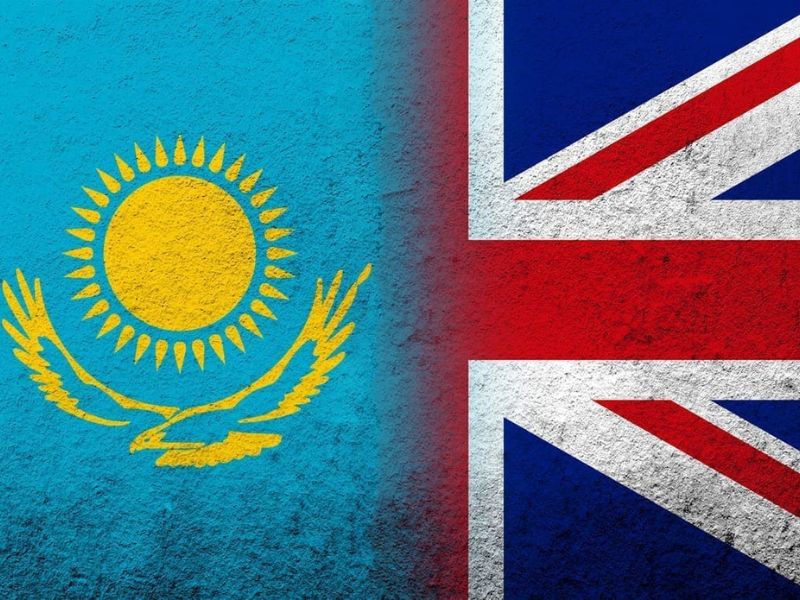
Kazakhstan’s President, Kassym-Jomart Tokayev, has recently signed the law ratifying the Agreement on Strategic Partnership and Cooperation between Kazakhstan and the United Kingdom, a move that may appear procedural at first glance, but in reality highlights a much larger geopolitical and economic shift.
The agreement formally elevates bilateral relations to a new strategic level and creates an updated legal framework for cooperation across trade, investment, energy, education, innovation and security. It was necessary in part because Britain’s departure from the European Union created the need for a standalone bilateral framework between London and Astana.
But the bigger question is why does this agreement matter now?
The answer lies in the changing realities of the global economy and a rapidly shifting geopolitical environment. Supply chains are being redrawn, not least because of the conflicts in Ukraine and the Middle East. Governments are seeking alternatives to overdependence on a small number of markets for critical resources. Trade routes are being reassessed amid instability in traditional shipping corridors. And middle powers are increasingly building pragmatic partnerships based on economic resilience rather than ideology.
Against this backdrop, Kazakhstan is quietly becoming Britain’s most important partner in Central Asia.
That shift has been building for some time and it became particularly visible during Foreign Minister Yermek Kosherbayev’s visit to London in February, where both sides signalled that their relationship is evolving far beyond traditional diplomacy.
One of the clearest examples is critical minerals.
As countries accelerate the energy transition and attempt to secure supply chains for advanced manufacturing, defence technologies and clean energy infrastructure, access to critical raw materials has become a strategic priority. Kazakhstan now occupies an increasingly important position in that equation.
The country produces 22 of the 36 minerals identified in Britain’s Critical Minerals Strategy, including uranium, titanium, silicon and rhenium. It remains the world’s largest producer of uranium and ranks among the top ten globally in reserves of tungsten, molybdenum, tantalum, niobium, nickel and cobalt.
This explains why one of the most significant outcomes of Kosherbayev’s February visit was the renewal of the Kazakhstan-UK Roadmap on Strategic Partnership in Critical Minerals. Importantly, discussions are increasingly focused not simply on extraction, but on processing, refining, recycling and value-added production, areas where British engineering expertise, ESG standards and financial services capabilities can play a major role.
For Britain, this represents an opportunity to diversify supply chains at a time when excessive concentration of mineral processing in a limited number of countries has become a growing strategic vulnerability.
Trade ties are also expanding at an increasingly rapid pace. In 2025, bilateral trade turnover reached $1.62 billion, an increase of 83.6 percent compared with 2024. Kazakhstan’s exports to Britain rose by more than 190 percent to reach $1.22 billion.
Meanwhile, cumulative British foreign direct investment in Kazakhstan has reached approximately $23 billion since 1993, placing Britain among Kazakhstan’s top ten foreign investors. In 2024 alone, British investment reached $723.7 million, while a further $471.5 million was invested in just the first nine months of 2025.
Today, 516 companies with British participation operate in Kazakhstan.
These figures matter because they demonstrate that this partnership is no longer aspirational. It is already being built through real capital flows and commercial engagement.
Kazakhstan’s broader economic trajectory also helps explain why British interest is growing. Its GDP surpassed $300 billion last year, with economic growth reaching 6.5 percent. Kazakhstan accounts for more than 60 percent of all foreign direct investment flowing into Central Asia and has increasingly positioned itself as the region’s largest economic hub.
For British businesses looking at Central Asia, Kazakhstan increasingly represents the most logical entry point.
That is particularly true when it comes to connectivity and logistics. As geopolitical tensions disrupt traditional trade routes, whether through the Red Sea, Russia-related sanctions risks or broader supply chain instability, alternative transit corridors are becoming more strategically important.
Kazakhstan sits at the centre of this recalibration. Approximately 85 percent of overland cargo moving between Europe and Asia passes through Kazakhstan. The Trans-Caspian International Transport Route, often referred to as the Middle Corridor, continues to expand through investments in rail infrastructure and ports such as Port of Aktau and Port of Kuryk. Digital systems such as Smart Cargo are also improving efficiency across transit routes.
For Britain, which is increasingly seeking supply chain resilience and diversified access to Asian markets, Kazakhstan’s role as a logistics hub is becoming far more strategically relevant.
There is also a broader geopolitical dimension to this relationship. In February, Britain hosted the first-ever CA5+UK Foreign Ministers meeting, an important signal that London is institutionalising its engagement with Central Asia rather than treating the region as a peripheral diplomatic issue.
That matters because Central Asia is becoming increasingly important to global energy security, food security, transport connectivity and critical mineral supply chains. Kazakhstan, as the region’s largest economy and one of its most active diplomatic players, naturally occupies a central role in that strategy.
Education and human capital are becoming another pillar of the relationship. Nearly 6,000 Kazakh students have studied in Britain under the Bolashak scholarship programme. British institutions including Cardiff University, Coventry University, Heriot-Watt University and Queen’s University Belfast have expanded their presence in Kazakhstan.
These institutional links create long-term familiarity with British legal systems, educational standards and business culture, strengthening ties beyond commodity markets.
This brings us back to the Agreement on Strategic Partnership and Cooperation between Kazakhstan and the United Kingdom. The newly ratified strategic partnership document does not create this relationship from scratch. Rather, it formalises a reality that has already emerged.
Britain increasingly needs reliable partners that can help strengthen supply chains, support energy transition goals, provide access to fast-growing regions and reduce geopolitical vulnerabilities. Kazakhstan offers precisely that combination. And for London, as it continues defining its global economic role after Brexit, few partnerships in Central Asia now carry greater strategic importance.
The information provided in this article is for general informational and educational purposes only. It is not intended as legal, financial, or professional advice. Readers should not rely solely on the content of this article and are encouraged to seek professional advice tailored to their specific circumstances. We disclaim any liability for any loss or damage arising directly or indirectly from the use of, or reliance on, the information presented.