
By Joseph Mazur
Winning a war calls for an understanding of the enemy, confidence in intelligence briefings, and skillful strategies, attributes sorely missing from America’s war on Iran.
– Simone Weil, The Iliad or The Poem of Force
History tells us that all wars are fraught with risk. No one can predict the outcome, not even with the involvement of the strongest army in the world. Here, Joseph Mazur, Emeritus Professor of Mathematics at Emerson College’s Marlboro Institute for Liberal Arts & Interdisciplinary Studies, sets America’s ongoing war in Iran against the backdrop of previous wars – real and fictional – and considers the parallels to be drawn.
Many years ago, never mind how many, I read The Iliad and The Odyssey, required reading in my college Great Books class. The immense syllabus started with The Epic of Gilgamesh and ended with George Eliot’s Middlemarch, if I am correct – or maybe it was Moby Dick; I don’t recall precisely. That class was an overwhelming experience that brought me into the world of reading and understanding our world in its abstract form. I had to know the answer to the first question in The Iliad. In my naiveté and belief in the goodness of my God, I could not imagine the answer to the question that opens The Iliad: “What god drove them to fight with such a fury?” Now, with age, trying to understand war with a modicum of wisdom, my latest editor and friend at the University of Chicago Press sent me a copy of David Mendelson’s translation of Homer’s Odyssey, straight off the press. That said, you might take me as a scholar. I am not, but my Great Books class forever changed the way literature prompts me to dig into the meaning of wars in fiction. They tell us something about who we are and why we perpetually fight in real wars, from Attila the Hun’s battles to Napoleon’s sieges, through two world wars, and into this century with warnings of consequence. Wars in fiction show us how war is destructive through the misfortune and chaos that destroy lives. Not just ancient wars. Even ancient wars in fiction refer us to real wars “from Alexander’s to Putin’s, with the hovering question: how do we face the fighting that kills our own species?” [1]
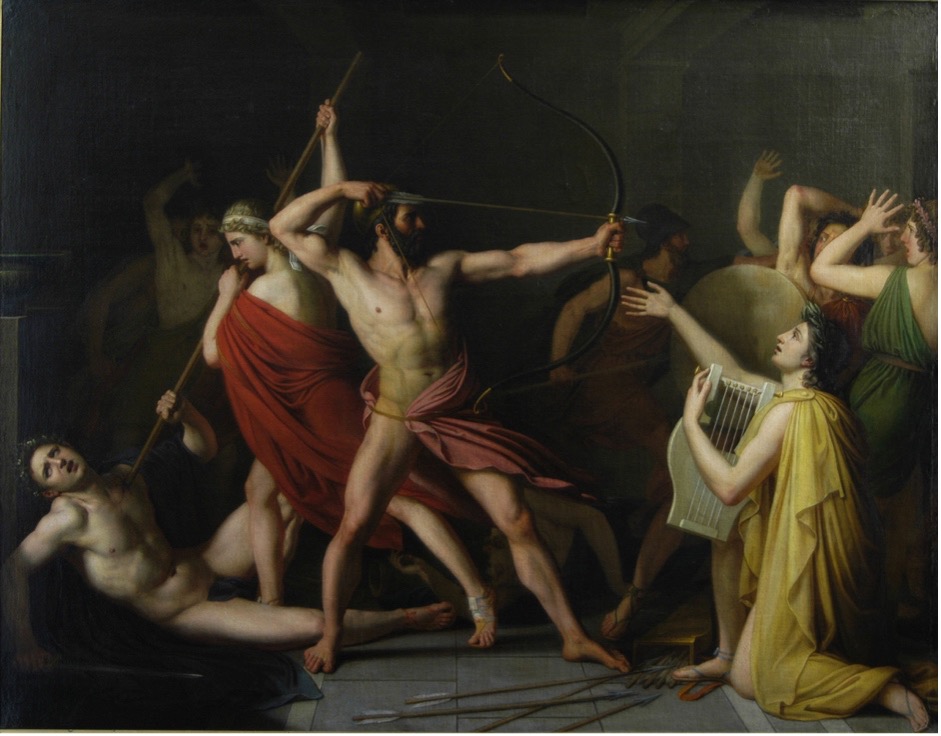
The Odyssey is now the first full-scale movie interpretation of Homer’s poem. There have been a few attempts to stage the epic as a movie, but none have interpreted what Homer imagined: a broad sense of what war really means. We don’t generally think that real wars include gods that actively control and interfere to settle battle scores, though if we lived in Homer’s time, we would. The only way to process causes then, whether they be wins or losses, was to understand the myths of gods who seemed to have human strengths and foibles. Warriors may be things of terror, yet they are also filled with grief and anger in witnessing deaths on battlefields.
Let us recall what war is: simply, it is a natural necessity that springs from points of evolutionary struggle for survival or power, bitter collisions, greed, or a genetic remnant or ancillary defense that leads to territorial expansion. [2] Wars come naturally from evolutionary struggle for survival or power. The causes also come from the dispositions and compliances of leadership. Causes of war rely on blind belief in advantage, hope, and luck. “Force,” Simone Weil wrote, “is as pitiless to the man who possesses it, or thinks he does, as it is to its victims; the second it crushes, the first it intoxicates.” The “it” for her is the force that is a thing that has a soul. The truth is, nobody really possesses it, because humans are not divided into conquered persons, slaves, and suppliants, on the one hand, and conquerors and chiefs on the other.” So, by “force”, she means the brutal powers that swerve human beings into blind things incapable of making decisions that could reset the balance of aggressor and victim to equilibrium. And then I suppose it was either Athena or her brother, Ares, who favored valor through brutality in warfare, or neither god nor goddess, but a typically false belief that luck is on one’s side.
Licensed under the Creative Commons Attribution-Share Alike 3.0 Unported license
What can we learn from the wars of classical fiction?
Wars take lives and force the quintessential question: Will it be worth it? The greatest fictional war poems give us answers.
Reasons for war are multifactorial; most have overlaps involving weapons and the supply of people. Whatever the reason, there are always middlemen, arms manufacturers, or even cottage enterprises behind arms dealing, a collective weapons industry supported by powerful influence to provide all the tools of war. Think about that; without them, there would be no wars. Odysseus did not make his own weapons, according to Homer’s fictional epic poem. His bronze sword was a gift from Alcinous, the King of the Phaeacians, and his legendary hunting bow was forged, not by him, and probably not by gods, but by bronze-smiths, for Homer tells us that it was given to Odysseus, not by any god, but by “godlike Iphitus,” a prince and friend of Heracles. [3] Achilles did not make his “great and massive shield, blazoning well-wrought emblems all across its surface.” Hephaestus, the blacksmith god of fire, made it.
These days, wars are different. Weapons, offensive and defensive, are not made by Greek gods. Warriors now rely on massive, powerful industries of creative understanding of how to use tools to kill or protect with the ease a sword could never provide. Yet both The Odyssey and especially The Iliad tell us of the catastrophic consequences of the fictional Trojan War, offering warnings of non-fictional war-death risk and bereavement loss. They may have been artful stories of a war that did occur around 1200 BCE near the village of Tevfikiye in northwest Turkey, once called Troy.
The story – and history – of war
All war stories, both fictional and non-fictional, tell us something we should learn. We, the public, in a limited democracy, have the authority and power to stop wars of which we do not approve. To do so means we must know the suspicious reasons for a war and the power behind leaders who are influenced to proceed on dubious grounds. Homer gave us all we need to know about war. His first lines relay his thoughts about the suffering of the Trojan War:
“Sing, O goddess, the anger of Achilles son of Peleus, that brought countless ills upon the Achaeans.”
And Homer asks:
“And which of the gods was it that set them on to quarrel?”
It is the first question in The Iliad. So, from that we learn it wasn’t a human who started that war, but rather Apollo, the son of Zeus. From that information, we understand that wars are influenced by outside interference. The gods in Homer’s tales are manipulators, not participants.
I dwell on these myths and nonsensical histories of war only to understand the inner nature and abstractions of war that tell us more than actual history allows: the complications of war, the fallacies, the catastrophic consequences, the strengths that are weaknesses, the reasons, the illusions, the triumphs, the cruelty and rage, the advances of plans, and the necessary swerves away from flawed plans. But every time I try to understand, I face the strongest reason: examining the weapons rather than the human pawns in battle.
Rarely do combatants hone their own weapons; they are produced, sold, and traded by people and companies that benefit from wars. Pressures for wars come from the arms dealers, manufacturers, politicians, and public investors. I’m not saying that arms dealers push the pressure, but let’s get real; weapon industries have powerful influence on governments. They may not encourage the invasions, but their profits and shareholders, some with lobbying power, do. When military agencies are pumped with unfathomable funds, they’re tempted to buy weapons. Once those weapons are built and stocked, there is a push to use them, because the drivers of arms dealing – very influential people – want to show off their products in battlefield performance. Ever since Russia invaded Ukraine, however, militaries have been entering a rapid new phase of warfare, a very different kind of war where the newest weapons – in particular cheap drones – are now manufactured by independent millennials under contract with the Pentagon.
The causes and reasons
– William Hovgaard, Is War Inevitable? [4]
Wars start for many reasons. Some are hidden. Some wars are caused by ambition, some by greed, some by revenge, some by opportunity, some by soothing the insanity of anger, and some for ridiculous reasons. There was the Pastry War (1828), started over a ransacked café in Mexico owned by a French pastry chef. King Louis-Philippe declared war after Mexico rejected a rather hefty compensation for the chef’s losses; the Pig War (1859), when an American farmer gunned down a boar in a potato patch belonging to a British farmer; and the War of the Stray Dog (1925), when a Greek soldier crossing the border into Bulgaria was shot after allegedly chasing his runaway dog. Conflicts like those happen frequently. People and a pig died in those wars that seem silly. We can say they were about petty anger, a human trait that twists emotions without regard to consequences. When it comes to more serious wars, we behave differently. We choose a side, either out of patriotic sentiment, base considerations locked in the minds of wise mentors, or alternative pathways.
A search for wars started by greed shows many examples. The Opium Wars, when Britain opened Chinese markets for drug profits, or the 19th-century European invasions of Africa for profits from gold, diamonds, copper, and rubber. For ambition wars, we have the Napoleonic Wars, which destabilized most of Europe for multiple reasons, but mostly for patriotic expansion.
In search of the “why” of war
Referring to my October 2025 TWFR article “The Dehumanizing Forces of War,” I again ask, “Why do we fight to kill?” I have no definitive answer, though searching through primary sources and original documents, fact-checking multiple times, I can only agree with William Hovgaard, who in 1937 wrote, “Generally speaking about the whole world, it is no exaggeration to say that war or the threat of war is the normal condition.” [5] Hovgaard was a Danish-American academic who expressed his view on the history of battles. “War is a biological phenomenon,” he wrote, “being part of the struggle for existence common to all organic beings in the wild state of nature.” He saw war as an instinct for control over defending and controlling resources and lands that provide the subjectively best-possible living conditions. Disagreements, then, heat to elevating levels of instincts of control, a pull not unlike Weil’s force of the “it” that has drawn disputes to skirmishes to conflicts to gruesome battles through centuries from those before history.
Hovgaard’s question ties to how wars begin and end. Wars at their start generally kill with ferocious animal instincts, though few wars of the past have ended with no deaths. Some discordances led to declarations of war that lasted hundreds of years, some ending in authentic peace treaties, and others were forever trapped in arguments over tea, spices, dyes, animals, boundaries, or liquor. [6]
In another one of my TWFR articles, “The Future of Autonomous Battling”, I quoted the military historian and Prussian general Friedrich Adams Julius von Bernhardi, who wrote that war “is a biological necessity… the natural law, upon which all the laws of Nature rest, the law of the struggle for existence.” [7] Like Hovgaard’s belief that conflict is part of the wild state of nature, von Bernhardi felt that the primordial impulse will always be with us, along with the good, bad, and acceptable human urges that brought us to this stage of existence. [8]
The beneficiaries of war
But I still believe that the modern impulse to start a war comes indirectly from weapons suppliers, mostly companies squeezing tens of billions of dollars through political lobbying in their favor. Think about it; Lockheed Martin’s annual revenue in 2025 increased by 6 percent to $75.0 billion. Add a few more defense contractors to the list – Boeing, Northrop-Grumman, RTX Corporation, and General Dynamics – and you see the extraordinary stakes in continuous contracts. Add a few more suppliers to those six behemoth companies to understand that the web of weapon manufacturers would not stand idle in accepting peace throughout the world. However, those companies must adhere to the U.S. Arms Export Control Act, which requires governments receiving weapons from the U.S. to use them for legitimate self-defense. [9] [10] In addition, American arms manufacturers and dealers are required to submit documentation of trade with international parties and are prohibited from selling sensitive technologies.
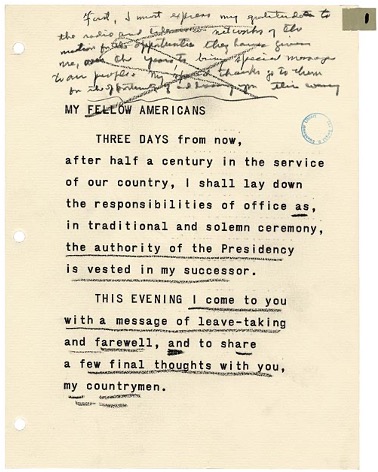 That same act also places certain restrictions on American defense suppliers, prohibiting them from selling certain sensitive technologies to certain parties and requiring documentation for such trades to trusted parties. Of course, honestly, none of those companies donate directly to political parties, candidates, or political committees. They comply with all laws and regulations connected to political and public policy issues. They do, however, support Political Action Committees (PACs) that contribute to federal and state candidates, political committees, party committees, and other political organizations through exclusive voluntary contributions from employees and directors. Interestingly, those contributions, averaging approximately $14 million a year in the last decade, have been almost evenly split among government parties. [11] However, General Dwight Eisenhower, when leaving office three days before the end of his term in office, gave Americans a warning through a farewell message of final thoughts on January 17, 1961:
“We have been compelled to create a permanent armaments industry of vast proportions.… This conjunction of an immense military establishment and a large arms industry is new in the American experience.… Yet we must not fail to comprehend its grave implications.… In the councils of government, we must guard against the acquisition of unwarranted influence, whether sought or unsought, by the military-industrial complex. The potential for the disastrous rise of misplaced power exists and will persist.” [12]
It was a 10-minute speech on national television that surprised everyone: the dangers of what he called the “military-industrial complex.” Eisenhower was telling Americans, and future presidents, to watch out for the pressure to spend and build a massive industry excused by an impending arms race in an imminent Cold War.
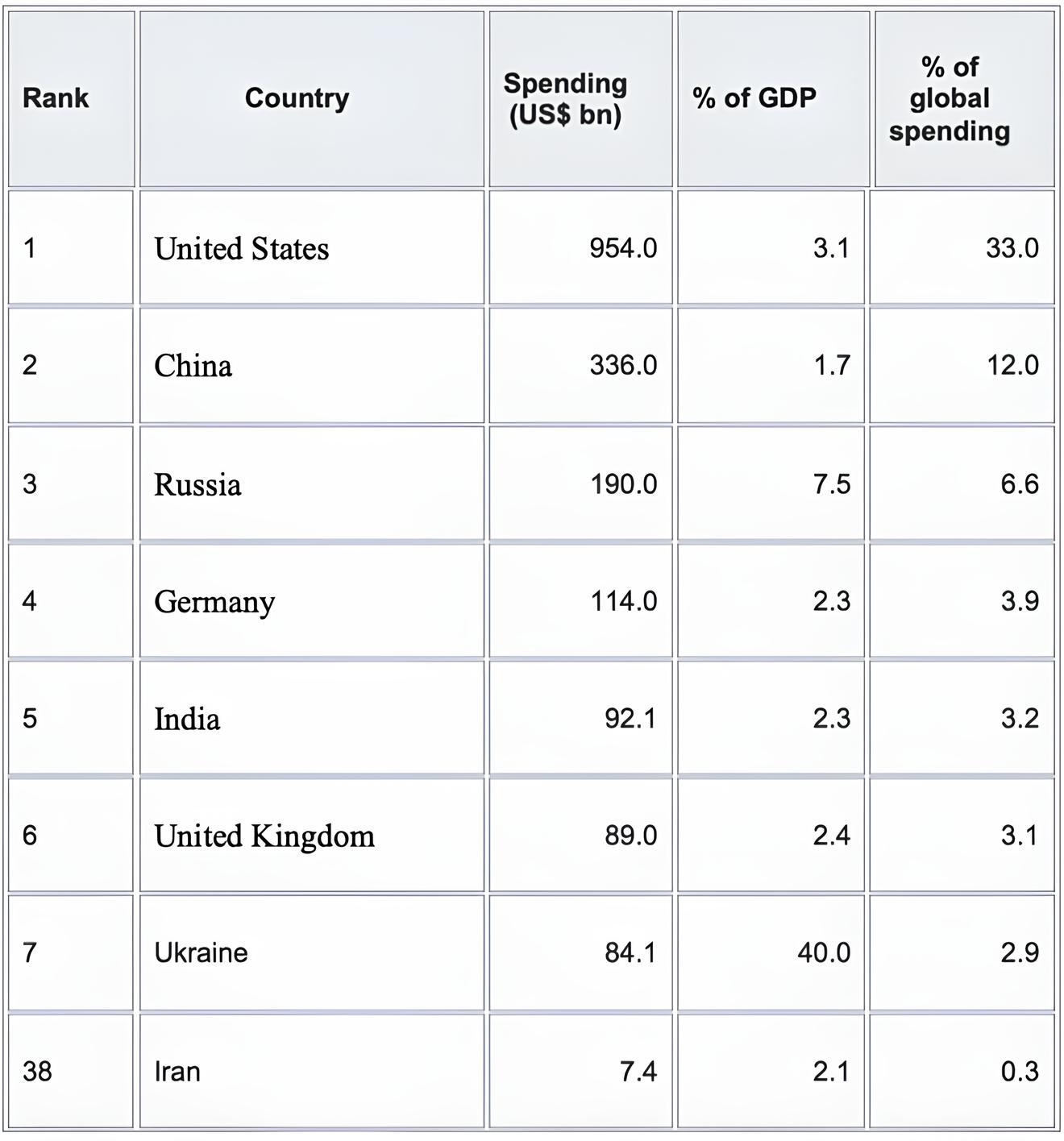
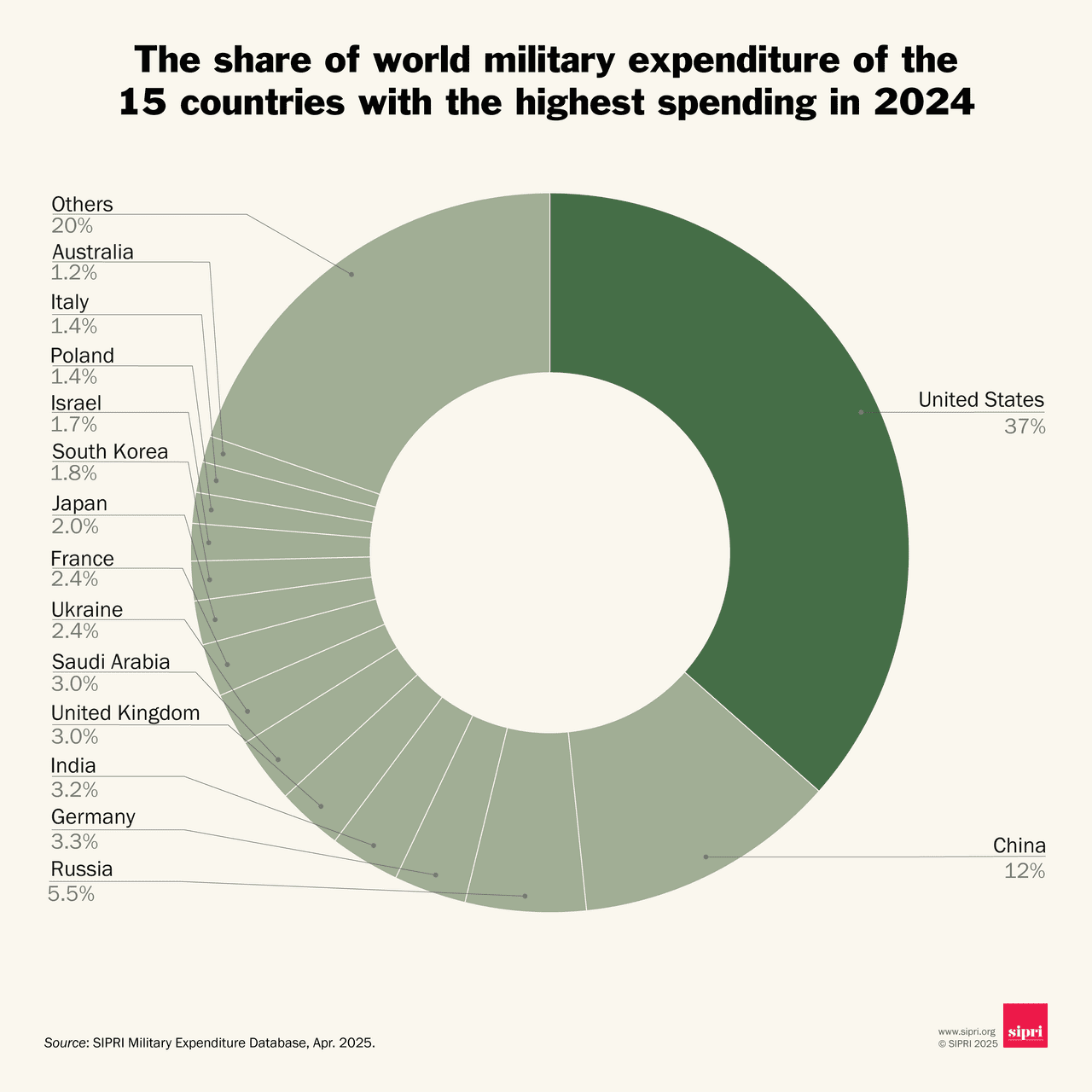
And here we are. That warning played out in a concealment to build that industry. Today, we have a military with a yearly budget of approximately $1 trillion, 18 percent of the total U.S. Federal budget for fiscal year 2026. Undeniably, the United States is the strongest military in the world. And yet, it has lost three wars since WWII: the Vietnam War, the War in Afghanistan, the Korean War (an armistice agreement), and now, inevitably, the Iran War. What would that mean when the best military lost three wars with relatively small countries? To be clear, North Vietnam had Russia and China as war sponsors, funding this war and supplying ammunition.
Source: SIPRI Military Expenditure Database
Author: UpdatesSIPRI
licensed under the Creative Commons Attribution-Share Alike 4.0 International license
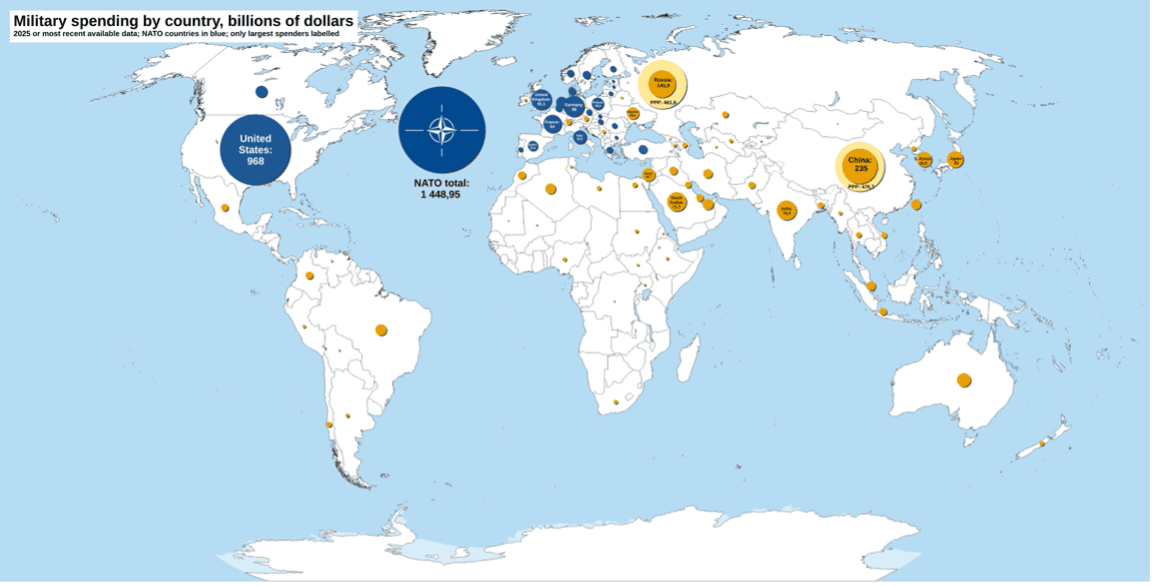
Source: https://www.iiss.org/publications/the-military-balance/2025/defence-spending-and-procurement-trends/
Creative Commons CC0 1.0 Universal Public Domain Dedication
Two leading military spearheads misconstrue the acumen of war
“The Naval Blockade remains in full force and effect,” Trump wrote on Truth Social on August 18th. “The Hormuz Strait is open and operating. All water mines have been removed or detonated.” There is very little truth in what he forwards in frustration to end his unpopular war that has brought inflation trouble to Americans, a war he foolishly started. No! Few ships pass the channel, and some still come under fire from Iran. And when Pete Hegseth, the United States Secretary of Defense, says, “We fight to win, and we don’t waste time or lives,” he misconstrues the point of war. War is not about winning. The only possible humanitarian justification for war is honest defense, not to win but to compromise, benefiting all sides. America, owning the world’s biggest and most equipped military, perhaps under premature assumptions, may have lost its war with Iran. With 3,000 Iranians and 18 U.S. service members killed, Americans should ask: What was this war for? The international rumor mill claims that this war is lost; maybe not, but surely not a “win,” whatever that means, because this administration has missed the principal principle: know your enemy. Trump should have known that Iran is not an easy target. Its resilience and adaptability must have been either a surprise to U.S. intelligence, a wild, insane idea coming from the noise in the president’s brain, or simply an ignorant plan to attack without an exit plan.
Who started the war against Iran?
America has foolishly and ignorantly started a war on a country with the second-largest population in the Middle East – 93 million. It wasn’t started solely by Trump’s lifelong urge to fix the Middle East. Let’s remember that Benjamin Netanyahu, the Prime Minister of Israel, who for decades planned to annihilate Iran, may have played Trump in convincing him to have the U.S. and Israel jointly plan and coordinate an attack on Iran. But now, Israel is concentrating its military objectives elsewhere.
With no understanding of the nature of Iran and ignoring advice from his daily intelligence briefings, the man who came to fame from a reality TV show, which was not reality, smugly went ahead anyway to damage Iran, inadvertently also damaging America by causing high inflation for at least a year, when fuel and groceries are already too high for many Americans. His habitual belligerence led him to think that the U.S., with its legendary superiority, would easily win a war with Iran, simply because the U.S. military budget is 135 times that of Iran’s. It is not just Trump’s ignorance. Where are the generals at the Pentagon, who must have known, given the evidence and lessons behind Russia’s foolish invasion of Ukraine that changed the conventionally assumed intelligence behind how wars could be won by astute planning or cleverness with cheap drones that outlast defense interceptors? After six months of war, Iran has drawn down the number of stockpiled American weapons to an alarming low, so low that the U.S. is “nearly out of certain long-range missiles.” [14] That statement, pointing to diminishing air-defense interceptors, brings with it a deterrence problem: adversaries, now seeing American weakness, are likely assessing their future military plans.
According to the Center for Strategic and International Studies, “the military has used up about two-thirds of its Patriot interceptors’ defensive weapons against incoming fire.” Russia, China, and North Korea are watching, as one $4 million Patriot PAC-3 MSF interceptor missile or one $14 million Terminal High-Altitude Area Defense (THAAD) missile takes down a single Iranian Shahed-136 drone costing approximately $35,000.
Wars have costs; this one, aside from casualties and killings, is running through defensive weapons. Iran’s cheap drone plans, along with blocking the Strait of Hormuz, have been ingeniously accomplishing what should have been understood before Trump started the war that he should have known he would lose. Of course, Mr. Trump will deny this report, and so it must be fake news. “So,” says Phillips Payson O’Brien, an American historian of war studies at the University of St. Andrews, Scotland, “the fact that they start a war that they did not understand – they thought it would be a short war – and before they know it, they’re in a longer war that’s going on for months, and they’re using up weapons in a way they never conceived of, and that’s where we are.” [15] For now, Trump is happily not completely using up rocket launchers and air defense systems that are protecting military personnel at U.S. bases around the Middle East without having to use them to keep the Strait of Hormuz open. He cannot win his war without ground troops, a risky plan that would expose soldiers to casualties and body bags.
For those reasons, he knows that he cannot win, partly because Iran holds the cards he thought he had. With the U.S. economy affected, he knows that his only hope is to get out and declare a win. But most of the world will know that if that war is not a loss, then we can expect it to either end as a humiliating defeat or another of those forever wars that the U.S, starts and does not finish.
A non-fictional tragedy
Did the U.S. military have a plan before entering a war in Iran, risking the lives of military service members and making the Gulf less safe, with any clue as to how to get out of it? Consider this: when we talk of military deterrents, if China were to attempt a takeover of Taiwan, the United States would have to relinquish its military power over the Asian Pacific. Would the United States be ready and able to intercept thousands of Chinese drones in the first few days, and be left with no protection by day three? Keep in mind that China is the largest drone manufacturer in the world. [16] It is watching the depletion of U.S. weapons interceptors.
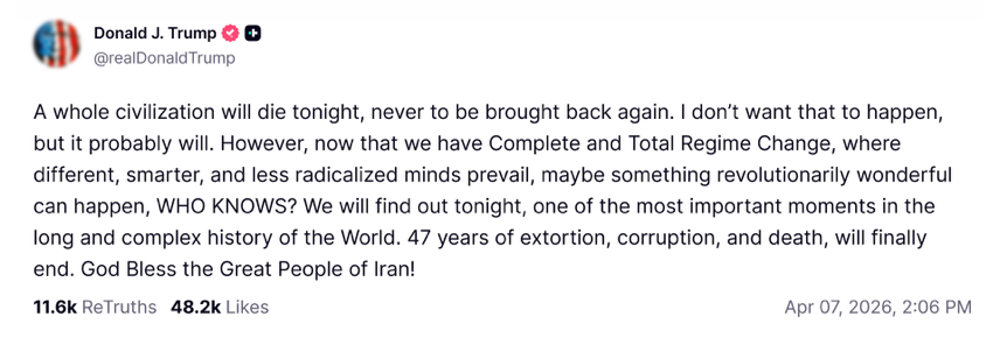
Public Domain
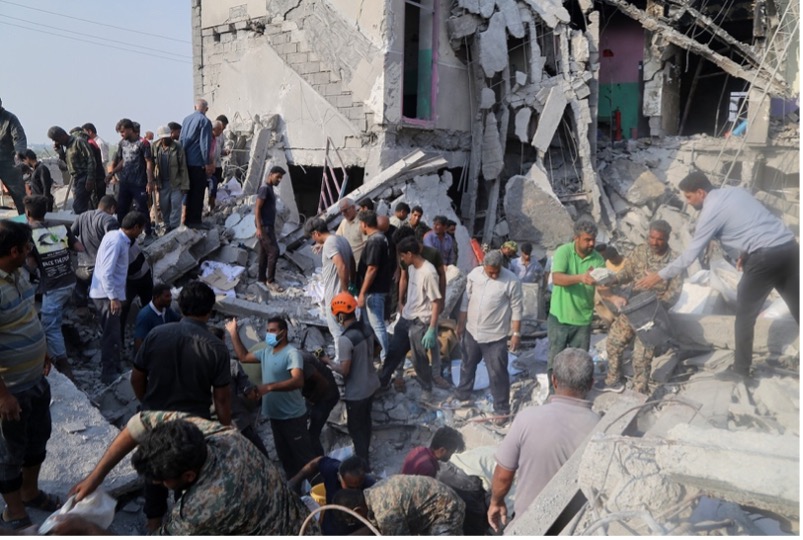
Source: Mehr News Agency
Creative Commons Attribution 4.0 International License.
Author: Abbas Zakeri
War is always complicated, more complicated than chess or Go. The Pentagon has tens of thousands of agents and hundreds of spies overseas collecting intelligence on every country that is hostile to the U.S., compiled for the Defense Intelligence Agency (DIA) to produce intelligence content for the President’s Daily Briefing, and yet, for some unknown reason, with such an enormous analysis of espionage information, the most powerful military in the world made a terrible mistake by blundering into a war with Iran. Trump’s destructiveness connected to his war is aimed at Iran, but the world will suffer too. According to the International Monetary Fund, it will upset the global economy and disrupt energy supply chains, causing inflation.
Starting with Trump’s bogged-down war 10,000 km away from the U.S. homeland, and a war with its own people at home, we must wonder why he started a war with Iran and why he cannot end it. Some cause-diggers, including me, have said that sooner or later he will do something so outrageous that he will politically checkmate himself and his favored friends and family forever. And now, he has done it. Ignoring the history of former presidents’ thoughts on a possible war with Iran, his flying whims or expansionist dream obsessions influenced his risks of starting a war with a country with a population of 93 million inhabitants, a massive entanglement of leaderships, and a strait that can easily stagger the world’s economy. He got away with his illegal gun war with random attacks on Venezuelan boats, and so he did what he always had done when feeling empowered with a minor success: risk a more daring move. A casino, airline, university, tie line, steaks, gold phones, bibles, gold coins, screwing laborers who worked for him, and let’s not forget not paying taxes – all failures through grifts or abandonments. What will he do with his latest war failure? Will it end in grift (another golf property in Tehran) or simply a military loss claimed as won – both deceptions.
Speaking to reporters on Air Force One, Trump said, “We’ve decimated their whole evil empire, a total and complete victory.” And yet, Iran was able to survive and stand against the most powerful army in the world using strategic advantages that previous U.S. presidents understood as strong deterrents that would take many lives on both sides of a war. Trump either doubted Iran’s advantage, given the Strait of Hormuz, or he didn’t know enough about the strait’s blocking power. Surely, his intelligence briefings highlighted those powers. Iranians are not stupid; they know many of the intricacies of the U.S. military plans. They forced a significant reduction in U.S. munitions and kept control of the Strait. So now, with Tehran’s confidence, Iran will rise again, fully reshaped with a younger generation of leaders and Ahmad Vahidi, commander of the Islamic Revolutionary Guard Corps (IRGC). They now know they can defend themselves against a fierce power and weaken American positions in the Middle East.
Snatching defeat from victory
America has made mistakes before, but this war with Iran could have been a success had the 12-day war in June 2025 continued with clever insight. Instead, the eight months between the first war and the second gave Iran enough time to strengthen and change its strategies by decentralizing executive decisions from Tehran to multiple regional hubs. Big mistake, America! These new IRGC leaders “look at Iran’s weaknesses frequently and publicly – something the founding generation was too insecure to do honestly – and they treat them as problems to be solved. That instinct drove the changes Tehran made between the two wars.” [17] The U.S. missed its chance to corner Iran’s technocrats that, in eight months, masterfully learned how to use data-driven solutions to balance a weighted military battle with “organizational discipline and resilience.” Trump learns the hard way by instinctively pushing forward with hopes of triumph that rarely emerge without destruction. Iran, on the other hand, has been learning to cleverly see five steps ahead by using the Strait of Hormuz, a guerrilla force, scattering its missile launchers beyond reach, and firing swarms of cheap one-way decoy drones that successfully deplete U.S. interceptors. “The Iranian military had learned,” Narges Bajoghli and Vali Nasr wrote in the July/August issue of Foreign Affairs, “not just to absorb punishment, but also to win strategic advantage by frustrating its adversaries’ war aims.”
Next, Trump’s instinct is to wage an economic war against Iran. This plan could have worked before he started the bombings, before he messed up America with threats and killings, causing inflation and bolstering his prime adversary. Veering from bombs to severe sanctions is too late. He is stuck in a weakness, being vulnerable to Iran’s pressure to escalate the war to show the world that the strongest military in the world lost another war by misjudging how wars are won or lost. If lost – and that’s a premature opinion – we can chalk up this American war to a foolish president’s uninformed urge. For centuries we have known that one man (and I do mean man) can mess up the world while searching the earth for personal gain. Democracy got him into office; let’s hope his messes are short-lived.
About the Author
 Joseph Mazur is an Emeritus Professor of Mathematics at Emerson College’s Marlboro Institute for Liberal Arts & Interdisciplinary Studies. He is a recipient of fellowships from the Guggenheim, Bogliasco, and Rockefeller Foundations, and the author of eight acclaimed popular nonfiction books. His latest book is The Clock Mirage: Our Myth of Measured Time (Yale).
Notes
[1] https://worldfinancialreview.com/the-dehumanizing-forces-of-war-to-kill-or-not-to-kill-that-is-the-quintessential-military-question/#_edn1
[2] https://worldfinancialreview.com/the-dehumanizing-forces-of-war-to-kill-or-not-to-kill-that-is-the-quintessential-military-question/#_edn4
[3] Homer, translated by Emily Wilson, The Iliad (New York: Norton, 2023) p 501
[4] U.S. Naval Institute, William Hovgaard, “Is War Inevitable?” Proceedings, October 1937, Vol. 63/10/416.
[5] https://www.usni.org/magazines/proceedings/1937/october/war-inevitable
[6] https://explorethearchive.com/bloodless-wars
[7] Barbara W. Tuchman, The Guns of August (Toronto: Presidio Press, 2004) p. 12-13.
[8] https://worldfinancialreview.com/the-future-of-autonomous-battling-will-it-change-the-balance-of-power/#_edn18m
[9] https://www.acquisition.gov/far/part-1#FAR_1_101
[10] https://www.law.cornell.edu/uscode/text/22/2778
[11] https://www.lockheedmartin.com/content/dam/lockheed-martin/eo/documents/governance/2025/LMEPAC-disbursements-2025.pdf
[12] https://www.archives.gov/milestone-documents/president-dwight-d-eisenhowers-farewell-address
[13] https://www.sipri.org/sites/default/files/2026-04/2604_milex_2025.pdf#page=2
[14] https://www.npr.org/2026/08/07/nx-s1-5922716/what-the-dwindling-u-s-missile-stock-means-for-the-future
[15] https://www.npr.org/2026/08/07/nx-s1-5922716/what-the-dwindling-u-s-missile-stock-means-for-the-future
[16] https://www.theatlantic.com/ideas/2026/08/the-us-isnt-making-enough-weapons/688150/
[17] https://www.foreignaffairs.com/iran/irans-new-grand-strategy?check_logged_in=1