
I. Introduction
The FP&A Paradox at Enterprise Scale
Over the past decade, Financial Planning & Analysis (FP&A) has expanded dramatically in scope, ambition, and visibility. Once primarily concerned with budgeting and variance explanation, FP&A is now expected to enable strategy execution, support complex capital allocation decisions, and provide forward-looking insight in increasingly volatile environments. This evolution has been widely documented in management and finance literature, reflecting rising expectations for finance functions to move beyond reporting accuracy toward decision enablement and strategic partnership (Harvard Business Review, 2019; McKinsey & Company, 2014).
At enterprise scale, FP&A teams often find themselves overwhelmed by volume rather than empowered by clarity. Processes multiply to accommodate local requirements, systems evolve unevenly across regions and functions, and analysts devote disproportionate effort to reconciliation, validation, and narrative construction. Senior leaders receive more information than ever before, yet frequently lack a consistent, decision-ready view of performance. This phenomenon has been identified as a growing barrier to effective managerial decision-making (Gartner, 2019).
The result is a function that is operationally busy, yet strategically constrained.
This disconnect is not primarily a failure of talent or technology. Rather, it reflects a structural design problem. In large, complex organizations, FP&A is rarely designed intentionally as an integrated system. Processes are refined independently of system architecture, systems are implemented without sufficient regard for decision workflows, and capability development lags behind the analytical demands placed on the function. Incremental improvements in any single dimension therefore tend to exacerbate tensions elsewhere rather than resolve them (Bain & Company, 2016).
This article argues that sustainable FP&A transformation requires a different design lens -one that treats FP&A as an integrated enterprise capability, purpose-built to create decision advantage. Decision advantage refers to an organization’s ability to consistently deliver timely, trusted, and actionable insights that shape management actions across levels and geographies.
To that end, the article introduces an integrated framework for FP&A transformation built around three interdependent pillars: processes, systems, and skills. When designed and evolved together, these elements enable FP&A to move beyond stewardship and reporting toward becoming a durable source of strategic clarity in complex organizations.
This article makes three contributions to the FP&A and performance-management literature. First, it reframes FP&A underperformance at enterprise scale as a system-design problem rather than a capability or tooling gap. Second, it introduces the concept of decision advantage as an explicit design objective for FP&A, distinct from analytical sophistication or forecasting accuracy. Third, it offers an integrated process–system–skill framework that explains why many large-scale FP&A transformations stall despite substantial investment.
Decision advantage therefore represents a higher-order organizational capability that links information production to decision execution.
II. Defining “Decision Advantage” in Modern FP&A
The concept of decision advantage has gained prominence as organizations contend with increasing volatility, scale, and complexity. In finance and performance management contexts, it reflects a growing recognition that the value of information lies not in its volume or precision alone, but in its ability to shape timely and effective managerial action. Research consistently links superior organizational performance to decision quality rather than analytical sophistication alone (Bain & Company, 2016).
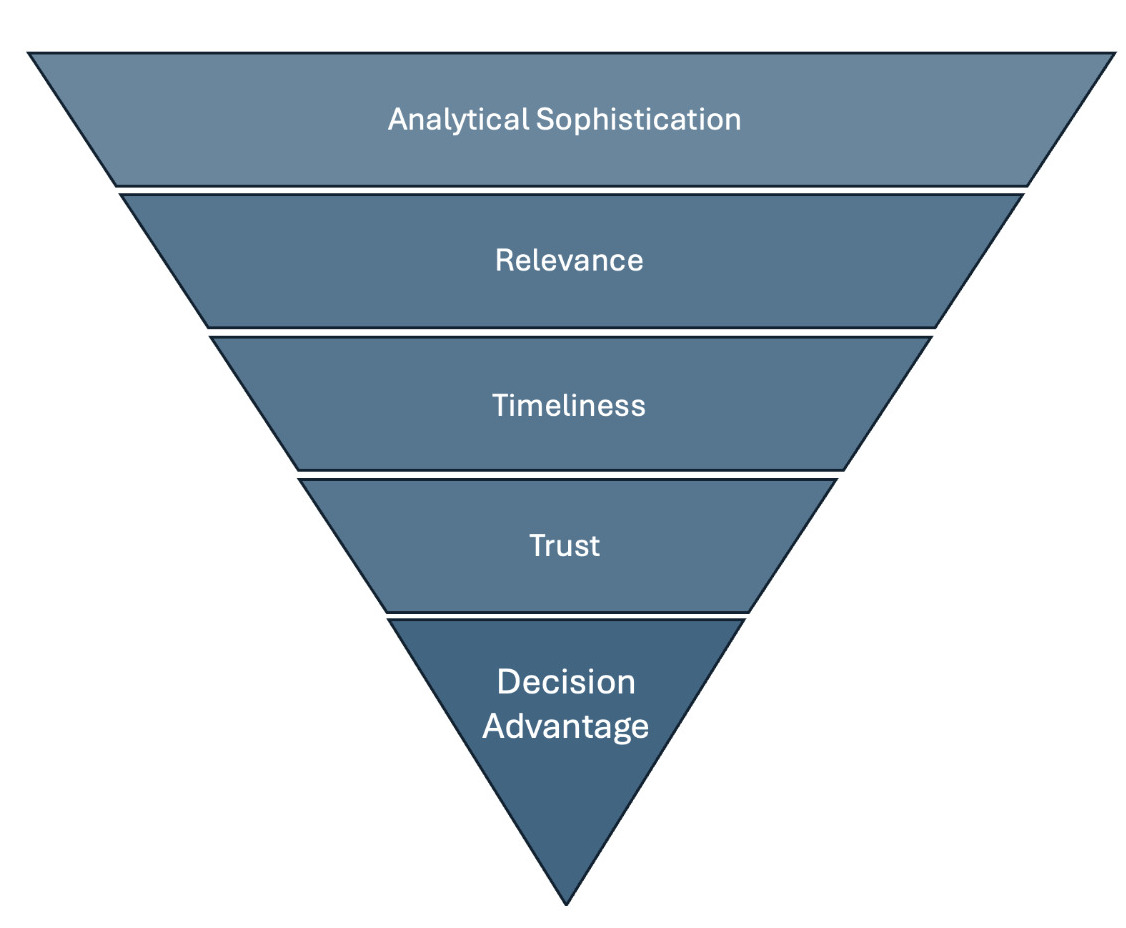
In the context of FP&A, decision advantage can be defined as the organizational capability to consistently support better decisions, faster and with greater confidence, across levels and geographies. This capability rests on three foundational attributes: timeliness, trust, and relevance.
Decision advantage requires timeliness. Insights must be available within the decision window in which they can still influence outcomes. Analyses delivered after decisions have effectively been made add limited value. While such analyses may inform lessons learned or enable corrective action, they cannot prevent the initial commitment of resources and often introduce additional cost or disruption when decisions must be reversed. As organizations scale, the accumulation of governance layers and reconciliation checkpoints systematically lengthens planning and review cycles, eroding the temporal relevance of FP&A insights and reducing their ability to shape initial resource commitments (McKinsey & Company, 2014).
Decision advantage also depends on trust. Decision-makers must have confidence that the information presented is consistent, comparable, and grounded in reliable data with shared definitions. Fragmented data models, competing versions of key metrics, and opaque calculation logic undermine this trust and lead leaders to discount analytics in favor of intuition or anecdote (Gartner, 2019).
Most critically, decision advantage requires relevance. Information must be explicitly tied to the decisions at hand. This implies a shift from comprehensive reporting toward insightful analysis that clarifies trade-offs, highlights material drivers, and frames options in ways that support action (MIT Sloan Management Review, 2019).
Importantly, decision advantage is not synonymous with predictive accuracy or advanced analytics. While forecasting techniques and data science capabilities can enhance insight, they do not by themselves guarantee better decisions. In practice, organizations with highly sophisticated analytical tools may still struggle to influence outcomes if insights are poorly integrated into decision processes or communicated without sufficient context (Bain & Company, 2016).
From an FP&A perspective, decision advantage therefore represents a design objective, not a functional byproduct. It requires intentional choices about what the organization plans, measures, reviews, and escalates – and equally about what it chooses not to do.
Decision advantage should be distinguished from related concepts such as analytical maturity, forecasting accuracy, or data availability. High analytical maturity does not guarantee decision advantage if insights arrive outside the decision window or lack credibility among decision-makers. Similarly, accurate forecasts that are poorly integrated into governance forums may improve reporting quality without influencing outcomes. Decision advantage therefore represents a higher-order organizational capability that links information production to decision execution.
Figure 1: Analytical sophistication is a necessary but insufficient condition for decision advantage. Only insights that are relevant, timely, and trusted pass-through successive filters to influence management decisions.
III. An Integrated Framework for FP&A Transformation
From Isolated Improvements to Systemic Design
FP&A transformations frequently focus on visible points of friction such as planning cycle duration, fragmented reporting, or outdated tools. While these symptoms are real, addressing them in isolation rarely produces lasting results. At enterprise scale, complexity does not stem from any single deficiency but from misalignment across processes, systems, and skills. Improvements in one area often expose weaknesses in another, shifting effort rather than reducing it. As organizations grow in size, geographic reach, and governance layers, what works in a single business unit often breaks when replicated across the enterprise. Sustainable FP&A transformation therefore requires treating FP&A as a socio-technical system whose effectiveness depends on deliberate alignment across its foundational elements.
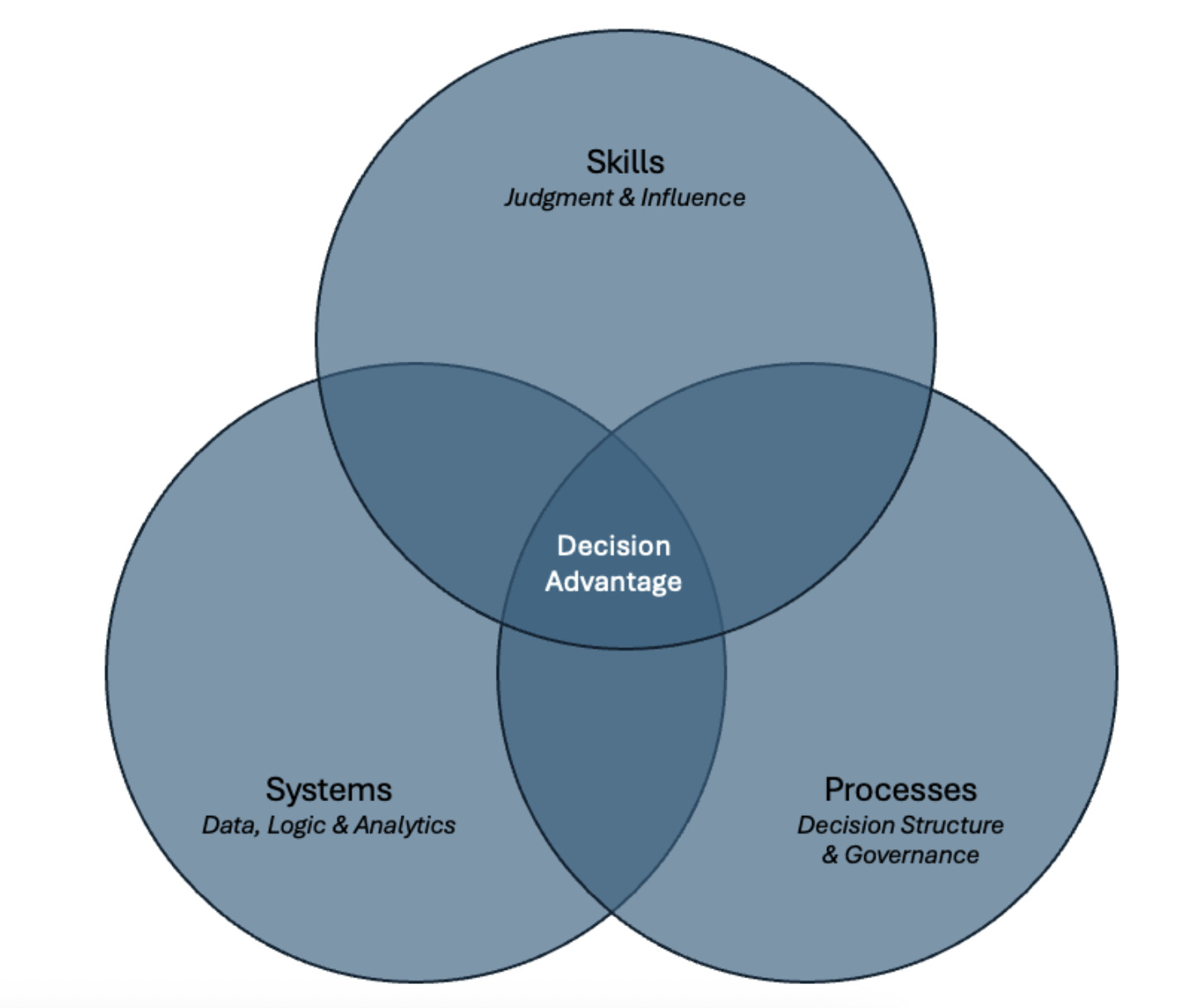
This framework is built around three interdependent pillars:
- Processes – how decisions are structured, sequenced, and governed
- Systems – how data, logic, and analytics are enabled and scaled
- Skills – how people interpret information, exercise judgment, and influence outcomes
At enterprise scale, none of these elements can be optimized independently.
The framework presented here is most applicable to large, multi-business, globally distributed organizations characterized by matrix governance and heterogeneous data landscapes. In smaller or less complex firms, decision latency and fragmentation may arise from different sources, and the relative emphasis across the three pillars may differ.
Figure 2: FP&A decision advantage emerges from the deliberate alignment of processes, systems, and skills. Optimizing any pillar in isolation may create local efficiency but fails to produce enterprise-level decision impact.
IV. Pillar 1 – Processes: Designing FP&A Around Decisions
In large organizations, FP&A processes are rarely designed from first principles. Instead, they tend to evolve incrementally, shaped by legacy reporting requirements, organizational restructurings, regulatory obligations, and the preferences of successive leadership teams. Over time, this accretion results in planning and performance cycles that are dense, labor-intensive, and increasingly detached from the decisions they are intended to support.
Decision-oriented FP&A processes reverse this logic. Rather than starting with what information can be produced, they begin with a more fundamental question: What decisions must FP&A enable, and under what conditions?
At enterprise scale, this distinction becomes critical. Processes that function adequately in smaller or less complex settings often collapse under the weight of volume, governance layers, and competing priorities when scaled globally.
In large, globally distributed organizations, effective FP&A processes consistently exhibit a small number of defining characteristics. These include a clear separation between foundational reporting and value-adding, decision-oriented analysis; explicit ownership of decision topics and outcomes; cadenced reviews that emphasize insight, trade-offs, and forward actions rather than exhaustive explanation of lagging indicators; and the intentional reduction of low-value work such as excessive reconciliations, parallel review layers, and activity that informs without enabling action.
By anchoring processes in decision requirements rather than reporting completeness, FP&A functions can reduce workload intensity while improving the quality of management dialogue and the speed of decision-making.
Simplifying FP&A processes does not imply weakening governance or analytical rigor. On the contrary, organizations that redesign processes around decisions often achieve stronger control and clearer accountability. Excessive process density has been shown to obscure accountability and slow response times, particularly in complex, matrixed environments (Harvard Business Review, 2006).
From a design perspective, FP&A processes function as decision architectures: they shape which issues receive attention, when alternatives are considered, and how trade-offs are evaluated. Poorly designed processes do not merely slow decisions; they systematically bias managerial attention toward explanation of the past rather than choice about the future.
At enterprise scale, decision quality emerges from the interaction of processes, systems, and skills. Optimizing any one in isolation produces local efficiency, not strategic impact.
V. Pillar 2 – Systems: Enabling Insight Without Creating New Complexity
Modern FP&A systems promise speed, automation, and advanced analytics, yet many organizations experience the opposite: growing fragmentation, declining trust in reported numbers, and increasing effort devoted to reconciliation. These outcomes are often attributed to technology limitations. In practice, they reflect system design failures (Harvard Business Review, 2019).
As FP&A ambitions expand, organizations deploy multiple tools across planning, reporting, and analytics, often heavily customized to meet localized requirements. Over time, this layered landscape becomes difficult to govern at enterprise scale. Data definitions diverge, calculation logic is replicated across platforms, and analytical effort shifts from insight generation toward validation and reconciliation (Gartner, 2019; McKinsey & Company, 2020).
Illustrative Example
In one large, multi-regional organization, successive FP&A initiatives introduced separate planning, reporting, and analytics platforms over several years. Each addressed legitimate business requirements and reflected the priorities of different leadership teams over time. Collectively, these efforts produced multiple versions of core performance indicators and shifted FP&A effort toward reconciliation and explanatory reporting rather than decision-oriented insight. The subsequent redesign did not begin with tool consolidation. It began with a clear articulation of which decisions required enterprise-wide consistency, and which required contextual flexibility, followed by deliberate alignment on a limited set of core performance indicators that genuinely mattered.
Effective FP&A system design emphasizes the deliberate separation of data, calculation logic, and visualization. When these elements are decoupled, systems gain flexibility, transparency, and resilience (MIT Sloan Management Review, 2020). Harmonized data foundations are also critical as organizations adopt advanced analytics and artificial intelligence, where inconsistent inputs degrade reliability and decision usefulness (Harvard Business Review, 2021).
An effective FP&A system architecture prioritizes coherence over sophistication. Rather than embedding logic deeply within individual tools, it emphasizes harmonized data models and KPI definitions as a foundational single source of truth; a deliberate separation between data, calculation logic, and visualization layers, fit-to-standard configurations that preserve upgradeability, and early, continuous validation using real business data and decision use cases.
At enterprise scale, effective FP&A system architectures exhibit three design principles: (1) semantic consistency through shared metric definitions, (2) logical transparency through separation of calculation layers, and (3) evolvability through modular design. Violations of these principles increase reconciliation effort and degrade decision trust, regardless of the specific technology stack employed.
Crucially, FP&A systems must be designed to evolve. Enterprise environments change through restructuring, portfolio shifts, and external shocks, and systems that cannot be re-tested and re-aligned quickly become constraints rather than enablers.
VI. Pillar 3 – Skills: Elevating FP&A as a Professional Discipline
Even the most thoughtfully designed processes and systems ultimately depend on the capabilities of the people who use them. At enterprise scale, FP&A effectiveness is constrained less by the availability of data or tools than by the organization’s ability to interpret information, exercise judgment, and influence decisions. Skills therefore represent the most decisive, and often the most underdeveloped, pillar of FP&A transformation.
Traditional FP&A skill models have emphasized technical competence, including accounting knowledge, financial modeling, and proficiency with analytical tools. While these capabilities remain necessary, they are no longer sufficient in environments characterized by scale, complexity, and rapid change.
Decision-oriented FP&A requires a broader skill set that combines analytical rigor with professional judgment and influence. High-performing FP&A professionals translate complex data into coherent narratives tied to business outcomes, distinguish signal from noise under uncertainty, challenge assumptions constructively across organizational boundaries, and balance precision with pragmatism when decisions must be made under time pressure.
Finance transformation literature consistently notes that investments in systems and automation frequently outpace investments in capability development, creating a persistent gap between analytical potential and decision impact (CIMA, 2021).
Organizations that under-invest in these capabilities often compensate by adding layers of process, documentation, and review to manage perceived risk. Over time, this approach increases workload and slows decision-making without improving outcomes (Bain & Company, 2016).
Treating FP&A as a professional discipline has important implications for talent development. Leading organizations design career paths that deliberately build business understanding, judgment, and credibility through rotations, exposure to strategic decision forums, and accountability for decision outcomes (Association for Financial Professionals, 2022).
From a capability perspective, FP&A skill development is path-dependent and socially embedded. Judgment, influence, and decision framing are not acquired solely through training but through repeated exposure to consequential decisions, feedback from outcomes, and credibility built over time. This helps explain why capability gaps persist even in organizations with advanced analytical infrastructure.
VII. Conclusion – Designing FP&A for Enduring Decision Advantage
As organizations continue to scale and operate in increasingly volatile environments, the demands placed on FP&A will only intensify. More data, more tools, and more analysis do not automatically translate into better decisions. In many cases, they exacerbate complexity and dilute managerial focus.
Sustainable FP&A transformation requires a shift in perspective – from optimizing individual components to intentionally designing FP&A as an integrated enterprise capability. Decision advantage does not emerge from processes, systems, or skills in isolation, but from their deliberate alignment around the explicit goal of improving decision quality.
Designing FP&A for decision advantage is therefore a strategic leadership responsibility. When approached deliberately, FP&A becomes a stabilizing force in complexity and a catalyst for better strategy execution. Organizations that succeed in this transition move beyond incremental improvement toward an FP&A capability that delivers enduring decision advantage at enterprise scale.
About the Author
 Werner van Rossum is a senior finance and business transformation leader specializing in enterprise-scale FP&A, performance management, and operating-model design. He has led large, multi-year enterprise finance and performance-management transformations across globally distributed organizations, focusing on aligning processes, systems, and capabilities to improve decision quality at scale.
His work centers on designing decision-oriented FP&A models that reduce complexity, strengthen governance, and enable timely, trusted insight in highly matrixed environments. He has held leadership roles spanning corporate finance, performance management, and enterprise transformation, and regularly contributes perspectives on finance transformation, decision effectiveness, and organizational design.
Werner holds an MSc in International Business and has completed executive education in global leadership and transformation. He is based in the United States.
References
- Bain & Company (2016). The Five Steps to Better Decisions.
- Harvard Business Review (2006). Who Has the D? How Clear Decision Roles Enhance Organizational Performance.
- Harvard Business Review (2019). Digital Transformation Is Not About Technology.
- Harvard Business Review (2021). Effective Digital Transformation Relies on a Shared Language.
- McKinsey & Company (2014). Putting the “A” Back in FP&A.
- McKinsey & Company (2020). Finance 2030: Four Imperatives for the Next Decade.
- Gartner (2019). How to Build Trust in Analytics and Data. Gartner Research.
- MIT Sloan Management Review (2019). Analytics as a Source of Business Innovation.
- MIT Sloan Management Review (2020). Building a Data-Driven Organization.
- Association for Financial Professionals (2022). FP&A Business Partnering.
- Chartered Institute of Management Accountants (CIMA) (2021). Finance Business Partnering.