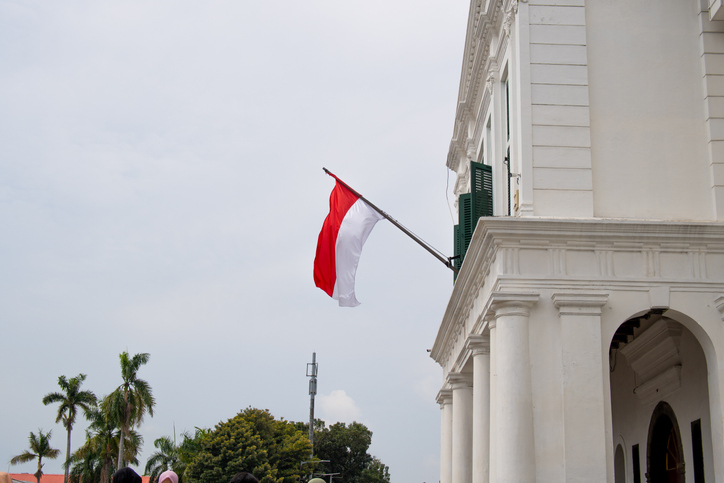
This essay decodes Indonesia’s Doktrin Sugiono of Foreign Minister Sugiono’s diplomatic framework through pop culture. One Piece’s relational multilateralism, K-drama’s interiority, Pokémon’s strategic diversification, and Digimon’s responsive resilience. As an aspiring middle power, Indonesia tries to assert dynamic, networked engagement despite domestic fragilities and a fragmented global order, proving doctrine and storytelling share the same survival logic despite its challenges and flaws.
There is something quietly revolutionary about watching a foreign minister frame national resilience not through the cold grammar of realpolitik, but through the language of networks, adaptability, and strategic courage. When Indonesia’s Foreign Minister Sugiono outlined what has since been called the Doktrin Sugiono, he was not merely articulating a policy position. He was proposing a way of being in the world, one that resonates far beyond the corridors of Kementerian Luar Negeri and lands, curiously, in the very same emotional registers that fans of anime, K-drama, and pop culture have inhabited for decades.
At the center of the doctrine lies the idea of dynamic resilience, a concept that refuses stillness. In One Piece, the long-running manga and anime by Eiichiro Oda, the protagonist Monkey D. Luffy does not survive a world of rival pirates and corrupt governments by holding a fixed position. He survives because he moves, adapts, and builds crews, alliances, and loyalties across the Grand Line. When Luffy declares that he will become the King of the Pirates not alone but surrounded by friends, he is, in diplomatic terms, describing multilateralism from a position of relational strength. This is not a coincidence. Dynamic resilience, as Sugiono presents it, is precisely this kind of elastic forward motion, surviving and shaping outcomes rather than merely enduring them.
The doctrine’s insistence on living in a multiplex world with many centers of power is, in cultural terms, a repudiation of the unipolar narrative that once dominated both geopolitics and popular imagination. Think of how long K-drama itself was dismissed as peripheral to so-called global culture, only to gradually become one of the most watched genres on Earth. Shows like Crash Landing on You and My Mister do not derive their power from mimicking a single dominant aesthetic tradition. They derive it from being distinctly Korean, emotionally honest, and deeply networked within a regional and then global audience. Strategic diversification in culture looks exactly like this, and in foreign policy, Sugiono is making the same argument: Indonesia’s strength emerges from its relationships, not from subordination to any one axis.
This brings us to one of the doctrine’s most politically important claims, that Indonesia does not place all its bets on a single partner or platform. The language is deliberately economic, almost casual, but its implications are profound. In the world of Pokemon, trainers who rely on a single powerful creature are vulnerable the moment that creature is countered. Ash Ketchum’s most enduring lesson across seasons and regions is that versatility, a team of diverse abilities built over accumulated experience, is what wins not just battles but championships. By keeping options open, Indonesia retains room to maneuver. This is not neutrality in the old Cold War sense. It is active strategic optionality, an approach that requires constant cultivation rather than passive non-alignment.
Perhaps the most emotionally resonant phrase in the entire doctrine is the warning that a country fragile at home will have limited leverage outside. This is the part where K-drama’s obsession with interiority becomes unexpectedly illuminating. In the beloved series Reply 1988, the drama’s power comes not from grand external events but from the painstaking attention it pays to neighborhood bonds, family fractures quietly mended, and the interior architecture of community resilience. The show argues, without ever stating it explicitly, that how you treat your own determines everything about how you stand in the world. Sugiono’s doctrine is making the same claim at the level of the nation-state. Domestic fragility is not a private matter. It becomes a structural vulnerability in every negotiation table you sit at.
Digimon, which many Indonesian children of the nineties grew up watching alongside Pokemon, offers another useful frame. The central conceit of Digimon is that digital monsters can digivolve, but only in response to the emotional and psychological state of their human partners. Resilience in that universe is not programmed. It is relational and responsive to context. The doctrine’s architecture follows similar logic. Indonesia’s capacity to safeguard policy space and protect its people is not a function of fixed military or economic mass alone. It is a function of how dynamically the country reads and responds to a fragmented, multiplex environment.
The Strengths of Sugiono’s Doctrine
The most immediately compelling argument in favour of the Doktrin Sugiono is that it is calibrated for the actual world Indonesia inhabits rather than a simplified version of it. The doctrine does not pretend that the rules-based international order is functioning smoothly, nor does it pretend that any single great power is benevolent enough to be trusted unconditionally. This is realistic in the best sense of the word, honest about constraints without being defeatist about possibilities. For a country of Indonesia’s size, geographic centrality, and demographic weight, the doctrine’s emphasis on network-building and diversification opens more doors than any single alignment would. In K-drama terms, it is the strategic posture of a protagonist like Kim Ji-Young in the film Kim Ji-Young, Born 1982, who does not wait for a system designed against her to reform itself but instead maps every available option and moves through them deliberately. The doctrine, similarly, refuses to be a passive object of forces larger than itself.
A second strength lies in the doctrine’s grounding of foreign policy in domestic resilience. This is not merely a rhetorical gesture. There is a coherent analytical claim embedded in it, namely that a state’s bargaining power externally is always a downstream function of how coherent, legitimate, and capable it is internally. This is something the international relations literature has known for a long time but that policy documents often elide in favour of simpler narratives about alliance structures or military capability. Sugiono’s doctrine makes the linkage explicit and puts it at the centre of the framework. In the Digimon universe, this is the difference between a Digimon that digivolves out of genuine partnership and one that is forced into a dark evolution by external pressure. The former produces sustainable power. The latter produces spectacular but ultimately self-destructive capability. The doctrine is, at its core, arguing for the former.
A third strength is the doctrine’s potential to speak credibly to multiple audiences simultaneously. In an era when Indonesian foreign policy must navigate relationships with China, the United States, the European Union, ASEAN partners, the Global South, and the Islamic world all at once, a doctrine organised around diversification and dynamic engagement is far more flexible than one that privileges any single relationship. This is a point that K-pop has, in its own domain, understood with remarkable sophistication. BTS does not make music for a single demographic or a single national market. Its artistic and commercial strategy is to build genuine connections across audiences without requiring any one of them to feel secondary. The result is a fandom that is globally distributed but locally resonant. Sugiono’s doctrine is reaching for something analogous in diplomatic terms, and the ambition is well-founded.
The Tensions and Limits of the Doctrine
The doctrine’s greatest strength, its deliberate ambiguity and flexibility, is also the source of its most significant analytical vulnerability. A framework that insists on dynamic resilience, strategic diversification, and engaged optionality without specifying the conditions under which any of these imperatives takes precedence over the others is a framework that can justify almost any policy after the fact. Critics of Indonesian foreign policy have long noted that bebas aktif, the free and active tradition that the doctrine clearly inherits, has sometimes functioned less as a coherent strategy and more as a retrospective justification for inaction or inconsistency. The Doktrin Sugiono, unless accompanied by more precise operational guidance, risks reproducing this pattern at a more sophisticated level of articulation. In One Piece terms, even Luffy eventually has to decide which enemies to fight and which islands to pass. A philosophy of perpetual flexibility becomes paralysis when hard choices arrive.
There is also a tension in the doctrine’s simultaneous insistence on domestic resilience and external engagement that deserves more serious interrogation than the document currently provides. Building genuine domestic resilience in Indonesia, a country with significant inequality, ongoing democratic consolidation challenges, and a complex relationship between central government and regional autonomy, requires precisely the kind of sustained, patient, politically costly investment that the pressures of active foreign policy engagement tend to crowd out. The K-drama Nevertheless, which traces a relationship that is clearly unhealthy but nonetheless compelling to its participants, captures something of this dynamic. The appeal of external visibility, of being present and engaged at every international table, can become its own form of distraction from the harder, less glamorous work of internal repair. The doctrine names the problem correctly but does not reckon fully with the trade-offs involved in addressing it.
A further concern is the doctrine’s treatment of what it means to engage from a position of strength in practical terms. The phrase is evocative and clearly intentional, but strength in international relations is not a single variable. It is a composite of military capacity, economic leverage, institutional credibility, and what scholars call soft power, the ability to attract and persuade rather than merely coerce. Indonesia’s portfolio across these dimensions is uneven. Its military capability, while significant in regional terms, is not a primary source of bargaining power. Its economy is large but unevenly developed. Its institutional credibility has been dented by democratic backsliding concerns that international observers have noted with increasing frequency. The doctrine assumes a position of strength that, in several of these dimensions, still needs to be built. Pokemon, once again, offers an instructive analogy. Even Ash does not walk into the Elite Four with an undertrained team and expect the power of optimism to compensate. Preparation precedes the position of strength. The doctrine would benefit from a more explicit account of what that preparation actually entails.
A Doctrine Worth Taking Seriously
What Sugiono is ultimately constructing is a doctrine of engaged presence. To stay engaged from a position of strength is a deceptively simple phrase that contains a very demanding set of requirements. It means that Indonesia must be strong enough internally that engagement is always a choice rather than a concession. It means that the networks built externally must be genuine and diversified, not transactional dependencies dressed up as alliances. And it means that resilience is not a destination but a continuous practice, something closer to the daily discipline that fans admire in their favorite characters across seasons, sequels, and story arcs.
In a world where the grand ideological contests of the twentieth century have given way to a more diffuse, fragmented competition among many centers of power, doctrines like this one matter precisely because they resist easy categorization. Sugiono’s framework is neither isolationist nor simply multilateralist in the old institutionalist sense. It is something more dynamic, more attuned to a world that looks, frankly, a great deal like the complex, multi-faction universes of the stories that have shaped the imagination of a whole generation of Indonesians and people around the world. To decode this doctrine through the eye of pop culture is not to trivialize it. It is to recognize that the most durable ideas about survival, adaptability, and dignified engagement with a difficult world have always lived in the stories we tell. The question now is whether the machinery of diplomacy can move with the same agility as the world it is trying to navigate.
About the Author

Darynaufal Mulyaman or Dary is currently an assistant professor at International Relations Study Program, Universitas Kristen Indonesia. His research interests including Soft Power, that include but not limited to Pop Culture, Korean studies, Asia Pacific region, third world, international development, cooperation, and political economy.