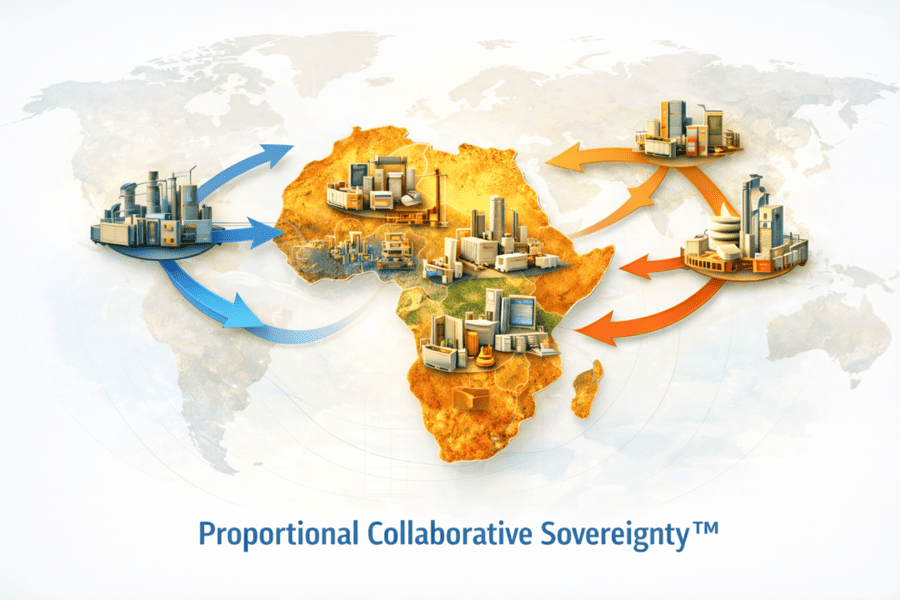
Africa holds many of the minerals that will determine Europe’s industrial, energy, and security future. Yet the current system leaves African countries trapped in low-value extraction while Europe remains exposed to fragile supply chains. Proportional Collaborative Sovereignty™ (PCS) offers a structured, partnership-based alternative.
Introduction: Europe’s mineral vulnerability
Europe’s green transition, digital economy, and defense industries all depend on a steady flow of minerals that the continent does not sufficiently produce itself. From lithium and cobalt to platinum group metals, rare earths, and manganese, the European Union is structurally dependent on imports for the inputs that power electric vehicles, renewable energy, advanced manufacturing, and aerospace.
This dependence is not abstract. The EU currently imports over 90 percent of its rare earth elements and most of its battery-grade lithium and cobalt. These materials are essential to everything from grid-scale energy storage to semiconductors and defense systems. Yet supply chains remain geographically concentrated, geopolitically exposed, and increasingly vulnerable to disruption.
At the same time, Africa holds a dominant share of many of these minerals. The Democratic Republic of the Congo produces about 70 percent of the world’s cobalt. South Africa holds over 75 percent of platinum group metals. Guinea supplies more than 20 percent of global bauxite. Zambia and the DRC together account for roughly 10 percent of global copper. Yet despite this geological centrality, African economies capture only a small portion of the value created by these resources.
This dual vulnerability — African under-industrialization and European supply insecurity — is the defining minerals challenge of the 21st century.
Why Current Approaches Fall Short
Two dominant governance models now compete in mineral-rich countries.
The first is resource nationalism: export bans, unilateral restrictions, and state control imposed without a viable industrial base. These measures often deter capital, disrupt supply chains, and trigger legal disputes without delivering sustained domestic manufacturing.
The second is unstructured liberalization: open access for global companies to extract and export raw materials, with limited domestic processing, weak technology transfer, and minimal local industrial upgrading. This model maximizes volumes but leaves countries dependent on commodity exports and vulnerable to price cycles.
Neither system produces stable development or secure supply chains. One creates political and commercial volatility; the other locks resource-rich countries into low-value roles. The result is growing friction, rising export controls, and increasing global supply risk.
What is missing is a governance system that aligns sovereignty with capacity and partnership with industrialization.
What is Proportional Collaborative Sovereignty?
Proportional Collaborative Sovereignty (PCS) is a governance and engagement framework designed to close this gap.
PCS starts from a simple principle: sovereignty should expand in proportion to real domestic capability. Rather than asserting absolute control over mineral flows or surrendering them entirely to markets, countries use a structured, phased approach to progressively capture more value as their industrial base grows.
At the same time, PCS recognizes that mineral value chains are global and capital-intensive. No country industrializes alone. Therefore, sovereignty is exercised through collaboration, not isolation.
The framework rests on three pillars.
1. Proportional Sovereignty
Under PCS, governments exercise control in stages, tied directly to what they can realistically operate. Instead of banning exports before domestic capacity exists, countries expand requirements as processing, infrastructure, regulation, and skills develop.
A country might first require domestic refining of mineral concentrates. Later, as capacity matures, it can mandate battery-grade chemicals, component manufacturing, or finished goods. This sequencing turns sovereignty into a credible, investable pathway rather than a political shock.
2. Collaborative Scale
Mineral processing requires massive capital, energy, logistics, and technical expertise. PCS therefore promotes regional cooperation: shared processing hubs, harmonized standards, and coordinated infrastructure across neighboring countries.
Crucially, it also integrates structured private-sector participation. Joint ventures, equity partnerships, and technology collaborations allow global firms to deploy capital and know-how while ensuring that domestic industrial capacity grows alongside investment.
3. Diversified Global Engagement
PCS rejects dependence on any single external partner. Instead, it promotes engagement with a broad range of international players through structured partnerships, technology licensing, and capability transfer.
This diversification reduces geopolitical risk for both sides while allowing African economies to progressively move up the value chain.
Why this matters for Europe
For Europe, PCS offers something no current approach provides: reliable access without political whiplash.
By aligning mineral sourcing with African industrial development, Europe can:
- Reduce over-reliance on concentrated suppliers
- Secure diversified, ESG-aligned supply chains
- Invest directly in in-country refining and processing
- Support African industrialization without undermining sovereignty
The European Court of Auditors has already warned that existing EU efforts to diversify critical mineral supplies have failed to deliver tangible results. PCS offers the missing architecture: a way to link investment, security, and development into a single, stable system.
Conclusion
Africa’s mineral wealth and Europe’s industrial future are structurally intertwined. The challenge is not geology, but governance.
Proportional Collaborative Sovereignty provides a disciplined, cooperative framework that turns resource ownership into industrial growth and transforms supply insecurity into long-term partnership. By aligning sovereignty with capacity and collaboration with investment, PCS offers a pathway toward shared resilience in a rapidly transforming global economy.
About the Author
 Kenneth D. Johnson is Principal of Devconia, LLC and the architect of Proportional Collaborative Sovereignty. He has led over US$1 billion in African value-chain programs and held senior roles at the African Development Bank, the World Bank Group, PwC, and Accenture. PCS was developed with technical contributions from James R. Calvin, Ph.D.