Public Domain
Source: Wikimedia
By Joseph Mazur
The enduring mystery surrounding war is the question of why we fight when we could negotiate simple, peaceful solutions? The answer often given is that we humans are subject to a biological force that craves conflict. The technology has changed over the centuries but, it seems, we have not.
– Simone Weil, The Poem of Force [1]
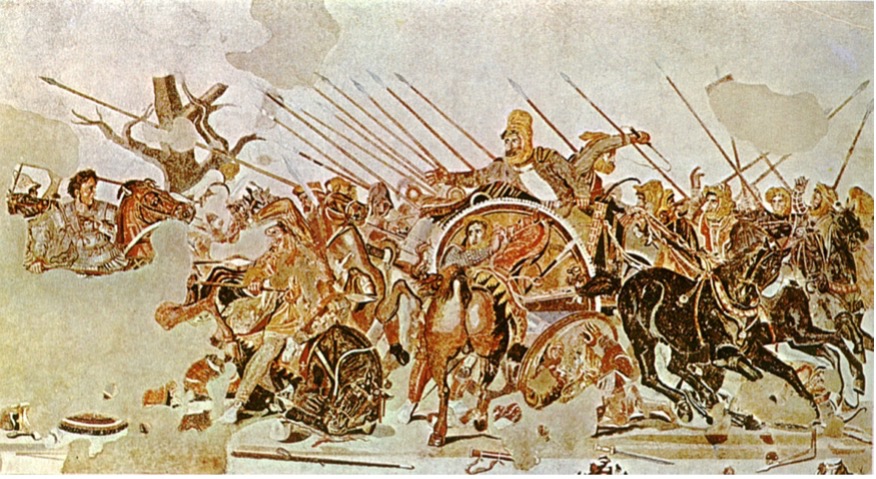
The Siege of Gaza did not end very well, at least not for the slaughtered men of Gaza, nor the enslaved women. It was the end of that war, one of many for Gaza, possibly because it was in the path of so many military campaigns along the Eastern Mediterranean. But that was then, when trade routes were important and empire builders, like a Macedonian who for his exploits was later called Alexander the Great, saw paths ahead of least resistance on his way to building his empire. It was neither the first nor the last of Gaza’s endless destruction and reconstruction from attacks. At one time, it was part of Judaea, governed by Herod, the Jewish king. Today, Gaza is once again, as almost always, involved in another one of its many wars—this time with modern Israel, not Ptolemy, the Maccabees, the Romans, or the Crusaders. And, too, like all other times of its multiple wars, there will come a time when its war ends with either destruction or a peace agreement. It is the way of almost all wars. They start and end in total defeat, exhaustion, or with an agreement that could have happened before they end to destroy all that is good.
Look back to any of the largest empires of the last two thousand years. We see victory after victory, military exploits that last for tens of years, sometimes hundreds, until they are ultimately defeated. All empires eventually fall. The Mongol Empire is no more. The Akkadian, Macedonian, Ming, Roman, Aztec, Japanese, British, Russian, Spanish, Portuguese, Ottoman, French, and Italian empires no longer exist in the massive sizes they once governed. They are all gone, now dwarfed to sovereign central political controls. What happened to reduce forces? Some empires grew through political dynasties of transborder governorates. Some were established through defense treaties that formed dominions, colonies, mandates, and protectorates, while others were acquired through states of limited means and unsustainable sovereignty. Many had been created from war victories. Regardless of what they were called or considered, they were all ruled or administered by a motherland-controlled country.
Public domain
The Iliad forces that lie within victims and victors
Forces of war are the drives to kill, but also not to kill unless there is a need to. Those forces turn men into what the French philosopher Simone Weil called a thing that has a soul, in her 1939 masterpiece poem “The Poem of Force”, as an analysis of The Iliad, concluding that humans are not divided into being conquered persons and conquerors. [2] Those forces are not the Star Wars energy fields of the galaxy harnessed by special people to achieve astonishing feats. But like the forces behind wars on earth, it has dark and light sides. The force for Weil is about the soul, and the “extraordinary house it finds itself in!” When a citizen becomes a warrior, Weil’s poem tells us, he is a thing of terror and slaughter and yet filled with grief in witnessing the deaths of his buddies. Think of Achilles’ mourning the death of Patroklos. “But what pleasure it is to me,” he says, “since my dear companion has perished, Patroklos, whom I loved beyond all other companions, as well as my own life.” [3] The combatant force within him seems only emotional, yet the pain of dreams in sleep that gash the soul are simply attempts to unravel reasons for brutality in missions to accomplish winning the conflict. “[That] property of force achieves its maximum effectiveness during the clash of arms, in battle.” The force is an it, a thing, a dehumanized object, that soldiers become when war brings indifference to life. It is the sad insanity that brings desolation to both victor and victim, emptiness to their souls.
“Herein lies the last secret of war,’’ Weil wrote, “a secret revealed by the Iliad in its similes, which liken the warriors either to fire, flood, wind, wild beasts, or God knows what blind causes of disaster.” What is that secret that we all wish to know? Could it simply be that war is natural, a necessity emanating from points of evolutionary struggle for either survival or power , another ingredient of primordial ambitions? Or could it be a genetic remnant or ancillary of cave real estate defense that led to territory expansion necessities? [4]
The force soars
“What god was it that then set them together in bitter collision?” It is the first question in Homer’s epic poem. [5] Well, I suppose it was either Athena or her brother, Ares, who favored valor through brutality in warfare, or neither god nor goddess, but a typical false sense of believing that luck is on one’s side.
Weil tells us there is a force that kills and a force that does not. The force works both ways to turn a human into a thing that has a soul, dead or alive. “Force,” she wrote, “is as pitiless to the man who possesses it, or thinks he does, as it is to its victims; the second it crushes, the first it intoxicates.” The truth is, nobody really possesses it. The human race is not divided in The Iliad into conquered persons, slaves, suppliants, on the one hand, and conquerors and chiefs on the other.” By force, she means the brutal power that converts beings into blind things, that are incapable of making decisions that could reset the balance of aggressor and victim to equilibrium. See what Weil is telling us? Humans can be turned to things or stones that beg the question, kill or not kill?
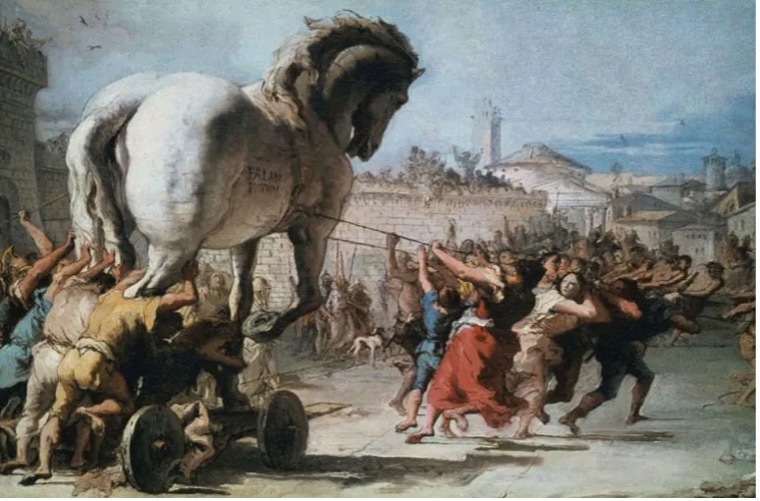
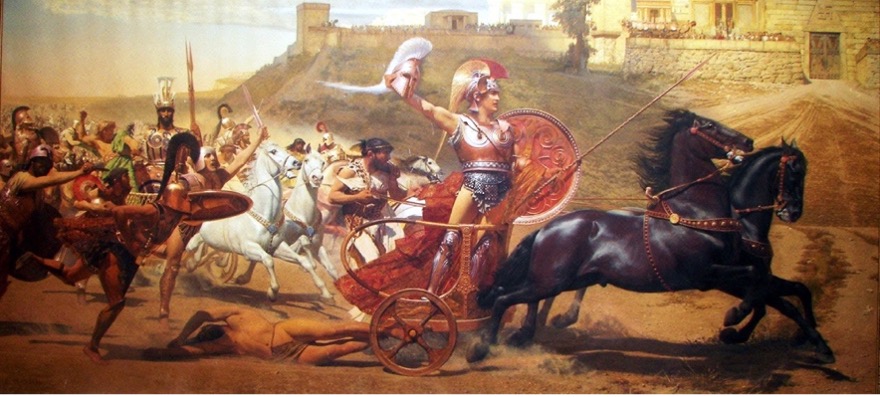
The Iliad is an artful account of a war that may have occurred around 1200 BCE near the city of Hisarlik, once called Troy. It is entirely fictional, but fiction, especially epic poems that involve wars, can tell us something about who we are. The Iliad is an ancient gift of reflection, a mirror centered on the question of why we fight. Weil’s Iliad force seems perpetual. It soars over the earth for centuries as the soul of a war-reminiscer searching for life, even though it might be an enslaved one. It was there in the past century and back with us in this one. It was there almost forever in the past. A force and soul that is always hovering, from high over Attila the Hun’s battles to Napoleon’s sieges, to two world wars, and over this hawk blistered new century.
Killing fast in large numbers
A half-million years ago, we discovered how to use tools to kill with stones, spears, and fire. In the 13th century, the Chinese invented gunpowder, which provided a far more effective means of killing. Not long ago, just before the building of railroads, we found a way to make a bullet and a gun. In the last century, because they could, armies employed tanks, planes, and missiles to kill fast and in large numbers. Now, we have autonomous fighter jets, lethal drones, and robotic missile launchers to kill from a distance too far for empathy. We, accomplices, will soon be killing robotically. It is difficult to estimate the number of deaths in human wars when so many innocent non-combatants die by indirect causes of wars. Some historians estimate deaths from all wars to be close to 1.1 billion. [6]
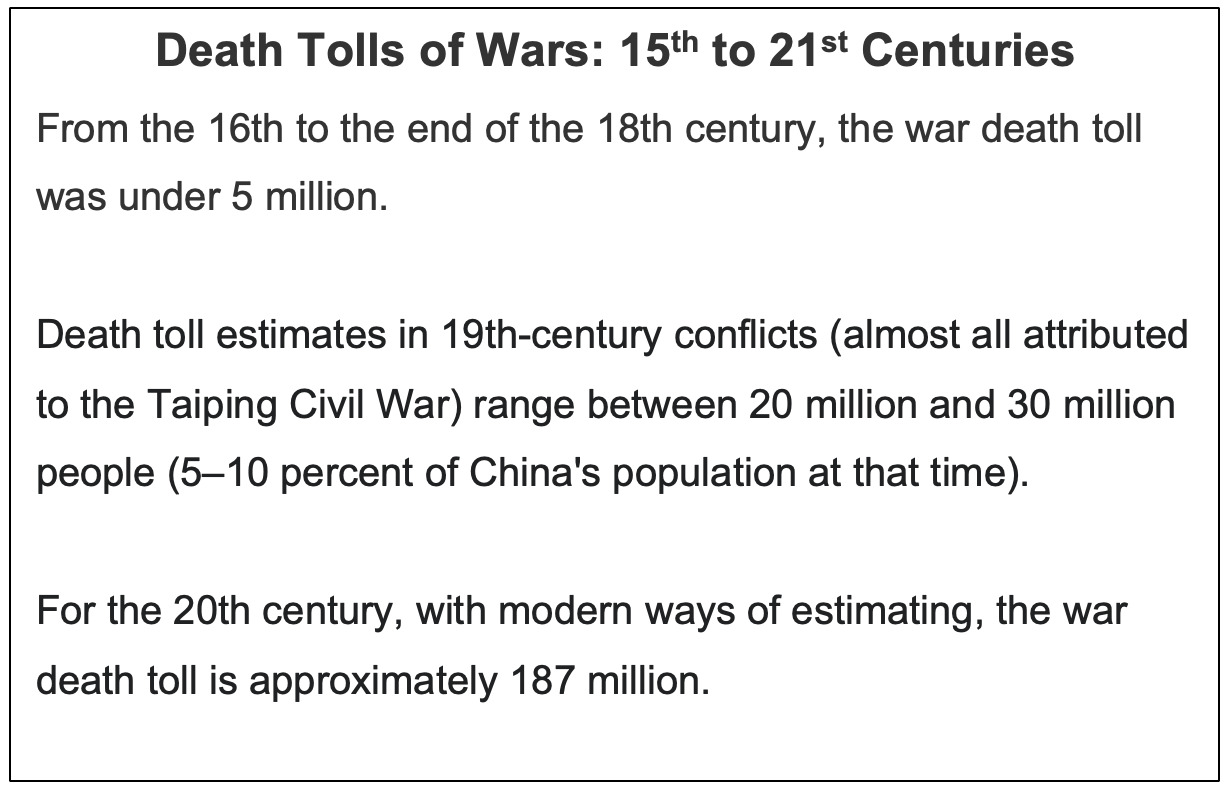
So far, in this new century, war death numbers are creeping not so fast upwards. The Watson School of International and Public Affairs estimate the number in this quarter-century to be close to 5 million. [7]
| Deaths (millions) |
Date | Wars (See Wikipedia) |
| 70–85 | 1939–1945 | World War II (see World War II casualties) |
| 60 | 13th century | Mongol Conquests (see Mongol invasions and Tatar invasions) |
| 40 | 1850–1864 | Taiping Rebellion (see Dungan Revolt) |
| 36 | 755–763 | An Lushan Rebellion (death toll uncertain) |
| 25 | 1616–1662 | Qing dynasty conquest of Ming dynasty |
| 15–22 | 1914–1918 | World War I (see World War I casualties) |
| 20 | 1937–1945 | Second Sino-Japanese War |
| 20 | 1370–1405 | Conquests of Tamerlane |
| 20.77 | 1862–1877 | Dungan Revolt |
| 5–9 | 1917–1922 | Russian Civil War and Foreign Intervention |
Take the Spanish Civil War, an internal war on an international battlefield.
Recent estimates of death put the toll close to 500,000. In 1937, when that war was intensifying and Germany was already rearming with war ambitions, William Hovgaard, a Danish-American academic, expressed his view on those battles, titled “Is War Inevitable?”, for the U.S. Naval Institute. “War is a biological phenomenon,” he wrote, “being part of the struggle for existence common to all organic beings in the wild state of nature.” Hovgaard saw war as an instinct for control over defending and controlling resources and lands that provide the subjectively best-possible living conditions. Disagreements, then, heat to levels goading instincts of control, a pull not unlike Weil’s force of the it that has drawn disputes to skirmishes to conflicts to gruesome battles through centuries from those before history.
If you flip through a zoetrope of historical maps of Europe from, say, 1450 to 1950, you will see national boundaries moving every few decades—in particular, Poland’s borders. Prussia or parts of the Grand Duchy of Warsaw will appear to be wiggling, splitting, bubbling, and revising like what you would see in the boiling brew of a witches’ cauldron. Yet the changing borders of Europe from 1950 to today will hardly be noticed. For more than 500 years, Europe was engaged in wars against neighboring countries with few years of peace. Hovgaard wrote that he had “been unable to find any two neighboring countries more than four generations old which have not been at war with one another at least once.” [8] For the 80 years since the end of World War II, Europeans felt comfort in the economic standards and amicable border agreements. Under the annoying aggravation of the Cold War with its moments of high anxiety, even with tens of millions of deaths indirectly caused by links to proxy and civil wars, both East and West came out the other end of the last millennium reasonably unscathed. That was before a Kremlin change with Putin’s grandiose schemes to bring Russia back to its Tsar-war glory days.
Public Domain
Why do we fight to kill?
That question ties to how wars begin and end. Hovgaard’s thoughts on the biological craving for conflict are not about a thirst for war. Lovers have quarrels and families argue, but blowups rarely have strong tailwinds pushing toward the cliffs of separation, and in far rarer cases, horrid assaults. Wars at their start, however, are gales that immediately kill with ferocious animal instincts. Few wars of the past (at least 14 out of many over the last two centuries) ended with no deaths. They were comical discordances that led to declarations of war, one lasting hundreds of years, all ending in authentic peace treaties, and almost all about tea, spices, dyes, animals, boundaries, or liquor.[9]
Fighting can have reasons. Perhaps it is about entertainment or settling scores. There are prizes for winners and, occasionally, sympathies for losers, but when it comes to war, generally, there is death and destruction, usually on both sides. While disputes can be settled by arbitration, settling hostilities needs far more diplomacy. When a dispute becomes a war, boundaries change, governments tumble, and in cases of major wars, the world suffers economically and, often, on the humanitarian plane, as poverty, expulsions of populations, hunger, and calls for retribution surface.
In my previous article for TWFR, “The Future of Autonomous Battling”, I quoted the military historian and Prussian general Friedrich Adams Julius von Bernhardi, who wrote that war “is a biological necessity… the natural law, upon which all the laws of Nature rest, the law of the struggle for existence.” [10] Like Hovgaard’s belief that conflict is part of the wild state of nature, von Bernhardi felt that the primordial impulse will always be with us, along with the good, bad, and acceptable human urges that brought us to this stage of existence. [11]
Why we fight requires a distinction between international and domestic wars, though many domestic wars do segue to being international. The Korean War, the Spanish and Vietnam civil wars quickly turned international from being internal civil conflicts, as did the American Revolutionary War. Two centuries ago, the wars were generally about empire-building and colonialist expansions. Going back further, conflicts were confined to neighbor against neighbor, with the usual disputes being over territory, minerals, spices, access routes, geopolitics, religious agreements, and silly clashes over pigs, tea, sugar, tobacco, or liquor, and even over the vibrant red pigment of the cochineal insect. But let’s consider territory prompted by empire building. Such a war comes from policy, not necessarily from anger over a territorial dispute. Governments have leaders who activate wars and, too often, leaders aspire beyond constraint and biased visions of power that disconnect from reality and ignore practical constraints linked to public opinion. It takes only one leader to start a war—the aggressor. The defender is a victim who has the right to defend. So as soon as combat begins, defense becomes offense, and war is then unstoppable.
My mulling question is about the distinction between aggressor and defender. Every international war starts from a confrontation, and usually one side or another is an aggressor that could have a reasonable dispute that calls for war. Out of many examples, let’s pick Germany’s invasion of neutral Belgium, which started World War I. Bound by the 1839 Treaty of London, Britain was obligated to defend Belgium and, thereby, forced a declaration of war on Germany. The aggressor in that case was Germany, though its reasons were to build a border deterrent fortress to protect itself from a possible invasion from France.
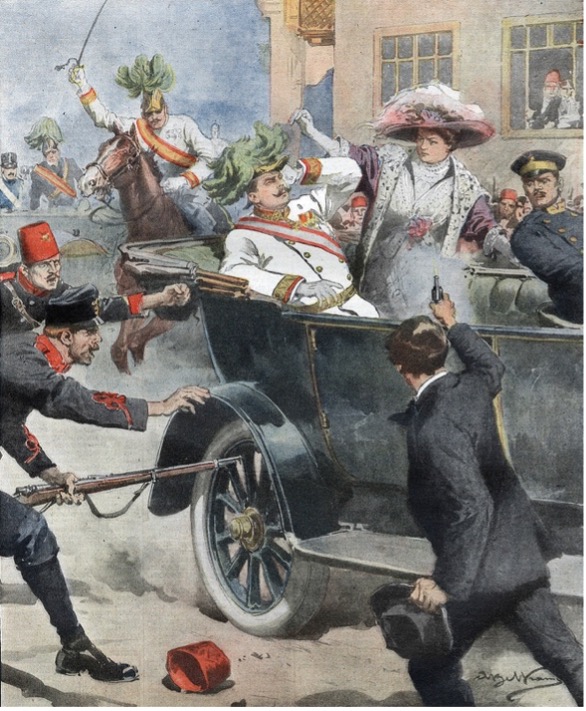
In my younger days, I ignorantly believed World War I started with the assassination of Archduke Franz Ferdinand. The assassin was a Serbian nationalist, and Serbia was a Russian ally. I did not understand the full connection between Germany and the Austro-Hungarian Empire, declaring war after a shooting in Serbia. Later, I learned that the assassination was simply the trigger leading to the invasion of Belgium, which brought Britain (protecting Belgium and France) into the war along with France and Russia. For me, it was a puzzle of missing pieces until I found one: an alliance with the Austro-Hungarian Empire that obligated Germany to respond. Germany’s invasion was not about the occupation of Belgium; it was a show of commitment to the alliance, a show that got out of hand. [12]
Public Domain
The alliance with the Austro-Hungarian Empire was an agreement to support each other. Bosnia was under the control of the Ottoman Empire from the 15th century to the end of the 19th century, when it was annexed by the Austro-Hungarian Empire in 1908. So, when a Bosnian Serb nationalist shot the Archduke and his wife, Sophie, the assassination played either as an excuse for war because there was fear that France might retake Alsace-Lorraine, or because of a policy to adhere to its alliance commitment, a pledge Germany could have ignored. [13] Acting on its assurance, it was seen as the aggressor. And that shows the problem with alliances that member parties feel cannot be broken.
Though the mess was started by Germany, the inevitable start was a significantly large bubble burst of power influencers panicking over Germany’s potential dominance in Europe. France had 170 miles (275 km) of border with Germany along the Imperial Territory of Alsace-Lorraine, a threatening possibility that France could invade Germany through that narrow corridor. The border between Belgium and France was (and still is) roughly 390 miles (520 km), with hardly any fortresses on the French side. Owning that border was a substantial threat to France if Germany were to build fortresses along the Belgium-France border. So, who is the aggressor in that war? Germany gets the blame, but what nation would stand by while a military buildup threatened an invasion?
The problem with alliances and the narrow bridges of diplomacy
Gangs are just alliances between friends. Nations have relied on alliances for millennia. In representative democracies, wars do not start by the will of the citizens, but rather by the decisions of elected representatives who tend to side with the will of alliances. They should make their decisions based on the opinions of citizens who vote but rarely do. Few countries have ever been direct democracies; no nation before the 6th century democratic reforms in Athens was, as far as I know. The Peloponnesian War began with disputes between the Delian and the Peloponnesian Leagues, two rival national alliances. The democratic government of Athens relied on town meetings. Annually elected generals attended monthly meetings where they were questioned and deposed. Athens declared war by indirect voting, whereas Sparta went to war by the voice of a hybrid aristocracy that included a council of elders who sided with military alliances.
Before the 16th century, there were agreements between duchies and vulnerable neighboring states that feared each other. At the peak of colonial conquests in the 19th century, when European empires were solidifying their conquests, alliances became the ramparts of imperial power. One could see it as an alliance race to build deterrents and threats, a sprint to build more power through trade and warnings that turned small wars into big ones. The German Empire did take over Belgium in 1914, but the likelihood of a world war would have been small had the Austro-Hungarian and Ottoman Empires and the Kingdom of Bulgaria stayed neutral. It was as if there were two gangs dividing Europe, the Central Powers, a quadruple alliance (the German Empire, the Austro-Hungarian Empire, the Ottoman Empire, and Italy) against the Triple Entente, also called the Alliance (Britain, France, and Russia), though Italy stayed neutral. Those alliances and treaties locked into each side’s commitments to defend any one of their member nations.
Under Adolph Hitler’s 1939 expansionist policy, Germany annexed Austria and Czechoslovakia, unopposed by alliance members of the European powers. It was so easy that Hitler felt emboldened to take on Poland. Why not? He had already arranged an agreement, the Tripartite Pact, with Italy, Japan, Romania, Hungary, Bulgaria, and Croatia, knowing it would be signed in a few weeks after invading Poland. That alliance was like others that embolden aggressive expansionists. That pact was not a defense deterrent; rather, it was a sword-drawn gang of states that felt comfortably encouraged by the military strength of Germany. But Poland was not to be taken so easily. Two days after the invasion, Great Britain and France declared war on Germany. One year later, the Allies, a gang of more than 47 countries with multiple treaties, were unified to help Great Britain, France, and Russia set the world on fire.
The utter pointlessness
– Simone Weil
Odysseus, Agamemnon, and Menelaus survived the Trojan War, though so many Greek soldiers did not. That war lasted 10 years without diplomatic peace negotiations, aside from the initial offering of peace for Helen’s return. Though Homer’s poem is fiction, there is so much to learn about the forces of war that have almost nothing to do with armaments. The war started because one person, Helen, left her husband, Menelaus, to be with Paris, the Trojan prince. For the retrieval of one person, though one considered to be the most beautiful in the Greek world by legend, the war took away hundreds of lives. Was it worth it? The doubt lives in the greatest epic war poem.
The forces of war compel all soldiers who were born in peace to become violent in the mess of hopes for victory. The Iliad, that unique epic masterpiece that Alexander the Great called “a portable treasury of military excellence”, profoundly presents the story as a representation of human tragedies under all wars.[14] I read The Iliad in a college great-books course with a naïve glimpse and impression that it was a beautifully sung drama of war adventure. I recently reread it, admittedly skipping scene after scene until I finished book XI. It was there that I saw war as a slaughterhouse of humans, love, and fighting in utter pointlessness.
– The Iliad of Homer [15]
The excerpt above appears roughly in the middle of the poem to highlight a scene that is a profound human story of suffering in the entanglement of the force that kills in any war.[16] It shows us how war is destruction and the misfortunes of chaos that destroys lives. Not just ancient wars. It refers to every real war from Alexander’s to Putin’s, with the hovering question: how do we face the fighting that kills our own species?
About the Author
 Joseph Mazur is an Emeritus Professor of Mathematics at Emerson College’s Marlboro Institute for Liberal Arts & Interdisciplinary Studies. He is a recipient of fellowships from the Guggenheim, Bogliasco, and Rockefeller Foundations, and the author of eight acclaimed popular nonfiction books. His latest book is The Clock Mirage: Our Myth of Measured Time (Yale).
Follow his World Financial Review column at https://worldfinancialreview.com/category/columns/understanding-war/. More information about him is at https://www.josephmazur.com/
Notes
[1] Originally published in Politics, November 1945. https://files.libcom.org/files/politics%20(November%201945).pdf
[2] https://files.libcom.org/files/politics%20(November%201945).pdf
[3] Homer, The Iliad, trans. Richmond Lattimore (Chicago: University of Chicago Press, 1951) Book 18, lines 80 to 82.
[4] https://www.usni.org/magazines/proceedings/1937/october/war-inevitable#:~:text=It%20is%20evident%20that%20there,the%20existence%20of%20human%20life.
[5] Ibid. Homer,
[6]https://www.jstor.org/stable/23609808#:~:text=In%20order%20to%20estimate%20the,deaths%20for%20all%20of%20history.
[7] Eckhardt, William. “WAR-RELATED DEATHS SINCE 3000 BC.” Peace Research 22/23 (1990): 80–86. http://www.jstor.org/stable/23609808
[8] https://www.usni.org/magazines/proceedings/1937/october/war-inevitable#:~:text=It%20is%20evident%20that%20there,the%20existence%20of%20human%20life.
[9] https://explorethearchive.com/bloodless-wars
[10] Barbara W. Tuchman, The Guns of August (Toronto: Presidio Press, 2004) p. 12-13.
[11] https://worldfinancialreview.com/the-future-of-autonomous-battling-will-it-change-the-balance-of-power/#_edn18
[12] Barbara Tuchman’s book The Guns Of August dismisses the assassination of the Archduke Franz Ferdinand as just a trigger and claims that it was poor leadership and diplomacy that led to the war.
[13] George Frost Kennan, The Fateful Alliance: France, Russia, and the Coming of the First World War, (Manchester, UK: Manchester University Press, 1984). pp. 82–86.
[14] Plutarch, Trans. Sir Thomas North, Life of Alexander (Toronto: MacMillan, 1911) p. 29. https://ia801406.us.archive.org/14/items/in.ernet.dli.2015.7204/2015.7204.Pautarchs-Life-Of-Alexander_text.pdf
[15] Homer, The Iliad of Homer (Chicago: University of Chicago Press, 1951) Book XI line 155, p. 238.
[16]There was a time when The Iliad was on the reading list of a literature course at West Point to learn about the fearsome losses in wars. In browsing through the West Point reading list, I was impressed by the number of scholarly books on war, from Sun Tzu’s Art of War (an ancient Chinese military treatise dating from the 5th century BC) to Thucydides’ Peloponnesian War to Machiavelli’s Art of War. I did not find The Iliad but noticed that quite a few copies were circulating in the West Point United States Military Library, with many more online, and a 17th-century edition that is available in special collections.
https://usma.primo.exlibrisgroup.com/discovery/search?query=any,contains,The%20Iliad&tab=Everything&search_scope=MyInst_and_CI&vid=01USMA_INST:Scout&facet=tlevel,include,available_p&mode=basic&offset=10&came_from=pagination_1_2