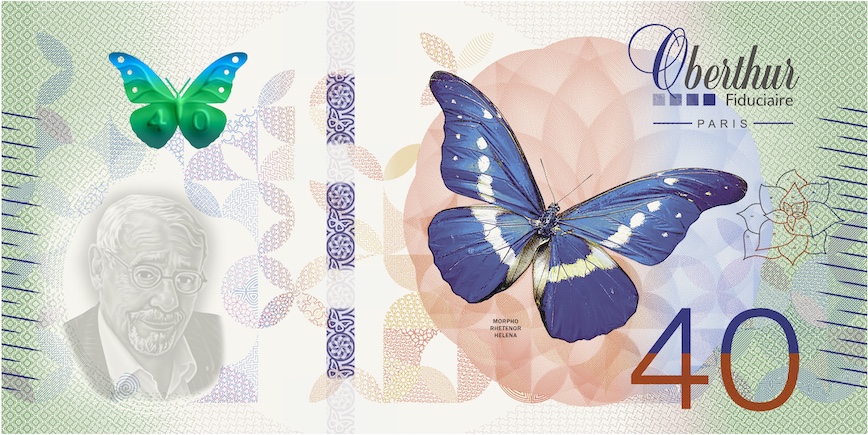
Image courtesy of Oberthur Fiduciaire, showcasing its “Art of Butterflies” family of banknotes introduced at the Global Currency Forum.
Around the world, billions of people still rely on physical banknotes every day. This enduring use means that cash is more than just a piece of paper—it must be safe to handle and secure against fraud. How is this achieved? The answer lies in a hidden, high-stakes world of continuous innovation, where scientists and engineers wage a silent war against counterfeiters while ensuring that the simple act of handing over cash remains a gesture of trust.
Beginning in early 2026, the familiar look and feel of U.S. currency will start to change. The Federal Reserve plans to introduce a newly redesigned $10 bill—the first in a regular, biennial cycle of updates to American paper money. Each new series will incorporate advanced security features intended to stay ahead of counterfeiters and preserve trust in physical cash. Yet as the world pivots toward digital payments, this move invites a deeper question: In an increasingly cashless society, does the humble banknote still need innovation?
Certainly. Across the globe, cash remains a daily reality for billions of people. It is the primary way to pay for over 90% of the population in countries like Cambodia and Laos, and is still broadly used by a large majority in nations. Even in the United States, a leader in digital finance, a significant portion of transactions are conducted with physical money. For all these users, cash offers a unique combination of speed, privacy, and tangible security. At that, the latter doesn’t happen by accident—it is engineered and relies on the constant, behind-the-scenes innovations of central banks and a handful of specialized security printers, companies whose entire mission is to stay ahead of counterfeiters through research and development. This is the world of firms like France’s Oberthur Fiduciaire, which has spent decades building its reputation not on mere production, but on pioneering the patented technologies and protected features that make modern banknotes both a trusted tool and a feat of anti-fraud engineering. “Cash is—and will remain—a key instrument of the economy, even in the most developed countries, and a cornerstone of society,” says Thomas Savare, Chairman of Oberthur Fiduciaire. “History demonstrates the resilience of physical currency. A banknote carried in a wallet will always be trusted—if properly manufactured and supported by sound monetary policy.”
Can innovation stay ahead of fraud?
The crime of counterfeiting cash may feel like an old-school and low-tech scheme in a digital age. Yet this perception is dangerously outdated. As the widespread global use of physical currency demonstrates, where there is genuine value, there is incentive for fraud. Counterfeiting remains a pervasive and evolving threat, with criminal networks continuously refining their techniques to exploit even the most advanced security features. The scale is still substantial: a recent joint law enforcement operation, supported by Europol, disrupted a sophisticated enterprise distributing counterfeit notes through international mail. Authorities intercepted nearly one million items—including fake euros, U.S. dollars, and British pounds—with an estimated face value surpassing €66 million.
Law enforcement agencies worldwide are ramping up efforts to prevent such crimes. Yet for every operation they shut down, criminals are refining their methods. The very tools of the digital age, from high-resolution printing to advanced graphic software, have dramatically lowered the barrier to creating convincing fake bills, ensuring counterfeiting remains a stubborn problem. And as artificial intelligence is rapidly evolving in the landscape of financial fraud, counterfeiters are starting to generate highly realistic forgeries, reverse-engineer security features, and systematically probe for vulnerabilities in authentication systems.
This merging of cutting-edge technology with age-old crime underscores an ongoing race: for central banks and the security printers they trust, continuous innovation becomes their primary tactic to protect the physical foundation of our economies. Yet innovation alone is not a complete defence. If a cutting-edge feature were to fall into the wrong hands, its protective value would be instantly nullified. This is why intellectual property protection forms the other pillar of a robust anti-counterfeiting strategy. The designs, manufacturing methods, and specialized techniques used to produce secure banknotes are among the world’s most closely guarded secrets, accessible only to a small circle of authorized experts. Security printers and central banks protect these processes to preserve the integrity of a nation’s currency.
Partnering for the perfect security feature
For established innovators like Oberthur Fiduciaire, this complex strategy is core to its mission. While research and development keep it a step ahead of fraudsters, an equal commitment to safeguarding its intellectual property protects the trust placed in it by central banks and, ultimately, the billions of people who rely on cash every day. In this high-stakes field, progress must be both pioneering and perfectly secure—but not as isolated as it may seem. It thrives on partnership and the strategic acquisition of specialized expertise, and this reality is shaping the industry’s evolution, as evidenced by Oberthur Fiduciaire’s recent move. To accelerate its development of next-generation anti-counterfeiting tools, the French company has acquired the Swedish firm Rolling Optics in 2023. This acquisition is a direct investment in advanced visual authentication. Rolling Optics, a company born from research at Uppsala University’s renowned Ångström Laboratory, has pioneered the world’s highest-resolution printing technology. Its specialty is creating micro-optical images with realistic motion and 3D effects—features that can transform a banknote’s security into something both beautiful and difficult to forge.
The collaboration provides Oberthur Fiduciaire with key capabilities in this field. For a security printer, this is particularly significant: research shows that a person’s first glance at a banknote is crucial, with visual information heavily influencing their immediate judgment of its authenticity.
“We maintain several specialised teams, mainly in France and Sweden, and I ensure they collaborate whenever doing so can accelerate progress,” Savare notes.
Essentially, the more visually striking and sophisticated the optical security feature is, the more secure the banknote becomes. In practice, this notion is used in Anima™, banknote security feature based on Rolling Optics’s world-class micro-lenses technology. It allows central banks to integrate a highly secure thread into their banknotes—complex for fraudsters to replicate, yet simple for the public to check. The imagery for Anima™ uses a rich palette of foreground and background effects, colours, and narrative design options for each denomination. The result is a feature that lets users authenticate a note quickly, but whose development and design specifics are strictly confidential, impossible to reproduce without proprietary materials and technology. This final layer not only fortifies the banknote itself but also fits into the broader mission: to protect the user and uphold the integrity of a nation’s monetary system.
When banknotes protect public health
The work of a security printer is not confined to fighting counterfeiters, but is equally vital to preserving the profound, everyday social role that cash continues to play. While digital transactions are invisible, cash makes value exchange tangible and personal. It facilitates the small ceremonies of trust that weave communities together: the gift of money for a wedding, a tip for a server, or the exact change settled between friends. To sustain this human connection role in a digital world, the industry must innovate for social durability as much as for security. This means engineering banknotes with thoughtful features, like clear tactile differentiation for the visually impaired or advanced materials that can endure countless hand-to-hand exchanges without wearing out. These are not just technical improvements; they are investments in ensuring that cash remains an inclusive and resilient part of our social fabric.
Now, this mission has taken on a new dimension: public health. One of the most interesting innovations in this space is Bioguard, a permanent antimicrobial treatment developed by Oberthur Fiduciaire. Conceived years before the COVID-19 pandemic, this technology embeds banknotes with a lasting defence against viruses, bacteria, and fungi. Its relevance was powerfully validated in early 2020, when international lab tests confirmed Bioguard’s high effectiveness against the coronavirus, providing reassurance for the entire cash ecosystem. Coupled with enhanced endurance, the anti-pathogen properties remain fully active for the life of the banknote and form a durable barrier against not just one virus, but the myriad of seasonal health threats that circulate annually. Studies show it reduces the concentration of viruses like influenza and coronaviruses on treated notes by 100 to 1,000 times compared to standard paper—a significant step toward curbing transmission.
Now, Oberthur Fiduciaire continues to advance the technology, and its application is expanding. The company now licenses Bioguard for use far beyond banknotes. The treatment can be applied to high-touch surfaces in public spaces—from mass transit handrails to office furniture—and integrated into the manufacturing of consumer goods like touchscreen devices, making them inherently antimicrobial. It also offers solutions for packaging and paper production, helping to safeguard supply chains. What began as an innovation for currency security has evolved into a versatile tool for building healthier, more resilient everyday environments. And what’s more, it has become another milestone in the French printer’s journey towards new reality that involves balancing two priorities: carefully protecting the intellectual property that underpins secure currency, while also finding appropriate ways to share certain innovations with other sectors. The company’s approach rests on maintaining control over its core proprietary technologies, while selectively making other developments available through licensing. In this highly specialized field, success is defined by this dual capability. The patented technologies and protected features that result are what make a modern banknote more than just paper: they are a trusted tool for everyday users and central banks alike, and a continual feat of anti-fraud engineering. “At the heart of our industry are fiduciary means based on trust,” Savare concludes. “A banknote carried in a wallet will always be trusted—if it is properly manufactured.”