


Related Articles
The Future of Business Schools in the MENA Region

By Dr. George Sammour
To remain relevant in today’s business environment, schools in the Middle East and North Africa must provide students with digital and...
Empowering Your Leadership at the Pulse of Business in New York City

A Special Interview with Professor Paul Ingram, Faculty Director of the Advanced Management Programme at Columbia Business School Executive Education.
Nine Advantages of an Online Degree

Often, people take a job and then find they would prefer some other work but do not have the qualifications needed. They could have...
Is an Accounting Degree Beneficial for Business or Employment?

In your career, it is likely that you will at some point be an employee but at another time assume the role of a...
How to Beat Your Competitors in Business

Starting a business is not something that can be done in isolation. You can’t simply launch your business and then not pay attention to...

In present times of political uncertainty and the rising economic inequality, destabilisation, populism, and political gridlock across all nations, what tools and strategies should the present and aspiring leaders of our society use to address these compounding challenges?
Further, the emergence of new and key digital economy players has also tumultuously led to changing market and social dynamics that foster competition and demands for a more complex and differentiated level of adaptability, expertise, objective analysis of facts, and effective leadership that every leader in either the public or the private sector must have.
One right strategy for leaders to stay ahead of change and keep pace with the fast-moving international environments and address the demands of the increasingly multi-polar world is having a solid grasp of current global affairs through pursuing graduate programmes on international relations and public affairs.
Building on our long term dedication to providing revelatory insights and unbiased analysis into influential world affairs, we present to you our special series on the TOP GRADUATE PROGRAMMES FOR INTERNATIONAL RELATIONS AND PUBLIC AFFAIRS.
We invite our readers to browse through the leading-edge and results-oriented graduate programmes/executive education that offer the highest value for aspiring leaders in the future of government and public affairs.
Specifically, we look into the different core values and focus of these highly specialised programmes that would provide lifelong skills and integrated knowledge that would not just propel both the individual and the organisation to long-term profitability and success, but the society they belong to as well.
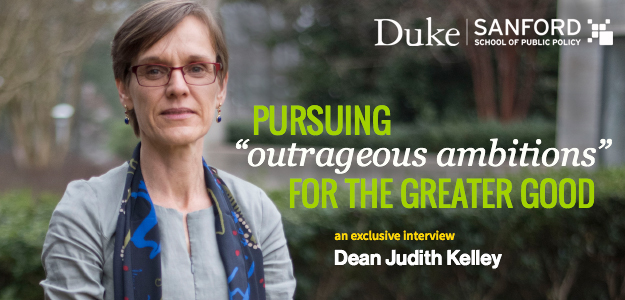
For our May/June 2019 issue, we are honoured to feature Duke University-Sanford School of Public Policy through an exclusive interview with their Dean Judith Kelley.
Further, the emergence of new and key digital economy players has also tumultuously led to changing market and social dynamics that foster competition and demands for a more complex and differentiated level of adaptability, expertise, objective analysis of facts, and effective leadership that every leader in either the public or the private sector must have.
One right strategy for leaders to stay ahead of change and keep pace with the fast-moving international environments and address the demands of the increasingly multi-polar world is having a solid grasp of current global affairs through pursuing graduate programmes on international relations and public affairs.
Building on our long term dedication to providing revelatory insights and unbiased analysis into influential world affairs, we present to you our special series on the TOP GRADUATE PROGRAMMES FOR INTERNATIONAL RELATIONS AND PUBLIC AFFAIRS.
We invite our readers to browse through the leading-edge and results-oriented graduate programmes/executive education that offer the highest value for aspiring leaders in the future of government and public affairs.
Specifically, we look into the different core values and focus of these highly specialised programmes that would provide lifelong skills and integrated knowledge that would not just propel both the individual and the organisation to long-term profitability and success, but the society they belong to as well.
For our May/June 2019 issue, we are honoured to feature Duke University-Sanford School of Public Policy through an exclusive interview with their Dean Judith Kelley.
Other articles you might be interested in

Hair Transplant in Turkey: A Complete Guide for First-Time Patients
Turkey has become a major destination for people considering hair restoration abroad. Istanbul, in particular,...

How Businesses Can Keep Growing Across Borders in a More Fragmented World
By Marco Donzelli
Digitalisation, fragmentation, and rising trade risks are reshaping cross-border growth, creating new challenges...

Building Resilient Cross-Border Supply Chains in an Era of Trade Uncertainty
By Jesse Mitchell
Trade volatility is reshaping global logistics, making resilient cross-border supply chains a strategic...

Human-AI Collaboration Is Not Enough: From Hybrid Intelligence to Co-Generation
By Akihiko Morita
As AI becomes embedded in work and decision-making, value creation is shifting from...

What Gets Measured Gets Improved: Rethinking Trust in Global Supply Chains
By Benjamin Hulot
Recent disruptions, from the COVID-19 pandemic to geopolitical tensions and climate-related events, have...

Why Energy Markets Are Harder to Read Than Ever
Interview with Igor Isaev of Mind Money
Oil markets no longer respond to one signal at...